New Seeds Bill

Why in News?
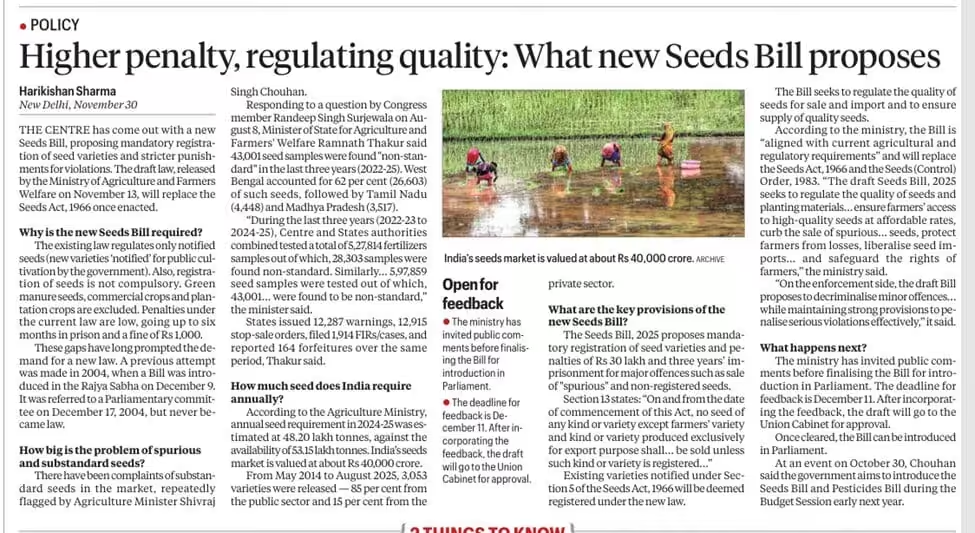
- The Union Agriculture Ministry has released the Draft Seeds Bill 2025 and the government is inviting public comments and seeking public feedback.
- The new Seeds Bill (2025), proposed by the Indian government, aims to improve the quality of seeds used in agriculture, regulate seed sales more strictly, and punish violations more severely.
Why is the new Seeds Bill needed?
The existing Seeds Act of 1966 and the Seeds (Control) Order 1983 are outdated and doesn’t cover all seed varieties. Right now, it only regulates seeds that are officially “notified” by the government, meaning only those varieties that are approved for public cultivation.
However, there are gaps:
- Not all seeds are regulated: Green manure seeds, commercial crops, and plantation crops are not covered.
- Registration is voluntary: Seed varieties do not have to be registered, which can lead to poor-quality seeds being sold.
- Low penalties: The penalties for selling bad seeds are very weak (e.g., fines of just 1,000 rupees or a 6-month prison sentence).
Over the years, there have been numerous complaints about spurious (fake) and substandard seeds in the market. This has caused significant problems for farmers, leading to poor crop yields and financial losses. The new Seeds Bill is designed to address these issues.
What’s the problem with seeds right now?
There are serious issues with the quality of seeds in the market:
- Substandard seeds: Over the last three years, a large number of seed samples were found to be of poor quality. For example, 43,001 out of 5,97,859 seed samples tested between 2022 and 2025 were non-standard (not meeting the required quality).
- The problem is particularly bad in states like West Bengal, where 62% of the substandard seeds were found.
- The government has tried to address this by issuing warnings, stop-sale orders, and filing cases, but the issue persists.
What does the new Seeds Bill propose?
The new bill proposes several important changes to improve seed quality and protect farmers:
- Mandatory registration of seed varieties:
- Under the new bill, all seed varieties (except for farmer-produced seeds or those meant only for export) must be registered before they can be sold. This means that only officially approved seeds will be available in the market.
- Existing varieties that are already notified under the old Seeds Act will automatically be registered under this new law.
- Stricter penalties for violations:
- The bill proposes much harsher penalties for selling bad seeds. If someone is caught selling fake or non-registered seeds, they could face:
- A fine of up to 30 lakh rupees
- Up to 3 years in prison
- This is a major step up from the previous law, which only imposed a maximum fine of 1,000 and six months in jail.
- The bill proposes much harsher penalties for selling bad seeds. If someone is caught selling fake or non-registered seeds, they could face:
- Focus on regulating seed imports and sales:
- The new bill will also regulate seed imports to ensure that only high-quality seeds are coming into India from other countries.
- The idea is to make sure that farmers have access to quality seeds at reasonable prices.
- Balancing enforcement:
- For minor violations, the bill suggests decriminalizing them, meaning smaller offences wouldn’t lead to criminal charges but would still have penalties.
- However, serious violations (like selling fake seeds) will face severe punishments.
- Protection of farmers:
- By ensuring the availability of high-quality seeds, the government hopes to protect farmers from losses caused by poor seeds. This also helps increase overall productivity in agriculture.
- Encouraging private sector involvement:
- The bill allows greater freedom for the private sector to sell seeds, which could encourage innovation and the introduction of better seed varieties. However, this will be regulated to ensure that the quality of seeds remains high.
- Regulation of Seed Quality:
- The Bill aims to create a more robust regulatory system for seed production, distribution, and sales, ensuring better quality seeds for farmers. It does not restrict farmers’ rights to grow, use, save, or exchange seeds but limits commercial sales under brand names to registered companies. This ensures farmers can still save and reuse seeds, but any commercial sale of seeds must follow specific regulations.
- Farmer and Industry Definitions:
- The Bill defines key players in the seed industry, including farmers, dealers, distributors, and producers, each with clear roles. This is intended to ensure accountability at every stage of the seed supply chain.
- Creation of Central and State Committees:
- The Bill establishes Central and State Seed Committees to oversee seed standards. The Central Committee will recommend standards for germination rates, genetic purity, seed health, and other essential qualities. The State Committees will handle the registration of seed producers, dealers, and seed processing units.
- Mandatory Registration for Seed Processing Units:
- All seed processing units will need to be registered with state governments. This is a step toward ensuring that seeds processed in India meet quality standards.
- National Register for Seed Varieties:
- The Bill proposes creating a National Register of seed varieties under the Central Seed Committee, which will track and regulate the seeds available in the market. This will make it easier to ensure the availability of quality seeds and prevent fraud.
- Seed Testing Laboratories:
- Both Central and State seed testing laboratories will be set up to carry out tests on seed quality, ensuring that all seeds meet prescribed standards.
- Powers of Seed Inspectors:
- The Bill grants seed inspectors the power to conduct inspections, search premises, and seize substandard seeds. This aims to enforce the regulations strictly.
What is India’s seed market like?
India needs a lot of seeds every year to support its agricultural activities. The annual seed requirement for the 2024-25 period was estimated at 48.20 lakh tonnes, while the country has a total seed production capacity of 53.15 lakh tonnes.
- Public vs. private sector:
- Around 85% of the seed varieties released in India come from the public sector, while 15% come from the private sector.
- India’s seed market is valued at about 40,000 crore Rupees (about $5 billion).
What happens next?
The draft of the Seeds Bill has been released, and the government is seeking public feedback. After considering the feedback, the government will send the bill for approval by the Union Cabinet, and once that happens, the bill will be introduced in Parliament.
The government aims to pass this bill during the Budget Session of Parliament, which takes place in early 2025.
Concerns Raised by Farmers
While the government claims the new Bill will benefit farmers, many farmer groups have raised concerns:
- Impact on Small Farmers:
- The All India Kisan Sabha fears the Bill will increase the cost of cultivation by making it easier for corporates to dominate the seed market. They believe large companies could engage in predatory pricing, making seeds too expensive for small farmers.
- There is concern that the Bill could lead to a centralized and corporatized regulatory system that weakens protections for farmers, especially small-scale and traditional farmers.
- Seed Sovereignty:
- Some farmers believe that the Bill could threaten India’s seed sovereignty, as it may give multinational companies too much control over the seed market. They fear it could undermine India’s ability to control its own agricultural resources.
- Compatibility with Existing Laws:
- Farmers argue that the Bill should complement existing laws like the Protection of Plant Varieties and Farmers’ Rights Act, which safeguards farmers’ rights over indigenous seeds. They worry the new Bill might conflict with these laws and undermine biodiversity protections.
- Corporatization of Seed Industry:
- The Bill introduces a more corporate-friendly regulatory framework, which farmer groups fear could lead to the dominance of a few large companies over the seed market, leaving small farmers vulnerable to exploitation.
- The Federation of Seed Industry of India has welcomed the Bill, calling it a timely and necessary step to modernize seed regulations. However, the Samyukt Kisan Morcha, which represents farmers, has expressed concerns, fearing the Bill could hurt farmers’ interests, especially small farmers.
Conclusion
The draft Seeds Bill is an attempt to modernize India’s seed regulations, ensuring higher quality seeds, improving the business environment, and streamlining the process for seed businesses. However, it has sparked concerns, especially among farmer organizations. While it aims to make seed production and distribution more efficient, critics fear that it may harm small farmers, reduce seed sovereignty, and increase the corporatization of the seed industry.