NH-22 Hybrid Annuity Project and the India-Nepal Feeder Corridor
Why in News?
On 19 August 2026, the CCEA approved four-laning of the Muzaffarpur-Sitamarhi-Sonbarsa section of NH-22 in Bihar under the Hybrid Annuity Mode.
- The approved project covers an 82.578 km section and carries a stated capital cost of Rs 3,590.73 crore.
- The corridor would connect Sonbarsa near the India-Nepal border with Muzaffarpur and NH-27, the East-West Corridor.
- PIB presents faster passenger and freight movement, safer travel and stronger supply-chain links as intended benefits, not completed outcomes.
- The approval provides for four-laning under HAM; implementation still requires construction, monitoring and performance against the concession contract.
- The project turns PPP risk allocation into a concrete case: payment certainty can attract private execution without transferring traffic demand risk.
- Its strategic value comes from feeder connectivity between a border-facing corridor, NH-27, rail nodes, production centres and freight networks.
- A road approval alone does not complete cross-border logistics; border facilities, customs processes and connecting links must also function.
UPSC Relevance
Prelims Relevance
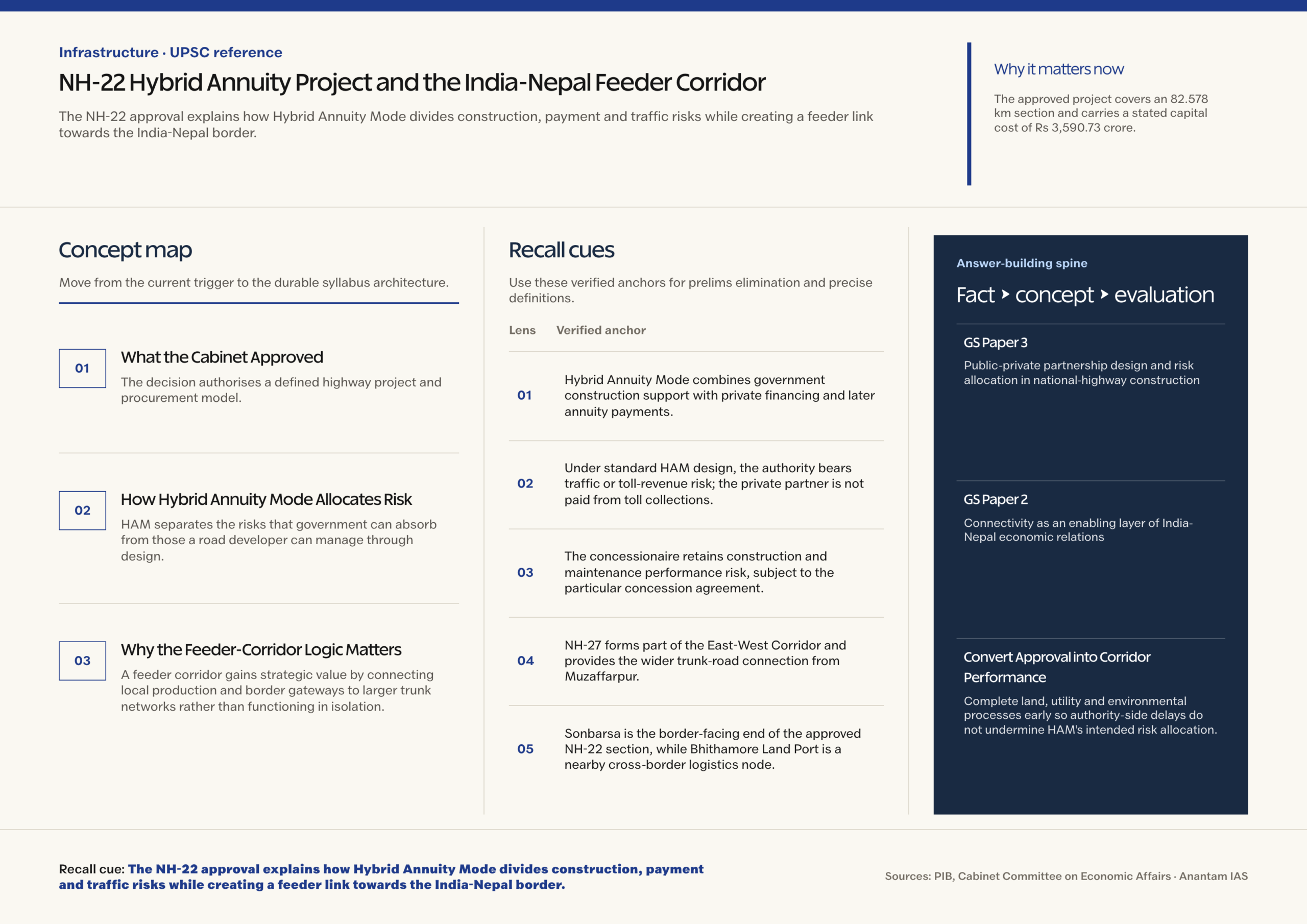
- Hybrid Annuity Mode combines government construction support with private financing and later annuity payments.
- Under standard HAM design, the authority bears traffic or toll-revenue risk; the private partner is not paid from toll collections.
- The concessionaire retains construction and maintenance performance risk, subject to the particular concession agreement.
- NH-27 forms part of the East-West Corridor and provides the wider trunk-road connection from Muzaffarpur.
- Sonbarsa is the border-facing end of the approved NH-22 section, while Bhithamore Land Port is a nearby cross-border logistics node.
Mains Relevance
GS Paper 3
- Public-private partnership design and risk allocation in national-highway construction
- Feeder corridors, multimodal logistics and the integration of border regions with freight networks
GS Paper 2
- Connectivity as an enabling layer of India-Nepal economic relations
- Need for coordination between road infrastructure, land-port administration and customs processes
Essay
- Infrastructure creates value when contracts, institutions and connecting systems work together, not merely when a project receives approval.
Background and Context
What the Cabinet Approved
The decision authorises a defined highway project and procurement model; it does not certify construction or operational gains.
- The CCEA approval covers upgrading the Muzaffarpur-Sitamarhi-Sonbarsa section of NH-22 in Bihar to four lanes under HAM, specifying a PPP pathway rather than a budget-only announcement.
- The approved section runs for 82.578 km, ending at Sonbarsa near the India-Nepal border and linking westward to Muzaffarpur, which fixes the physical scope on the Indian side.
- At Muzaffarpur, the section meets NH-27, allowing border-facing movement to enter the wider East-West Corridor and national freight network for longer-distance freight and passenger distribution.
- The design includes grade-separated and bridge infrastructure intended to protect through movement from local crossings and physical bottlenecks while retaining access through dedicated structures.
- Expected reductions in congestion, travel time and vehicle costs remain projected benefits until works are delivered and operating performance is measured against a baseline after opening.
How Hybrid Annuity Mode Allocates Risk
HAM separates the risks that government can absorb from those a road developer can manage through design, construction and maintenance.
- During construction, the road authority normally pays 40% of project cost in linked instalments, reducing the developer’s upfront financing burden and the quantum of commercial debt required.
- The private concessionaire finances the remaining 60%, which the authority repays through scheduled annuities after operation begins rather than through a one-time completion payment.
- Because repayment is authority-backed rather than toll-dependent, traffic demand risk stays substantially with the public side, shielding project cash flows from uncertain user volumes.
- The concessionaire bears construction risk: delays, design execution, cost control and compliance affect milestone payments; poor execution is not automatically shifted back to the authority.
- It also carries maintenance and availability risk; annuity and operation payments can depend on meeting specified road-condition and performance standards throughout the concession’s operating phase.
Why the Feeder-Corridor Logic Matters
A feeder corridor gains strategic value by connecting local production and border gateways to larger trunk networks rather than functioning in isolation.
- The NH-22 section would channel movement between the Sonbarsa border belt, Sitamarhi, Muzaffarpur, the NH-27 trunk corridor and onward domestic markets.
- Connections with railway stations, industrial areas and food-processing nodes can support first-mile and last-mile movement, but value depends on dependable interchanges and access roads.
- The nearby Bhithamore Land Port adds a cross-border logistics dimension, but the approved road neither creates customs facilities nor guarantees faster border clearance.
- The corridor can improve access to a border gateway only if connecting roads, terminals and procedures avoid shifting delays from highways to checkpoints or freight terminals.
- For answers, distinguish domestic connectivity infrastructure from bilateral trade arrangements: a highway facilitates movement, while border agencies govern clearance, preventing an approval from being overstated as a foreign-policy outcome.
Way Forward
Convert Approval into Corridor Performance
- Complete land, utility and environmental processes early so authority-side delays do not undermine HAM’s intended risk allocation.
- Link annuity and maintenance payments to transparent availability, safety and pavement-quality indicators, with independent engineering checks.
- Coordinate highway operations with land-port, customs and rail authorities so the feeder link reduces end-to-end logistics time.
- Track actual travel reliability, crashes and freight movement against a pre-construction baseline instead of treating expenditure or road length as success.
Conclusion
- The NH-22 decision is best understood as an approved HAM corridor project: it combines public payment support with private construction and maintenance obligations.
- In a Mains answer, connect contract design to corridor outcomes and explain that cross-border benefits depend on roads, gateways and procedures working as one system.
UPSC Practice Questions
Prelims MCQ 1
With reference to the Hybrid Annuity Mode used for national-highway projects, consider the following statements:
- The road authority normally provides part of the project cost during construction.
- The private concessionaire’s repayment depends primarily on toll revenue collected from users.
- The concessionaire remains responsible for construction and contracted maintenance performance.
How many of the above statements are correct?
(a) Only one (b) Only two (c) All three (d) None
Answer: (b) Only two
Explanation:
Statements 1 and 3 are correct. Under HAM, authority-backed annuity payments reduce dependence on toll revenue, so traffic demand risk does not primarily sit with the concessionaire.
Prelims MCQ 2
What is the most accurate description of the approved Muzaffarpur-Sitamarhi-Sonbarsa NH-22 project’s cross-border role?
(a) It is a bilateral treaty corridor administered jointly by India and Nepal. (b) It replaces customs and land-port procedures at the international border. (c) It is a domestic feeder link connecting a border-facing area with wider highway and logistics networks. (d) It transfers traffic-revenue risk entirely to the private developer.
Answer: (c) It is a domestic feeder link connecting a border-facing area with wider highway and logistics networks.
Explanation:
The approved section is an Indian national-highway project. It can facilitate access towards border gateways, but it neither constitutes a bilateral treaty nor replaces customs administration.
UPSC Mains Questions
- Explain how the Hybrid Annuity Mode allocates construction, financing, maintenance and traffic risks in national-highway projects. Why does this allocation matter for project delivery?
- The value of a border feeder corridor depends on the network and institutions around it. Discuss with reference to the approved NH-22 Muzaffarpur-Sitamarhi-Sonbarsa project.
Source: PIB, Cabinet Committee on Economic Affairs.
Frequently Asked Questions
What did the Cabinet approve for NH-22?
The CCEA approved four-laning of the 82.578 km Muzaffarpur-Sitamarhi-Sonbarsa section in Bihar under Hybrid Annuity Mode. The decision is an approval, not completion of construction.
What is the Hybrid Annuity Mode?
HAM is a road PPP structure combining government construction-stage support with private financing, followed by authority-paid annuities and performance-linked operation and maintenance obligations during the operating period.
Who bears traffic risk under HAM?
Traffic or toll-revenue risk substantially remains with the road authority because the concessionaire receives authority-backed payments rather than relying mainly on toll collections during the operating period.
Why is NH-22 relevant to India-Nepal connectivity?
The section links the Sonbarsa border-facing area with Muzaffarpur and NH-27, feeding local and potential cross-border passenger and freight movement into a larger highway and logistics network.
Does the highway project itself operate the international border?
No. The national highway can improve access towards border gateways, but customs clearance, land-port operations and bilateral trade rules remain separate institutional functions at the international boundary.