Access-Controlled Highways: New Rules for Safer Corridor Design
Why in News?
On 21 September 2026, NHAI announced new planning and design guidelines for upcoming access-controlled high-speed national highways other than expressways.
- The guidelines cover upcoming four-lane and six-lane greenfield and brownfield high-speed access-controlled national highways.
- They seek uniform standards for Detailed Project Reports, replacing variations in corridor planning and design.
- Key provisions include ramp interchanges, advance information about entries and exits, and boundary protection.
- This is a guidelines release, not evidence that the covered highways have already been constructed or opened.
- A highway can have several lanes without having controlled access; the location and design of entry points shape traffic conflicts.
- Reliable freight movement depends on predictable corridor operation and connections to major destinations, not simply a wider carriageway.
UPSC Relevance
Prelims Relevance
- NHAI and national highway planning
- Access control and designated entry or exit points
- Interchanges, ramps and grade separation
- Greenfield and brownfield highway projects
- Detailed Project Reports and traffic assessment
Mains Relevance
GS Paper 3
- How engineering design can reduce road-safety risks.
- Connecting freight destinations without undermining corridor access control.
GS Paper 2
- Uniform standards and accountability in infrastructure project preparation.
Essay
- Public infrastructure quality depends on how safely people use it, not only how much is built.
Background and Context
What the guidelines standardise
The immediate change concerns project preparation: a common planning framework for a defined class of highways, rather than a nationwide road-opening announcement.
- Access control means vehicles join or leave through designated connections. It limits direct roadside entry, distinguishing corridor operation from an ordinary road where numerous adjoining properties or smaller roads may connect directly.
- The stated scope includes greenfield projects on new alignments and brownfield projects involving existing corridors. Both need access planning, although an existing road may already serve settlements and local movements along its route.
- Expressways are excluded from this particular framework. The release addresses the absence of separate planning and design standards for the specified high-speed national highways; it does not redefine every access-controlled road as an expressway.
- A Detailed Project Report translates a corridor proposal into a project design. Uniform requirements make safety and access arrangements part of preparation, instead of leaving comparable corridors with inconsistent technical provisions at that stage.
- Lane configuration is to follow detailed traffic assessment. The useful principle is matching capacity and structures to expected demand; more lanes alone do not establish that entry, crossing and exit movements are safely organised.
How interchanges and advance information work
The central relationship is between uninterrupted through movement and carefully designed connections: traffic must enter, leave or cross without creating uncontrolled conflict points.
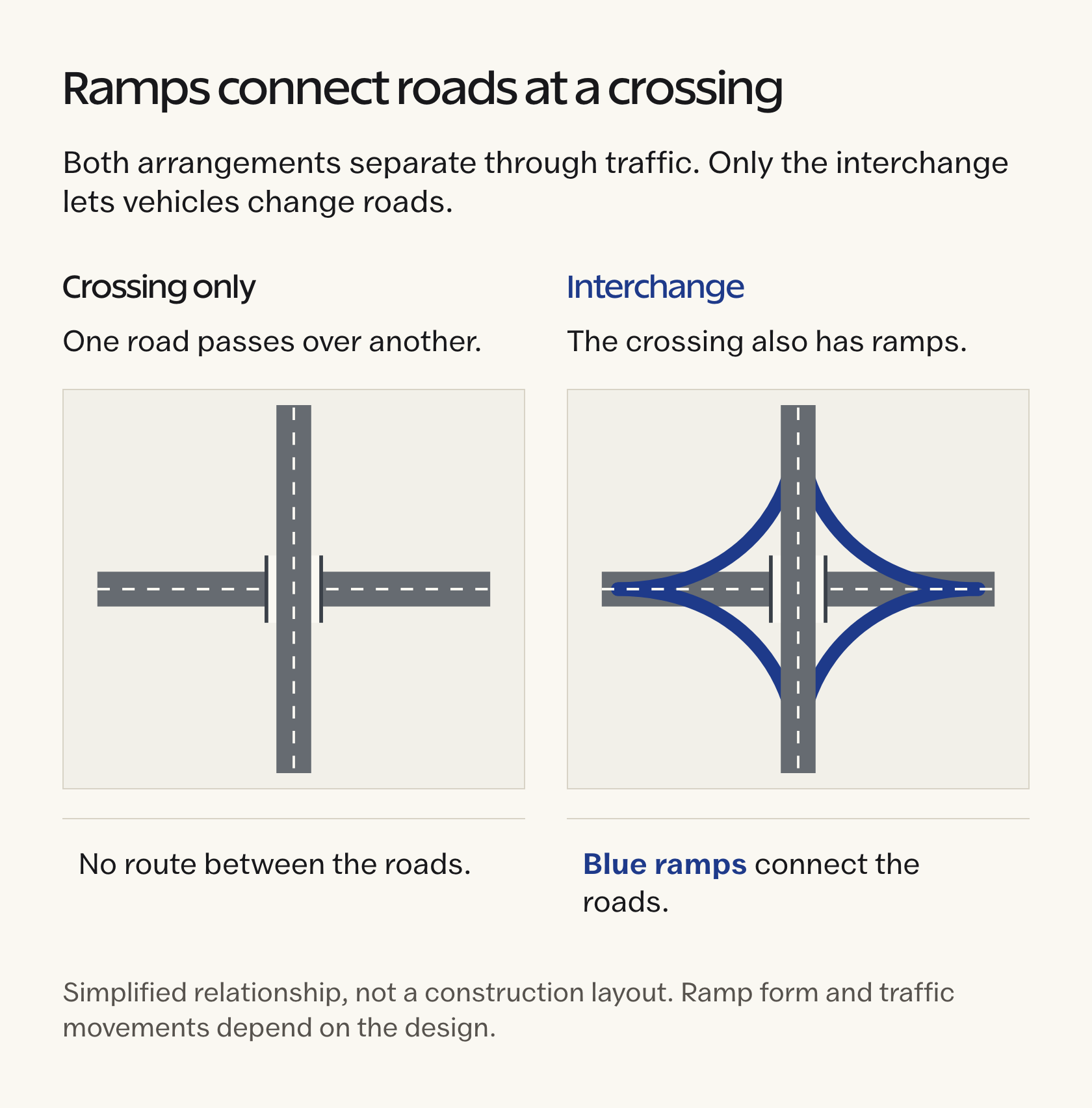
- A grade-separated crossing carries intersecting roads at different levels, while an interchange adds connecting ramps. The distinction matters: a bridge carrying one road over another does not automatically provide access between those roads.
- Ramps channel joining and departing vehicles through defined paths. They separate the act of changing roads from a direct crossing of through traffic, but their geometry and operation still require careful design and assessment.
- The release specifies interchanges at crossings with expressways, national highways, state highways and important traffic-generating arterial roads. This organises major network connections rather than allowing each roadside access demand to become an uncontrolled opening.
- Connections also serve roads leading to ports, airports and logistics parks, alongside industrial and major tourist destinations. Corridor usefulness depends on reaching such destinations while preserving the through route’s access-control function and operational continuity.
- Advance entry and exit information gives drivers time to recognise an approaching connection and prepare their movement. Its safety purpose is anticipation: an exit noticed too late can encourage sudden lane changes or braking.

Boundary protection and the implementation test
Physical separation supports access control, but the public benefit depends on complete project design, workable local connections and continuing upkeep after construction.
- The guidelines prescribe a one-metre boundary wall along the corridor’s outer edge. The stated purposes are preventing encroachment, unauthorised access and stray cattle entry; the announcement does not establish that these risks are eliminated.
- A boundary wall manages access at the corridor edge; an interchange manages authorised connections. They perform different jobs, so neither should be treated as a substitute for the other when explaining the safety mechanism.
- Local connectivity remains a planning question where settlements depend on an existing road. Restricting direct entry requires assessment of how legitimate local trips can reach designated connections without creating pressure for unsafe informal openings.
- Uniform design can improve consistency, but a standard on paper is not a measured safety outcome. Construction quality, maintained boundaries and usable driver information determine whether the intended arrangement works throughout the corridor’s operating life.
- The release establishes guidelines, not completed delivery. Evaluation should separately examine compliant project reports, constructed access arrangements and operational results, rather than using the announcement itself as proof of fewer crashes or faster freight journeys.
Way Forward
Check the design as a connected system
- Review ramps, crossings and advance signs together during project preparation, so users receive clear information before reaching the relevant decision point.
- Assess settlement access alongside corridor protection, including whether planned connections serve everyday local journeys.
- Inspect boundary continuity and upkeep after opening; damaged sections can undermine the access-control design.
- Measure safety and journey reliability after implementation rather than treating guideline publication as an outcome.
Conclusion
- Access control is a system of designated connections, understandable driver information and protected corridor edges; widening a road does not deliver those functions automatically.
- For infrastructure answers, connect planning standards to the mechanism they govern and distinguish a released framework from construction, operation and demonstrated safety improvements.
UPSC Practice Questions
Prelims MCQ 1
With reference to the newly announced NHAI guidelines, consider the following statements:
- They apply to upcoming four-lane and six-lane greenfield and brownfield high-speed access-controlled national highways other than expressways.
- They provide for advance notification of entries and exits.
- Their publication establishes that all covered corridors are already operational.
How many of the above statements are correct?
(a) Only one (b) Only two (c) All three (d) None
Answer: (b) Only two
Explanation:
The first two statements describe the release. The third confuses a planning framework with completed construction and operational delivery.
Prelims MCQ 2
Which best describes the role of connecting ramps in an interchange?
(a) They remove the need for any information about exits. (b) They permit unrestricted entry from every roadside property. (c) They provide designated paths for vehicles moving between intersecting roads. (d) They establish that every grade-separated crossing is an expressway.
Answer: (c) They provide designated paths for vehicles moving between intersecting roads.
Explanation:
A crossing can be grade-separated without connecting the roads. Interchange ramps provide the connecting movements; they do not remove the need for access management or information.
UPSC Mains Questions
- Explain how controlled access, ramp interchanges and advance exit information can contribute to safer high-speed highway operation. (150 words)
- Uniform highway design standards must address local connectivity as well as through traffic. Discuss with reference to NHAI’s new access-controlled highway guidelines. (250 words)
Source: PIB, Ministry of Road Transport and Highways.
Frequently Asked Questions
What is an access-controlled highway?
It is a highway where vehicles enter and leave through designated connections rather than unrestricted roadside openings. The objective is to organise access and reduce conflicts with traffic travelling along the corridor.
Do the new NHAI guidelines cover expressways?
No. The announced framework covers upcoming four-lane and six-lane greenfield and brownfield high-speed access-controlled national highways other than expressways. Its immediate purpose is greater consistency in planning and project preparation.
How is an interchange different from a grade-separated crossing?
Grade separation places crossing roads at different levels. An interchange also provides connecting ramps so vehicles can move between those roads. A bridge over another road need not itself provide a connection.
Have the covered highways already been built?
The release announces planning and design guidelines, not completion of the covered corridors. Construction, opening and measured safety or freight outcomes require separate evidence from individual projects and their subsequent operation.