NHAI-NCAER Centre: India Gets Its First Institute for Transport Economics and Logistics
Why in News?
The National Highways Authority of India (NHAI) has signed a Memorandum of Understanding with the National Council of Applied Economic Research (NCAER) to establish the NHAI Centre for Economics of Transportation, Mobility and Logistics. As reported by The Statesman and The Tribune, the centre will be India’s first permanent and independent research institution focused exclusively on the economics of transportation, mobility and logistics, and will be supported by NHAI for the next ten years.
The move places hard economic analysis at the heart of highway planning. Rather than treating road-building as an engineering exercise alone, the centre is meant to study the returns, costs and wider effects of national-highway spending, feeding evidence into toll policy, freight movement and the national push to lower logistics costs as a share of output.
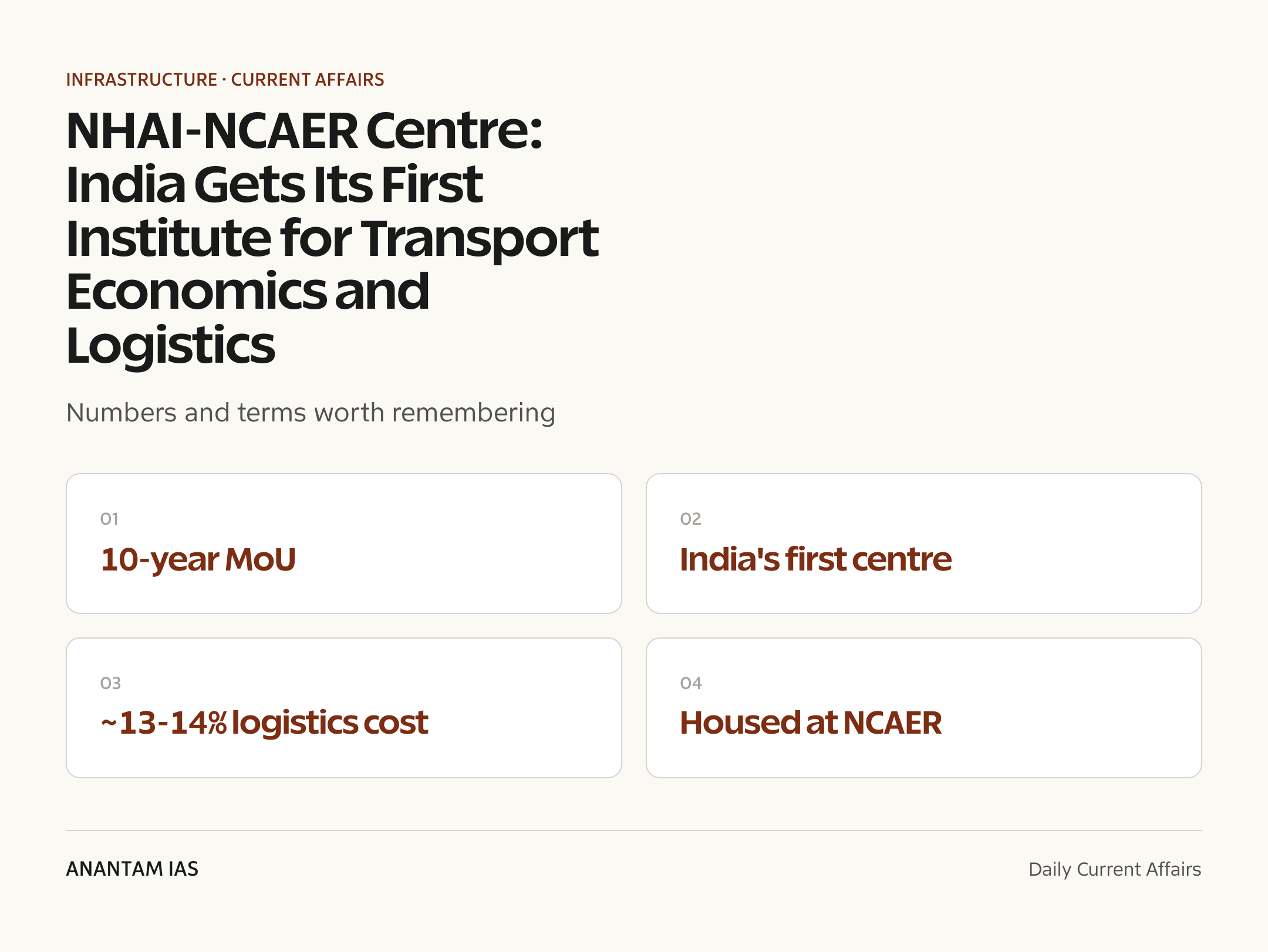
- NHAI and NCAER signed a 10-year MoU to set up the NHAI Centre for Economics of Transportation, Mobility and Logistics, housed at NCAER.
- It is described as India’s first permanent, independent research centre dedicated to transport, mobility and logistics economics.
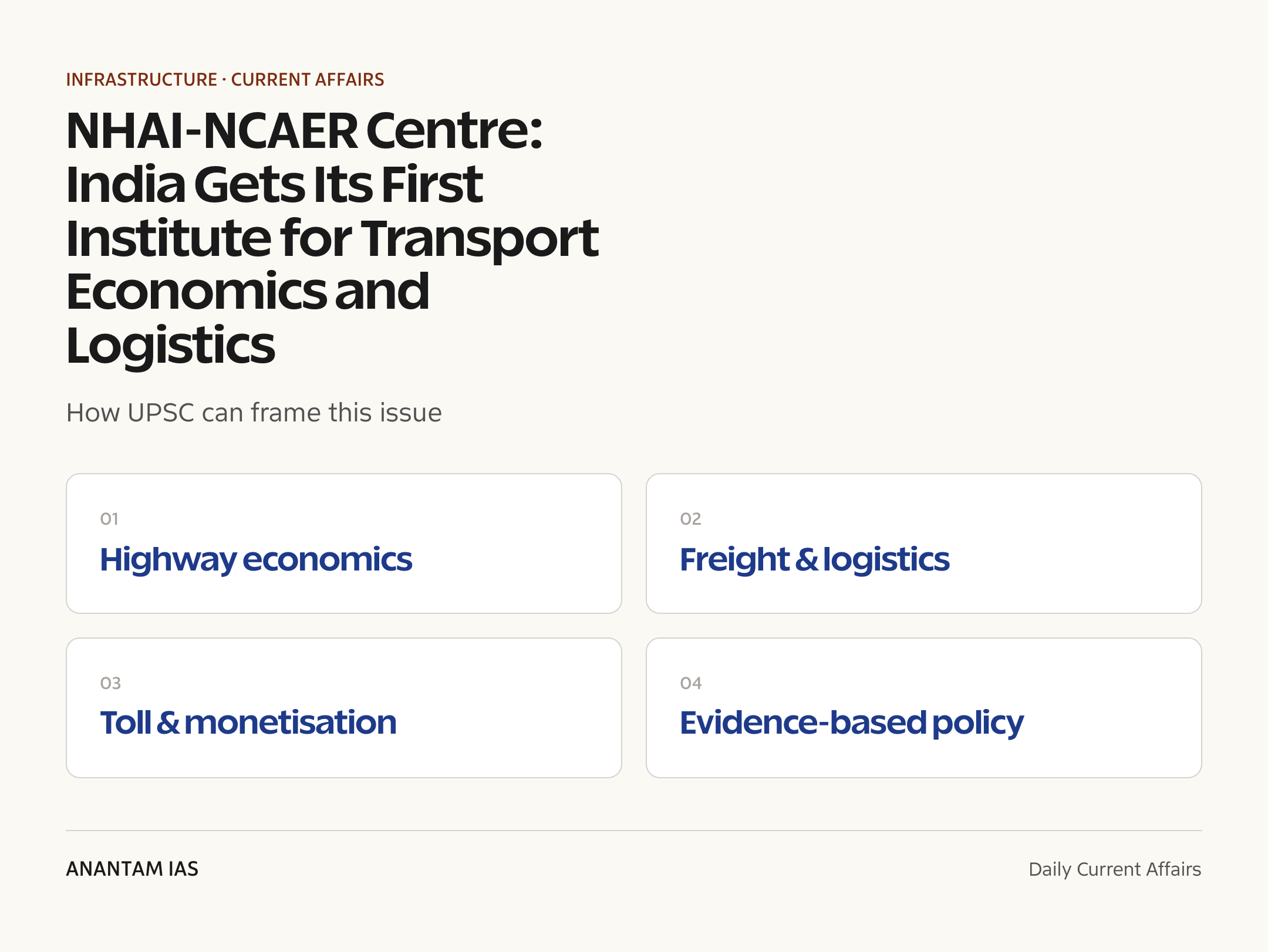
- Research themes span national-highway economics, freight logistics, modal integration, toll policy, asset monetisation and road-safety interventions.
- The centre will also act as a knowledge hub, publishing policy briefs, working papers and flagship reports and running stakeholder consultations.
- The tie-up links highway investment to evidence-based policymaking and the wider logistics-cost-reduction agenda.
The development matters in the context of:
- NHAI builds and manages most of India’s national highways and operates the country’s main tolling and highway asset-monetisation programmes.
- NCAER, founded in 1956, is one of India’s oldest independent economic think-tanks, giving the centre arm’s-length analytical credibility.
UPSC Relevance
Prelims Relevance
- NHAI is a statutory body under the Ministry of Road Transport and Highways (MoRTH), set up under the National Highways Authority of India Act, 1988.
- NCAER (National Council of Applied Economic Research), established in 1956, is an autonomous, non-profit economic research institute, not a government department.
- The National Logistics Policy 2022 aims to cut logistics costs and improve India’s ranking on the Logistics Performance Index.
- PM GatiShakti (2021) is a national master plan for multi-modal infrastructure integration through a GIS-based digital platform.
- Asset monetisation of highways is largely routed through Infrastructure Investment Trusts (InvITs) under the National Monetisation Pipeline.
- Bharatmala Pariyojana is the umbrella programme for highway corridor and economic-corridor development.
- FASTag enables electronic toll collection; India is moving towards GNSS-based (satellite) tolling for distance-based charges.
- Logistics cost in India is commonly debated at roughly 13-14% of GDP, against a stated ambition to bring it closer to single digits.
Mains Relevance
GS Paper 3
- Infrastructure-economy linkage: how dedicated transport-economics research can improve the returns on national-highway and logistics investment.
- Evaluating toll policy, asset monetisation and InvIT-based financing as tools to fund and sustain highway assets.
- The role of the National Logistics Policy and PM GatiShakti in lowering logistics costs and boosting export competitiveness.
- Institutionalising evidence-based policymaking in infrastructure through independent think-tank partnerships.
Essay
- Building physical infrastructure is the easy half; building the evidence to use it well is the harder one.
- Roads carry goods, but data carries policy: why the economics of mobility shapes a nation’s growth.
Background and Context
What the MoU sets up
The agreement creates a standing research home for the economics of how India moves goods and people.
- NHAI and NCAER signed an MoU to establish the NHAI Centre for Economics of Transportation, Mobility and Logistics, located at NCAER.
- NHAI will support the centre for ten years, giving it durable funding rather than project-by-project commissions.
- It is positioned as India’s first permanent, independent research centre in this specific field, as reported by The Statesman and The Tribune.
- Beyond research, it will publish policy briefs, working papers and flagship reports and convene workshops and stakeholder consultations.
Who the partners are
The tie-up pairs the country’s main highway builder with an arm’s-length economic think-tank.
- NHAI is a statutory authority under MoRTH, responsible for building, maintaining and tolling national highways.
- NCAER, founded in 1956, is one of India’s oldest and most respected independent economic research institutions.
- Housing the centre at NCAER is meant to keep its analysis analytically independent of day-to-day project pressures.
- The partnership is designed to convert NHAI’s operational data into peer-quality economic research.
The logistics-cost agenda it feeds
The centre slots into a larger national effort to make moving goods cheaper and faster.
- India’s logistics cost is widely debated at around 13-14% of GDP, seen as higher than in many competitor economies.
- The National Logistics Policy 2022 targets lower logistics costs and a better Logistics Performance Index ranking.
- PM GatiShakti seeks multi-modal integration so road, rail, ports and warehousing are planned together.
- Better evidence on freight logistics and modal integration can guide where highway spending yields the biggest economic gains.
Toll policy and asset monetisation
Two of the centre’s research themes touch directly on how highways are financed and priced.
- Toll policy research can inform the shift from plaza-based collection towards FASTag and GNSS-based distance tolling.
- Asset monetisation recycles capital by leasing operational highways, largely through InvITs under the National Monetisation Pipeline.
- Independent analysis can test whether toll rates and monetisation deals are fair to users and viable for investors.
- Studying the regional economic impact of highway investment helps justify and prioritise future corridors under Bharatmala.
Why it matters
The deeper significance lies in institutionalising economics inside infrastructure decisions.
- It signals a move from building roads to measuring what roads deliver for the economy.
- A permanent centre creates continuity of expertise instead of one-off consultancy studies.
- Credible, public research can improve transparency and accountability in toll and monetisation decisions.
- It strengthens the data backbone for India’s logistics-cost-reduction and competitiveness goals.
Way Forward
Publish the centre’s research openly so that policy briefs and working papers are available to states, investors and citizens, not just NHAI.
Use the centre’s findings to refine toll-pricing and asset-monetisation design, balancing user affordability with investor returns.
Connect its outputs to PM GatiShakti and the National Logistics Policy so that highway spending is sequenced for maximum economic and modal-integration gains.
Build genuine independence into the centre’s governance so its analysis can challenge, not merely endorse, NHAI’s plans.
Conclusion
The NHAI-NCAER centre marks a quiet but meaningful shift: India is starting to treat the economics of transport as a discipline worth a permanent institutional home. For a country spending heavily on highways while chasing lower logistics costs, that evidence base could decide whether the spending pays off.
Its real test will be independence and influence. If the centre’s research genuinely shapes toll policy, monetisation design and corridor choices, rather than ratifying decisions already taken, it could become one of the more useful additions to India’s infrastructure-policy machinery.
UPSC Practice Questions
Prelims MCQ 1
With reference to the National Council of Applied Economic Research (NCAER), consider the following statements: 1. It is a department directly under the Ministry of Finance. 2. It is one of India’s oldest independent, non-profit economic research institutions. 3. The proposed NHAI Centre for Economics of Transportation, Mobility and Logistics is to be housed at NCAER. Which of the statements given above are correct?
1 and 2 only 2 and 3 only 1 and 3 only 1, 2 and 3
Answer: 2 and 3 only
Explanation:
NCAER, founded in 1956, is an autonomous, non-profit economic research institute, not a government department, so statement 1 is wrong. It is among India’s oldest independent think-tanks (2) and the new NHAI centre is to be set up at NCAER (3).
Prelims MCQ 2
Consider the following pairs of programmes/initiatives and their primary focus: 1. PM GatiShakti — multi-modal infrastructure integration 2. National Logistics Policy 2022 — reducing logistics costs 3. Bharatmala Pariyojana — highway and economic-corridor development How many of the above pairs are correctly matched?
Only one Only two All three None
Answer: All three
Explanation:
PM GatiShakti is a master plan for multi-modal infrastructure integration; the National Logistics Policy 2022 targets lower logistics costs and a better Logistics Performance Index ranking; Bharatmala Pariyojana is the umbrella highway and economic-corridor programme. All three pairs are correctly matched.
UPSC Mains Questions
- “Building highways is an engineering task; getting value from them is an economic one.” In light of the NHAI-NCAER transport-economics centre, discuss how evidence-based research can improve returns on India’s infrastructure investment. (250 words)
- Examine the tools available to India for financing and sustaining its national-highway assets, including toll policy and asset monetisation through InvITs. What role can independent research play in making these tools fairer and more effective? (250 words)
- India’s logistics costs are seen as a drag on its competitiveness. Analyse how the National Logistics Policy and PM GatiShakti, supported by dedicated economic research, can help lower these costs. (150 words)
Sources: The Statesman and The Tribune.
Frequently Asked Questions
What is the NHAI-NCAER centre?
It is the NHAI Centre for Economics of Transportation, Mobility and Logistics, a research institution to be set up at NCAER under a 10-year MoU with NHAI, focused on the economics of transport, mobility and logistics.
Why is it called India’s first such centre?
Reports describe it as India’s first permanent and independent research centre dedicated exclusively to the economics of transportation, mobility and logistics, rather than to engineering or general infrastructure.
What will the centre research?
Its themes include national-highway economics, freight logistics, modal integration, the regional economic impact of highway investment, toll policy, asset monetisation, road safety and technology adoption in highway operations.
How does this connect to logistics costs?
India’s logistics cost is widely debated at around 13-14% of GDP. The centre’s research is meant to support the National Logistics Policy 2022 and PM GatiShakti in bringing those costs down.
What is NHAI’s role in tolling and asset monetisation?
NHAI builds and maintains national highways, collects tolls (increasingly via FASTag and moving towards GNSS-based tolling), and recycles capital by monetising operational highways, largely through InvITs.
Who are NHAI and NCAER?
NHAI is a statutory body under the Ministry of Road Transport and Highways that manages national highways. NCAER, founded in 1956, is one of India’s oldest independent, non-profit economic think-tanks.