Wildlife Crossings: Keeping Habitats Connected Across Highways
Why in News?
On October 8, 2026, NHAI announced its recently released Wildlife Mitigation Measures & Structures reference document, highlighting wildlife crossings and ecological safeguards in national highway planning.
- NHAI reported more than 2,150 structures constructed and/or proposed; this is not a count of completed wildlife crossings.
- The document covers underpasses, overpasses, adapted culverts and canopy crossings, alongside fencing, signage and speed regulation.
- The framework emphasizes site-specific planning, guided by ecological sensitivity, animal movement and engineering feasibility.
- The announcement describes a reference framework; it does not announce a new mandatory wildlife-crossing statute.
- Roads can connect settlements while creating barriers between habitats used by the same wildlife population.
- Effective mitigation must address both collision risk and the ability of animals to move through a connected landscape.
UPSC Relevance
Prelims Relevance
- Habitat fragmentation: division of habitat into smaller, separated patches.
- Barrier effect: infrastructure impedes wildlife movement across a landscape.
- Animal underpass: a passage beneath the road for wildlife movement.
- Canopy crossing: an elevated connection relevant to tree-dwelling animals.
- Camera trapping: a tool for recording animal movement and crossing use.
Mains Relevance
GS Paper 3
- Reconciling transport infrastructure with biodiversity conservation.
- Using ecological outcomes to evaluate wildlife mitigation investments.
GS Paper 2
- Coordination between highway agencies, forest authorities and conservation specialists.
Essay
- Development must preserve the ecological connections on which landscapes depend.
Background and Context
Why Roads Fragment Wildlife Habitats
A highway can affect animals even when they never collide with a vehicle; its ecological footprint includes the movement it prevents.
- Habitat fragmentation occurs when a continuous habitat is divided into smaller patches. A road can separate feeding, resting or breeding areas, making the remaining habitat less useful to animals needing several resources.
- The barrier effect concerns movement across the road. An animal may avoid traffic or disturbance, leaving suitable habitat physically present but difficult to reach from the other side of the highway.
- Wildlife–vehicle collisions are a different impact: animals attempt to cross and encounter moving vehicles. Reducing collision risk protects wildlife and road users, but does not by itself establish that habitat connections remain functional.
- Ecological connectivity means animals can move between habitat areas. For conservation planning, the relevant question is whether a road permits necessary movement, rather than whether forest cover survives on each side.
- A crossing structure addresses a particular road barrier within a wider landscape. Its usefulness depends on accessible habitat at both ends; a technically sound passage cannot compensate for every loss of surrounding habitat.
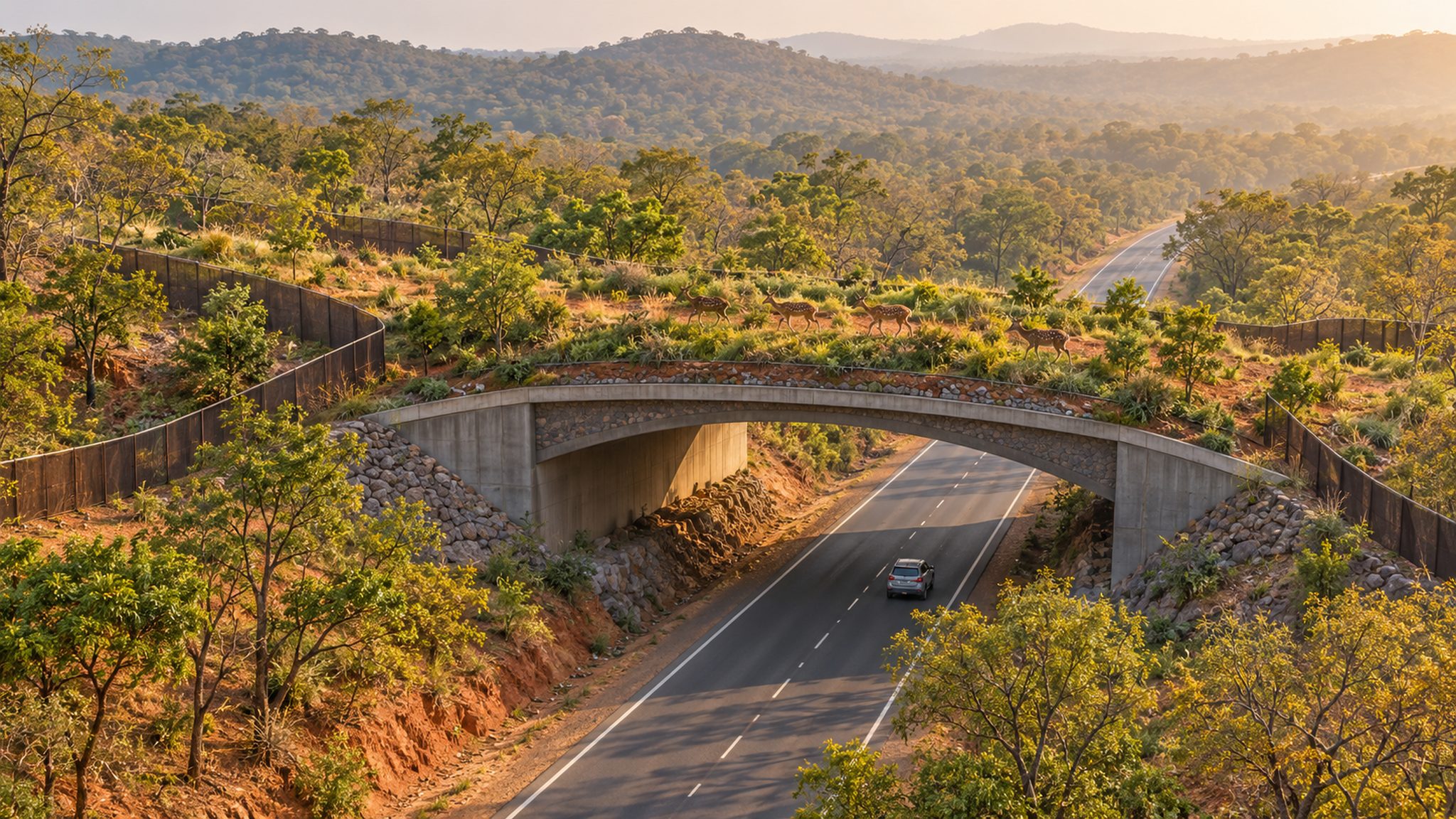
How Crossings and Guide Fences Work Together
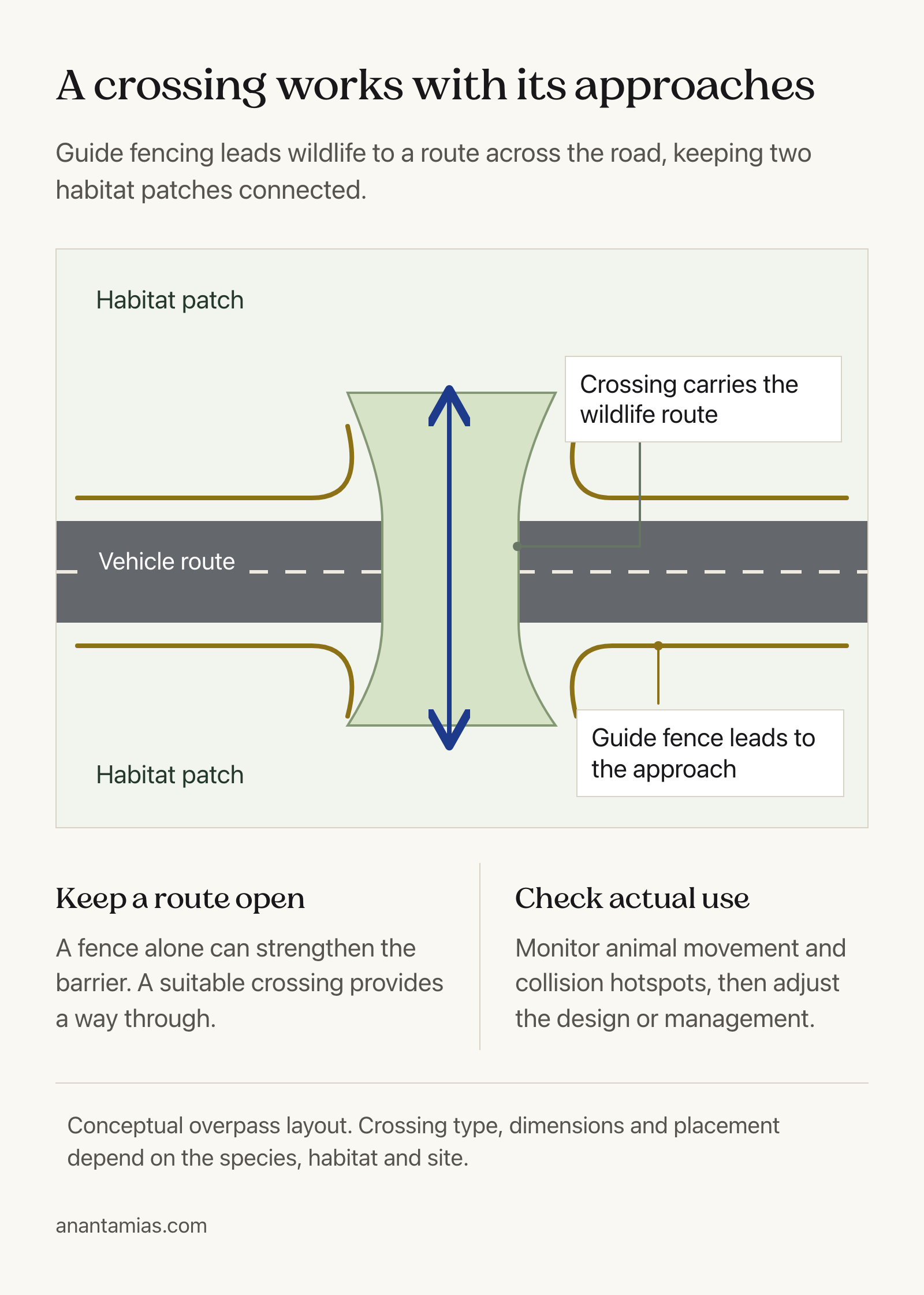
Crossings provide passage; guide fences help animals find it. The design must fit the species, terrain and movement route at that location.
- Underpasses carry animal movement beneath a road, while overpasses carry it above. NHAI includes both approaches, allowing ecological requirements and engineering conditions to influence the form chosen for a particular corridor.
- Adapted culverts and bridge-integrated passages can also provide routes for fauna. Listing a structure as a crossing does not establish suitability for every animal; passage design must respond to the intended users.
- Canopy crossings address movement above ground for tree-dwelling animals. They illustrate why a single standard structure cannot meet every need: the relevant movement level and behavior differ across wildlife species and habitats.
- Guide fencing directs animals toward designated passages instead of leaving road entry unrestricted. Fencing and crossings must operate together; a barrier that blocks movement without an accessible passage does not restore ecological connectivity.
- Noise barriers, signage and speed regulation complement structural measures by addressing disturbance and traffic risk. They serve different functions, so warning drivers cannot substitute for providing an animal with a usable crossing route.
Measuring Results Beyond Construction Counts
A completed passage is an infrastructure output. Its conservation value requires evidence that wildlife uses it and that the intervention addresses the local problem.
- NHAI reports camera trapping to assess movement and evaluate mitigation measures. Records can show which animals approach or use a structure, helping managers examine whether its actual use matches the intended ecological purpose.
- Collision-hotspot records identify places needing attention. Monitoring should examine crossing use alongside collision patterns, because an apparent reduction in collisions could reflect animals being unable to cross rather than a restored movement route.
- The announced total combines constructed and proposed structures. It describes a mixed implementation pipeline, so it cannot support a claim that every listed passage is operational or has already delivered measured conservation benefits.
- The reference document describes mitigation approaches across highway projects. Existing statutory environmental requirements remain relevant; describing good practice in a reference framework is different from creating a new legal obligation through legislation.
- Periodic evaluation makes mitigation a continuing responsibility after construction. Where observations show weak use or persistent collision risks, managers should investigate the crossing, its approaches and surrounding conditions before assuming the intervention has succeeded.
Way Forward
Plan for Movement and Verify Use
- Map wildlife movement routes early enough to influence highway alignment and crossing placement, involving conservation specialists alongside road engineers.
- Define target species and local outcomes before choosing a structure; preserve accessible habitat and maintain the approaches, fencing and passage.
- Publish separate proposed, completed and monitored counts, then use crossing observations and collision records to guide repairs and design improvements.
Conclusion
- Wildlife crossings should be judged as connections within living landscapes. Their value depends on species-appropriate design, usable approaches and evidence of movement, as well as the engineering work that creates the passage.
- For infrastructure policy, distinguish building a structure from achieving a conservation outcome. NHAI’s reference framework provides a planning basis; credible implementation requires continued coordination and monitoring at the places where highways intersect wildlife movement.
UPSC Practice Questions
Prelims MCQ 1
With reference to wildlife mitigation along highways, consider the following statements:
- Guide fencing can direct wildlife toward designated crossing structures.
- A canopy crossing and an animal underpass necessarily serve identical movement requirements.
- Camera trapping can help evaluate wildlife use of crossing structures.
How many of the above statements are correct?
(a) Only one (b) Only two (c) All three (d) None
Answer: (b) Only two
Explanation:
Statements 1 and 3 are correct. Fencing guides movement and camera traps help record crossing use. Statement 2 is incorrect: canopy crossings serve movement above ground, while underpasses provide routes beneath roads.
Prelims MCQ 2
Which finding most directly demonstrates wildlife use of a newly completed highway underpass?
(a) The project’s expenditure exceeds its original estimate. (b) The underpass is included in a national list of proposed structures. (c) Repeated camera records show the intended animals passing through it. (d) Warning signs are installed along the neighboring highway.
Answer: (c) Repeated camera records show the intended animals passing through it.
Explanation:
Observed passage supplies direct evidence of use. Expenditure, proposals and warning signs do not show animals using the underpass. Crossing use alone still does not prove every long-term population benefit.
UPSC Mains Questions
- Explain how highway development can fragment wildlife habitats. Discuss the roles of species-specific crossings and guide fencing in maintaining ecological connectivity.
- Why are construction counts insufficient to evaluate wildlife mitigation along highways? Suggest a monitoring and coordination framework for assessing conservation outcomes.
Sources: PIB, Ministry of Road Transport and Highways and Wildlife Institute of India.
Frequently Asked Questions
What are wildlife crossings?
Wildlife crossings are structures that help animals move across infrastructure barriers. They include underpasses, overpasses, adapted culverts and canopy connections, with designs selected according to species, habitat conditions and movement patterns.
Are all the reported NHAI wildlife structures completed?
No. The October 8 announcement combines more than 2,150 structures constructed and/or proposed. That figure should not be presented as the number of operational crossings or as evidence of measured conservation success.
Why do wildlife crossings need guide fencing?
Guide fencing directs animals toward designated passages and helps limit unsafe entry onto the road. Fencing needs accessible crossings: blocking movement alone can strengthen a barrier instead of restoring connections between habitats.
Does the NHAI document create a new wildlife-crossing law?
The announcement describes a reference framework documenting mitigation measures and structures used across highway projects. It does not announce a new statute, and project implementation must still consider existing statutory environmental requirements.
How can wildlife-crossing performance be assessed?
Camera traps can record crossing use, while collision records help identify persistent risks. Evaluations should consider the intended species and local movement needs, rather than treating construction or isolated animal sightings as complete proof of success.