Pahalgam Terror Attack: NIA chargesheet names LeT founder Hafiz Saeed
Why in News?
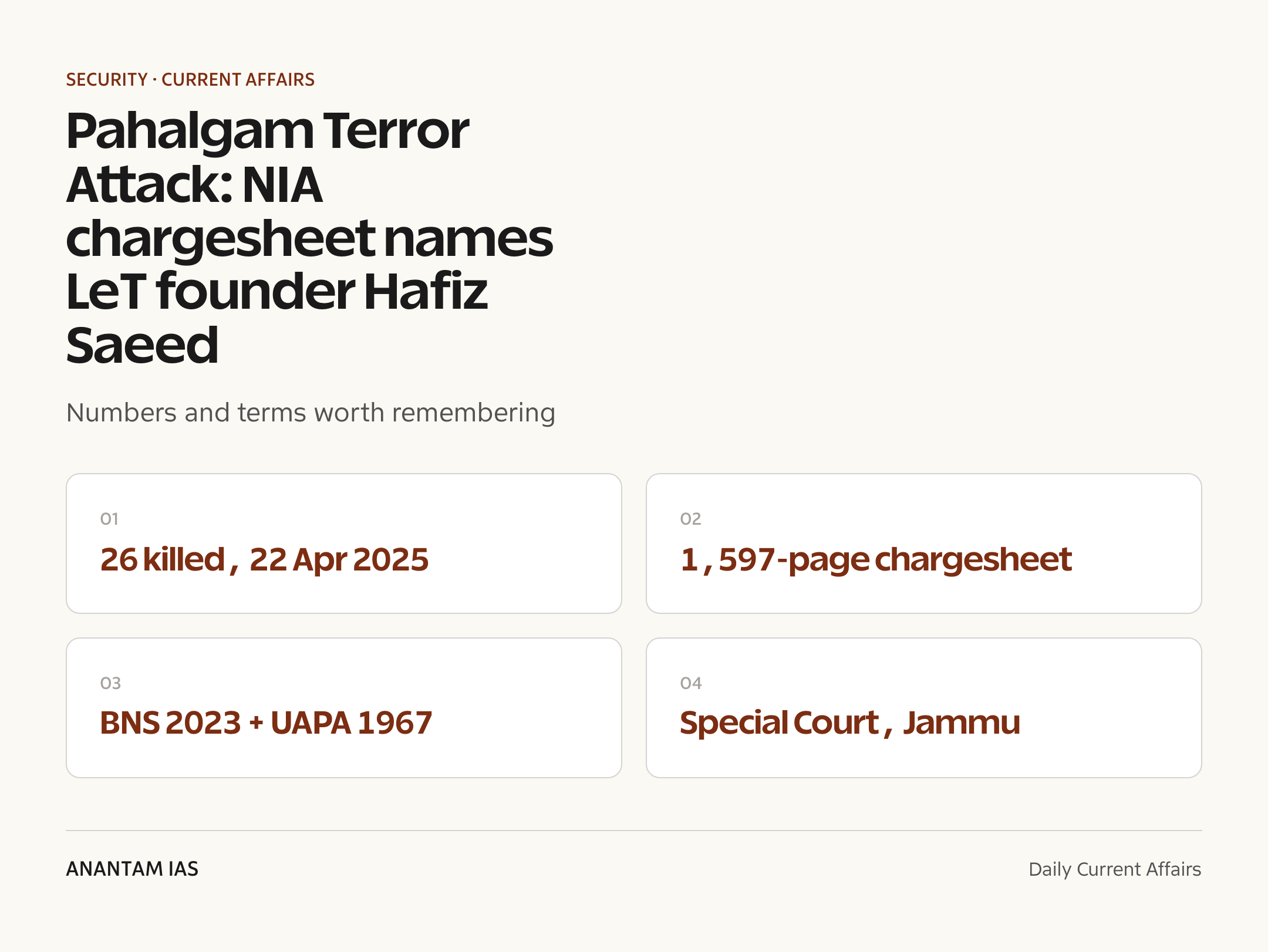
The National Investigation Agency (NIA) on July 6, 2026 filed a supplementary chargesheet before the NIA Special Court, Jammu, naming Hafiz Saeed — founder and chief of the Pakistan-based Lashkar-e-Taiba (LeT) and its proxy The Resistance Front (TRF) — as an accused in the Pahalgam terror attack of April 22, 2025, in which 26 civilians were killed. The Hindu reported that Saeed has been charged both in his personal capacity and as head of the two proscribed outfits.
The chargesheet invokes the Bharatiya Nyaya Sanhita (BNS), 2023 and the Unlawful Activities (Prevention) Act, 1967, including penal provisions for waging war against India and hatching a conspiracy from across the border. LeT and TRF have also been charged as legal entities for planning, facilitating and executing the attack — formally documenting the Pakistan-based conspiracy in a court of law.
- Filed on July 6, 2026 as a supplementary chargesheet, in continuation of the original 1,597-page chargesheet of December 15, 2025.
- Saeed charged in his personal capacity and as founder-chief of the proscribed LeT and its active proxy TRF.
- Provisions invoked: BNS 2023, UAPA 1967, plus sections for waging war against India and cross-border criminal conspiracy.
- LeT and TRF charged as legal entities — for their role in planning, facilitating and executing the attack.
- The NIA says the evidence comes from scientific investigation and on-ground examination; the probe into the full Pakistan-backed conspiracy continues.
- The original chargesheet had named Pakistani handler Sajid Jatt, three terrorists killed in Operation Mahadev (July 2025), and two arrested local logistics providers.
The development matters in the context of:
- This is India’s formal legal attribution of the Pahalgam attack to Pakistan-based leadership — evidence that supports India’s diplomatic case on cross-border terrorism at forums like the UN and FATF.
- It tests the machinery India built after 26/11: the NIA Act, 2008, the UAPA designation regime, and the 2019 amendments that let the NIA probe offences plotted outside India.
- Charging organisations as legal entities alongside individuals reflects a strategy of targeting the terror ecosystem — leadership, proxies, financiers and local facilitators together.

UPSC Relevance
Prelims Relevance
- NIA — statutory body under the NIA Act, 2008 (set up after the 26/11 Mumbai attacks); investigates scheduled offences without state consent; works under the Ministry of Home Affairs.
- NIA (Amendment) Act, 2019 — extended jurisdiction to offences committed outside India affecting Indian citizens or interests; added cyber-terrorism, human trafficking and Explosive Substances Act offences to the schedule; enabled designation of Special Courts.
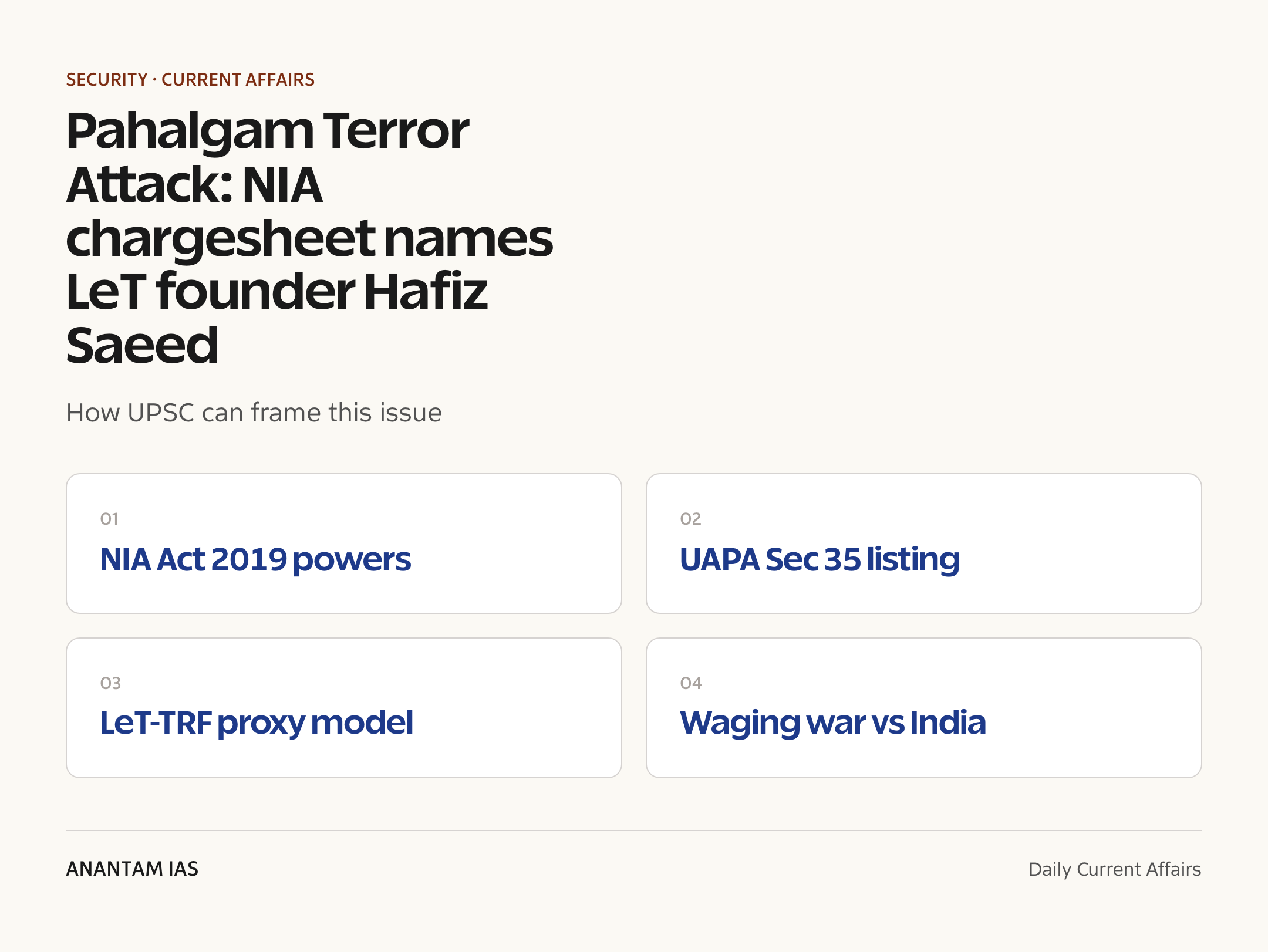
- UAPA, 1967 — India’s principal anti-terror law; the 2019 amendment (Section 35) allows the Centre to designate individuals as terrorists; Hafiz Saeed was among the first four so designated in 2019.
- Hafiz Saeed — founder of LeT; listed by the UNSC 1267 Sanctions Committee in December 2008 after the Mumbai attacks; carries a US $10 million Rewards for Justice bounty.
- The Resistance Front (TRF) — LeT proxy that emerged in 2019; banned by MHA under UAPA in January 2023; designated a Foreign Terrorist Organisation by the United States in July 2025.
- BNS, 2023 — replaced the IPC; retains the offence of waging war against the Government of India (Section 147) and adds a dedicated terrorist act provision (Section 113).
- Pahalgam attack — April 22, 2025, near Pahalgam in Anantnag district, J&K; 26 civilians (25 tourists, one local) killed in targeted shootings.
- Operation Sindoor — India’s May 2025 precision strikes on terror infrastructure in Pakistan and PoK in response to Pahalgam; Operation Mahadev (July 2025) eliminated three attackers in J&K.
Mains Relevance
GS Paper 3
- Cross-border terrorism and state-sponsored proxies: how the LeT–TRF layering is designed to evade attribution and FATF scrutiny, and how investigation pierces it.
- Role and evolution of the NIA as a federal counter-terror agency — powers, 2019 expansion, extraterritorial investigation and conviction record.
- Linkages between external state actors and internal security: local overground workers providing logistics to foreign attackers.
GS Paper 2
- India’s legal-diplomatic response to terrorism: UNSC 1267 listings, FATF processes, extradition limits with Pakistan and the value of court-tested evidence.
- Efficacy of international designation regimes when the host state shields designated terrorists — the Hafiz Saeed precedent since 2008.
Essay
- Justice across borders: can law reach where armies cannot?
- Terrorism is waged by networks; states must respond with institutions.
Background and Context
The Pahalgam attack and the case so far
The chargesheet caps a 14-month investigation that moved from a local FIR to a documented cross-border conspiracy.
- On April 22, 2025, terrorists killed 26 civilians — 25 tourists and one local — in targeted, religion-based shootings near Pahalgam, a tourist town in Anantnag district of Jammu & Kashmir.
- An FIR was first registered at the Pahalgam police station; after initial investigation by J&K Police, the Union Home Ministry transferred the case to the NIA.
- The original 1,597-page chargesheet (December 15, 2025) named Pakistani handler Sajid Jatt, the three attackers killed by security forces in Operation Mahadev (July 2025), and two arrested civilians who allegedly provided logistics.
- The July 6, 2026 supplementary chargesheet moves up the chain of command to Hafiz Saeed himself, and indicts LeT and TRF as organisations.
- The NIA says its evidence rests on scientific investigation — forensics, digital trails and on-ground examination — and that the probe into the complete conspiracy continues.
Hafiz Saeed, LeT and the TRF proxy model
The accused is not a foot soldier but the head of a UN-designated terror network operating from Pakistani soil.
- Hafiz Saeed founded Lashkar-e-Taiba, the group behind the 2008 Mumbai attacks (166 killed); the UNSC 1267 Committee listed him as a global terrorist in December 2008.
- The US placed a $10 million Rewards for Justice bounty on him; India designated him an individual terrorist under the amended UAPA in 2019.
- Despite convictions in terror-financing cases in Pakistan, he has never been prosecuted there for attacks on India — the core of India’s charge of state complicity.
- The Resistance Front surfaced in 2019 as an LeT front with a secular-sounding name — a deliberate rebranding to project terrorism in J&K as indigenous and to dodge FATF terror-financing scrutiny of Pakistan.
- India banned TRF under UAPA in January 2023; the US State Department designated it a Foreign Terrorist Organisation in July 2025, expressly linking it to the Pahalgam attack.
- TRF initially claimed the Pahalgam attack and later retracted — the chargesheet now fixes responsibility on the LeT–TRF continuum as one legal enterprise.
The legal arsenal: BNS, UAPA and waging war
The charges knit together India’s new criminal code and its special anti-terror statute.
- The Bharatiya Nyaya Sanhita, 2023 (which replaced the IPC) retains waging war against the Government of India (Section 147) — one of the gravest offences, punishable with death or life imprisonment — and adds a dedicated terrorist act offence (Section 113).
- The UAPA, 1967 supplies the terrorism-specific framework: terrorist acts, conspiracy, membership of and support to a banned organisation (LeT and TRF are both proscribed in the First Schedule).
- The UAPA (Amendment) Act, 2019 lets the Centre designate individuals (Section 35, Fourth Schedule) as terrorists — earlier only organisations could be banned, so leaders escaped by floating new fronts.
- Charging LeT and TRF as legal entities means the organisations themselves face prosecution for planning, facilitating and executing the attack — attacking the institution, not just its members.
- Invoking criminal conspiracy from across the border anchors the extraterritorial dimension: the plot was hatched in Pakistan, executed in India.
NIA: mandate, powers and the 2019 expansion
The case showcases the federal counter-terror architecture India built after 26/11.
- The NIA Act, 2008 created India’s first truly federal investigation agency; it can take up scheduled offences (terrorism, bomb blasts, hijacking, terror financing) anywhere in India without state consent.
- The NIA (Amendment) Act, 2019 gave it extraterritorial jurisdiction — offences committed outside India against Indian citizens or Indian interests — the legal basis for investigating a conspiracy hatched in Pakistan.
- The 2019 amendment also widened the schedule (cyber-terrorism, human trafficking, Explosive Substances Act) and allowed Centre and states to designate Sessions Courts as NIA Special Courts for speedy trial — the Jammu court hearing this case is one such court.
- Cases reach the NIA by MHA transfer, as happened here after the initial J&K Police probe.
- The agency maintains one of the highest conviction rates among Indian investigative agencies in terror cases, built on chargesheets designed to survive judicial scrutiny. Details of the agency’s mandate are on the official NIA portal (nia.gov.in).
Why chargesheet an accused who may never stand trial
Saeed remains in Pakistan, so the chargesheet’s value is strategic as much as judicial.
- India and Pakistan have no extradition treaty, and Islamabad has consistently refused to hand over Saeed — as it did after the 26/11 case.
- A court-filed chargesheet converts intelligence into admissible, documented evidence — the strongest currency in diplomacy at the UNSC, FATF and bilateral forums.
- It enables downstream legal tools: proclaimed offender proceedings, Interpol notices, property attachment under UAPA, and pressure on states that host or fund the network.
- It also builds the record of Pakistan’s state sponsorship — relevant if FATF re-examines Pakistan’s commitments on terror financing.
- The precedent: the 26/11 chargesheets underpinned a decade of sanctions, listings and Pakistan’s 2018–2022 stint on the FATF grey list.
The wider post-Pahalgam response
The legal track ran parallel to military and diplomatic instruments through 2025-26.
- Operation Sindoor (May 2025): precision strikes on terror infrastructure in Pakistan and Pakistan-occupied Kashmir — India’s declared doctrine of treating terror attacks as acts of war.
- Diplomatic measures after the attack included placing the Indus Waters Treaty in abeyance, closing the Attari integrated check post and downgrading diplomatic missions.
- Operation Mahadev (July 2025) neutralised the three attackers inside J&K, closing the tactical loop while the NIA pursued the command chain.
- The combined effect is a template: kinetic response + legal attribution + diplomatic isolation, each reinforcing the other.
- For the running record of such developments, see the daily digests at anantamias.com/current-affairs.
Way Forward
Sustain the legal-diplomatic offensive
- Pursue proclaimed offender status, Interpol notices and UAPA property attachment against Saeed and the charged entities; keep the evidence dossier before the UNSC 1267 Committee and FATF.
- Push for TRF’s listing in the UNSC sanctions framework, using the US FTO designation and the chargesheet as supporting material.
Harden the internal grid
- Deepen intelligence coverage of overground workers and logistics networks that enabled foreign attackers to operate in the Valley.
- Institutionalise tourist-area security protocols in J&K — the attack targeted the tourism economy as much as lives.
Build prosecution capacity
- Fast-track the trial in the NIA Special Court with protected witnesses and forensic continuity, so the verdict carries international weight.
- Invest in digital forensics and cross-border evidence-sharing arrangements (MLATs) that modern conspiracies demand.
Conclusion
The supplementary chargesheet does what military strikes cannot: it places Hafiz Saeed, LeT and TRF inside a documented, court-tested chain of responsibility for Pahalgam. Even if the trial proceeds without the principal accused, the record it creates is a durable instrument of state policy.
For UPSC, the case is a live illustration of how the post-26/11 architecture — the NIA Act, the amended UAPA, the new BNS — is deployed against externally sponsored terrorism, and why legal attribution, diplomatic pressure and kinetic response now operate as one integrated doctrine.
UPSC Practice Questions
Prelims MCQ 1
With reference to the National Investigation Agency (NIA), consider the following statements:
- The NIA was established by an Act of Parliament in the aftermath of the 2008 Mumbai terror attacks.
- The NIA (Amendment) Act, 2019 empowered the agency to investigate scheduled offences committed outside India affecting Indian citizens or interests.
- The NIA can investigate a scheduled offence in a state only with the prior consent of that state government.
How many of the above statements are correct?
(a) Only one (b) Only two (c) All three (d) None
Answer: (b) Only two
Explanation:
Statements 1 and 2 are correct — the NIA Act, 2008 followed 26/11, and the 2019 amendment added extraterritorial jurisdiction. Statement 3 is wrong: for scheduled offences the NIA needs no state consent; that is what makes it a federal agency.
Prelims MCQ 2
The Unlawful Activities (Prevention) Amendment Act, 2019 is significant primarily because it:
(a) created the National Investigation Agency (b) allowed the Central Government to designate individuals, and not just organisations, as terrorists (c) abolished the requirement of sanction for prosecution under the Act (d) transferred all terror trials to military courts
Answer: (b) allowed the Central Government to designate individuals, and not just organisations, as terrorists
Explanation:
The 2019 amendment inserted individual designation under Section 35 (Fourth Schedule). Hafiz Saeed, Masood Azhar, Zaki-ur-Rehman Lakhvi and Dawood Ibrahim were the first individuals so designated.
UPSC Mains Questions
- The chargesheeting of a Pakistan-based terrorist leader who may never face trial in India is still a meaningful instrument of state policy. Discuss with reference to the Pahalgam terror attack investigation and India’s legal-diplomatic options against cross-border terrorism.
- Proxy organisations like The Resistance Front are designed to blur attribution of state-sponsored terrorism. Examine how India’s legal framework — the UAPA, the BNS and the NIA Act — has evolved to counter this proxy model, and suggest further reforms.
- “India’s response to Pahalgam combined kinetic, diplomatic and legal instruments.” Evaluate the strengths and limits of this integrated approach to externally sponsored terrorism.
Sources: The Hindu and Indian Express.
Frequently Asked Questions
What has the NIA chargesheet on Pahalgam said?
The supplementary chargesheet, filed on July 6, 2026 before the NIA Special Court in Jammu, names LeT founder Hafiz Saeed as an accused in the April 2025 Pahalgam attack, both personally and as chief of LeT and its proxy TRF, and charges both outfits as legal entities.
Under which laws has Hafiz Saeed been charged?
He is charged under the Bharatiya Nyaya Sanhita, 2023 and the Unlawful Activities (Prevention) Act, 1967. The NIA has also invoked provisions for waging war against India and for hatching a criminal conspiracy from across the border in Pakistan.
What happened in the Pahalgam terror attack?
On April 22, 2025, terrorists carried out targeted shootings of civilians near Pahalgam in Anantnag district of Jammu & Kashmir, killing 26 people — 25 tourists and one local resident. The NIA describes it as an attack planned and directed by Pakistan-based LeT and TRF.
What is The Resistance Front (TRF)?
TRF is a proxy of Lashkar-e-Taiba that emerged in 2019 with a non-religious name to make terrorism in Kashmir look indigenous and evade FATF scrutiny. India banned it under UAPA in January 2023, and the US designated it a Foreign Terrorist Organisation in July 2025.
Can Hafiz Saeed actually be tried in India?
Only if he is brought to India, which is unlikely since Pakistan shields him and no extradition treaty exists. But the chargesheet still enables proclaimed-offender proceedings, Interpol notices, property attachment, and gives India court-grade evidence for diplomacy at the UNSC and FATF.
Why could the NIA probe a conspiracy hatched in Pakistan?
The NIA (Amendment) Act, 2019 gave the agency extraterritorial jurisdiction — it can investigate scheduled offences committed outside India that affect Indian citizens or India’s interests. The Pahalgam conspiracy, plotted across the border but executed in J&K, falls squarely within this mandate.