NJAC v/s Collegium System

Why in news:
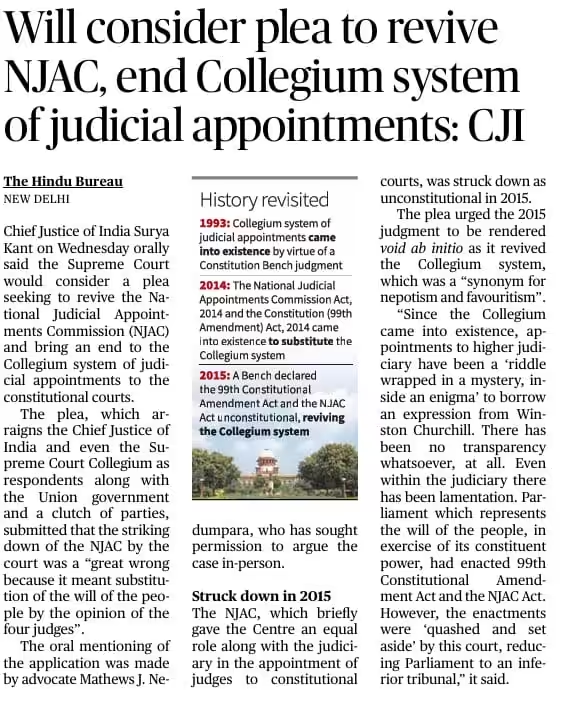
Chief Justice of India Surya Kant has orally stated that the Supreme Court will consider a plea that seeks:
- Abolition of the existing Collegium system for the appointment of judges to constitutional courts
- Revival of the National Judicial Appointments Commission (NJAC)
This is significant because it reopens the debate on judicial appointments, transparency, and separation of powers.
UPSC Relevance:
Polity and Governance
UPSC PYQ:
Q. Critically examine the Supreme Court’s judgement on the ‘National Judicial Appointments Commission Act, 2014’ with reference to the appointment of judges of higher judiciary in India. (2017)
About Collegium System and NJAC:
Collegium system:
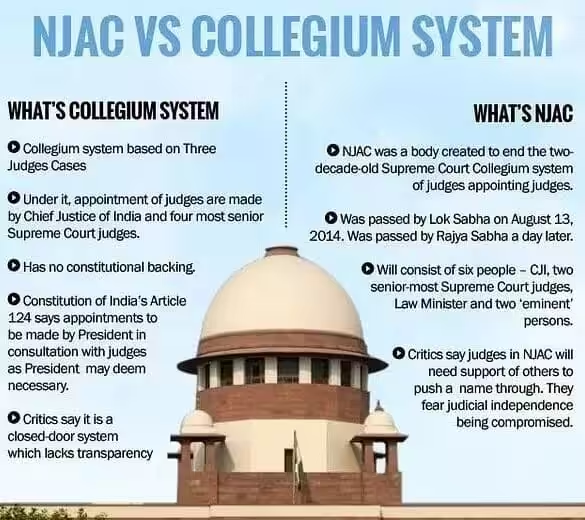
The Collegium system, in factual terms and as an express legal provision, does not find its place in the Constitution of India and has rather evolved in India as a process of appointment of judges, by three prominent cases.
- Article 124 and Article 217 provide that the SC and HC judges, respectively, are appointed by the President of India after consultation with such Judges of Supreme Court & High Court as necessary, along with the mandatory consultation with the CJI.
The Three Judge Cases that shaped this process are–
First Judge Case –
- SP Gupta vs. UOI (1981) (AIR 1982 SC 149)– The court by this gave the executive, a decisive hand for appointment of Judges for SC & HC. Bench went on to interpret that the term ‘consultation’ under Article 124 and Article 217, did not mean ‘concurrence’.
Second Judge Case-
- Supreme Court Advocates-on-Record Association v. Union of India (1993) (AIR 1994 SC 268)– 9 judge bench of Supreme Court in 1993, reversed the earlier decision. The apex court held that ‘consultation’ with the CJI actually meant ‘concurrence’ of the CJI. Following this, the CJI would make a decision along with the 2 senior most judges of the court and hence paved the collegium system.
Third Judge Case–
- IN RE: APPOINTMENT & TRANSFER OF JUDGES (1998) (AIR 1999 SC 1)– In 1998 the President sought the Supreme Court’s opinion over the primacy accorded to the CJI in Judge’s appointment under collegium. Supreme Court upheld the stance and went on to increase the strength of collegium to 5 judges
- Following this, the collegium consists of the 4 senior most judges and the CJI (i.e. Total 5 members). Another possible contingency is that the successor of the CJI may not be one of these 4 senior most judges and in those cases he is made a part of the collegium as well.
- As for the High Court collegium – it is led by the Chief Justice of the high court and the four senior most Judges of that particular High Court. The recommendations by the High Court collegium are further approved by the CJI and the Supreme Court Collegium and are then sent to the President.
Criticism of the Collegium System:
Absence of Transparency
- An important critique levelled against the Collegium system is its lack of transparency. Judge nomination and transfer procedures take place behind closed doors, and the standards and reasoning for judgments are never made public. Concerns concerning the impartiality and fairness of the system are raised by this lack of openness. It is challenging to determine whether decisions are motivated by merit or other considerations in the absence of precise, openly accessible rules.
Claim of Favouritism and Nepotism
- Nepotism and favouritism, according to critics, might result from the Collegium System’s lack of accountability and openness. Allegations have been made that personal relationships or factors other than merit occasionally affect appointments and transfers. The public’s confidence in the courts is weakened by this view, which also may have an impact on the officers’ morale.
Arguments in Favour of the Collegium System:
Judges’ Independence
- The Collegium system’s guarantee of judicial independence is among its strongest justifications. The Collegium system helps prevent political meddling by giving senior judges, not the executive branch, the authority to make judicial nominations and transfers. Maintaining an unbiased judiciary that is able to make decisions free from outside pressures depends on this division.
Shielding Against Political Pressures
- It is believed that the Collegium System protects the judiciary from political pressure. Judges may be appointed more on the basis of their political allegiances or affiliations than their qualifications in nations where the president plays a major role in judicial nominations. Because the Collegium System retains the appointment process inside the judiciary, it reduces this risk.
National Judicial Appointments Commission (NJAC):
- The National Judicial Appointments Commission Act, 2014, and the 99th Constitutional Amendment Act were passed in 2014 in order to create the NJAC. There has been a lot of criticism regarding the Collegium System, so there were certain provisions made to correct these flaws. These legislative actions established the NJAC’s legal foundation, formally substituting this new commission for the Collegium System. The NJAC encountered strong opposition despite its promising framework, especially from the court.
- As per the appointment procedure that previously existed in the form of the National Judicial Appointment Commission (NJAC), no recommendation made by the NJAC could be forwarded if it was denied by two of its members. The commission (NJAC) and the NJAC Act were stuck down back in the year 2015 via the 4th Judge Case (Supreme Court Advocate on Record Association & Anr. vs. UOI) ((2016) 5 SCC 1), declaring it to be ultra vires and against the basic structure doctrine of the constitution.

Concluding, against all this criticism, the fact is that the collegium system withstands and maintains the rule of separation of power and the independence of the judiciary. It may need its own improvement and lens of transparency, but that doesn’t call for an absolute overthrow or disregard of this system of appointment. CJI’s opinion, in practice, is rather a collective opinion by people at the apex court level. CJI is given the decisive lead as he would be best to know and scrutinize the candidates & is backed by the extensive scrutiny by the collegium.