Centre urges states to boost efforts under National Mission on Edible Oils – Oil Palm
Why in News?
Union Minister of Agriculture asked states to intensify efforts under NMEO-OP as progress and fund utilisation lag behind the mission targets aimed at edible oil self-sufficiency.
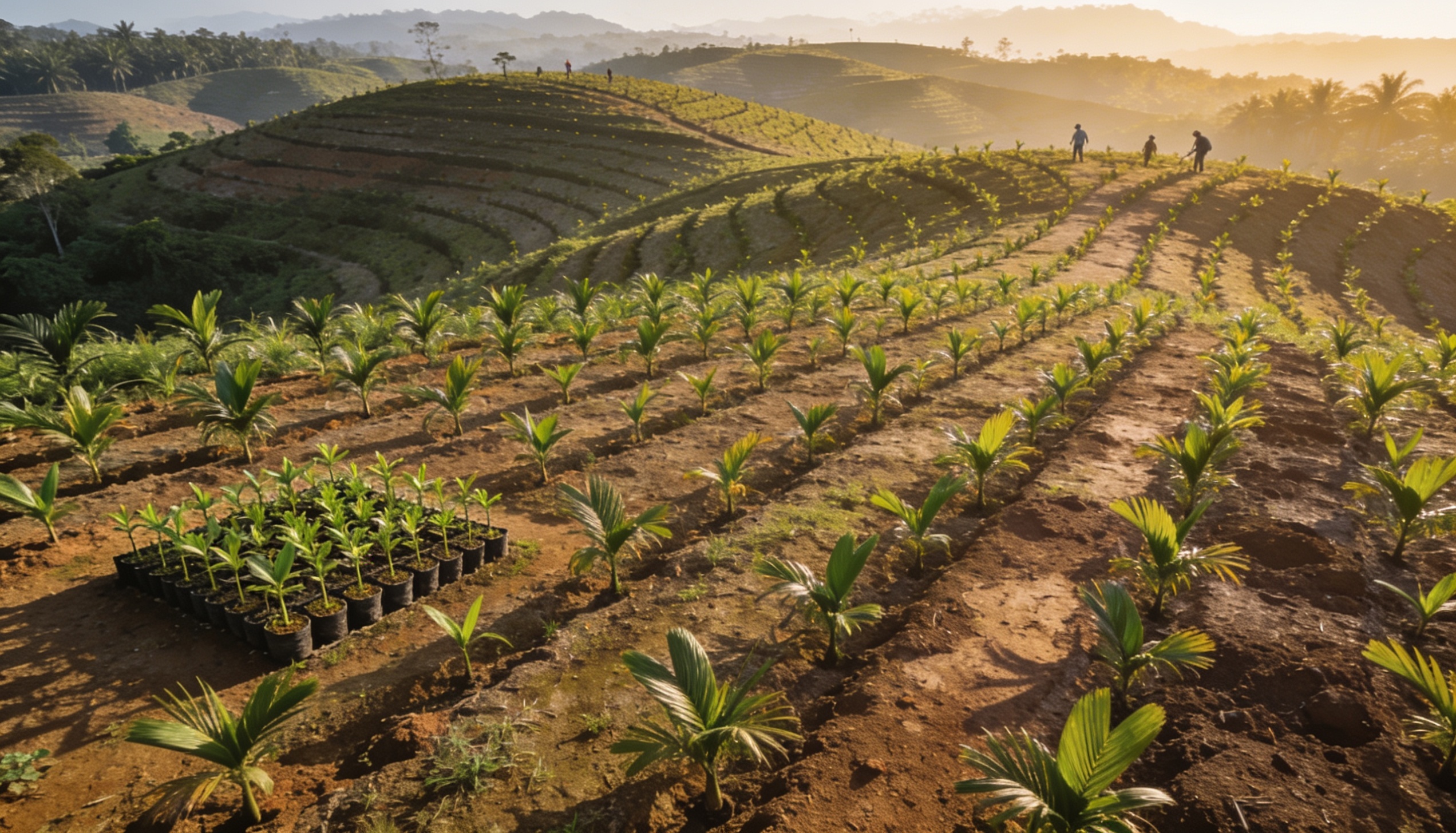
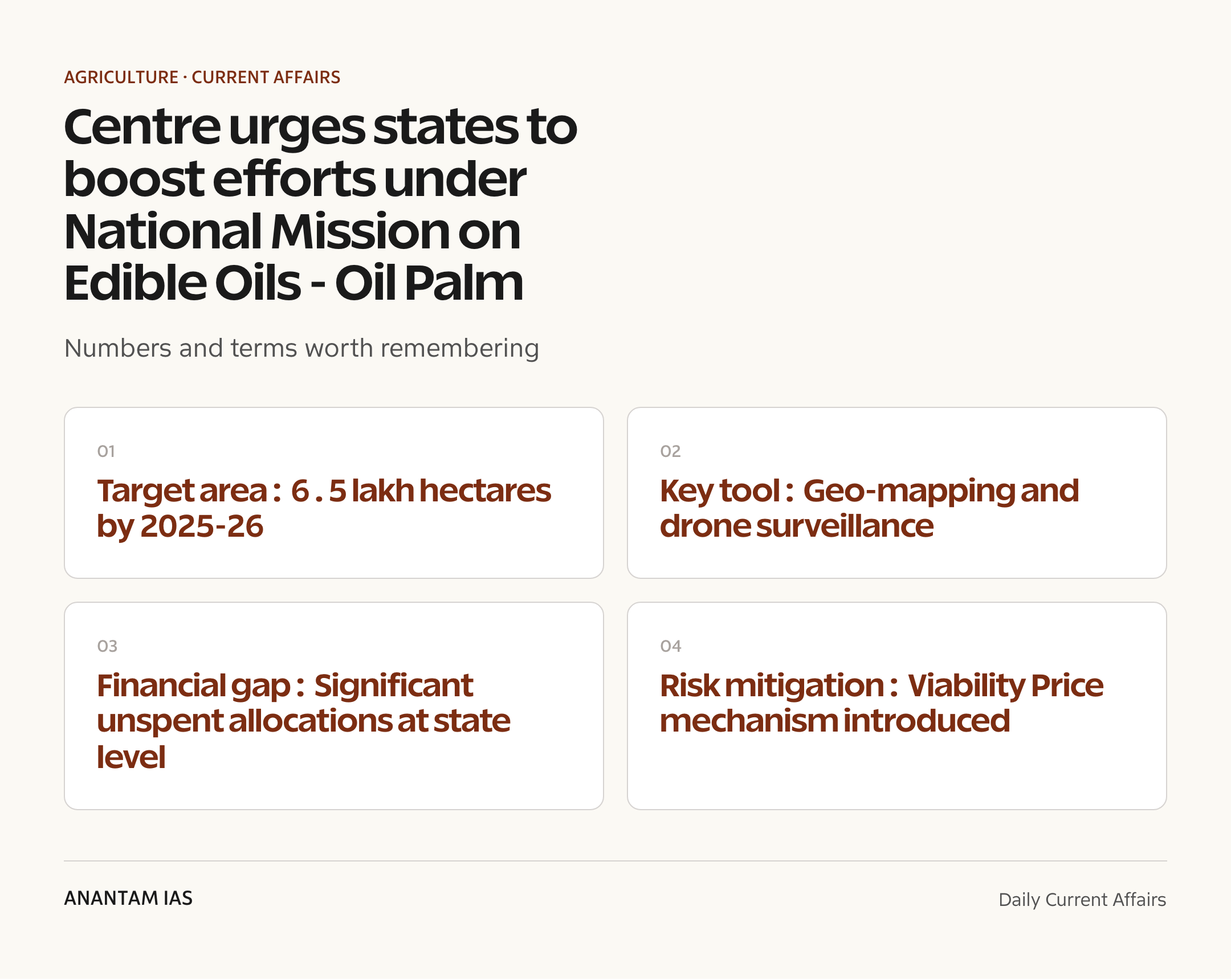
- Target shortfall: NMEO-OP aims to bring 6.5 lakh hectares under oil palm by 2025-26 but many states are behind schedule.
- Underutilised funds: Significant budget allocations remain unspent, limiting infrastructure, inputs and farmer incentives.
- Digital push: Centre promotes geo-mapping and drone surveillance to improve monitoring and transparency.
- Market protection: Introduction of a Viability Price (VP) mechanism to shield farmers from price volatility, pending state MoUs.
- Regional focus: Emphasis on leveraging the agro-climatic potential of the Northeast and other oil-palm suitable states.
The development matters in the context of:
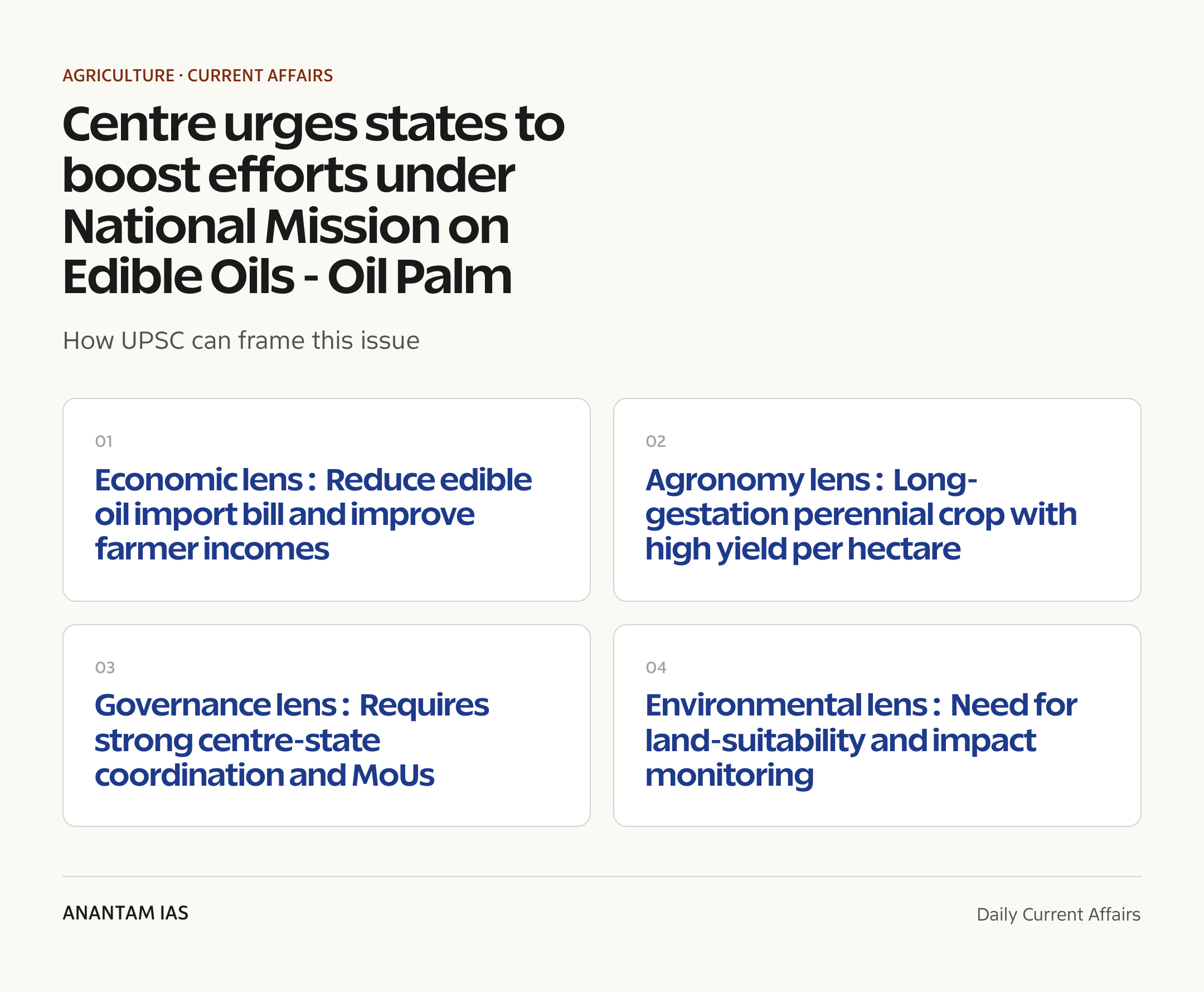
- Strategic objective: NMEO-OP is a central element of India’s edible oil strategy to reduce import dependence and support farmer incomes.
- Import dependence: India is one of the largest edible oil importers; expanding domestic oil palm is seen as a way to cut the import bill.
- Mission components: Includes planting material, subsidies, research, development of crop management practices and post-harvest infrastructure.
- State role: Implementation relies on state governments for on-ground mobilisation, land allocation, beneficiary selection and MoU signings for VP.
- Farmer risks: Oil palm is a long-gestation perennial; returns start after several years and require assured procurement or price support.
- Environmental concerns: Expansion needs to balance land-use, biodiversity and water considerations, especially in ecologically sensitive zones.
UPSC Relevance
Prelims Relevance
- Mission target: 6.5 lakh hectares by 2025-26 is a direct factual detail for prelims.
- Key instruments: Be aware of the Viability Price mechanism and digital monitoring tools like geo-mapping for scheme identification.
- Implementing agency: The mission is centrally sponsored; states are implementing partners—useful for scheme-characteristics questions.
Mains Relevance
GS3 Economy
- Policy analysis: Evaluate NMEO-OP’s role in reducing import dependence and improving farmer incomes under agricultural policy questions.
- Challenges and trade-offs: Discuss land-use, ecological impacts and long-gestation crop risks in questions on sustainable agriculture.
- Centre-state dynamics: Use NMEO-OP to illustrate cooperative federalism, fund utilisation and implementation bottlenecks.
Essay
- Food security and self-reliance: NMEO-OP links to themes of Atmanirbharta in agriculture for essays on national development.
- Rural livelihoods: The mission is relevant to essays on agrarian distress, diversification and income security for farmers.
- Sustainable development: Use oil palm expansion as a case to discuss balancing growth, environment and equity.
Background and Context
Genesis and objectives of NMEO-OP
Why the mission was launched and what it seeks to achieve.
- Launched as part of the National Mission on Edible Oils with a focus on oil palm to reduce high import dependence.
- Key objective: bring 6.5 lakh hectares under oil palm by 2025-26 across suitable agro-climatic zones.
- Targets include boosting production, productivity and developing a value chain from planting material to processing.
- Mission aims to increase farmer incomes through long-term perennial crop income streams and improved market support.
Scale of India's edible oil imports
The macroeconomic backdrop that motivates domestic edible oil expansion.
- India imports a large share of its edible oil requirement, creating a substantial import bill affecting trade balance.
- Palm oil, soybean oil and sunflower oil account for most imports; palm oil is dominant due to high yield per hectare.
- Domestic expansion is seen as a way to reduce import exposure and improve price stability for consumers and farmers.
- Import dependence exposes India to global price shocks and supply chain disruptions.
Design features and support mechanisms
Core components that define how NMEO-OP operates on the ground.
- Financial incentives for planting material, inputs, maintenance and small processing units are part of the mission package.
- Digital monitoring with geo-mapping and drone surveillance has been introduced to improve transparency.
- A Viability Price (VP) is designed to guarantee a minimum return to farmers in case of market downturns.
- States must sign MoUs to operationalise VP and access central support; implementation is a shared responsibility.
Implementation challenges observed
Operational bottlenecks that have slowed progress and reduced fund utilisation.
- Delayed plantation timelines due to the long gestation period of oil palm and initial farmer reluctance.
- Misinformation and lack of sustained farmer outreach have limited uptake in some regions.
- Administrative delays and weak capacity in certain states have led to unspent allocations and missed targets.
- Inadequate post-harvest infrastructure and uncertain procurement arrangements increase risk for farmers.
Regional focus and potential
Where expansion is viable and where the government is pushing efforts.
- The Northeast, Andaman and Nicobar Islands and parts of southern India are identified as suitable zones.
- Northeast offers expansion potential due to climatic fit and scope for livelihood diversification, if ecological safeguards are followed.
- State-specific strategies are needed: some states need land aggregation models, others need nursery and extension support.
- Coordination with state agriculture departments, research institutes and private sector is critical to scale up successfully.
Environmental and social considerations
Risks and safeguards linked to scaling up oil palm cultivation.
- Unplanned expansion can cause land-use change, biodiversity loss and pressure on water resources in sensitive areas.
- Promoting oil palm on degraded or fallow land is a mitigation option but requires careful site selection and monitoring.
- Social impact: long-gestation crops demand adequate compensation or transitional income support for farmers.
- Adopting sustainable practices and compliance with environmental clearances will be essential for credibility.
Way Forward
Improve fund utilisation and project execution
- States must carry out budget revalidation and fast-track utilisation plans for pending funds.
- Set clear timelines and milestones for annual plantation phases to convert targets into actionable work plans.
- Strengthen district-level project management units with dedicated staff and performance-linked reviews.
- Encourage public-private partnerships for nursery, logistics and processing to share implementation burden.
Strengthen farmer engagement and risk mitigation
- Roll out targeted extension campaigns to address misinformation and explain long-term benefits and risks.
- Operationalise the Viability Price quickly through timely MoUs and clear procurement protocols.
- Provide transitional income support or intercropping options for the gestation period to reduce farmer cash-flow risk.
- Use farmer producer organisations to aggregate supply and improve bargaining power for smallholders.
Deploy technology for monitoring and accountability
- Expand geo-mapping and drone-based surveillance for plantation verification and growth monitoring.
- Create a single dashboard for fund flow, plantation progress and farmer grievance redressal accessible to states and Centre.
- Use remote sensing to monitor land-use change and ensure expansion happens on suitable lands.
- Link digital records to payments to reduce leakages and speed up beneficiary assistance disbursal.
Balance expansion with sustainability
- Adopt a land-suitability framework to prioritise degraded and fallow lands over forests and sensitive ecosystems.
- Mandate soil, water and biodiversity impact assessments for large plantation blocks in ecologically fragile areas.
- Promote best agricultural practices, integrated pest management and water-efficient planting methods.
- Facilitate certification and value-addition to access premium markets for sustainably produced palm oil.
Conclusion
NMEO-OP is central to reducing edible oil imports and improving farmer incomes, but success requires faster state-level action, better fund utilisation, strong farmer engagement, adoption of digital monitoring and safeguards for sustainability. Operationalising VP and improving post-plantation value chains will determine whether the mission achieves its 2025-26 target.
UPSC Practice Questions
Prelims MCQ 1
What is the target area under oil palm plantations set by NMEO-OP to be achieved by 2025-26?
(a) 4.5 lakh hectares (b) 6.5 lakh hectares (c) 8.5 lakh hectares (d) 10 lakh hectares
Answer: (b) 6.5 lakh hectares
Explanation:
The National Mission on Edible Oils – Oil Palm aims to bring 6.5 lakh hectares under oil palm cultivation by 2025-26.
Prelims MCQ 2
Which of the following digital tools has the Centre promoted for monitoring NMEO-OP implementation?
(a) Block-chain based ledger (b) Geo-mapping and drone surveillance (c) QR-coded seed packets (d) DNA-based varietal tracking
Answer: (b) Geo-mapping and drone surveillance
Explanation:
The government has introduced geo-mapping and drone surveillance to improve transparency and monitoring of plantations under NMEO-OP.
UPSC Mains Questions
- {‘question’: ‘Analyse the role of the National Mission on Edible Oils – Oil Palm (NMEO-OP) in achieving edible oil self-sufficiency for India. Discuss key implementation challenges and policy measures to overcome them.’, ‘model_answer_points’: [‘Start with context: India imports a large share of edible oils; oil palm offers high yield per hectare and is central to reducing import dependence.’, ‘Outline NMEO-OP objectives: target of 6.5 lakh hectares, farmer income enhancement, development of value chains, support mechanisms like VP and digital monitoring.’, ‘Discuss implementation challenges: long gestation period, unspent funds, weak state capacity, misinformation among farmers, inadequate procurement and post-harvest infrastructure, environmental concerns.’, ‘Policy measures: accelerate fund utilisation, strengthen state PMUs, quick operationalisation of Viability Price via MoUs, staggered transitional support for farmers, adopt geo-mapping for transparency, incentivise PPPs for infrastructure, and enforce land suitability assessments.’, ‘Conclude with balanced view: NMEO-OP can reduce import dependence if implemented with strong centre-state coordination and sustainability safeguards.’]}
- {‘question’: ‘Examine the environmental and social trade-offs of scaling up oil palm cultivation in India and suggest a policy framework that ensures sustainable expansion.’, ‘model_answer_points’: [‘Introduce the issue: oil palm expansion can boost incomes and reduce imports but carries ecological and social risks.’, ‘Elaborate environmental risks: deforestation, biodiversity loss, water stress, soil degradation if poorly sited.’, ‘Elaborate social risks: land tenure conflicts, displacement of food crops, long-gestation income uncertainty for smallholders.’, ‘Policy framework: mandatory land-suitability mapping, prioritise degraded/fallow lands, require impact assessments, ensure community consent and benefit sharing, provide transitional income and intercropping options, monitor via remote sensing and periodic audits.’, ‘Conclude: sustainable yield increases, market linkages and social safeguards are needed to reconcile development and conservation goals.’]}
Source: PIB, Ministry of Agriculture & Farmers Welfare.
Frequently Asked Questions
q
a
q
a
q
a
q
a
q
a
q
a