NMDC Pellet Chain: Turning Ore Fines Into Steelmaking Feed
Why in News?
On 27 September 2026, NMDC announced commissioning of its Bacheli–Nagarnar processing, slurry-pipeline and pellet-production chain in Chhattisgarh, including maiden pellet production.
- The Nagarnar pellet plant has a stated capacity of 2 million tonnes per annum; this is capacity, not verified sustained production.
- A 135 km slurry pipeline connects processed ore concentrate at Bacheli with Nagarnar, providing an alternative to road transport.
- The plant uses Straight Grate Induration to make pellets from concentrate derived from Bailadila iron ore fines and slimes.
- Beneficiation and pelletisation solve different problems: unwanted mineral content and the handling of very fine particles.
- Greater use of fines and slimes can improve resource recovery, but water, residues, energy and pipeline integrity still require management.
UPSC Relevance
Prelims Relevance
- Beneficiation: upgrading ore by separating unwanted mineral material.
- Concentrate: an enriched mineral fraction, not finished steel.
- Slurry: fine solids suspended in liquid for pumping.
- Pelletisation: agglomeration of fine ore into larger rounded bodies.
- Induration: heat hardening of freshly formed pellets.
Mains Relevance
GS Paper 3
- Mineral value addition: connecting extraction, processing, transport and furnace-feed preparation.
- Environmental assessment: judging resource recovery alongside water, tailings, energy and transport impacts.
Essay
- Resource efficiency depends on process design and measured outcomes, not simply the label of waste utilisation.
Background and Context
Why fines need beneficiation and agglomeration
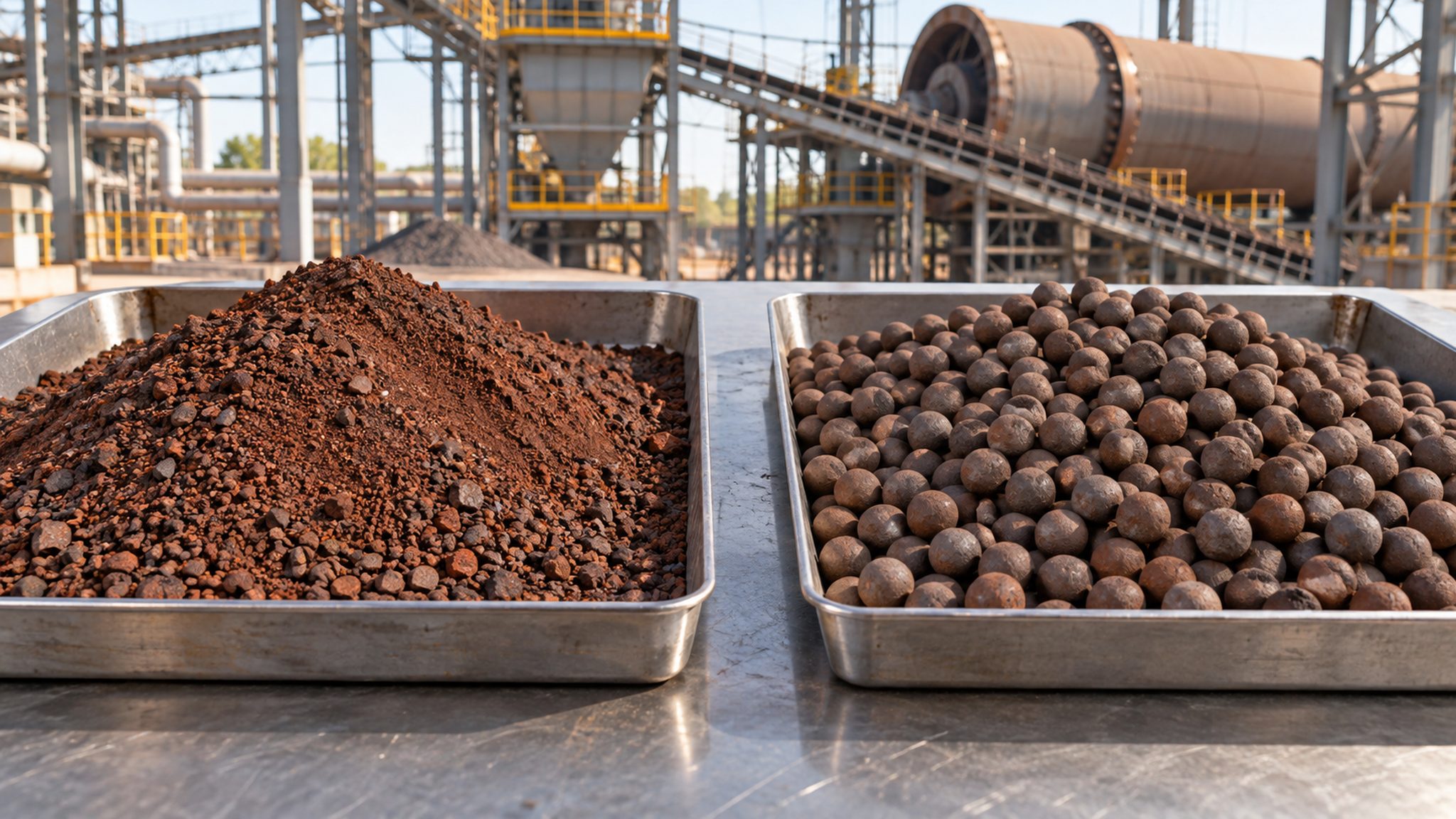
Iron ore beneficiation changes the quality of mineral feed; pelletisation changes its physical form so that downstream furnaces can use it.
- Fines and slimes are small particles associated with mining and ore processing. Their iron content and unwanted minerals vary, so small size alone does not establish whether material is usable or waste.
- Beneficiation separates useful iron-bearing material from unwanted minerals, often called gangue. The resulting concentrate is enriched feed; the rejected fraction still needs safe handling and cannot be assumed to disappear.
- Concentrate describes composition after enrichment, not a standard lump size. Fine concentrate may still need agglomeration before charging into a furnace designed for sized burden and controlled gas flow.
- Pelletisation gathers fine particles into rounded bodies. In general, moisture and binders help form unfired green pellets; the word green describes their unheated state, not environmental certification or hydrogen production.
- Ore pellets remain an iron-bearing raw material, not metallic iron or finished steel. Removing oxygen during ironmaking and controlling composition during steelmaking are later transformations with their own inputs and emissions.
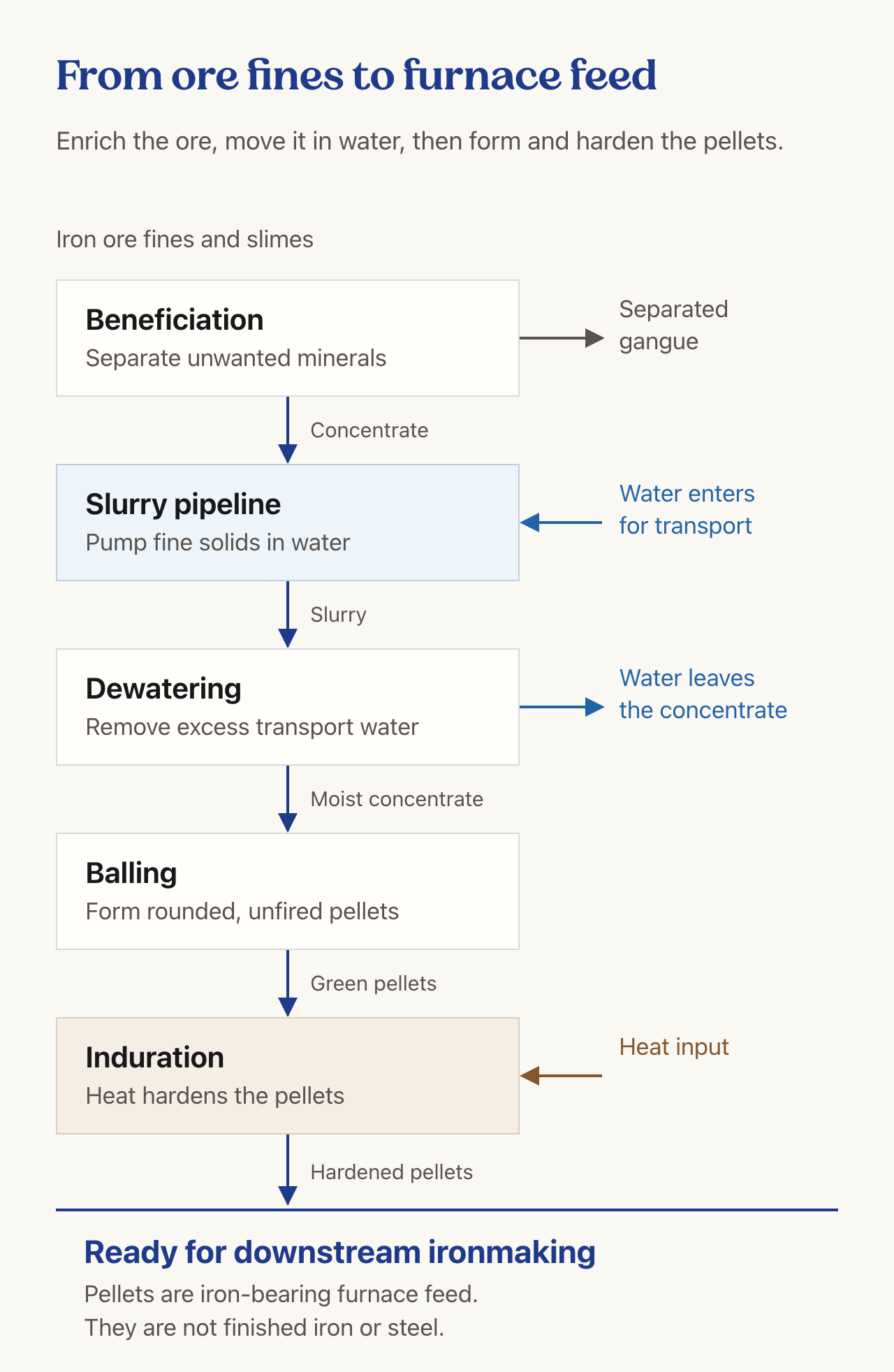
How the Bacheli–Nagarnar chain connects the stages
The announced chain joins mineral preparation, transport and pellet production; the following sequence explains the general engineering logic rather than undisclosed plant specifications.
- At Bacheli, processing produces iron ore concentrate for onward movement. Beneficiation should be understood as preparation for transport and use, rather than the manufacture of finished pellets at the mine itself.
- In slurry transport, fine mineral solids travel suspended in water through a pipeline. Pumping moves the mixture; a pipeline transports the material but does not itself perform the subsequent pellet-forming operation.
- At the receiving end, dewatering removes excess transport water so moisture can be controlled for pellet preparation. Water recovery matters, although the announcement does not specify the project’s recycling arrangement or rate.
- Balling and induration are separate steps: first particles form green pellets, then heating develops strength. Straight-grate systems carry a pellet bed through thermal treatment; this is distinct from simply drying loose concentrate.
- The Nagarnar output is pellet feed for steelmaking supply chains. Maiden production confirms an initial milestone; it does not demonstrate continuous full-capacity operation, final product performance across customers or future annual output.
Resource recovery has environmental conditions
The strongest evaluation follows material, water and energy through the entire chain instead of inferring sustainability from a single transport or processing improvement.
- Transport substitution may reduce reliance on trucks for the connected route. Actual benefits depend on displaced journeys, pumping electricity, operating reliability and maintenance; the release supplies no measured emissions comparison.
- Water management must cover sourcing, recovery and losses. A slurry pipeline moves water with solids, so describing it as automatically water-saving would require evidence beyond its length or the fact of commissioning.
- Residue management remains necessary after beneficiation. Higher mineral recovery can reduce discarded useful material, but it does not prove zero waste; containment, monitoring and the properties of remaining solids still matter.
- Thermal energy is needed for pellet hardening. Whether the full chain lowers emissions depends on fuels, electricity and downstream ironmaking; pellet production alone cannot establish low-carbon steel or renewable-hydrogen use.
- Upstream ore recovery differs from steel-slag road reuse, which handles a later industrial by-product. Both require tested material quality; their treatment steps, risks and end uses should not be conflated.
Way Forward
Measure the chain, not just commissioning
- Publish operating evidence on pellet quality, sustained throughput and downtime before treating design capacity as realised annual output.
- Track water balance, residue storage and pipeline integrity alongside ore recovery, with clear responsibilities for monitoring and incident response.
- Assess energy and emissions across processing, transport and downstream use; compare actual alternatives rather than claiming automatic decarbonisation.
- Apply the same recovery-versus-disposal distinction to protein recovery from chrome shavings: usable output and remaining residues need separate assessment.
Conclusion
- The NMDC chain illustrates how enrichment, transport and agglomeration turn fine mineral feed into a different industrial input; each stage solves a separate problem.
- In a resource-efficiency answer, connect value addition with measurable water, residue and energy safeguards. Commissioning is an industrial milestone, while sustained performance and environmental gains require operating evidence.
UPSC Practice Questions
Prelims MCQ 1
With reference to iron ore processing, consider the following statements:
- Beneficiation can enrich the useful iron-bearing fraction of ore.
- Green pellets necessarily indicate production using renewable hydrogen.
- Induration hardens freshly formed pellets through thermal treatment.
How many of the above statements are correct?
(a) Only one (b) Only two (c) All three (d) None
Answer: (b) Only two
Explanation:
Statements 1 and 3 are correct. Green pellets are unfired pellets; the term does not certify an energy source or low emissions.
Prelims MCQ 2
Which sequence best represents an ore-concentrate slurry and pellet-production chain?
(a) Pellet hardening → slurry transport → ore beneficiation (b) Steel refining → ore beneficiation → green-pellet formation (c) Beneficiation → slurry transport → dewatering → balling and induration (d) Slurry transport → finished steel → mineral separation
Answer: (c) Beneficiation → slurry transport → dewatering → balling and induration
Explanation:
Enrichment precedes transport of concentrate. Receiving-end moisture control prepares the material for forming and hardening pellets; steelmaking is a later stage.
UPSC Mains Questions
- Explain how beneficiation, slurry transport and pelletisation improve the use of iron ore fines. What environmental safeguards should accompany such an integrated chain?
- Why should commissioning of a mineral-processing project be distinguished from demonstrated resource efficiency and low-carbon performance? Discuss with suitable indicators.
Sources: PIB, Ministry of Steel and Ministry of Steel, industry glossary.
Frequently Asked Questions
What is the difference between concentrate and a pellet?
Concentrate is an enriched mineral fraction after beneficiation. A pellet is a rounded agglomerate formed from fine material and usually hardened by heating. Enrichment and physical shaping solve different production problems.
What does a slurry pipeline carry?
A slurry pipeline carries fine solid particles suspended in liquid, commonly water. In this chain, processed iron ore concentrate moves between Bacheli and Nagarnar before receiving-end preparation and pellet production.
Are green pellets environmentally certified products?
No. Green pellets are newly formed, unfired pellets before heat hardening. The term describes a production stage and does not establish renewable energy use, hydrogen-based ironmaking or a verified low-carbon footprint.
Does pelletisation make finished steel?
No. Pelletisation prepares iron-bearing feed for downstream metallurgical use. Reduction to metallic iron and subsequent steelmaking involve further transformations; the pellet plant’s commissioning does not mean those later steps are emission-free.