Nobel Prize in Economics 2026
Why in News?
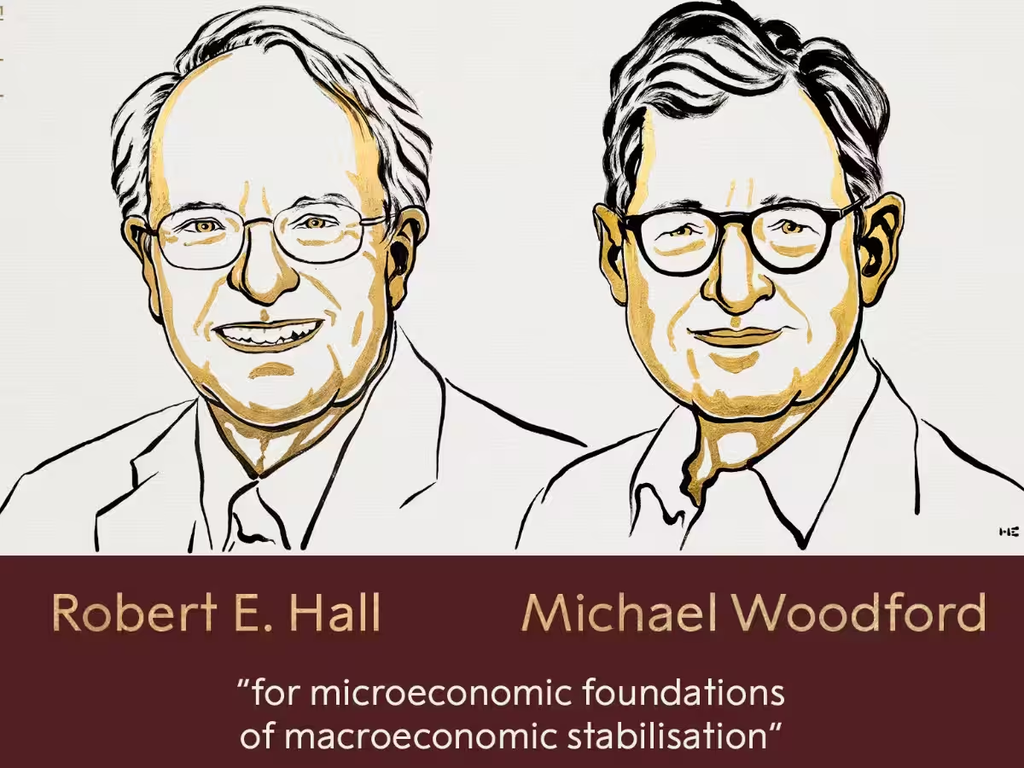
The 2026 Sveriges Riksbank Prize in Economic Sciences in Memory of Alfred Nobel was awarded jointly to Robert E. Hall (Stanford University) and Michael Woodford (Columbia University) for their groundbreaking research on the “microeconomic foundations of macroeconomic stabilisation”.
Their research explains how household and business decisions shape the wider economy, helping governments and central banks design more effective fiscal and monetary policies.
| UPSC Relevance: GS-3 Economy: Nobel Prize Prelims: Nobel Prize in Economics |
What is Economic Stabilisation?
Stabilisation policy refers to government and central-bank measures intended to moderate economic fluctuations and prevent prolonged unemployment or excessive inflation.
- Fiscal Policy: Utilises government expenditure, public borrowing, and taxation to directly manage aggregate demand.
- Monetary Policy: Manipulates policy rates (e.g., Repo Rate), reserve ratios, and systemic liquidity to regulate credit availability, borrowing costs, and inflation.
While demand-driven shocks are easily corrected by standard expansions or contractions, supply-side shocks (E.g., geopolitical oil price spikes) trigger stagflation, simultaneously raising inflation and depressing output.
What are Microeconomic Foundations?
Microeconomic foundations explain economy-wide outcomes through the decisions and interactions of individual households and firms, taking account of their preferences, expectations and constraints. Microfounded models explain:
- Household choices: How households allocate resources between present consumption and saving for future needs, considering expected income, wealth, interest rates and borrowing constraints.
- Firm decisions: How firms determine prices, production and investment in response to demand and costs..
- Role of expectations: How anticipated changes in taxation, government spending or interest rates influence consumption, saving and investment today.
Contributions of Nobel laureates:
(i) Robert Hall’s Contribution:
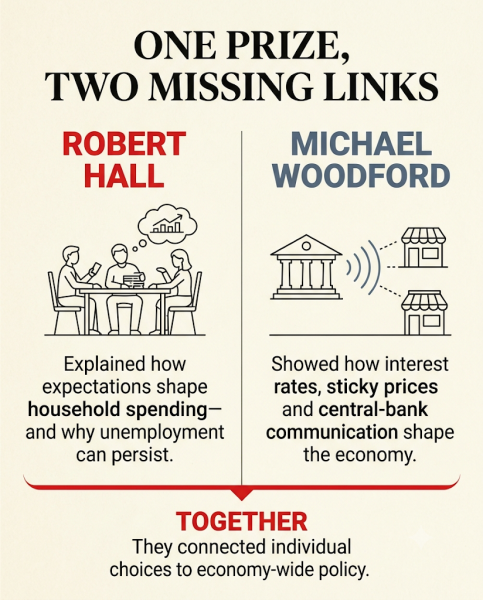
- Permanent Income / Random Walk Hypothesis: Hall proved that household consumption depends on lifetime wealth and expected future income, not just current income. Because people adjust spending based on new information, changes in consumption behave like a “random walk”— making it hard to predict from past trends alone.
- Labour-Market Search Frictions: He studied why unemployment remains sticky and slow to drop even after a recession officially ends (matching workers to jobs takes time and cost).
Significance: This explains why tax cuts or short-term cash transfers often fail to trigger an immediate surge in consumption if households expect future economic distress.
(ii) Michael Woodford’s Contribution:
- Microeconomic Foundations: Shifted macroeconomics away from top-down aggregate models to models built on how individual households and firms rationalise choices.
- Forward Guidance as a Policy Tool: Showed that what a Central Bank says it will do in the future matters just as much as what it does with the repo rate today. Managing public expectations anchors future inflation.
- Natural Rate of Interest: Emphasised the theoretical benchmark rate where the economy grows at potential with stable inflation.
Significance: Provides a theoretical basis for understanding how the RBI’s Monetary Policy Committee (MPC) can influence borrowing, spending and inflation expectations through interest-rate decisions, policy communication and credible commitments.
Relevance for India’s Monetary and Fiscal Policy:
The insights of Hall and Woodford offer crucial lessons to the Reserve Bank of India (RBI).
- Inflation Expectations and RBI Credibility: India’s flexible inflation-targeting framework, adopted in 2016, targets 4% CPI inflation with a ±2 percentage-point tolerance band. Woodford’s work highlights how credible communication, backed by appropriate policy action, can anchor inflation expectations and reduce the risk of temporary food or fuel shocks spreading into broader price and wage increases.
- Uneven Monetary-Policy Transmission: Repo-rate changes do not translate immediately or uniformly into lending rates because of differences in funding costs, loan-reset periods and borrower risk. External benchmarking can improve transmission, but a repo-rate cut alone cannot guarantee cheaper credit for all borrowers.
- Credit Constraints and Targeted Fiscal Support: Hall’s work highlights the role of household expectations in consumption decisions. Credit-constrained households may instead spend a larger share of additional current income. Consequently, well-targeted transfers and timely wage payments can support consumption during downturns. Tax cuts also have differing effects depending on their design and beneficiaries.
- Complementary Responses to Supply Shocks: Interest-rate increases cannot directly reverse crop losses or expand oil supply, although they can contain demand pressures and second-round inflation. India therefore needs monetary policy supported by timely buffer-stock releases, efficient agricultural markets and carefully calibrated trade or fuel-tax measures. Excessive tightening can weaken growth, while ignoring persistent inflation can undermine price stability.
Thus, the work of Hall and Woodford has helped transform how Central Banks understand and manage economic fluctuations. By accounting for how households and businesses form expectations and respond to policy decisions, their research has helped policymakers better anticipate the effects of interest-rate changes, communicate policy intentions and stabilise economies.