Nobel Prize in Medicine for ‘controlling’ Neurons with Light
Why in News?
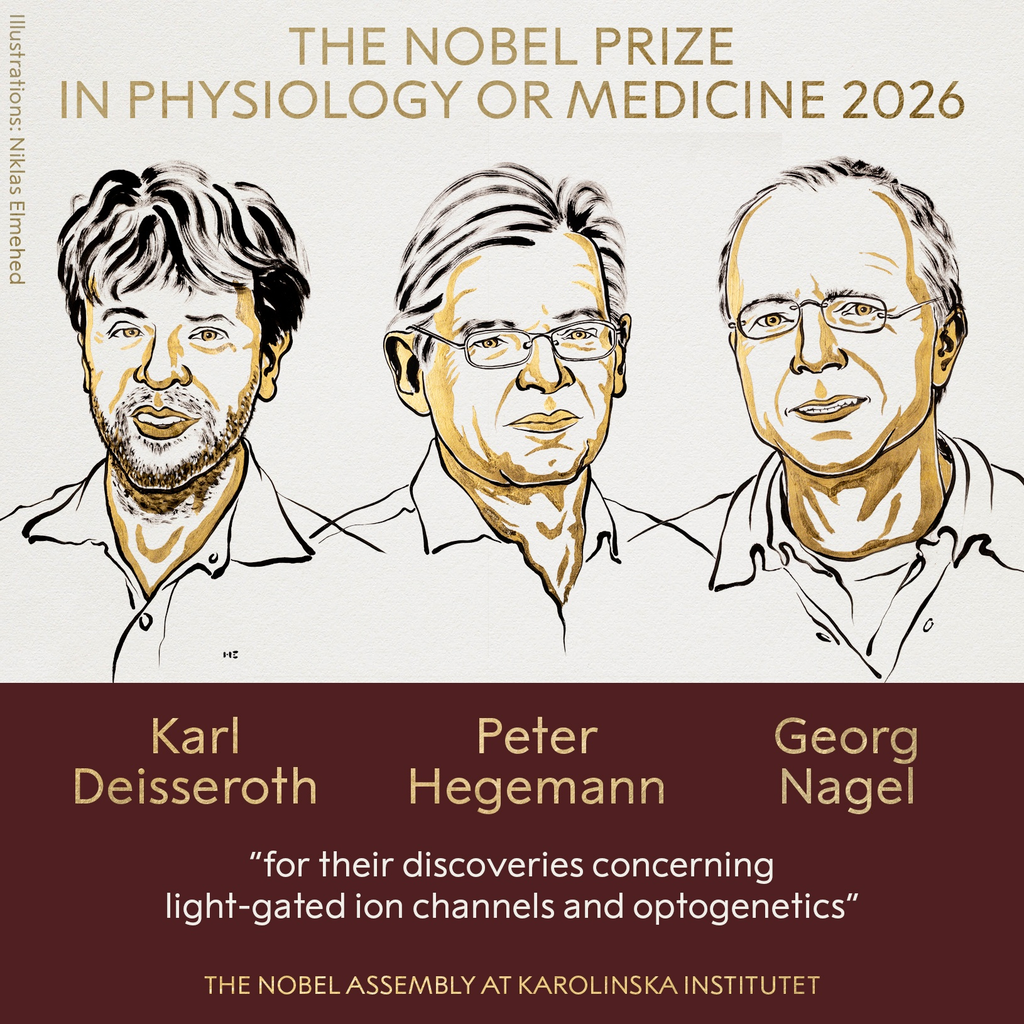
The 2026 Nobel Prize in Physiology or Medicine has been awarded jointly to Karl Deisseroth, Peter Hegemann, and Georg Nagel by the Nobel Assembly at Karolinska Institutet for their discoveries concerning light-gated ion channels and optogenetics- a revolutionary bioengineering technique that enables scientists to control selected nerve cells using light.
| UPSC Relevance: GS-3 Science and Technology: Biology and Biotechnology Prelims: Optogenetics, Nobel Prize in Medicine, Microbial opsins, Viral vectors (AAV) |
What is Optogenetics?
- Optogenetics combines genetic engineering and optical technologies (light) to activate or inhibit selected cells (particularly neurons) with millisecond precision.
- Scientists introduce genes encoding light-sensitive proteins called opsins into target cells. Illumination with a suitable wavelength of light then changes these cells’ electrical activity (switching their electrical activity ON or OFF).
This enables researchers to examine how specific neural circuits influence complex functions like movement, memory and behaviour.
Scientific Basis: Light-Gated Ion Channels:
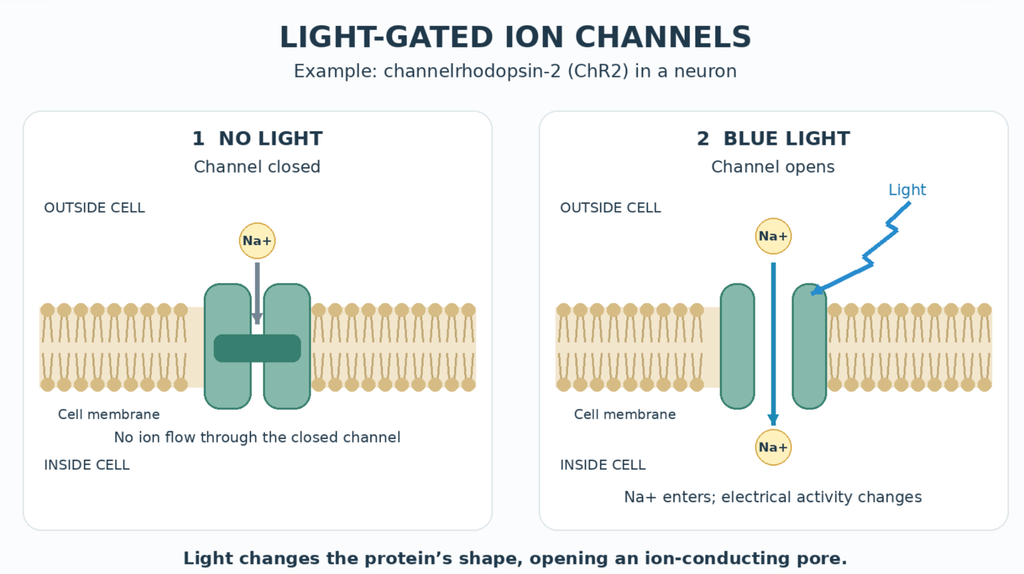
- Light-gated ion channels are specialised proteins embedded in cell membranes that act as gates for charged particles (sodium, potassium, calcium, or chloride ions). When a particular wavelength of light hits the protein, it changes shape and opens. Charged particles (ions) can then flow through the channel.
- Channelrhodopsins: These proteins were discovered in the green microalga Chlamydomonas reinhardtii, and serve as the foundation of optogenetics. Channelrhodopsin-2 allows positively charged ions (Na⁺ and Ca²⁺) to enter a cell when illuminated, helping trigger a nerve impulse (firing the neuron).
| Contributions of the Laureates: Peter Hegemann: Investigated how Chlamydomonas senses light and proposed that its light-sensitive protein could itself function as an ion channel. Georg Nagel: Working with Hegemann, demonstrated the function of channelrhodopsin-1 and channelrhodopsin-2. Karl Deisseroth: His team demonstrated light-driven activation of mammalian neurons in 2005, subsequently extending the technique to specific neurons in living animals. |
Controlling Neurons with Light: How does it work?
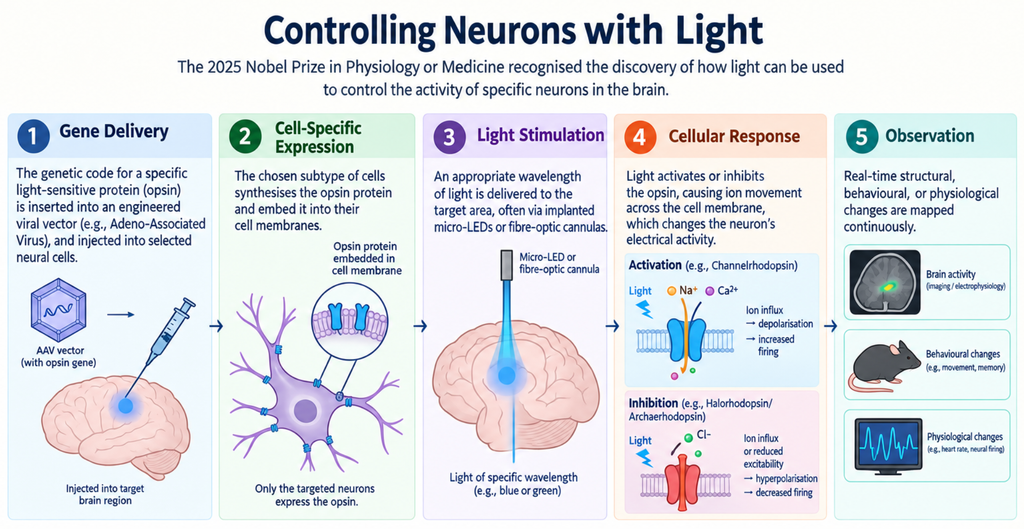
- Gene Delivery: The genetic code for a specific light-sensitive protein (opsin) is inserted into an engineered viral vector (e.g., Adeno-Associated Virus) and injected into selected neural cells.
- Cell-Specific Expression: The chosen subtype of cells synthesises the opsin protein and embeds it into their cell membranes.
- Light Stimulation: An appropriate wavelength of light is delivered to the target area, often via implanted micro-LEDs or fibre-optic cannulas.
- Cellular response: Ion movement changes electrical activity, enabling activation or inhibition depending on the protein used.
- Observation: Real-time structural, behavioural, or physiological changes are mapped continuously.
Why is it a Breakthrough?
- Traditional methods (like functional MRI or pharmacology) either just observe active regions or affect the whole brain. Optogenetics isolates a single circuit to prove if it directly causes a specific behaviour or symptom.
- It successfully differentiates between diverse neural cell types even when they are tightly intermingled in the same brain structure.
Major Applications:
- Understanding Brain Circuits: Identifying networks involved in pain, sleep, reward, attention, memory and social behaviour.
- Disease Research (Neuropsychiatric and movement disorders): Studying abnormal circuits associated with Parkinson’s disease, depression, schizophrenia and other neurological or psychiatric conditions; helping identify potential treatment targets.
- Sensory Restoration (Clinical Milestones):
- Vision: Early clinical trials demonstrated partial recovery of visual function in a patient with retinitis pigmentosa, using optogenetic gene therapy and specialised light-amplifying goggles.
- Hearing: Development of experimental optical cochlear implants that use light instead of electricity to stimulate auditory neurons.
Limitations and Ethical Concerns:
- Invasive Infrastructure: Effective deep-brain delivery requires structural gene therapy and the surgical implantation of hardware like fibre-optic cables.
- Biosafety risks: Potential long-term cellular toxicity, insertional mutagenesis from viral vectors, immunogenic reactions to foreign algal proteins, and localised tissue heating.
- Clinical translation: Results in animal models do not automatically translate into safe, effective human treatments.
- Ethics: Human applications require informed consent, protection of autonomy and safeguards against misuse.
The therapeutic promise of Optogenetics requires rigorous clinical validation and responsible oversight.
Practice Prelims MCQ:
Q. Consider the following statements regarding optogenetics:
- It uses genetically introduced light-sensitive proteins called opsins to control the electrical activity of specific cells.
- Adeno-associated virus (AAV) can be used as a vector to deliver the genetic code for an opsin to selected neural cells.
- Stimulation of neurons with light always results in their activation, irrespective of the type of opsin expressed.
- Optogenetics can enable precise and reversible manipulation of neural circuits and help study their role in behaviour and physiological processes.
Which of the statements given above are correct?
(a) 1, 2 and 4 only
(b) 1 and 3 only
(c) 2, 3 and 4 only
(d) 1, 2, 3 and 4
Answer: (a) 1, 2 and 4 only
Explanation: Optogenetics combines genetic engineering and light stimulation to control specific cells. Opsins are light-sensitive membrane proteins; AAV vectors can deliver the relevant genes to targeted neurons. Depending on the opsin, light can activate or inhibit neuronal activity. For example, channelrhodopsins generally depolarise neurons, whereas inhibitory opsins such as halorhodopsins can suppress neuronal firing. Thus, Statement 3 is incorrect.