Nobel Prize in Physics 2026
Why in News?
Francis Halzen, a Belgian-born physicist at the University of Wisconsin-Madison, has been awarded the 2026 Nobel Prize in Physics for his decisive contributions to the IceCube Neutrino Observatory and the discovery of high-energy neutrinos of astrophysical origin. His work helped establish neutrinos as messengers for studying some of the universe’s most energetic phenomena.
| UPSC Relevance: GS-3 Science and Technology: Nobel Prize in Physics Prelims: Nobel Prize in Physics, Neutrino, IceCube Neutrino Observatory |
What are Neutrinos?
- Neutrinos are fundamental subatomic particles belonging to the Lepton family (fermions).
- Charge: Neutral (no electric charge); hence, they are not deflected by magnetic or electric fields.
- Mass: Extremely small, but non-zero (proven by neutrino oscillation). They are much lighter than electrons.
- They are called Ghost Particles, as:
- They interact extremely weakly with matter. Billions of neutrinos pass through every square centimetre of the Earth (and our bodies) every second without colliding with a single atom.
- Detection requires massive underground detectors (e.g., IceCube in Antarctica, or India’s upcoming INO – India-based Neutrino Observatory).
- Major Sources of Neutrinos:
- Natural Sources:
- Nuclear fusion reactions inside the Sun and stars.
- Core-collapse Supernovae
- Cosmic rays interacting with Earth’s atmosphere (atmospheric neutrinos).
- Big Bang relics (Cosmic Neutrino Background).
- Artificial Sources:
- Nuclear fission power reactors.
- Particle accelerators.
- Natural Sources:
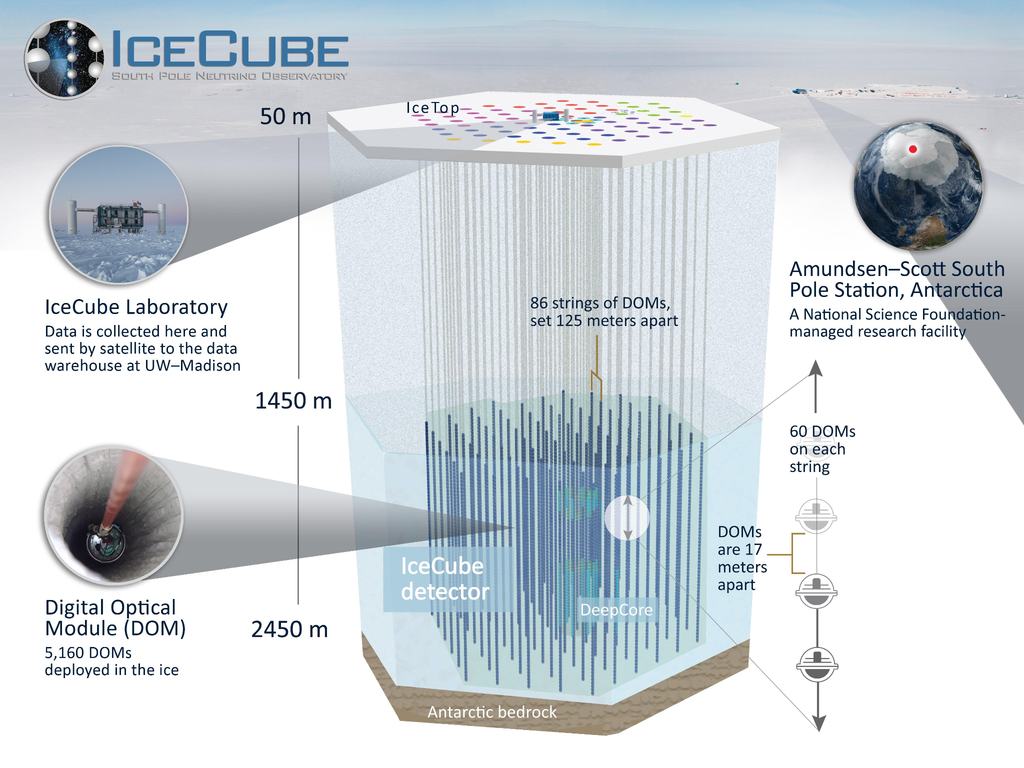
IceCube Neutrino Observatory:
- Location: Deployed at the Amundsen-Scott South Pole Station in Antarctica.
- Scale: It is the world’s premier cubic-kilometre-scale neutrino telescope.
- Architecture: Consists of 5,160 Digital Optical Modules (DOMs) suspended along 86 vertical strings dropped into deep boreholes.
- Depth: Positioned between 1.45 km and 2.45 km beneath the surface. At this depth, the extreme pressure makes the ice exceptionally clear and free of air bubbles.
- Timeline: Construction was completed in 2010.
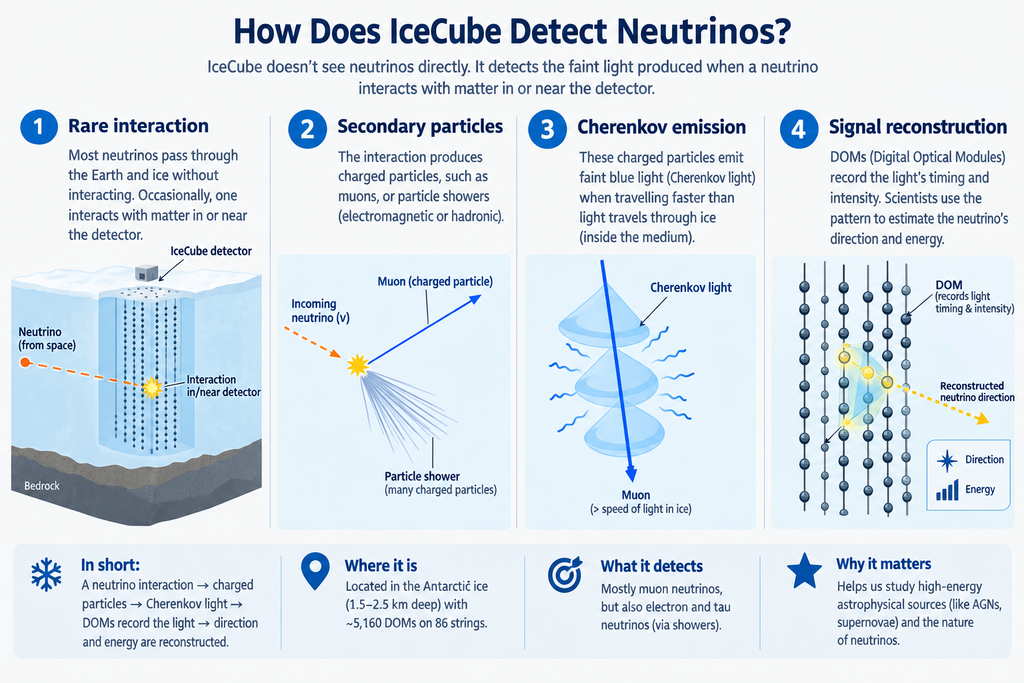
How does IceCube detect Neutrinos?
- Rare interaction: Most neutrinos pass through the ice unnoticed. Occasionally, one high-energy neutrino collides with an atom in the ice.
- Secondary particles: This interaction (collision) produces secondary charged particles (like muons).
- Cherenkov emission: As these charged particles (muons) travel faster than the speed of light in the ice, they emit a faint light (Cherenkov radiation).
- Signal reconstruction: The DOMs record the light’s timing and intensity. Scientists use the pattern to estimate the neutrino’s direction and energy.
Note: The charged particle exceeds light’s speed in the medium, not light’s speed in a vacuum. Thus, Cherenkov radiation does not violate relativity. The light is emitted by the secondary charged particles, not directly by the neutrino.
Why Antarctica? The deep Antarctic ice sheets provide an abundant, ultra-pure, and optically transparent medium that acts both as the target material and the shield against surface background radiation.
Objective of IceCube Neutrino Observatory & Discoveries:
- High-Energy Cosmic Messengers: Detects high-energy astrophysical neutrinos originating from violent cosmic events (e.g., blazars, active galactic nuclei, and gamma-ray bursts).
- Locating cosmic accelerators: Charged cosmic rays are deflected by magnetic fields. Electrically neutral neutrinos can preserve information about their source direction. Thus, unlike photons (light), high-energy neutrinos can travel from the edge of the observable universe unhindered by dust, gas, or magnetic fields, and give a clear picture of cosmic accelerators like black holes and active galactic nuclei.
- Dark Matter Search: Looks for indirect signatures of dark matter, such as neutrinos produced by dark matter annihilation in the Sun or the galactic centre.
- Exploring physics beyond the Standard Model: Neutrino masses, their ordering, and differences between neutrino and antineutrino behaviour remain major research questions. Their study may help explain how neutrinos acquire mass.
Key Milestone: In 2018, IceCube traced a high-energy neutrino back to a blazar (TXS 0506+056), a giant elliptical galaxy with a spinning black hole at its core, marking a breakthrough in multi-messenger physics.
Thus, IceCube demonstrates how fundamental research can create new ways of observing the universe.
Prelims Practice MCQ:
Q. With reference to neutrino detection, consider the following statements:
- IceCube detects light emitted by secondary charged particles produced in neutrino interactions.
- Cherenkov radiation requires particles to travel faster than light in a vacuum.
- Neutrino oscillations provide evidence that neutrinos have mass.
Which of the statements given above are correct?
(a) 1 and 2 only
(b) 1 and 3 only
(c) 2 and 3 only
(d) 1, 2 and 3
Answer: (b)