Non-Tariff Barriers: The New Frontier of India’s Trade Strategy
Why in News?
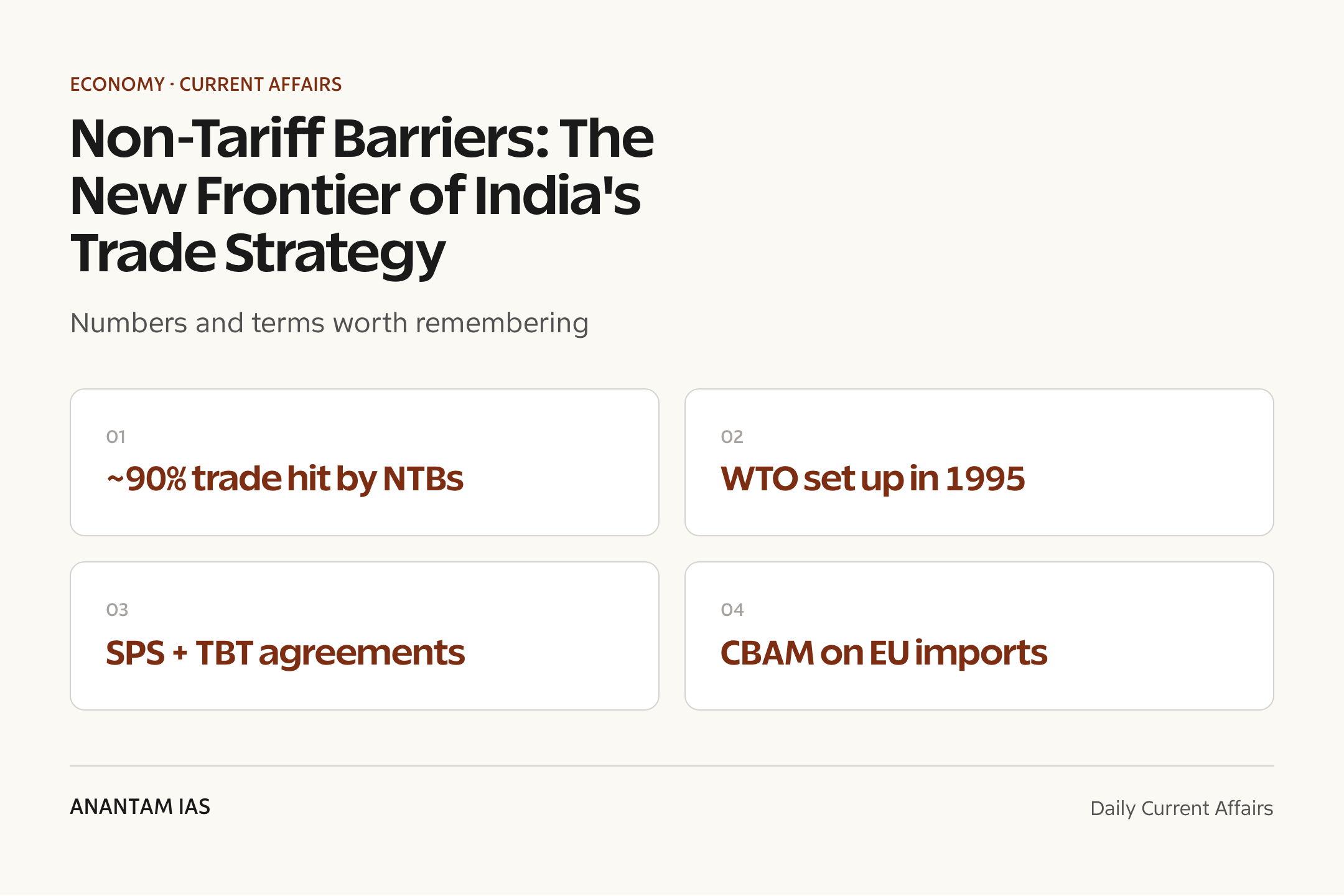
A June 2026 editorial in The Hindu argued that as conventional tariffs fall across the world, non-tariff barriers (NTBs) have become the decisive force shaping market access, with the editorial noting that such measures now affect close to 90% of global trade even as thousands of new regulatory requirements appear every year.
The piece framed regulatory cooperation and mutual-recognition agreements (MRAs) embedded in recent free-trade agreements as India’s forward-looking lever, pointing to provisions in the India-UAE CEPA and the India-EFTA TEPA as templates for handling the standards-and-conformity frontier rather than the older tariff-cutting playbook.
- Editorial argues tariffs are no longer the main barrier; regulatory governance is.
- Cites the claim that NTBs touch nearly 90% of global trade (attributed to the editorial).
- Flags new instruments like the EU’s Carbon Border Adjustment Mechanism (CBAM) and Deforestation Regulation.
- Positions MRAs and conformity-assessment cooperation in FTAs as India’s strategic response.
The development matters in the context of:
- Since the WTO was established in 1995, average global tariff rates have fallen sharply, shifting the trade battleground to standards and regulation.
- India’s FTA utilisation rate remains notably lower than that of developed economies despite deals with ASEAN, Japan and South Korea.
UPSC Relevance
Prelims Relevance
- NTB vs NTM: non-tariff barrier vs the broader, neutral term non-tariff measure (NTM).
- SPS Agreement: WTO pact on food safety and animal/plant health, must be science-based.
- TBT Agreement: WTO pact on technical regulations, standards and conformity assessment.
- CBAM: EU carbon levy on imports based on embedded emissions.
- MRA: mutual-recognition of standards/test results between trading partners.
- Rules of origin: criteria deciding a product’s economic nationality for FTA tariff benefits.
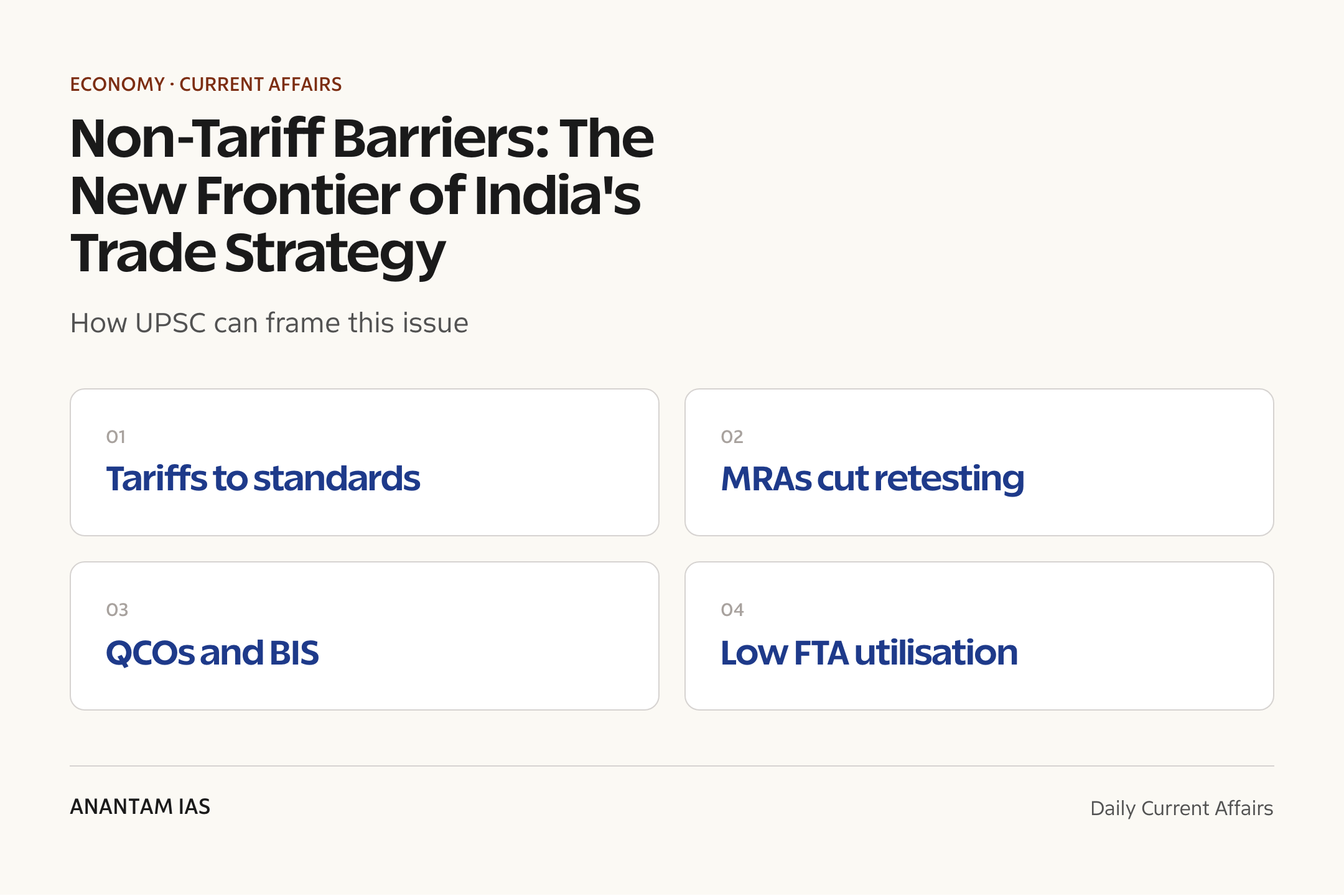
- QCOs and BIS: India’s quality control orders and the national standards body.
- India-UAE CEPA and India-EFTA TEPA carry regulatory-cooperation clauses.
Mains Relevance
GS Paper 3
- Effect of non-tariff barriers on India’s export competitiveness and integration into global value chains.
- Role of standards, conformity assessment and quality infrastructure in trade strategy.
GS Paper 2
- Economic diplomacy through FTAs: leveraging MRAs and regulatory cooperation for market access.
Essay
- Walls without tariffs: how rules, standards and carbon borders are redrawing globalisation.
Background and Context
What Non-Tariff Barriers Are
Barriers other than customs duties that restrict or distort trade.
- Non-tariff barrier (NTB): any measure other than an ordinary tariff that limits imports or exports.
- Non-tariff measure (NTM): the neutral umbrella term; an NTM becomes an NTB when it acts as disguised protection.
- Common forms: technical standards, health and safety rules, environmental requirements, certification, packaging and labelling norms, and licensing procedures.
- Quantitative tools include quotas, import licensing and tariff-rate quotas.
The WTO Rulebook: SPS and TBT
Two agreements try to separate genuine safeguards from hidden protectionism.
- SPS Agreement (Sanitary and Phytosanitary Measures): covers food safety and animal and plant health; measures must be science-based and applied only as far as needed.
- TBT Agreement (Technical Barriers to Trade): covers technical regulations, voluntary standards and conformity assessment across the wider product landscape.
- Both encourage use of international standards and demand transparency so rules do not become unnecessary trade obstacles.
- The World Trade Organization, set up in 1995, anchors this discipline as tariffs lose centrality.
The New Generation of Barriers
Climate and technology rules are reshaping access to large markets.
- CBAM (Carbon Border Adjustment Mechanism): the EU’s levy on carbon embedded in imports like steel, aluminium and cement.
- The EU Deforestation Regulation conditions market entry on traceable, deforestation-free supply chains.
- Export controls on semiconductors and advanced computing add a strategic-technology layer of restriction.
- These measures hit emerging exporters hardest, since compliance and certification costs are steep.
How NTBs Hurt Indian Exporters
Compliance friction, not duties, is the binding constraint.
- Divergent standards force repeated, costly testing and certification in each destination market.
- Small exporters lack the quality infrastructure to meet stringent SPS and TBT norms.
- India’s FTA utilisation rate stays well below that of advanced economies, blunting the gains from signed deals.
- Rules of origin paperwork can erode the value of preferential tariffs if firms cannot comply.
MRAs and Regulatory Cooperation in India's FTAs
Recent deals shift the focus from duty cuts to mutual recognition.
- Mutual-recognition agreements (MRAs): partners accept each other’s standards, test results or certifications, cutting duplicate compliance.
- The India-UAE CEPA carries mutual recognition of standards and acceptance of international testing.
- The India-EFTA TEPA includes streamlined conformity assessment and legally binding commitments on regulatory cooperation.
- Conformity assessment: the process of checking that a product meets a standard; recognising it across borders removes a major NTB.
India's Domestic Toolkit
Standards are both a shield and, if overused, a self-imposed barrier.
- Quality Control Orders (QCOs) mandate compliance with specified standards for listed goods, raising the quality floor.
- The Bureau of Indian Standards (BIS) sets and certifies national standards under the BIS Act.
- QCOs protect consumers and curb sub-standard imports, but poorly designed orders can raise input costs for domestic manufacturers.
- Aligning Indian standards with international benchmarks eases two-way recognition.
Way Forward
Build national quality infrastructure
- Expand accredited testing labs and certification capacity so exporters meet SPS/TBT norms at home.
- Support MSMEs with shared compliance facilities and certification subsidies.
Negotiate smarter FTAs
- Make MRAs and regulatory-cooperation chapters standard features of new trade deals.
- Push partners toward acceptance of Indian conformity-assessment results.
Align standards internationally
- Harmonise QCOs with global benchmarks to enable mutual recognition without lowering safety.
- Engage actively in WTO SPS and TBT committees to flag unjustified barriers.
Prepare for green and tech barriers
- Develop carbon-accounting and traceability systems ahead of CBAM and deforestation rules.
- Raise FTA utilisation through exporter awareness and simpler rules-of-origin procedures.
Conclusion
The centre of gravity in trade policy has moved from the customs counter to the standards lab. With duties already low, market access now turns on whether a product clears another country’s safety, technical and environmental rules, which is why the editorial frames non-tariff barriers as the real frontier.
India’s path is twofold: build credible domestic quality infrastructure and bake mutual recognition and regulatory cooperation into every new FTA. Done well, standards become a passport rather than a wall, letting Indian exporters convert signed agreements into actual trade.
UPSC Practice Questions
Prelims MCQ 1
With reference to non-tariff barriers in international trade, consider the following statements:
- The WTO Agreement on Sanitary and Phytosanitary Measures deals mainly with food safety and animal and plant health.
- The Technical Barriers to Trade Agreement covers technical regulations, standards and conformity assessment.
- A mutual-recognition agreement requires both partners to adopt an identical single tariff schedule.
How many of the above statements are correct?
(a) Only one (b) Only two (c) All three (d) None
Answer: (b) Only two
Explanation:
SPS (food safety, plant/animal health) and TBT (technical regulations and conformity assessment) statements are correct. MRAs are about recognising each other’s standards/test results, not about a common tariff schedule, so statement 3 is wrong.
Prelims MCQ 2
The Carbon Border Adjustment Mechanism (CBAM), frequently discussed as a non-tariff barrier, is best described as:
(a) A WTO subsidy permitted for clean-energy exports (b) An EU levy on the carbon embedded in certain imported goods (c) An Indian quality control order issued by BIS (d) A rules-of-origin protocol under the India-UAE CEPA
Answer: (b) An EU levy on the carbon embedded in certain imported goods
Explanation:
CBAM is the European Union’s mechanism that prices the carbon embedded in imports such as steel, aluminium and cement, acting as a climate-linked non-tariff barrier.
UPSC Mains Questions
- As tariffs decline globally, non-tariff barriers have become the decisive determinant of market access. Examine their impact on India’s export competitiveness and suggest a strategy to address them.
- Mutual-recognition agreements and regulatory cooperation are emerging as the core of new-generation free-trade agreements. Discuss with reference to India’s recent trade deals.
Source: The Hindu (editorial).
Frequently Asked Questions
What is the difference between a non-tariff barrier and a non-tariff measure?
A non-tariff measure (NTM) is any policy other than a tariff that affects trade, such as a standard or licensing rule. It becomes a non-tariff barrier (NTB) when it acts as disguised protection or unjustifiably restricts trade. NTM is the neutral term; NTB carries the negative, trade-distorting sense.
What do the WTO SPS and TBT agreements cover?
The SPS Agreement governs food safety and animal and plant health measures, requiring them to be science-based. The TBT Agreement covers technical regulations, voluntary standards and conformity assessment for the broader range of products. Both aim to allow genuine safeguards while preventing rules from becoming hidden trade barriers.
What is CBAM and why does it worry Indian exporters?
The Carbon Border Adjustment Mechanism is the European Union’s levy on carbon embedded in imports such as steel, aluminium and cement. It raises costs for emission-intensive Indian exports and demands detailed carbon accounting, making it a significant climate-linked non-tariff barrier for India to prepare for.
What is a mutual-recognition agreement (MRA)?
An MRA is an arrangement where two trading partners accept each other’s standards, testing or certifications. It removes duplicate compliance, so a product certified in one country need not be re-tested in the other. India’s recent deals with the UAE and EFTA include such regulatory-cooperation provisions.
What are Quality Control Orders and the role of BIS?
Quality Control Orders (QCOs) make compliance with specified standards mandatory for listed goods, curbing sub-standard imports and protecting consumers. The Bureau of Indian Standards (BIS) sets and certifies these national standards. If poorly designed, QCOs can also raise input costs, so alignment with international benchmarks matters.
Why is India’s FTA utilisation rate important here?
A low FTA utilisation rate means exporters are not fully using the preferential access their trade deals offer, often because of compliance burdens, rules-of-origin paperwork and unfamiliarity. Raising utilisation, alongside mutual recognition and better quality infrastructure, is key to turning signed agreements into real export gains.