North Korea’s Kang Kon Destroyer: Naval Signalling and Freedom Edge
Why in News?
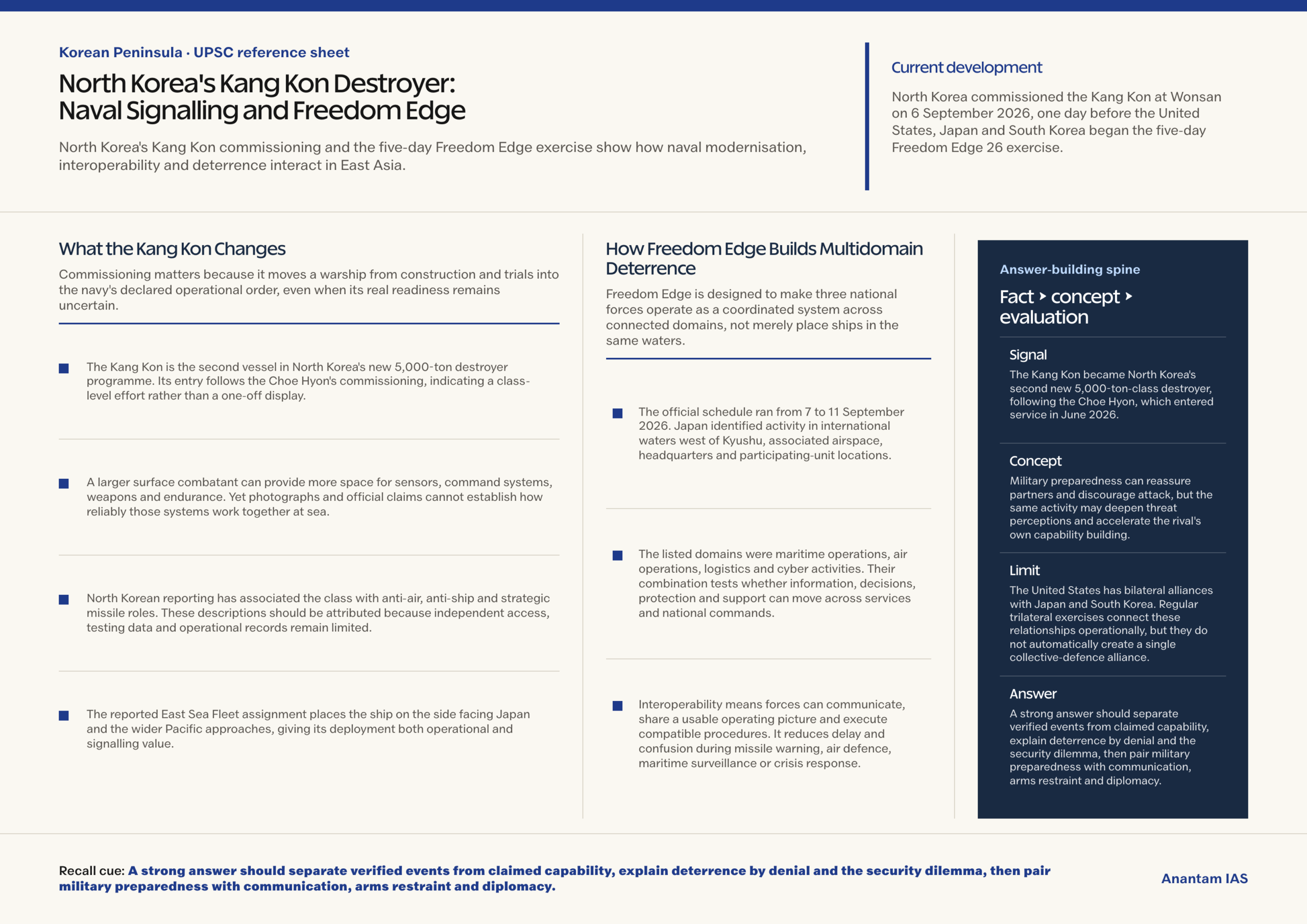
North Korea commissioned the Kang Kon at Wonsan on 6 September 2026, one day before the United States, Japan and South Korea began the five-day Freedom Edge 26 exercise.
- The Kang Kon became North Korea’s second new 5,000-ton-class destroyer, following the Choe Hyon, which entered service in June 2026.
- North Korean state media assigned it to the East Sea Fleet and presented the commissioning as part of a wider naval-modernisation drive.
- Claims about a nuclear deterrent role or nuclear-capable missile carriage come from state reporting and external assessments; they are not independently verified technical specifications.
- The official Japanese notice scheduled Freedom Edge 26 from 7 to 11 September and listed maritime, air, logistics and cyber activities.
- Japan described it as the fourth Freedom Edge iteration since the trilateral multidomain series began in 2024.
- The paired developments show an action-reaction cycle: North Korea seeks greater sea-based military options while the three partners improve detection, defence and coordinated response.
- For Mains, distinguish deterrence, which seeks to alter an adversary’s calculation, from war-fighting, arms-racing and diplomatic crisis management.
- The correct analytical frame is a security dilemma: measures one side calls defensive may appear threatening to the other and stimulate further military preparation.
UPSC Relevance
Prelims Relevance
- The Kang Kon was commissioned at Wonsan and assigned by North Korean state media to the East Sea Fleet.
- A ship’s commissioning marks formal entry into naval service; it is different from launch, fitting-out, trials or first public display.
- Freedom Edge is a trilateral exercise involving Japan, the Republic of Korea and the United States.
- The exercise is multidomain: Freedom Edge 26 officially included maritime, air, logistics and cyber activities.
- Freedom Edge was first conducted in 2024; the September 2026 edition was officially described as its fourth iteration.
- Japan and South Korea are separate United States treaty allies; Freedom Edge does not itself create a NATO-style trilateral collective-defence treaty.
Mains Relevance
GS Paper 2
- Effect of policies and politics of developed and developing countries on India’s interests; regional groupings and agreements involving India or affecting India’s interests.
- Assess the emerging Japan-South Korea-United States security coordination and its consequences for stability on the Korean Peninsula.
GS Paper 3
- Security challenges and their management in border areas; linkages of organized military capability, technology and strategic deterrence.
- Explain how multidomain interoperability links sensors, platforms, logistics and cyber resilience to deterrence by denial.
Essay
- Deterrence may prevent immediate conflict, but lasting security also requires communication, restraint and institutions that stop defensive preparations from becoming an uncontrolled arms race.
Background and Context
What the Kang Kon Changes
Commissioning matters because it moves a warship from construction and trials into the navy’s declared operational order, even when its real readiness remains uncertain.
- The Kang Kon is the second vessel in North Korea’s new 5,000-ton destroyer programme. Its entry follows the Choe Hyon’s commissioning, indicating a class-level effort rather than a one-off display.
- A larger surface combatant can provide more space for sensors, command systems, weapons and endurance. Yet photographs and official claims cannot establish how reliably those systems work together at sea.
- North Korean reporting has associated the class with anti-air, anti-ship and strategic missile roles. These descriptions should be attributed because independent access, testing data and operational records remain limited.
- The reported East Sea Fleet assignment places the ship on the side facing Japan and the wider Pacific approaches, giving its deployment both operational and signalling value.
- Naval modernisation broadens deterrence beyond land-based missiles by creating mobile maritime platforms. Mobility can complicate surveillance, but survivability depends on training, maintenance, escorts, sensors and secure communications.
How Freedom Edge Builds Multidomain Deterrence
Freedom Edge is designed to make three national forces operate as a coordinated system across connected domains, not merely place ships in the same waters.
- The official schedule ran from 7 to 11 September 2026. Japan identified activity in international waters west of Kyushu, associated airspace, headquarters and participating-unit locations.
- The listed domains were maritime operations, air operations, logistics and cyber activities. Their combination tests whether information, decisions, protection and support can move across services and national commands.
- Interoperability means forces can communicate, share a usable operating picture and execute compatible procedures. It reduces delay and confusion during missile warning, air defence, maritime surveillance or crisis response.
- This supports deterrence by denial: an adversary may reconsider an attack if detection, interception, force protection and recovery appear credible enough to prevent the expected military gain.
- Logistics and cyber elements are not decorative. Sustained operations require fuel, repair and supply, while resilient networks must continue carrying trusted data despite disruption, intrusion or electronic pressure.
The Security Dilemma and Its Limits
Military preparedness can reassure partners and discourage attack, but the same activity may deepen threat perceptions and accelerate the rival’s own capability building.
- The United States has bilateral alliances with Japan and South Korea. Regular trilateral exercises connect these relationships operationally, but they do not automatically create a single collective-defence alliance.
- For the three participants, Freedom Edge improves readiness and signalling. For North Korea, the exercise can be portrayed as encirclement, reinforcing domestic arguments for additional missiles, ships and nuclear forces.
- This action-reaction pattern is the security dilemma: defensive steps by one side can reduce the other’s sense of security even when neither side says it seeks immediate war.
- Deterrence also carries risks of misperception, compressed decision time and escalation. More platforms and faster data-sharing help defence, but a false warning or ambiguous manoeuvre can become harder to contain.
- For India, instability matters through Indo-Pacific sea lanes, non-proliferation norms and major-power relations. A balanced answer should support peace and denuclearisation without overstating India’s direct operational role.
Way Forward
Pair Readiness With Risk Reduction
Credible defence and diplomatic guardrails must develop together if deterrence is to prevent conflict rather than merely postpone a sharper crisis.
- Maintain military hotlines, exercise notifications and incident-at-sea procedures so commanders can clarify unexpected movements before political leaders face pressure to escalate.
- Use phased diplomacy to seek verifiable restraints on testing, deployment and fissile-material production, matched by reciprocal steps rather than unsupported declarations of final denuclearisation.
- Keep trilateral exercises defensive, transparent and proportionate, while preserving the readiness needed to respond to missile, air, maritime and cyber threats.
- Strengthen enforcement of United Nations sanctions alongside humanitarian safeguards, and judge every capability claim through attributed evidence instead of accepting propaganda or speculation as specification.
Conclusion
- The Kang Kon and Freedom Edge capture a regional capability-response cycle: maritime modernisation seeks new options, while multidomain interoperability seeks to detect, withstand and deny their effective use.
- A strong answer should separate verified events from claimed capability, explain deterrence by denial and the security dilemma, then pair military preparedness with communication, arms restraint and diplomacy.
UPSC Practice Questions
Prelims MCQ 1
With reference to the Kang Kon and Freedom Edge 26, consider the following statements:
- The Kang Kon was commissioned into North Korea’s East Sea Fleet according to North Korean state reporting.
- Freedom Edge 26 included maritime, air, logistics and cyber activities.
- Freedom Edge constitutes a NATO-style collective-defence treaty among Japan, South Korea and the United States.
How many of the above statements are correct?
(a) Only one (b) Only two (c) All three (d) None
Answer: (b) Only two
Explanation:
Statements 1 and 2 are correct. Freedom Edge is a trilateral exercise; it does not itself create a collective-defence treaty among the three participants.
Prelims MCQ 2
In strategic studies, ‘deterrence by denial’ is best understood as:
(a) Threatening punishment after every hostile statement (b) Preventing all diplomatic contact with an adversary (c) Convincing an adversary that an attack is unlikely to achieve its intended gains (d) Eliminating the need for surveillance and defensive systems
Answer: (c) Convincing an adversary that an attack is unlikely to achieve its intended gains
Explanation:
Deterrence by denial changes the attacker’s calculation by making successful detection, penetration or military gain appear unlikely, rather than relying only on threatened retaliation.
UPSC Mains Questions
- North Korea’s naval modernisation and the Freedom Edge exercise illustrate both deterrence by denial and the security dilemma. Discuss their implications for stability on the Korean Peninsula.
- Trilateral military interoperability can strengthen crisis response without creating a formal trilateral alliance. Critically examine with reference to Japan, South Korea and the United States.
Sources: The Hindu and Japan Joint Staff.
Frequently Asked Questions
What is the Kang Kon?
The Kang Kon is North Korea’s second new 5,000-ton-class destroyer. It was commissioned at Wonsan on 6 September 2026 and assigned to the East Sea Fleet according to state reporting.
What does nuclear-capable mean in reports about the Kang Kon?
It refers to attributed claims about the ship’s possible missile or deterrent role. It does not establish nuclear propulsion, and independent technical verification of the reported weapons remains limited.
What is Freedom Edge?
Freedom Edge is a Japan-South Korea-United States trilateral exercise first conducted in 2024. Its September 2026 iteration officially covered maritime, air, logistics and cyber activities.
What does multidomain interoperability mean?
It is the ability of different services and national forces to communicate, share usable information and coordinate operations across domains such as sea, air, logistics and cyber.
Why can deterrence create a security dilemma?
One side’s defensive preparation may look offensive to another. The rival then expands its forces, making both sides feel less secure despite their stated aim of preventing attack.