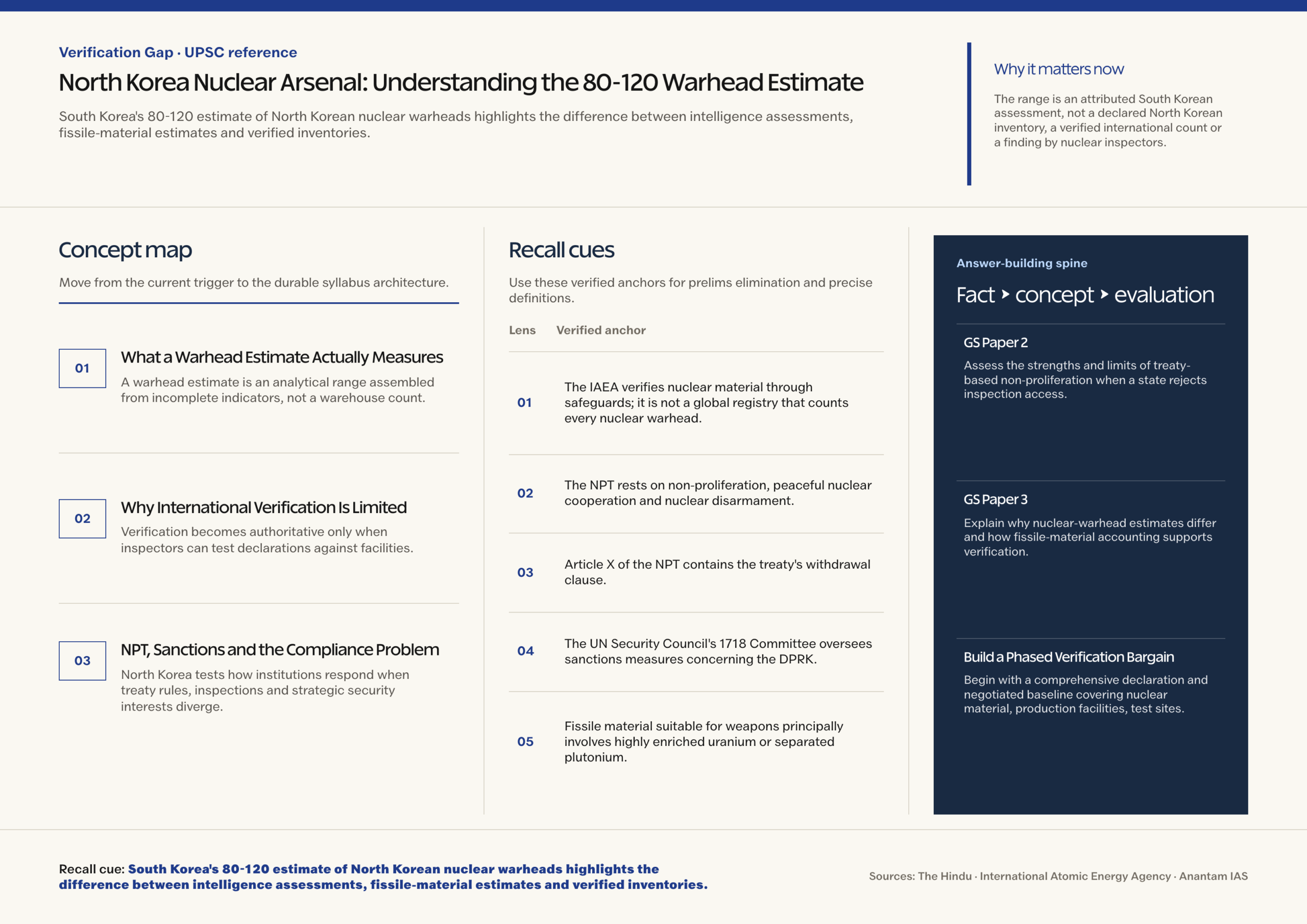
North Korea Nuclear Arsenal: Understanding the 80-120 Warhead Estimate
Why in News?
South Korea’s defence minister told lawmakers that North Korea was generally estimated to possess 80-120 nuclear warheads, while stressing that the exact figure was difficult to determine.
- The range is an attributed South Korean assessment, not a declared North Korean inventory, a verified international count or a finding by nuclear inspectors.
- The breadth of the range signals intelligence uncertainty about fissile-material stocks, weapon designs, assembly rates and how many devices are operationally deployable.
- The IAEA does not publish a warhead count for North Korea; its mandate centres on nuclear-material safeguards and verification under applicable agreements.
- The estimate matters because arsenal size influences deterrence calculations, missile-defence planning, crisis stability and the scope of any future disarmament bargain.
- A larger presumed arsenal can support multiple missions, including retaliation and battlefield coercion, but an estimated stockpile does not by itself reveal readiness or reliability.
- Verification is unusually weak because inspectors lack access, while public assessments must combine remote observation, production indicators, tests and intelligence with substantial analytic assumptions.
- For India, the issue connects Asian security, nuclear non-proliferation, missile technology, sanctions enforcement and the risks created by opaque command-and-control systems.
UPSC Relevance
Prelims Relevance
- The IAEA verifies nuclear material through safeguards; it is not a global registry that counts every nuclear warhead.
- The NPT rests on non-proliferation, peaceful nuclear cooperation and nuclear disarmament.
- Article X of the NPT contains the treaty’s withdrawal clause.
- The UN Security Council’s 1718 Committee oversees sanctions measures concerning the DPRK.
- Fissile material suitable for weapons principally involves highly enriched uranium or separated plutonium.
Mains Relevance
GS Paper 2
- Assess the strengths and limits of treaty-based non-proliferation when a state rejects inspection access.
- Examine how sanctions, diplomacy and security guarantees interact in negotiations over the Korean Peninsula.
GS Paper 3
- Explain why nuclear-warhead estimates differ and how fissile-material accounting supports verification.
- Analyse the relationship between arsenal opacity, deterrence, missile defence and crisis instability.
Essay
- Security built on secrecy may strengthen deterrence while simultaneously increasing mistrust and miscalculation.
Background and Context
What a Warhead Estimate Actually Measures
A warhead estimate is an analytical range assembled from incomplete indicators, not a warehouse count.
- Analysts first estimate fissile-material production: separated plutonium from reactors and reprocessing, and highly enriched uranium from centrifuge enrichment facilities.
- They then apply assumptions about material used per device, production losses, test consumption, weapon-design efficiency and material retained outside assembled weapons.
- A device may be assembled yet not miniaturised or integrated with a tested delivery system; stockpile size and deployable capability are different questions.
- Remote imagery can reveal construction, reactor operation indicators or support activity, but it cannot show each hidden component, assembly status or maintenance condition.
- Human intelligence, intercepted signals and test evidence can narrow estimates, but each source has coverage gaps and deception risks; a range is more honest than false precision.
Why International Verification Is Limited
Verification becomes authoritative only when inspectors can test declarations against facilities, records and nuclear material.
- The IAEA reports that it has been unable to conduct all necessary safeguards activities in the DPRK since 1994.
- IAEA inspectors have not been present in the country since April 2009, leaving the Agency dependent on satellite imagery and other available information.
- Without access, inspectors cannot independently confirm facility configurations, operational status, undeclared sites, production records or the correctness and completeness of nuclear-material declarations.
- Safeguards use material accountancy, seals, surveillance, inspections and environmental sampling to detect diversion or undeclared activity; these tools require cooperation and access.
- The IAEA can maintain readiness and report observed indicators, but it cannot convert remote monitoring into a verified warhead inventory.
NPT, Sanctions and the Compliance Problem
North Korea tests how institutions respond when treaty rules, inspections and strategic security interests diverge.
- The Nuclear Non-Proliferation Treaty exchanges non-acquisition commitments and safeguards for peaceful cooperation, alongside a broader obligation to pursue disarmament negotiations.
- Its Article X permits withdrawal after notice when extraordinary events jeopardise supreme national interests; North Korea announced withdrawal, while aspects of that process remain legally debated.
- The UN Security Council’s 1718 regime combines prohibitions, asset freezes and oversight to constrain nuclear and missile-related procurement and financing.
- Sanctions can raise costs and slow access to technology, but they do not themselves establish a verified baseline, dismantle facilities or resolve the security motives behind proliferation.
- A durable settlement must reconcile denuclearisation goals with sequencing, reciprocal steps, regional deterrence concerns and credible verification of declared and undeclared activities.
Way Forward
Build a Phased Verification Bargain
- Begin with a comprehensive declaration and negotiated baseline covering nuclear material, production facilities, test sites, assembled devices and relevant delivery-system interfaces.
- Sequence access, monitoring and disablement with reciprocal sanctions relief, while using predefined snapback provisions for verified non-compliance.
- Combine on-site inspections, environmental sampling, seals and remote monitoring with satellite analysis to test declarations and detect undeclared activity.
- Maintain crisis hotlines, notification arrangements and military risk-reduction measures so deterrence failures do not derail slower arms-control negotiations.
Conclusion
- The 80-120 figure should be used as an uncertain assessment range, never as a verified inventory or an IAEA count.
- A strong answer should separate estimated material and devices from deployable capability, then connect the verification gap to safeguards access, diplomacy and regional stability.
- The central policy challenge is not merely counting weapons; it is creating conditions under which declarations can be independently tested and irreversible steps credibly demonstrated.
UPSC Practice Questions
Prelims MCQ 1
With reference to nuclear safeguards and the Nuclear Non-Proliferation Treaty, consider the following statements:
- IAEA safeguards are designed to verify nuclear-material declarations and detect diversion.
- Article X of the NPT contains a withdrawal provision.
- The IAEA maintains a verified public count of every state’s assembled nuclear warheads.
How many of the above statements are correct?
(a) Only one (b) Only two (c) All three (d) None
Answer: (b) Only two
Explanation:
Statements 1 and 2 are correct. Safeguards verify nuclear material under agreements, while the IAEA does not maintain a verified global inventory of assembled warheads.
Prelims MCQ 2
Which institution oversees the sanctions measures established by UN Security Council resolution 1718 concerning the Democratic People’s Republic of Korea?
(a) UN Security Council 1718 Committee (b) Nuclear Suppliers Group Secretariat (c) IAEA Board of Governors alone (d) UN Peacebuilding Commission
Answer: (a) UN Security Council 1718 Committee
Explanation:
The Security Council’s 1718 Committee oversees the relevant sanctions measures. The IAEA has a distinct safeguards and verification role.
UPSC Mains Questions
- Why do estimates of a state’s nuclear arsenal differ? Explain how fissile-material accounting and inspection access affect confidence in such estimates. (150 words)
- Evaluate the limits of sanctions and treaty mechanisms in addressing North Korea’s nuclear programme. Suggest elements of a credible phased verification arrangement. (250 words)
Sources: The Hindu and International Atomic Energy Agency.
Frequently Asked Questions
Does North Korea definitely possess 80-120 nuclear warheads?
No. The range is an attributed South Korean estimate based on incomplete intelligence. It is not a North Korean declaration, an inspected inventory or an IAEA count.
Why is North Korea’s exact warhead count difficult to determine?
Uncertainty surrounds fissile-material production, hidden facilities, material used per design, assembly rates, test consumption, weapon-design efficiency, operational readiness and the absence of sustained on-site inspections.
What does the IAEA verify in North Korea?
The IAEA’s mandate concerns nuclear-material safeguards and verification. Without inspector access, it monitors available information and maintains readiness, but cannot certify a complete operational warhead inventory.
What is the significance of Article X of the NPT?
Article X permits a party to withdraw after notice when extraordinary events jeopardise its supreme interests. North Korea announced withdrawal, though legal questions about the process persist.
Can sanctions alone eliminate a nuclear programme?
Sanctions can restrict finance, trade and sensitive technology, but dismantlement requires political agreement, a declared baseline, inspector access, technical verification, credible reciprocal sequencing and enforceable compliance mechanisms.