NSE files for IPO: Could it be India’s largest ever?
Why in News?
The National Stock Exchange (NSE), the country’s biggest bourse by trading volume, has filed its draft prospectus with the Securities and Exchange Board of India (SEBI) to launch an Initial Public Offering. As the Indian Express reported, the offering could become one of the largest public issues in the country’s history.
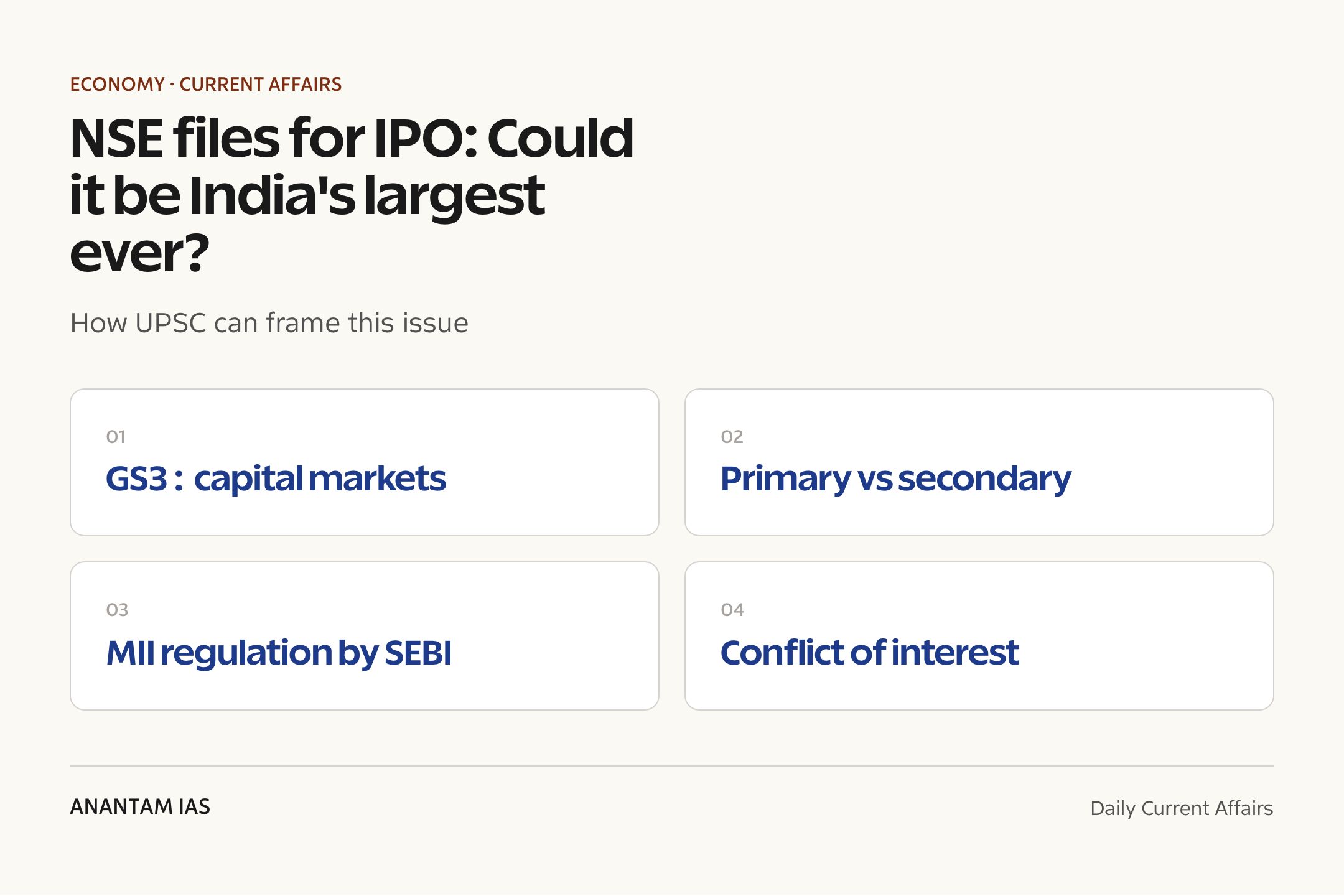
An exchange going public is unusual because NSE is itself a frontline regulator of the very market it wants to list in. The filing reopens long-running questions on self-listing, conflict of interest and how SEBI governs Market Infrastructure Institutions, making it a clean test-case for the capital-markets section of the UPSC GS3 economy syllabus.
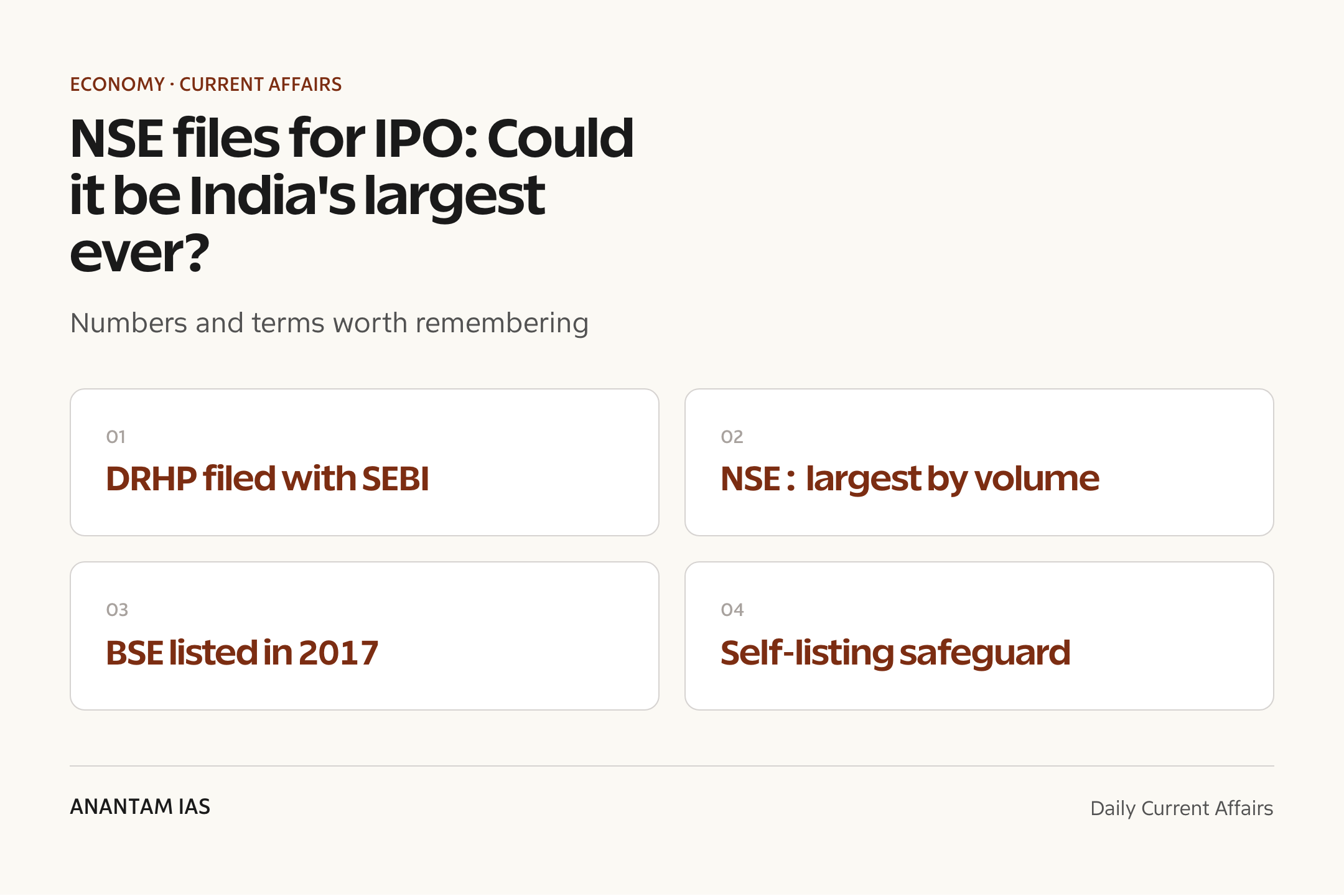
- NSE filed a Draft Red Herring Prospectus (DRHP) with SEBI to take the exchange public.
- The issue is being described as potentially the largest IPO in Indian history, though the exact size is not yet finalised.
- The listing had been stalled for years, partly due to the unresolved co-location case and SEBI clearances.
- Because NSE regulates trading on its own platform, the share sale raises a structural conflict-of-interest and self-listing question.
The development matters in the context of:
- An IPO is a one-time event in the primary market; subsequent buying and selling of those shares happens in the secondary market.
- NSE is classified as a Market Infrastructure Institution (MII) alongside stock exchanges, depositories and clearing corporations.
UPSC Relevance
Prelims Relevance
- IPO — first sale of shares by a company to the public in the primary market.
- DRHP — Draft Red Herring Prospectus, the preliminary offer document filed with SEBI for review.
- Red Herring Prospectus — offer document that omits final price/issue size, used in book-building.
- Book building — price-discovery process where investors bid within a price band.
- Primary vs secondary market — new issuance vs trading of existing securities.
- Market Infrastructure Institution (MII) — exchanges, depositories, clearing corporations.
- SECC Regulations, 2018 — SEBI rules governing ownership and listing of stock exchanges and clearing corporations.
- SEBI — statutory capital-market regulator under the SEBI Act, 1992.
- Depositories — NSDL and CDSL hold securities in dematerialised (demat) form.
- Anchor investor — large institutional investor allotted shares ahead of an IPO opening.
Mains Relevance
GS Paper 3
- Capital markets as a source of long-term financing; role of equity markets in mobilising household savings for investment.
- Regulation of Market Infrastructure Institutions and the governance challenge of a regulator-like entity seeking a public listing.
- Financial inclusion and market deepening through rising demat accounts, retail participation and SIP inflows.
- Conflicts of interest in self-regulatory and market-infrastructure bodies, and how disclosure-based regulation mitigates them.
Essay
- Markets reward trust: how the credibility of institutions underpins economic growth.
Background and Context
What an IPO actually is
Strip away the headline and an IPO is simply a company selling ownership to outside investors for the first time.
- An Initial Public Offering (IPO) is the first sale of a company’s shares to the general public, after which the shares list on a stock exchange.
- It happens in the primary market, where securities are created and capital flows directly to the issuer (a fresh issue) or to existing shareholders (an offer for sale).
- Once listed, the shares trade among investors in the secondary market; the company itself does not raise new money from those trades.
- Most large IPOs use the book-building route: the company files a Red Herring Prospectus with a price band, investors bid, and the final price is discovered from demand.
- The document NSE has filed is a Draft Red Herring Prospectus (DRHP) — the preliminary version submitted to SEBI for examination before the issue opens.
Why the NSE listing is unusual
The NSE is not an ordinary company; it is a piece of market plumbing that polices the market it wants to join.
- NSE is India’s largest stock exchange by traded volume and a Market Infrastructure Institution (MII) — the category that also covers BSE, depositories and clearing corporations.
- An MII runs the rails of the financial system: matching trades, surveilling for manipulation and enforcing listing norms on the companies that trade on it.
- When such a frontline regulator lists, it must answer to investors for profit while still policing the market neutrally, creating a conflict of interest.
- The classic worry is self-listing — an exchange supervising the trading of its own shares; the established fix is to list the shares on the rival exchange, so NSE shares would trade on BSE.
- BSE itself listed back in 2017, which set the template and weakened the argument that an exchange cannot be publicly held.
SEBI and the rulebook for exchanges
How an exchange can be owned and listed is tightly scripted by the capital-market regulator.
- SEBI is the statutory regulator under the SEBI Act, 1992, charged with protecting investors and developing and regulating the securities market.
- Ownership and listing of exchanges are governed by the Securities Contracts (Regulation) (Stock Exchanges and Clearing Corporations) Regulations, 2018, commonly called the SECC Regulations.
- The SECC framework caps shareholding by any single entity, mandates that a majority of the board be public-interest directors, and ring-fences the regulatory functions of an MII.
- SEBI must clear the DRHP, satisfy itself on disclosures and pending litigation, and approve the governance safeguards before the issue can proceed.
- Further detail on the regulator’s mandate is available on the official site, sebi.gov.in.
Why the listing took so long
NSE has wanted to go public for nearly a decade; legacy litigation kept the door shut.
- NSE first attempted to list around 2016, but the plan was derailed by the co-location case, which alleged that some brokers got unfair, faster access to the exchange’s trading servers.
- The episode raised governance and surveillance concerns and led to regulatory action, penalties and prolonged scrutiny of the exchange’s controls.
- Resolving the regulatory overhang — including SEBI’s no-objection and settlement of pending matters — was a precondition for any credible IPO.
- The fresh DRHP signals that NSE believes those clearances and governance reforms are now substantially in place.
Could it really be India's largest IPO?
The scale claim rests on the value the market puts on a near-monopoly franchise, not on a published number.
- NSE handles the overwhelming share of India’s cash-equity and derivatives turnover, giving it a dominant, fee-generating franchise.
- A high valuation multiplied by even a modest share of stock on offer can translate into a very large absolute issue size, which is what drives the talk of a record-setting IPO.
- The actual issue size and price band are not yet finalised and will be set closer to launch through book-building; no figure should be assumed.
- If priced as reported, the offering would test the market’s appetite to absorb a very large issue without crowding out other listings.
India's deepening equity culture
The IPO arrives against a backdrop of unprecedented retail participation in Indian markets.
- The number of demat accounts has surged into the hundreds of millions, widening the base of individual investors.
- Steady SIP (Systematic Investment Plan) inflows into mutual funds have become a stable, domestic counterweight to volatile foreign flows.
- Deeper participation raises both opportunity and risk: more households are exposed to market swings, sharpening the case for strong regulation and investor protection.
- A landmark exchange listing is a visible symbol of this market deepening and of growing confidence in domestic capital markets.
Way Forward
Safeguards for a credible listing
- Keep the regulatory and commercial arms of NSE firmly ring-fenced, with independent oversight of surveillance and listing functions.
- List the shares on a competing exchange and define clear protocols for any regulatory action that touches NSE’s own securities.
- Strengthen disclosure-based regulation so investors can fairly price governance and litigation risks.
- Use the rising retail base as a reason to expand investor-awareness and grievance-redressal, not just market turnover.
Conclusion
The NSE filing is more than a big-ticket share sale. It is a stress-test of whether a market-infrastructure institution can be commercially owned without compromising its role as a neutral referee.
For UPSC purposes the durable takeaways are the mechanics of an IPO, the SEBI-anchored governance of exchanges, and the self-listing safeguard. Whether or not it sets a record, the offering captures India’s broader story of a deepening, increasingly retail-driven capital market that now demands sturdier institutions to match.
UPSC Practice Questions
Prelims MCQ 1
With reference to capital markets in India, consider the following statements:
- An Initial Public Offering raises capital for a company in the secondary market.
- A Red Herring Prospectus does not contain the final issue price or issue size.
- Stock exchanges and depositories are both classified as Market Infrastructure Institutions.
How many of the above statements are correct?
(a) Only one (b) Only two (c) All three (d) None
Answer: (b) Only two
Explanation:
An IPO raises capital in the primary market, not the secondary market, so statement 1 is wrong. A Red Herring Prospectus omits the final price and size, used in book-building, so statement 2 is correct. Exchanges, depositories and clearing corporations are all Market Infrastructure Institutions, so statement 3 is correct. Two statements are correct.
Prelims MCQ 2
Consider the following with respect to the regulation of stock exchanges in India. Which one of the following is the regulator that must approve a stock exchange’s draft offer document and governs its ownership through the SECC Regulations?
(a) Reserve Bank of India (b) Ministry of Corporate Affairs (c) Securities and Exchange Board of India (d) Insolvency and Bankruptcy Board of India
Answer: (c) Securities and Exchange Board of India
Explanation:
SEBI, the statutory capital-market regulator under the SEBI Act, 1992, vets the DRHP and governs the ownership and listing of stock exchanges and clearing corporations through the SECC Regulations, 2018. The RBI regulates banking and money markets, the MCA administers company law, and the IBBI handles insolvency.
UPSC Mains Questions
- An exchange that regulates the market in which it seeks to list raises a structural conflict of interest. Examine the safeguards available to reconcile the commercial and regulatory roles of a Market Infrastructure Institution in India. (250 words)
- Rising demat accounts and SIP inflows reflect a deepening equity culture in India. Discuss the opportunities and risks this creates, and the role of SEBI in protecting retail investors. (250 words)
Sources: Indian Express Explained and Securities and Exchange Board of India.
Frequently Asked Questions
What is a DRHP?
A Draft Red Herring Prospectus is the preliminary offer document a company files with SEBI before an IPO. It discloses the business, risks and use of funds but leaves out the final price and issue size, which are fixed later through the book-building process once SEBI clears the document.
Why is NSE listing controversial?
NSE is a frontline regulator of the market it wants to list in, creating a conflict of interest known as self-listing. The accepted safeguard is to list its shares on a rival exchange, so NSE shares would trade on BSE rather than on NSE’s own platform, keeping surveillance neutral.
What is a Market Infrastructure Institution?
A Market Infrastructure Institution, or MII, is a body that forms the core plumbing of the securities market. It includes stock exchanges such as NSE and BSE, depositories like NSDL and CDSL, and clearing corporations. SEBI regulates MIIs closely because the whole market depends on them.
What are the SECC Regulations?
The Securities Contracts (Regulation) (Stock Exchanges and Clearing Corporations) Regulations, 2018, are SEBI rules governing how exchanges and clearing corporations are owned, governed and listed. They cap individual shareholding, require public-interest directors and ring-fence the regulatory functions of an MII.
Will NSE’s IPO be the largest ever?
Reports describe it as potentially the largest public issue in India’s history, driven by NSE’s dominant market franchise and high valuation. However, the exact issue size and price band are not yet finalised; they will be set closer to launch through book-building, so no firm figure can be assumed.
What is the difference between primary and secondary markets?
The primary market is where new securities are issued and capital flows to the company, as in an IPO. The secondary market is where those securities are subsequently traded among investors, for example on the NSE or BSE; the company itself does not raise fresh funds from secondary trades.