OBC Creamy Layer: Income Tests, Service Status and CSE 2025
Why in News?
On August 25, the Supreme Court agreed to constitute a Special Bench to hear the Centre’s clarification plea on applying its March 11 OBC creamy-layer judgment to CSE 2025.
- The March judgment came five days after the CSE 2025 final result, while service allocation and training arrangements were still progressing.
- The Centre says applying the ruling to this cycle could reopen category-wise merit, service allocation, cadre allocation, seniority and training arrangements.
- The Court has not yet decided that temporal question. Agreeing to form a Special Bench is a listing step, not a final ruling on the plea.
- The March holding itself remains clear: salary income alone cannot exclude children of PSU or private-sector employees from OBC reservation benefits.
- The dispute joins substantive equality in reservation law with certainty and fairness in an examination process nearing completion.
- For UPSC answers, separate the Court’s interpretation of creamy-layer criteria from the unresolved question of temporal relief for CSE 2025.
UPSC Relevance
Prelims Relevance
- Indra Sawhney established exclusion of the creamy layer from OBC reservation as part of the equality framework.
- The 1993 Office Memorandum contains category-based exclusions and an income/wealth test for identifying socially advanced OBC sections.
- Under that framework, income from salary and agricultural land is not clubbed with other income for the income/wealth test.
- A parent’s service status and post category remain material; creamy-layer determination is not a single income-threshold exercise.
- The rules of the game doctrine generally restrains authorities from changing selection criteria after a recruitment process begins.
Mains Relevance
GS Paper 2
- Creamy-layer exclusion as an instrument of substantive equality under Articles 14 and 16.
- Judicial interpretation of executive instructions governing reservation and public recruitment.
GS Paper 2
- Balancing lawful OBC claims with recruitment finality and the settled expectations of other candidates.
- Designing transparent equivalence rules for government, PSU and private-sector employment.
Essay
- Equality requires both accurate identification of disadvantage and fair administration of rules once a public selection process has begun.
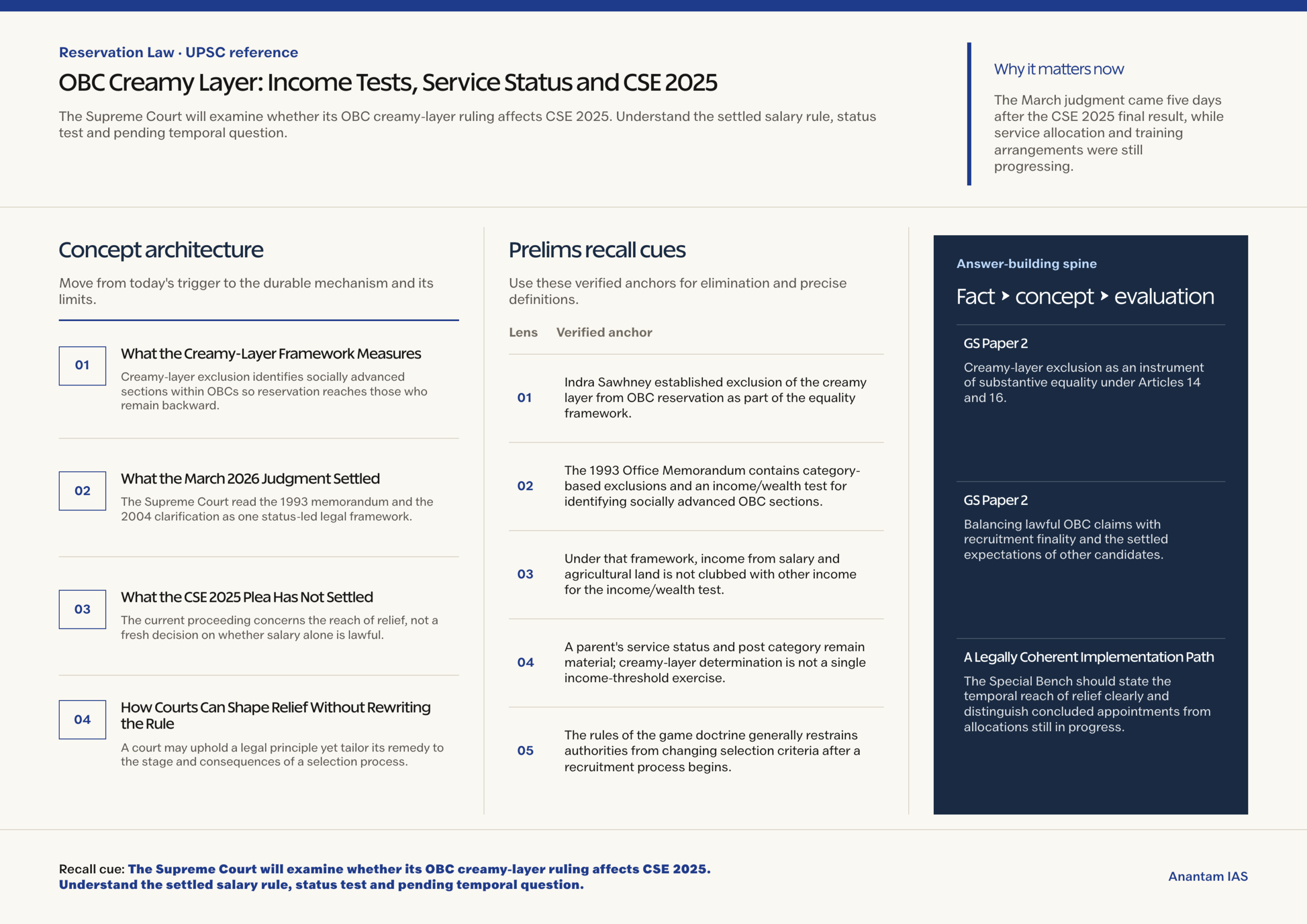
Background and Context
What the Creamy-Layer Framework Measures
Creamy-layer exclusion identifies socially advanced sections within OBCs so reservation reaches those who remain backward.
- The doctrine emerged from Indra Sawhney, which treated exclusion of advanced OBC sections as necessary to preserve substantive equality.
- The 1993 Office Memorandum created several exclusion categories, including constitutional posts, service classes, property holdings and an income/wealth test.
- For service-linked categories, a parent’s rank, mode of entry and age of promotion may matter because occupational status can indicate social advancement.
- The separate income/wealth category addresses income from relevant non-salary sources; it does not convert the framework into a family-income-only test.
- The candidate’s own income or a spouse’s income does not replace the inquiry into the parents’ status under the applicable criteria.
What the March 2026 Judgment Settled
The Supreme Court read the 1993 memorandum and the 2004 clarification as one status-led legal framework.
- In Union of India v. Rohith Nathan, the Court dismissed Union appeals arising from OBC claims linked to PSU and private employment.
- It held that salary, agricultural income and other income cannot be mechanically clubbed when applying the income/wealth test.
- A parent’s salary cannot be the sole criterion; the parent’s service status and the category of post are essential to the decision.
- Using salary alone for PSU or private employees, while similarly placed government employees receive status-based assessment, creates hostile discrimination.
- The Court linked this unequal treatment to Articles 14, 15 and 16 and directed consideration of affected claims within six months.
What the CSE 2025 Plea Has Not Settled
The current proceeding concerns the reach of relief, not a fresh decision on whether salary alone is lawful.
- CSE 2025 results were declared before the March judgment, but important administrative steps such as service allocation were still underway.
- The Centre seeks protection for the existing cycle, citing effects on merit lists, training, cadre allocation, seniority and candidates not before the Court.
- The rules of the game doctrine protects predictable selection criteria, but courts may also interpret what the governing rule legally meant from the start.
- That tension makes prospective application, retrospective application and moulded relief distinct possibilities for the Special Bench to examine.
- Until the Bench decides the application, neither automatic reopening nor automatic insulation of CSE 2025 should be presented as settled law.
How Courts Can Shape Relief Without Rewriting the Rule
A court may uphold a legal principle yet tailor its remedy to the stage and consequences of a selection process.
- A declaration explains the correct legal standard; the separate question of relief decides which candidates and completed steps it should affect.
- The Court can distinguish candidates already appointed, candidates awaiting allocation and claimants whose cases remain pending before DoPT or courts.
- It can also protect candidates who relied on the existing list while preventing an unlawful criterion from governing future recruitment cycles.
- The March judgment already contemplated supernumerary posts for qualifying respondents and intervenors, showing one method of reducing displacement while enforcing rights.
Way Forward
A Legally Coherent Implementation Path
- The Special Bench should state the temporal reach of relief clearly and distinguish concluded appointments from allocations still in progress.
- DoPT should publish a uniform method for assessing post equivalence and parental status across government, PSU and private employment.
- Individual claims should receive reasoned decisions, while relief should protect eligible OBC candidates without unnecessarily unsettling third-party rights.
- Where the judgment permits, supernumerary posts can reduce zero-sum disruption while preserving lawful claims and administrative continuity.
Conclusion
- The durable rule is that OBC creamy-layer exclusion is status-led and equality-based; parental salary by itself cannot decide the claim.
- In a Mains answer, treat CSE 2025 as a pending relief-design question involving legality, recruitment finality and the rights of candidates inside and outside the case.
UPSC Practice Questions
Prelims MCQ 1
With reference to the OBC creamy-layer framework, consider the following statements:
- Creamy-layer status under the 1993 Office Memorandum is determined solely by total parental income.
- Salary and agricultural income are excluded from the income/wealth test under the framework examined by the Supreme Court.
- Parental service status and the category of post may be relevant to creamy-layer determination.
How many of the above statements are correct?
(a) Only one (b) Only two (c) All three (d) None
Answer: (b) Only two
Explanation:
Statements 2 and 3 are correct. The Supreme Court held that salary alone cannot be determinative and that the status and category of the parents’ posts are essential.
Prelims MCQ 2
What did the Supreme Court do in August 2026 regarding the application of its OBC creamy-layer judgment to CSE 2025?
(a) It automatically reopened the CSE 2025 merit list (b) It stayed the March 2026 judgment in full (c) It agreed to constitute a Special Bench to hear the Centre’s clarification plea (d) It cancelled service allocation for all selected candidates
Answer: (c) It agreed to constitute a Special Bench to hear the Centre's clarification plea
Explanation:
The Court took a listing-related step. It did not finally decide the plea’s merits or the temporal application of the March ruling to CSE 2025.
UPSC Mains Questions
- The OBC creamy-layer test is a status-based equality mechanism, not merely an income ceiling. Examine with reference to the Supreme Court’s 2026 judgment.
- How should courts balance correction of an unlawful recruitment criterion with finality, administrative continuity and third-party rights in a selection process?
Sources: The Indian Express Explained Law and Supreme Court of India, Union of India v. Rohith Nathan, 2026 INSC 230.
Frequently Asked Questions
What is the OBC creamy layer?
It refers to socially advanced sections within OBCs that are excluded from reservation benefits so affirmative action reaches groups that continue to experience social and educational backwardness.
Did the Supreme Court abolish the creamy-layer test?
No. It reaffirmed creamy-layer exclusion but held that parental salary cannot be the sole test. Service status, post category and the 1993 framework remain central.
Does salary above the income threshold automatically make an OBC candidate creamy layer?
Not under the March 2026 holding. Salary alone is not determinative; authorities must apply the relevant status categories and income/wealth rules to the candidate’s parental circumstances.
Has the March judgment been applied to CSE 2025?
That question remains unresolved. The Supreme Court agreed to constitute a Special Bench to hear the Centre’s clarification plea, but no final decision on temporal application was reported.
What is the rules of the game doctrine?
It generally bars authorities from changing selection criteria after recruitment begins, protecting predictability and equal treatment. Courts may still need to determine what the governing rule legally meant.