Odisha’s 575-km coastline: harnessing the blue economy
Why in News?
The Odisha government has approved dedicated policies to harness the economic potential of its 575-km coastline on the Bay of Bengal, framed as a push for blue-economy-led growth. The Indian Express reported the decisions in early July 2026.
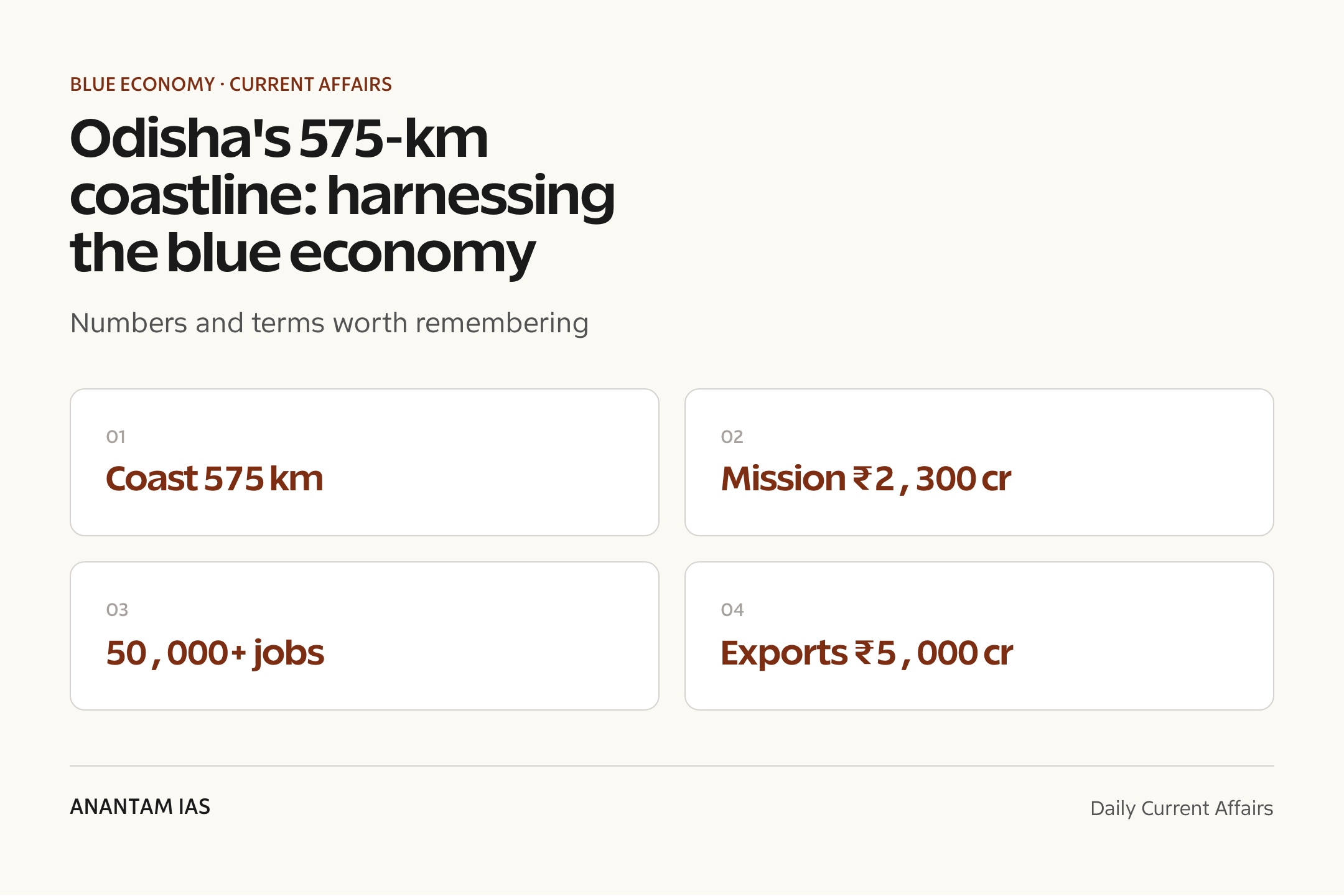
The two headline measures are a 10-year Deep Sea Fishing Mission (2026-36) with a ₹2,300-crore outlay, and a new regulatory framework letting white-leg shrimp culture extend into inland saline waters beyond the Coastal Aquaculture Authority’s 2-km coastal belt.
- Odisha’s marine fishing population is around 15 lakh across 800-plus villages, but operations stay confined to near-shore waters.
- Chief Secretary Anu Garg cited scientific assessments of untapped offshore and deep-sea resources — tuna, billfish, oceanic squid and other pelagic species.
- The Mission targets an extra 2 lakh tonnes of marine fish a year and 50,000-plus jobs, lifting marine exports from below ₹1,000 crore to about ₹5,000 crore.
- A dedicated Blue Economy Hub (B-Hub) will act as the Mission’s knowledge, innovation and coordination centre.
- Shrimp rules now cover the 2-10 km inland saline zone, targeting 25,000 ha of new area and a jump in production from 1.6 lakh MT to 9 lakh MT.
The development matters in the context of:
- The move connects a state coastal-development plan to India’s national Blue Economy framework, Sagarmala port-led growth and the Deep Ocean Mission.
- It reopens the tension between livelihood expansion and fragile coastal ecology — mangroves, turtle rookeries and Ramsar wetlands sit along the same shore.
UPSC Relevance
Prelims Relevance
- Blue economy — sustainable use of ocean resources for growth, jobs and ocean-ecosystem health.
- Deep Ocean Mission — Ministry of Earth Sciences flagship; Samudrayaan manned submersible.
- Sagarmala — port-led development programme, Ministry of Ports, Shipping and Waterways.
- Coastal Aquaculture Authority (CAA) — statutory body under the Ministry of Fisheries; regulates the 2-km coastal aquaculture belt.
- Litopenaeus vannamei — the white-leg (Pacific) shrimp, India’s dominant farmed export shrimp.
- Chilika Lake — Asia’s largest brackish-water lagoon; India’s first Ramsar site (1981).
- Gahirmatha — world’s largest mass-nesting rookery of Olive Ridley turtles; a marine sanctuary.
- Bhitarkanika — mangrove and Ramsar wetland in the Brahmani-Baitarani delta.
- Paradip, Dhamra, Gopalpur — Odisha’s major/notified ports on the Bay of Bengal.
- CRZ Notification, 2019 — Coastal Regulation Zone rules governing coastal activity.
Mains Relevance
GS Paper 3
- Blue economy as a growth strategy — fisheries, ports, aquaculture and coastal jobs.
- Balancing marine-fisheries expansion with sustainable stock management and ecosystem-based fishing.
GS Paper 1
- Coastal geography of the east coast — deltas, lagoons, mangroves and the resources they anchor.
GS Paper 2
- Centre-state division on coastal aquaculture regulation (CAA jurisdiction vs state inland-saline rules).
Essay
- Development along a coast is a negotiation with the sea, not a conquest of it.
- The ocean as India’s next frontier of growth — and of restraint.
Background and Context
What the blue economy means
The term frames the ocean as an economic space that must be grown without being exhausted.
- The blue economy covers fisheries, aquaculture, shipping, ports, coastal tourism, offshore energy, marine biotechnology and seabed minerals — used sustainably.
- India’s Draft Blue Economy Policy Framework (Ministry of Earth Sciences) treats coasts and the Exclusive Economic Zone as engines of growth, jobs and food security.
- India’s EEZ spans about 2.2 million sq km, giving vast fishing, energy and mineral rights beyond the territorial sea.
- The idea sits alongside SDG 14 (Life Below Water) and India’s SAGAR maritime-neighbourhood vision.
Odisha's coast: the geography
The state’s shoreline is a stack of deltas, lagoons, mangroves and turtle beaches — an ecologically loaded coast.
- Odisha’s coast is cited by the state at 575 km; the long-used Survey-of-India figure is about 480 km, so the higher number reflects a revised shoreline measurement.
- Chilika Lake — Asia’s largest brackish lagoon and India’s first Ramsar site — supports fisheries and Irrawaddy dolphins.
- Bhitarkanika, in the Brahmani-Baitarani delta, holds India’s second-largest mangrove cover and a Ramsar wetland.
- Gahirmatha beach is the planet’s largest mass-nesting site for Olive Ridley turtles, protected as a marine sanctuary.
- Major cargo gateways — Paradip (a major port), Dhamra and Gopalpur — line the same coast.
The Deep Sea Fishing Mission (2026-36)
The flagship measure pushes fishing effort from crowded near-shore waters out into untapped deep-sea grounds.
- A ₹2,300-crore, 10-year mission to modernise marine fisheries and build a deep-sea and export hub in eastern India.
- Interventions include modern deep-sea vessels, upgraded mechanised boats and mother vessels for offshore operations.
- Plans cover fishing harbours, fish-landing centres, seafood parks, cold-chain, processing units, digital governance and vessel monitoring systems (VMS).
- Scientific management tools — resource assessment, traceability, artificial reefs, sea ranching and ecosystem-based fisheries — are built in.
- A Blue Economy Hub (B-Hub) anchors knowledge and coordination; private players will be roped in.
Inland saline shrimp culture
The second decision stretches shrimp farming inland, into a zone the central regulator does not cover.
- Litopenaeus vannamei (white-leg shrimp) is currently farmed in brackish water within a 2-km belt of the high-tide line under the Coastal Aquaculture Authority.
- Odisha’s new framework opens the 2-10 km inland saline band — beyond CAA jurisdiction — to regulated shrimp and brackish-water species.
- Safeguards include mandatory online farm registration, scientific site selection, biosecurity, disease surveillance, water-quality monitoring and effluent-treatment systems.
- The model is cluster-based with common infrastructure, aiming at 25,000 ha of new area and output up from 1.6 to 9 lakh MT.
- By 2036 the state targets seafood exports rising from about ₹5,429 crore to ₹15,000 crore and roughly 2.5 lakh livelihoods.
National frameworks it plugs into
Odisha’s plan is a state expression of several central marine and coastal programmes.
- Sagarmala drives port-led growth, coastal shipping and hinterland connectivity — relevant to Paradip and Dhamra.
- Deep Ocean Mission (Ministry of Earth Sciences) explores deep-sea minerals, biodiversity and the Samudrayaan submersible.
- The Pradhan Mantri Matsya Sampada Yojana (PMMSY) funds fisheries infrastructure, harbours and exports.
- The CRZ Notification, 2019 and coastal-zone management plans govern what may be built along the shore.
- Offshore wind targets under the National Offshore Wind Energy Policy add a renewable-energy dimension to the coast.
- The Central Marine Fisheries Research Institute (CMFRI) supplies the stock assessments on which sustainable deep-sea quotas ultimately depend.
The ecological tightrope
Every new tonne of catch or hectare of ponds presses on a coast that is already ecologically stressed.
- Intensive shrimp aquaculture risks salinisation of soil and groundwater, effluent loading and mangrove loss if effluent-treatment rules slip.
- Deep-sea fleets can trigger overfishing and bycatch of turtles and marine mammals without strict quotas and gear rules.
- Gahirmatha imposes seasonal fishing bans to protect Olive Ridley nesting — a recurring flashpoint with fishers.
- Mangroves at Bhitarkanika are natural cyclone buffers on a coast repeatedly hit by Bay of Bengal storms.
- Coastal erosion and sea-level rise make the shoreline itself a moving, contested resource.
- Prawn and shrimp ponds have historically been a driver of mangrove clearance along Indian coasts, so the 2-10 km push needs firm no-conversion lines to avoid repeating that pattern.
Way Forward
Manage the stock, not just the catch
- Tie the deep-sea push to a hard, science-based total allowable catch and stock assessments by CMFRI before fleets scale up.
- Mandate turtle-excluder devices and honour Gahirmatha seasonal bans to keep bycatch and protected-species deaths down.
Make aquaculture genuinely sustainable
- Enforce effluent-treatment and biosecurity in the 2-10 km zone from day one, with third-party audits and real-time water-quality data.
- Protect mangroves and Ramsar buffers as no-conversion zones so pond expansion never eats into cyclone defences.
Share the gains with fishers
- Channel training, credit and cooperative ownership so traditional fisherfolk — not only private operators — capture the deep-sea and export upside.
Conclusion
Odisha’s twin decisions turn a 575-km shoreline from a backdrop into a balance sheet — deep-sea fleets, shrimp clusters and a Blue Economy Hub aimed at jobs and exports. It is a concrete, state-level test of what the blue economy means in practice.
The prize is real: more protein, higher exports and livelihoods for a fishing population of 15 lakh. But the same coast holds Chilika, Bhitarkanika and Gahirmatha. Whether growth and guardianship can share one shoreline is the question the plan will have to answer.
UPSC Practice Questions
Prelims MCQ 1
With reference to the concept of the blue economy in India, consider the following statements:
- The blue economy is limited to marine and coastal fisheries alone.
- The Deep Ocean Mission is implemented by the Ministry of Earth Sciences.
- India’s Exclusive Economic Zone extends up to 200 nautical miles from the baseline.
How many of the above statements are correct?
(a) Only one (b) Only two (c) All three (d) None
Answer: (b) Only two
Explanation:
Statement 1 is wrong — the blue economy spans fisheries, shipping, ports, tourism, offshore energy and seabed minerals, not fisheries alone. Statements 2 and 3 are correct: the Deep Ocean Mission is a Ministry of Earth Sciences flagship, and the EEZ extends to 200 nautical miles.
Prelims MCQ 2
The Coastal Aquaculture Authority, referred to in the context of Odisha’s shrimp-culture rules, functions under which Union ministry?
(a) Ministry of Environment, Forest and Climate Change (b) Ministry of Fisheries, Animal Husbandry and Dairying (c) Ministry of Earth Sciences (d) Ministry of Ports, Shipping and Waterways
Answer: (b) Ministry of Fisheries, Animal Husbandry and Dairying
Explanation:
The Coastal Aquaculture Authority, a statutory body regulating aquaculture within the 2-km coastal belt, works under the Department of Fisheries in the Ministry of Fisheries, Animal Husbandry and Dairying.
UPSC Mains Questions
- The blue economy is often called India’s next growth frontier. Using Odisha’s coastal-development plans as a reference, examine how deep-sea fisheries and coastal aquaculture can be scaled without degrading marine ecosystems.
- Discuss the ecological significance of Odisha’s coast — Chilika, Bhitarkanika and Gahirmatha — and evaluate the challenges of reconciling fisheries expansion with the protection of these habitats.
- Analyse the roles of Sagarmala, the Deep Ocean Mission and the Pradhan Mantri Matsya Sampada Yojana in operationalising India’s blue-economy vision.
Sources: The Indian Express (Explained) and Department of Fisheries, Government of Odisha.
Frequently Asked Questions
What is the blue economy?
The blue economy is the sustainable use of ocean and coastal resources for economic growth, jobs and improved livelihoods while keeping marine ecosystems healthy. It covers fisheries, aquaculture, shipping, ports, coastal tourism, offshore renewable energy, marine biotechnology and seabed minerals. India frames it as a growth engine anchored in its long coastline and vast Exclusive Economic Zone.
How long is Odisha’s coastline?
The Odisha government now cites its coastline at about 575 km along the Bay of Bengal, the figure used in its new blue-economy plans. The long-standing Survey of India figure is roughly 480 km, so the higher number reflects a revised, more detailed shoreline measurement. Either way, it is one of India’s most ecologically rich coasts.
What is the Deep Sea Fishing Mission?
It is Odisha’s 10-year (2026-36) mission, backed by about ₹2,300 crore, to move fishing effort from crowded near-shore waters into untapped deep-sea grounds. It funds modern vessels, mother ships, harbours, seafood parks, cold chains and vessel monitoring, aiming to add 2 lakh tonnes of fish a year, create over 50,000 jobs and raise marine exports toward ₹5,000 crore.
Why is the 2-10 km shrimp rule significant?
White-leg shrimp farming was earlier allowed only within 2 km of the high-tide line, under the central Coastal Aquaculture Authority. Odisha’s new framework opens the 2-10 km inland saline band — outside that jurisdiction — to regulated shrimp culture, targeting 25,000 ha of new area. It shows a state extending aquaculture into zones the central regulator does not cover, with its own safeguards.
What is the Deep Ocean Mission?
The Deep Ocean Mission is a Ministry of Earth Sciences flagship to explore the deep sea for minerals, biodiversity and energy, and to build ocean technology. Its best-known component is Samudrayaan, a manned submersible designed to carry scientists to depths of several thousand metres. It is a core pillar of India’s blue-economy and ocean-research ambitions.
Why is Odisha’s coast ecologically sensitive?
The coast holds Chilika, Asia’s largest brackish lagoon and India’s first Ramsar site; Bhitarkanika’s mangroves in the Brahmani-Baitarani delta; and Gahirmatha, the world’s largest Olive Ridley turtle nesting beach. These habitats buffer cyclones and sustain biodiversity, so any expansion of fishing or shrimp ponds must avoid mangrove loss, effluent pollution and turtle bycatch.