Odisha Marine Fishing Regulation Bill, 2026
Why in News?
The Odisha Cabinet has approved the proposed Odisha Marine Fishing Regulation Bill, 2026, which seeks to replace the 44-year-old Orrisa Marine Fishing Regulation Act, 1982.
| UPSC Relevance: GS-3 Economy: Fishing Sector, Blue Economy, GS-3 Environment: Sustainable Development, GS-3 Internal Security Mains: Blue Economy and Sustainable Maritime Governance. |
Odisha Marine Fishing Regulation Bill, 2026:
Odisha, with a coastline of over 500 km and nearly 15 lakh fishermen, is among India’s major marine fishing states. The Odisha Marine Fishing Regulation Bill, 2026, aims to create a modern legal framework for sustainable marine fisheries, coastal security, blue economy growth, and marine ecosystem conservation in the state.
Need for the New Regulations:
The Orissa Marine Fishing Regulation Act, 1982, was limited to basic provisions: licensing of fishing vessels, their registration, power to restrict or prohibit fishing, and authority to search and seize vessels. It was never designed to address:
- Marine resource conservation and biodiversity threats
- Illegal, Unreported, and Unregulated (IUU) fishing
- Technological integration in monitoring and tracking
- Coastal security threats, including foreign vessel intrusion
- Economic frameworks such as deep-sea fishing and mariculture
- Cross-border infiltration through fishing routes
Hence, the existing law was limited in scope and inadequate to address emerging challenges such as marine resource conservation, fishermen’s safety, coastal security, and technological advancements.
Key Provisions of the 2026 Bill:
- Fisheries Governance & Regulation
- Strict licensing for fishing vessels and fishermen
- Regulation of fishing gear; ban on destructive fishing practices
- Protection of traditional fishers’ rights
- Mariculture & Blue Economy
- Regulation of deep-sea fishing activities
- Promotion of marine cage culture and seaweed culture
- Deployment of artificial reefs for territorial water rejuvenation
- Smart green integrated infrastructure for fishing harbours
- Coastal Security & Surveillance
- Mandatory transponders, VHF radios, and vessel tracking systems
- Biometric/QR-coded Aadhaar identification for fishermen
- Measures to prevent the entry of unauthorised foreign fishing vessels
- Curbing infiltration via coastal districts (Kendrapada, Jagatsinghpur, Bhadrak)
- Livelihood & Safety
- Enhanced insurance coverage for fishermen and livelihood support provisions.
- Mandatory modern safety and communication equipment.
- Employment generation through infrastructure modernisation.
Odisha aims to increase seafood exports from approximately ₹5,000 crore annually to ₹25,000 crore by 2036. Major export destinations include China, the United States, Japan, Vietnam, Thailand, the European Union and Gulf countries.
Broader Significance for India:
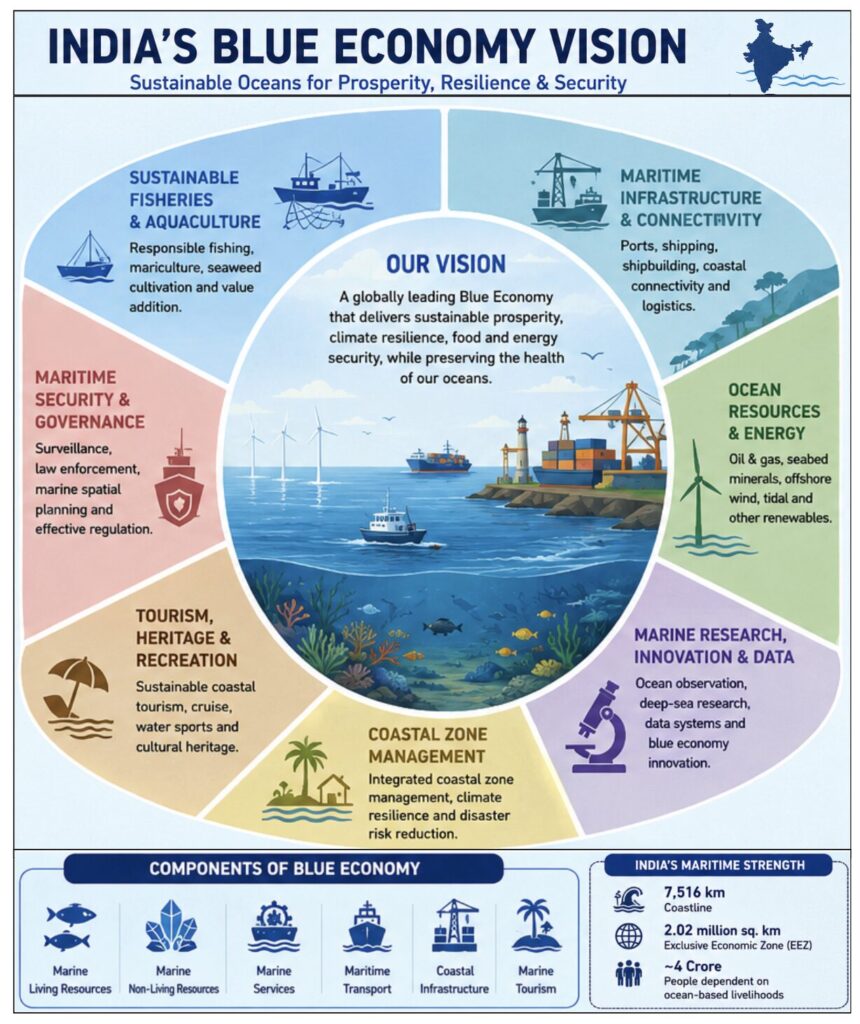
- Blue Economy & Economic Geography: India has a coastline of 7,516 km and an Exclusive Economic Zone (EEZ) of over 2.02 million sq. km. The Blue Economy (sustainable use of ocean resources) is central to India’s growth ambitions. The Bill may become a template for other coastal states and strengthen India’s Blue Economy Vision.
- Climate Change Adaptation: Marine ecosystems are critically threatened by overfishing, IUU fishing, Ocean warming, Cyclones, Coastal erosion and Salinity changes. Artificial reefs and seaweed cultivation in the Bill align with coral reef restoration and carbon sequestration goals. Scientific fisheries governance can improve climate resilience in coastal communities.
- Cooperative Federalism and Maritime Governance: Fisheries fall under the State List (Entry 21, List II) under the Seventh Schedule. However, Territorial waters (0-12 nautical miles) fall largely under state jurisdiction. The EEZ (up to 200 nautical miles) falls under Union jurisdiction through the Maritime Zones Act, 1976. Thus, regulation of deep-sea fishing creates a shared governance space between State governments, the Central government and Maritime security agencies.
- Internal Security and Coastal Surveillance: India’s coastline remains vulnerable to smuggling, Illegal migration, Arms trafficking and Maritime terrorism. The Bill has measures that strengthen fishermen identification systems, coastal surveillance architecture, and real-time maritime monitoring.
- Integration with National Security Mechanisms: The Bill complements the National Committee for Strengthening Maritime and Coastal Security (NCSMCS), Coastal Surveillance Network (CSN), and Joint Operations Centres (JOCs). It can enhance coordination among the Coast Guard, Marine police, Fisheries departments and Intelligence agencies.
The Bill represents a significant evolution in India’s marine governance framework. It goes beyond conventional fisheries regulation by integrating Blue Economy goals, Climate resilience, Coastal security, Scientific resource management and Livelihood protection. It has the potential to become a model for sustainable maritime governance in India.