ODOP Reforms 2026: District Products, Exports and Local Economic Development
The January 2026 ODOP update highlighted the One District One Product approach as a tool for local economic development, branding and market access. The policy idea is simple: identify what a district is good at and help it sell better.
For UPSC, ODOP is useful because it connects MSMEs, exports, handicrafts, agriculture processing, district planning and cooperative federalism.
This article explains ODOP as an economic-governance instrument and evaluates whether district-level branding can translate into jobs and exports.
Quick Facts
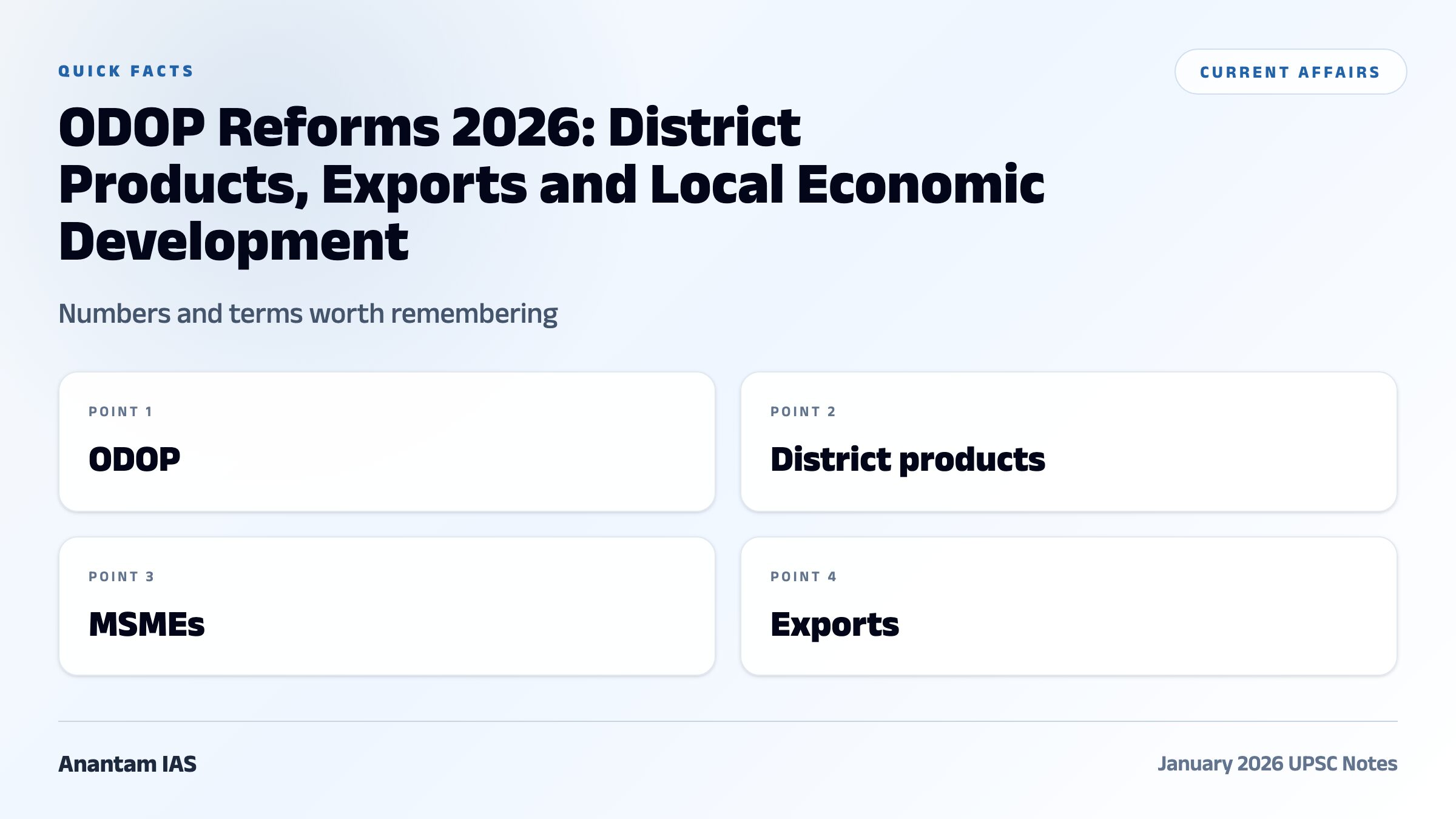
- ODOP stands for One District One Product.
- It identifies and promotes products with district-level strength.
- The approach supports branding, market access, value addition and exports.
- ODOP connects with Districts as Export Hubs and Vocal for Local.
- Products may include handicrafts, food processing, textiles, agriculture and local industry.
- Official source: PIB DPIIT release dated 23 January 2026.
- Official source: PIB, DPIIT.
What Just Happened
The official update highlighted ODOP reforms and the continuing push to strengthen district products.
The news matters because local products often fail not due to lack of skill, but because of weak packaging, finance, design, certification, logistics and market access.
For aspirants, ODOP is a good example of place-based economic development.
Background and Historical Context
The ODOP approach gained national visibility through state initiatives and central adoption as part of local-product promotion.
India’s districts often have clusters of skill, craft or agricultural specialisation, but producers remain fragmented and under-capitalised.
Districts as Export Hubs seeks to connect local products with export planning and trade facilitation.
Key Features of Local Economy
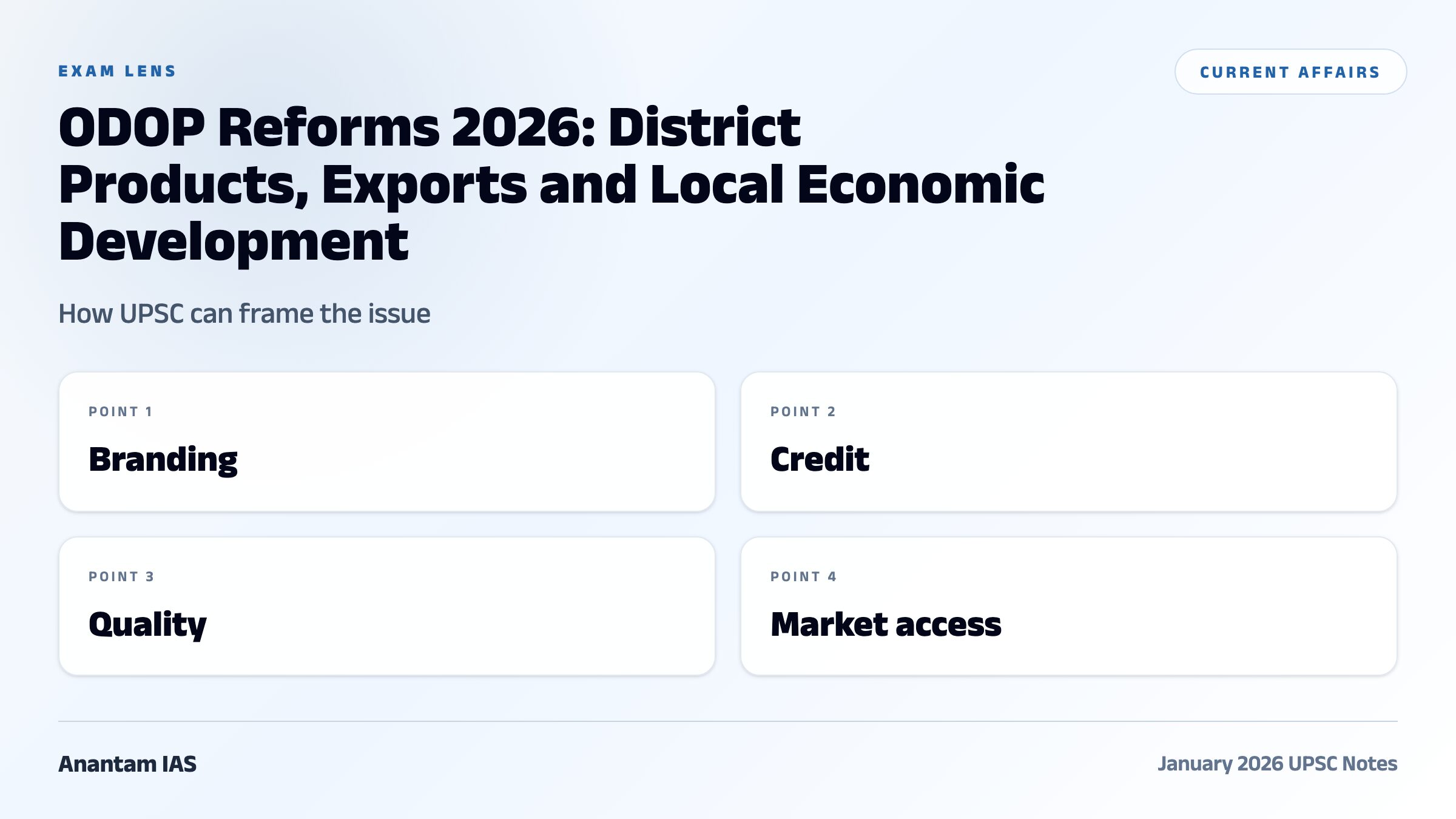
The core policy architecture can be read through these features.
- Product mapping: each district identifies priority products.
- Branding: local products receive a stronger market identity.
- Value addition: packaging, processing and design can raise incomes.
- Export linkage: district plans can connect producers with foreign markets.
- MSME support: credit, training and certification are critical.
- Federal role: district, state and Union agencies must coordinate.
Why It Matters
This is a high-yield UPSC topic because it joins current news with durable syllabus themes.
- It connects a January 2026 event with durable UPSC syllabus themes.
- It gives usable facts for Prelims and analytical hooks for Mains.
- It helps students move from news recall to policy reasoning.
- It can be linked with static concepts in polity, economy, governance, science, environment or society.
Detailed Analysis: Local Economy Lens
ODOP works when it solves business bottlenecks. Branding alone cannot compensate for poor quality control or working-capital shortages.
Cluster depth matters. Successful districts need common facilities, testing labs, design support and producer organisations.
Exports require compliance. Food safety, packaging, GI tagging, customs documentation and buyer reliability become decisive.
Comparative Perspective
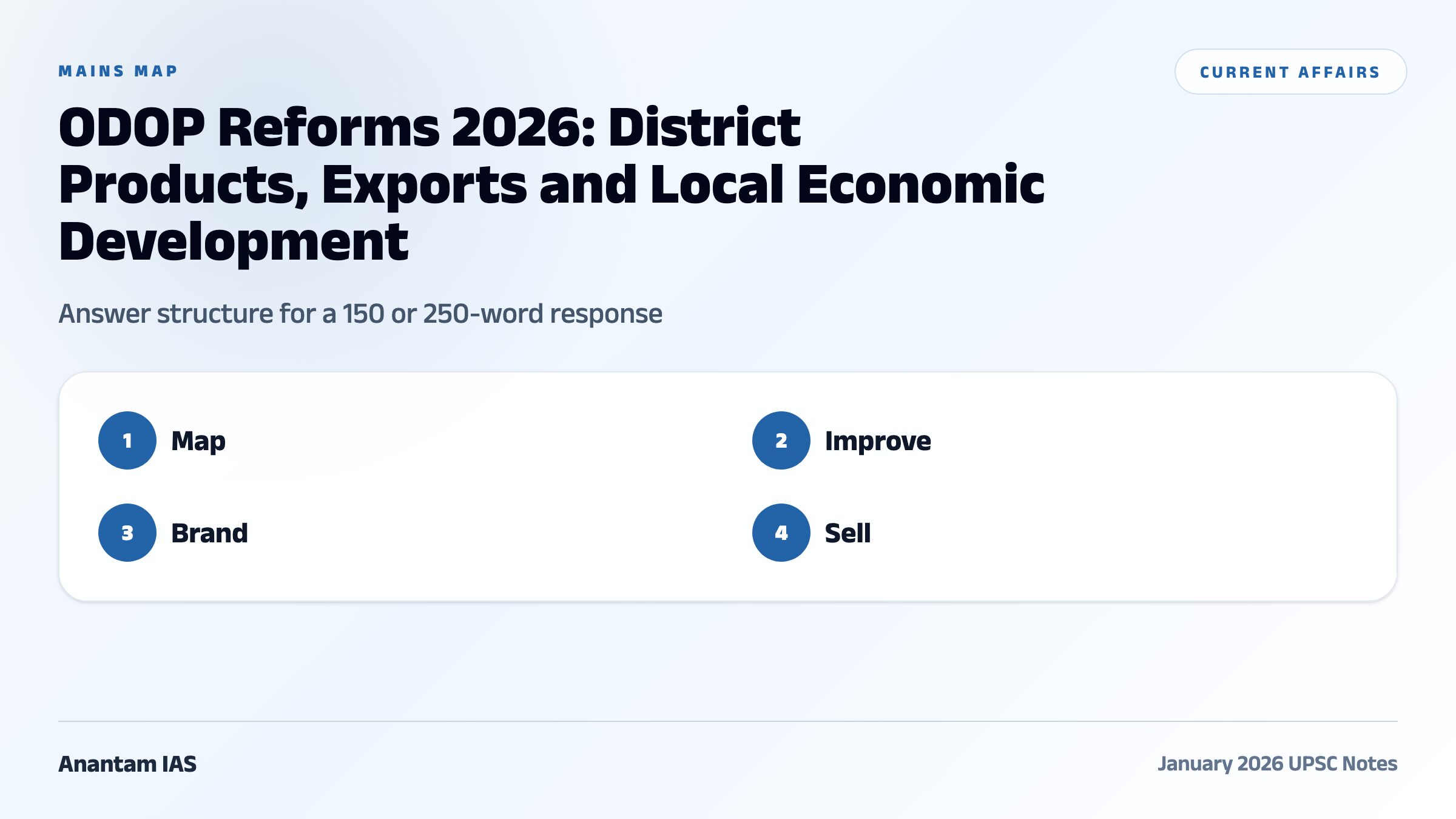
A comparison helps prevent the answer from becoming a one-dimensional news summary.
- ODOP: district-product promotion and branding.
- GI tags: legal protection for geographical indications.
- Cluster development: common facilities and ecosystem support.
- Districts as Export Hubs: export planning and trade facilitation at district level.
Challenges
The policy or institutional promise runs into recurring constraints.
- Producer fragmentation weakens bargaining power.
- Quality control and certification can be expensive.
- Market access often depends on intermediaries.
- District officials may lack export expertise.
- Branding can become symbolic without logistics and finance.
Prelims Pointers
- ODOP stands for One District One Product.
- GI means Geographical Indication.
- Districts as Export Hubs links district products with export planning.
- DPIIT is linked to industrial promotion and internal trade.
- MSMEs are important for employment and exports.
- Value addition raises producer income beyond raw-product sale.
Mains Questions
- ODOP can support local economic development only if branding is backed by market access and value addition. Discuss. (GS Paper III, 250 words)
- How can Districts as Export Hubs improve India’s export diversification? (GS Paper III, 150 words)
- Evaluate the role of district administration in MSME and craft-sector development. (GS Paper II/III, 250 words)
- Place-based development can reduce regional imbalance. Analyse with reference to ODOP. (GS Paper III, 250 words)
Way Forward
ODOP should be paired with credit support, common facility centres, quality certification, e-commerce onboarding and export documentation handholding.
District product plans should track producer income, repeat buyers and jobs, not only exhibitions.
In Mains, use ODOP as a bridge between local economy and national export strategy.
The examiner is unlikely to reward a bare fact dump here. The better answer connects the January 2026 event to institutional design, implementation capacity and India’s long-term development priorities.
Frequently Asked Questions
What is ODOP?
One District One Product is an approach to promote one or more products linked to a district’s strengths.
Why is ODOP important?
It can improve branding, value addition, market access and local jobs.
How does it link to exports?
District products can be integrated with Districts as Export Hubs and trade facilitation.
What is the main limitation?
Branding is not enough without credit, quality control, logistics and buyer access.
Which sectors benefit?
Handicrafts, food processing, textiles, agriculture products and local manufacturing clusters.
What is the UPSC angle?
MSME development, exports, district planning, cooperative federalism and inclusive growth.