OJ 287: Reading Black-Hole Activity Through Changing Light
Why in News?
On 6 October 2026, DST highlighted an ARIES-coordinated study of OJ 287 using optical observations from 2015–2025 to investigate its variable emission and binary black-hole interpretation.
- The decade-long optical time series tracks changing brightness and colour over different timescales, with supporting observations elsewhere in the electromagnetic spectrum.
- The study examines brightness, spectrum and polarization, using multiple properties of the received light to investigate the source.
- The binary interpretation depends on observational evidence and modelling; the announcement does not report a directly resolved image of both black holes or detected gravitational waves from OJ 287.
- A distant source can reveal its behaviour over time even when its central structures cannot be separately photographed.
- The useful distinction is between measurements and interpretation: astronomers record light, then test physical models against those observations.
UPSC Relevance
Prelims Relevance
- Blazar: an active galactic nucleus with a relativistic jet directed nearly along our line of sight.
- Light curve: brightness measured against time.
- Spectrum: the distribution of received light across wavelength or frequency.
- Polarization: information about the orientation of light-wave oscillations.
- ARIES: Aryabhatta Research Institute of Observational Sciences, an autonomous DST institution.
Mains Relevance
GS Paper 3
- Long-term astronomical observation and the testing of physical models.
- Indian research institutions and international collaboration in frontier science.
Essay
- How indirect evidence can reveal things beyond direct observation.
Background and Context
Why OJ 287 Is a Useful Cosmic Laboratory
The central lesson is how a changing signal can reveal physical processes in a distant source without resolving every component in an image.
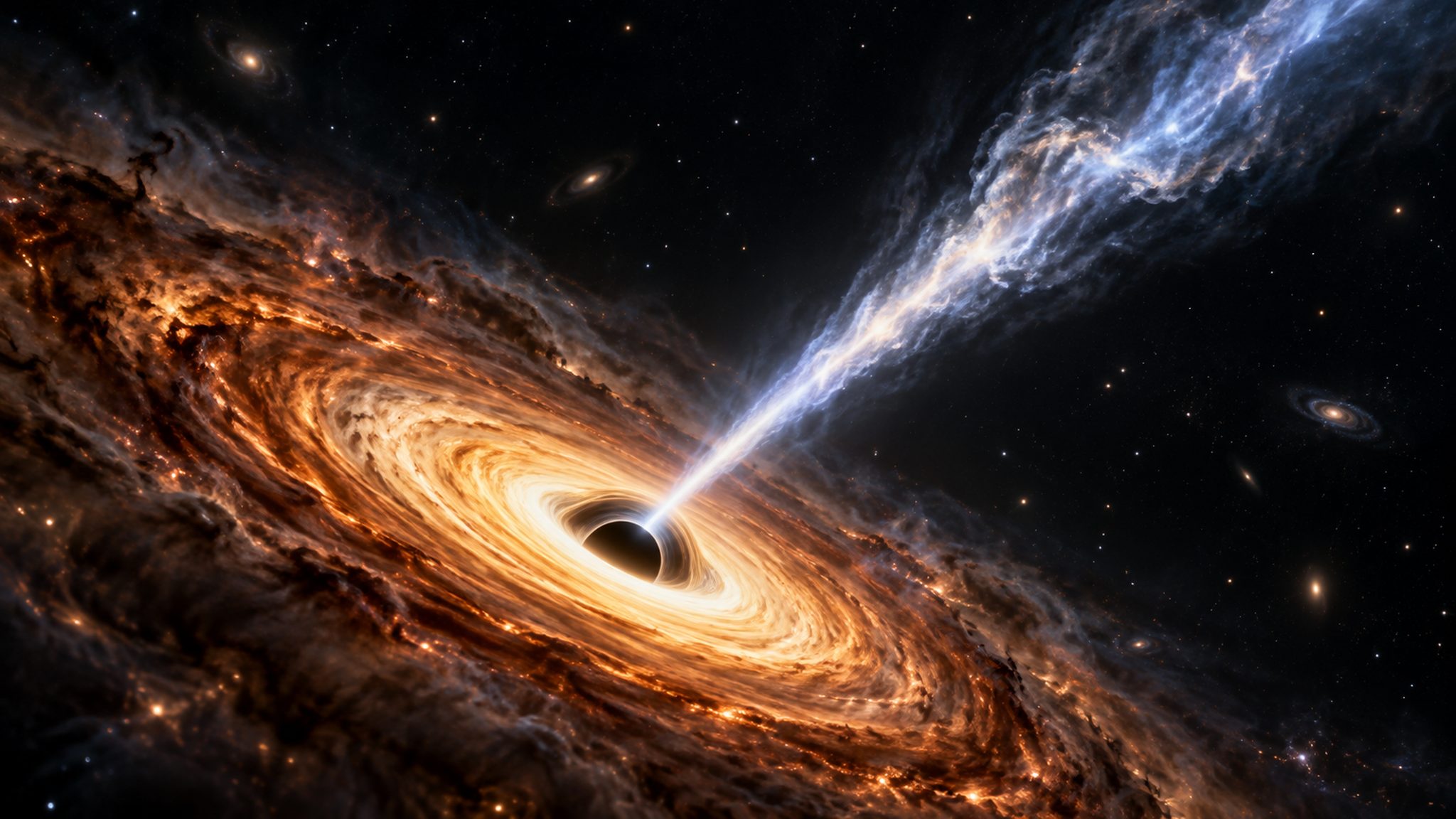
- A blazar is an active galactic nucleus whose powerful jet points nearly toward the observer. This viewing geometry helps explain why such objects can appear exceptionally bright and vary strongly across the electromagnetic spectrum.
- Accretion involves matter gathering around a black hole; the observable emission comes from surrounding material and associated jets. Light received from this environment should not be described as escaping from inside the event horizon.
- OJ 287 has a history of paired brightness outbursts that motivates a binary supermassive black-hole interpretation. In this model, a smaller companion interacts with material around the larger black hole during its orbit.
- The newly highlighted study assembled optical observations from 2015–2025. Sustained monitoring samples both long-term evolution and shorter fluctuations, supplying evidence that an isolated bright-state observation could miss.
- ARIES coordinated the campaign with international collaborators and observations from several telescopes. Combining records extends temporal coverage, while the scientific task remains to interpret changes consistently across instruments and observing periods.
Three Different Questions Asked of the Light
Brightness, spectrum and polarization describe different properties of the received signal; their combined behaviour can test explanations more effectively than brightness alone.
- A light curve records brightness over time. It shows when a source brightens, fades or repeats a pattern, allowing researchers to compare observed timing with the timing predicted by a physical model.
- A spectrum separates light by wavelength or frequency. Changes in the relative strengths of different bands provide information beyond total brightness and can help distinguish contributions from different emitting components in the source.
- Polarization describes preferred orientations in light-wave oscillations. As NASA explains, it provides clues to magnetic-field structure and particle behaviour in jets; it is a separate observable from how bright the source appears.
- Comparing timescales asks whether slow trends and rapid fluctuations have the same explanation. A successful interpretation must account for the observed behaviour, rather than assuming that every flare has an identical physical cause.
- Measurements across bands can test whether components brighten together or differently. Coordinated observations reduce ambiguity, but a correlation alone does not establish a unique causal mechanism or an exact spatial arrangement within the source.
What the Binary Interpretation Does Not Prove
The evidence is scientifically useful precisely when the distinction between a measured signal, a tested model and a future possibility remains explicit.
- The binary model connects recurring outbursts with orbital behaviour. NASA’s earlier account describes flare-timing predictions tested against observations; this is model-based inference, not a photograph showing two individually resolved event horizons.
- A new dataset is not an entirely new discovery: OJ 287 has been studied for decades. The present development adds a long observational record for examining variability and assessing interpretations of the system.
- Multiwavelength astronomy combines radio, optical, X-ray or other electromagnetic observations. These remain observations of photons, despite their different energies; using several bands does not by itself establish a multimessenger detection.
- Multimessenger astronomy combines distinct carriers of information, such as electromagnetic radiation with gravitational waves or neutrinos. The possibility of such connections should not be rewritten as an observed non-electromagnetic signal from this campaign.
- Continued monitoring can test predictions against future observations and expose weaknesses in existing interpretations. Strong scientific reporting preserves uncertainty instead of converting a plausible physical explanation into evidence stronger than the measurements support.
Way Forward
Test Predictions With Coordinated Monitoring
- Maintain long time-series observations to capture faint states, brief flares and long-term patterns with documented uncertainties.
- Coordinate different electromagnetic bands so changes in brightness, colour and polarization can be compared over the same observing periods.
- Report model assumptions and alternative explanations clearly; distinguish predicted signals from those actually detected.
Conclusion
- OJ 287 illustrates the value of time-domain astronomy: repeated measurements reveal behaviour that a single image cannot. Brightness, spectrum and polarization offer complementary evidence about a distant active galactic nucleus.
- The exam-ready distinction is observation versus inference. A model supported by changing light is not direct imaging, and multiple electromagnetic bands are not automatically multiple astronomical messengers.
UPSC Practice Questions
Prelims MCQ 1
With reference to blazars and astronomical observations, consider the following statements:
- A blazar has a relativistic jet directed nearly along the observer’s line of sight.
- A light curve represents brightness measured over time.
- Observing optical and radio photons necessarily constitutes a multimessenger detection.
How many of the above statements are correct?
(a) Only one (b) Only two (c) All three (d) None
Answer: (b) Only two
Explanation:
The first two statements are correct. Optical and radio observations are different electromagnetic wavelengths; both use photons and do not alone establish a multimessenger detection.
Prelims MCQ 2
What is the most accurate interpretation of a flare occurring when a binary black-hole model predicts it?
(a) It directly photographs both event horizons. (b) It establishes a gravitational-wave detection from the source. (c) It supplies observational support for the model’s timing prediction. (d) It proves that every flare has the same cause.
Answer: (c) It supplies observational support for the model's timing prediction.
Explanation:
Agreement between observation and prediction supports a model. It does not independently turn light measurements into direct imaging or a detection of gravitational waves.
UPSC Mains Questions
- Explain how long-term observations of brightness, spectrum and polarization can help investigate distant astronomical objects. (150 words)
- Distinguish multiwavelength from multimessenger astronomy. Discuss why scientific reporting must separate observations, model-based inferences and future possibilities. (250 words)
Sources: PIB, Department of Science and Technology and NASA: OJ 287 flare timing and binary model.
Frequently Asked Questions
What is special about OJ 287?
OJ 287 is a strongly variable blazar studied through recurring outbursts and other changes in its light. These observations have motivated and tested a binary supermassive black-hole interpretation of its central region.
What did the newly highlighted study observe?
The ARIES-coordinated campaign assembled optical observations spanning 2015–2025, supported by observations at other electromagnetic wavelengths. The record helps investigate changing brightness, colour and emission behaviour over different timescales in OJ 287.
Does the study directly image two black holes?
The announcement concerns light observations and their interpretation. It should not be presented as a directly resolved image of two event horizons, or as a reported gravitational-wave detection from OJ 287.
Are multiwavelength and multimessenger astronomy the same?
No. Multiwavelength astronomy combines electromagnetic bands, all carried by photons. Multimessenger astronomy adds distinct information carriers, such as gravitational waves or neutrinos, when those signals can be associated with the source or event.