Omkareshwar floating solar park highlights scale of India’s clean energy push
Why in News?
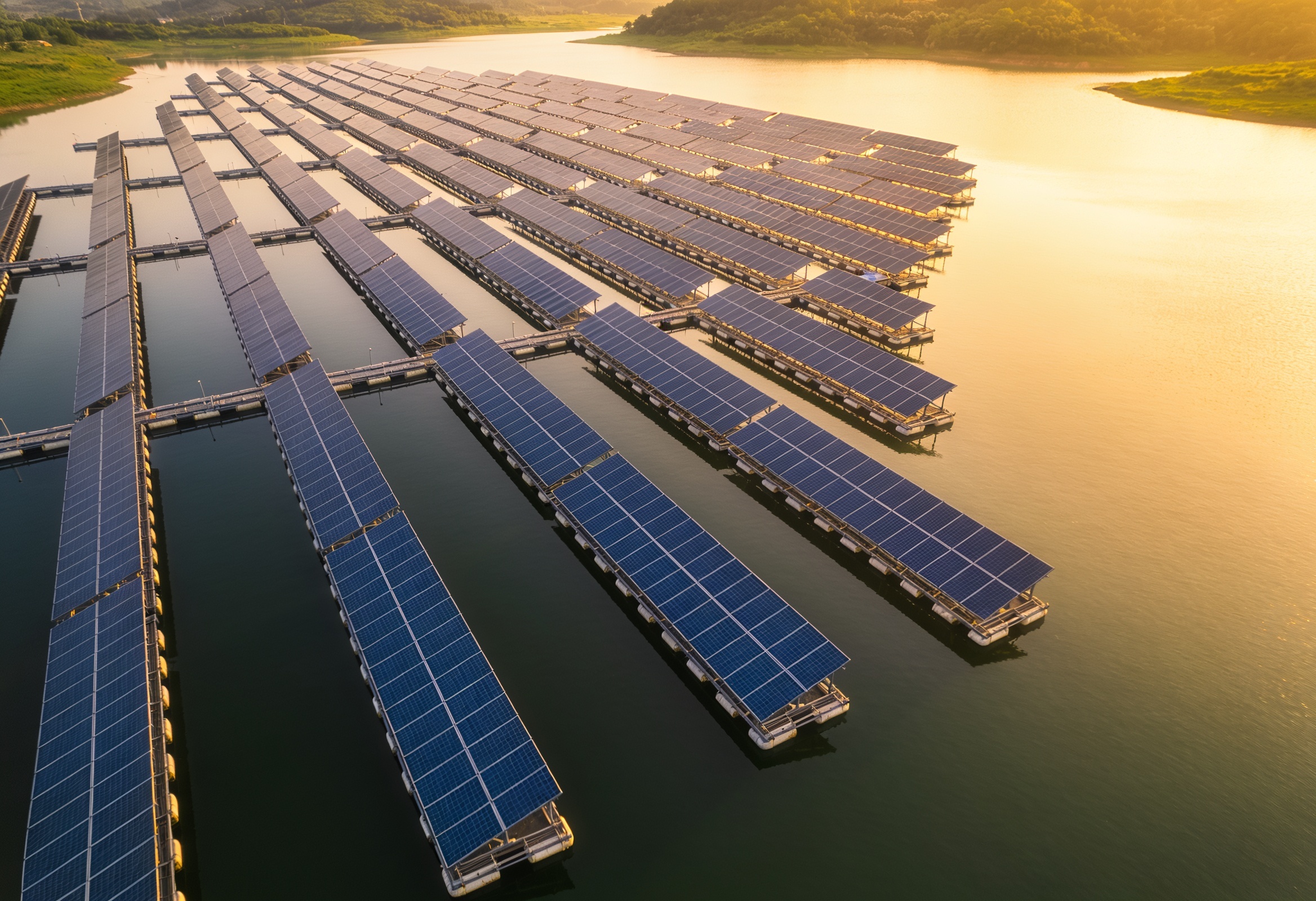
A high-profile visit and statement by the Union Minister after commissioning of part of the Omkareshwar floating solar park highlighted India’s push to expand large-scale, innovative renewable installations to meet climate and energy targets.
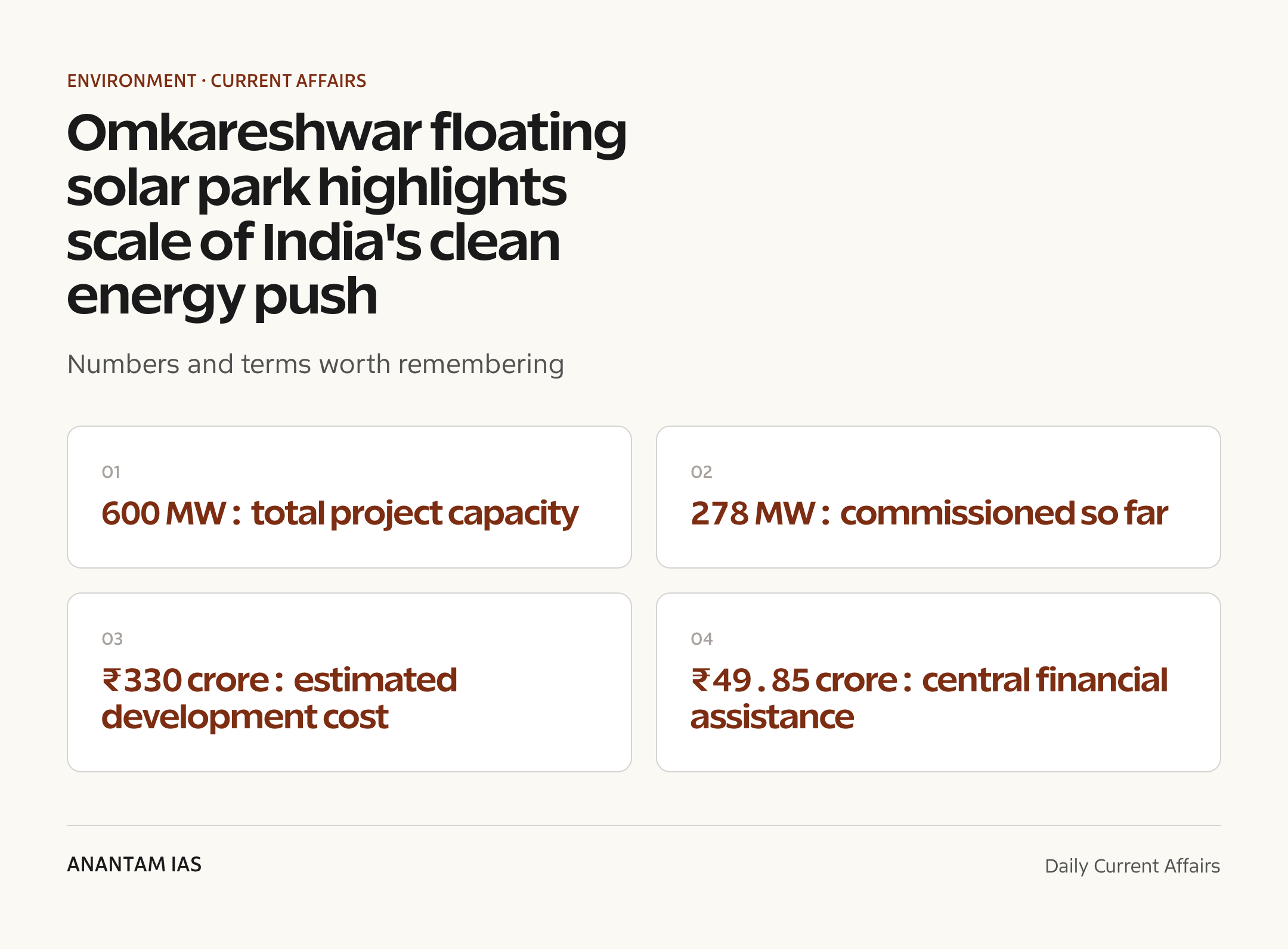
- Scale: Project billed at 600 MW capacity, with 278 MW commissioned so far, making it among the largest floating solar parks in Asia.
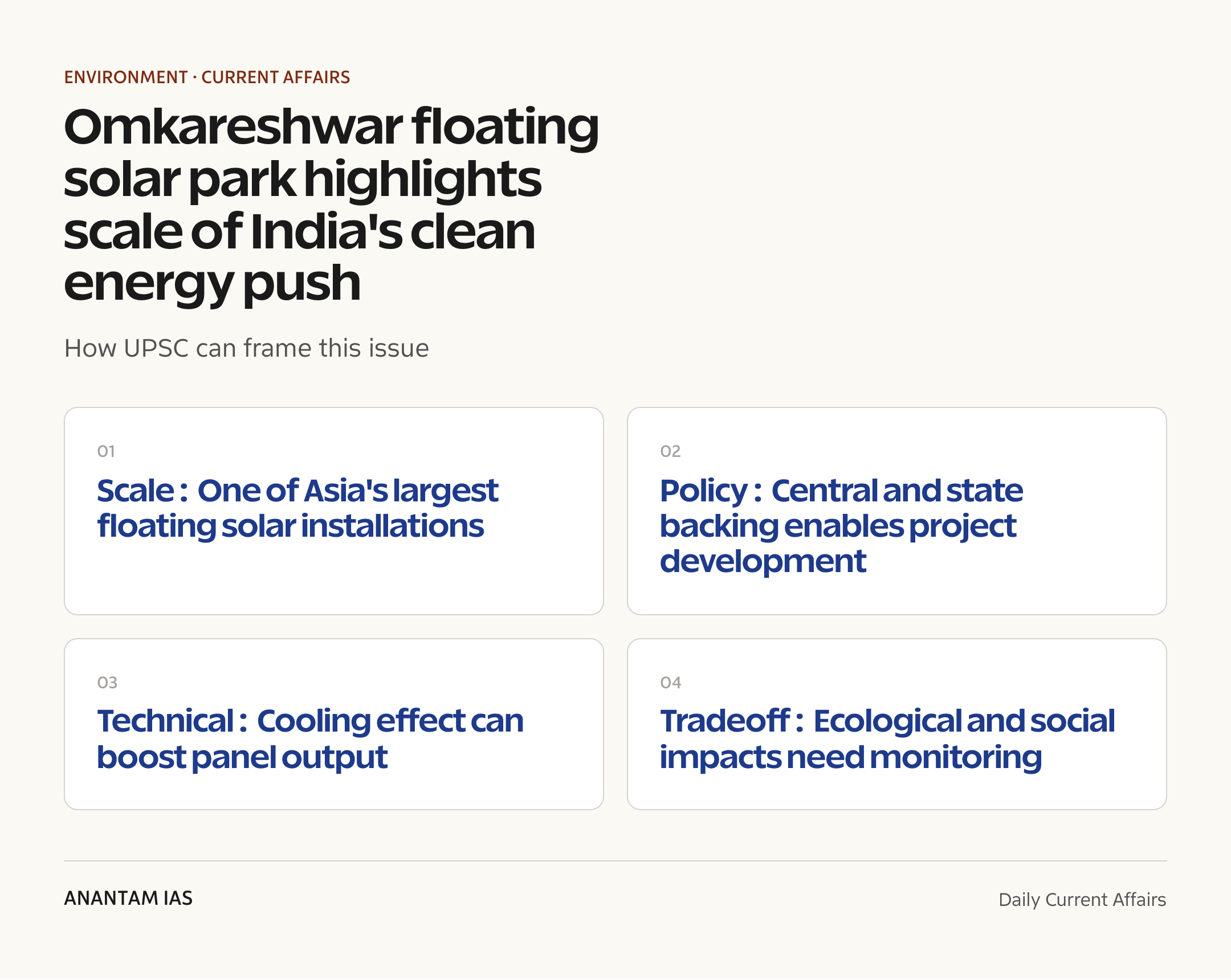
- Policy signal: Central and state leadership publicly highlighting the site underlines emphasis on renewable growth and institutional support.
- Cost and support: Project development cost ~₹330 crore with central financial assistance of ₹49.85 crore, illustrating financing mix for large renewables.
- Performance claim: Cooling effect of water expected to raise panel efficiency, improving energy yield per MW compared with ground-mounted plants.
- Resource tradeoffs: Raises questions on water-body impacts, reservoir management, fisheries, and local ecology alongside energy benefits.
The development matters in the context of:
- National targets: India aims for large increases in renewable capacity to meet national commitments on emissions intensity and non-fossil electricity share.
- Floating solar rationale: Addresses land scarcity by using existing water bodies, reduces evaporation, and can improve panel output due to lower operating temperature.
- Technology status: Floating solar combines PV arrays with pontoons, anchors, mooring and electrical jacketing; scale-up requires robust civil, electrical and O&M practices.
- Cost dynamics: Capex for floating installations is higher than ground-mounted PV per MW but may be offset by land savings and reduced transmission needs if sited near reservoirs serving demand centers.
- Grid integration: Large variable injection from a 600 MW resource requires grid reinforcement, forecasting, storage or demand management to avoid curtailment and maintain stability.
- Financing landscape: Project financing mixes government support, state entities, central PSUs and private developers; public support reduces risk to attract private capital.
- Global footprint: Floating PV has grown rapidly worldwide in the last decade with notable projects in Asia, Europe and Latin America; lessons on anchoring, corrosion and ecology are emerging.
- Local context: The site at Omkareshwar reservoir in Khandwa district leverages existing irrigation and hydropower infrastructure and multi-stakeholder partnerships including NHDC, SJVN and private developers.
UPSC Relevance
Prelims Relevance
- Remember key figures: 600 MW capacity (278 MW commissioned), ₹330 crore development cost, ₹49.85 crore central assistance.
- Know what floating solar (floatovoltaics) means and basic advantages: land conservation, reduced evaporation, higher panel efficiency.
- Identify stakeholders: Central Ministry of New and Renewable Energy, state government of Madhya Pradesh, public and private developers such as SJVN, NHDC, Rewa UMPP and AMP Energy Green.
Mains Relevance
GS3 Economy
- Explain the role of innovative renewable technologies like floating solar in India’s energy transition and land-use policy.
- Analyse economic, social and environmental tradeoffs of large hydros and floating PV co-location on reservoirs.
- Evaluate government policy and financing mechanisms used to scale up renewable infrastructure, with example of Omkareshwar.
Essay
- Use the project as an empirical example in essays on energy security, environmental sustainability and climate action.
- Illustrate themes of technology adoption, public-private collaboration and infrastructure investment in essays on development priorities.
Background and Context
What is floating solar and why it matters
Floating solar photovoltaic systems mount solar panels on water bodies using platforms and anchoring systems.
- Basic components: PV modules, floats/pontoons, mooring systems, electrical cabling and grid interconnection equipment.
- Primary benefits include land-saving, reduced reservoir evaporation, and potential efficiency gains from cooler panel operating temperatures.
- Common sites: reservoirs, irrigation tanks, lakes and former mines filled with water.
- Technical challenges: corrosion, biofouling, anchoring under varying water levels, and specialized maintenance routines.
- Environmental concerns: Shading of aquatic habitats, impacts on fish, changes to thermal stratification and water quality need assessment.
- Scale-up considerations: Large arrays require integrated planning with water managers, grid operators and local communities.
India's renewable trajectory and policy context
India has aggressively expanded solar and wind capacity under national targets and sectoral schemes.
- National targets include large increases in non-fossil electricity capacity and commitments under the Paris Agreement.
- Policy instruments: Viability Gap Funding, Central Financial Assistance, state-level land allotment and solar park models.
- Recent programmes encourage hybridisation with storage and pumped hydro to manage intermittency.
- Public sector developers and state utilities often partner with private investors to share risk for large projects.
- Emerging focus on floating PV in National Solar Mission guidance and state renewable policies.
- Capacity factors and tariff trends have improved, making utility-scale solar a competitive source of bulk power.
Technical and grid integration aspects
Connecting a 600 MW floating PV park requires grid planning and operational tools to manage variable generation.
- Large injection points need transmission reinforcement or local consumption to avoid bottlenecks.
- Forecasting solar generation at plant level improves scheduling and reduces imbalance costs.
- Solutions include energy storage, demand response, and coordination with hydro or thermal plants for flexibility.
- Protection against faults, earthing and insulation are critical because of water proximity and humidity.
- O&M regimes must plan for access, cleaning, electrical safety and replacement of floats over asset life.
- Plant-level SCADA and remote monitoring are necessary for performance optimisation and quick fault response.
Economic and financing profile
Project economics depend on capex, O&M, tariff structure and any fiscal or grant support.
- Reported development cost around ₹330 crore implies relatively low reported capex per commissioned MW; verify phased accounting.
- Central Financial Assistance of ₹49.85 crore reduces upfront cost and signals government backing.
- Revenue stream based on power purchase agreements, merchant sales, or park-level pooling arrangements.
- Ongoing costs include maintenance of floats, cleaning panels, mooring upkeep and electrical servicing.
- Risk allocation in contracts matters: hydrological risk, grid curtailment risk and module degradation must be assigned.
- Financing mix may include commercial loans, green bonds, concessional finance and equity from developers or state entities.
Environmental and social considerations
Large floating installations change reservoir uses and may affect ecology and local livelihoods.
- Potential positive: reduced evaporation supports water security in arid regions.
- Potential negative: shading could alter aquatic plant growth and fish habitat, affecting fisheries.
- Stakeholder engagement with fisher communities and irrigation managers is essential for social licence.
- Environmental Impact Assessments should consider cumulative effects if multiple projects cluster on a river basin.
- Adaptive management and monitoring frameworks can mitigate unforeseen ecological impacts over time.
- Co-benefits can be realised if installation design leaves areas open for fisheries or integrates habitat-friendly measures.
Case specifics: Omkareshwar site and stakeholders
Omkareshwar project sits on a reservoir in Khandwa district and is developed by a mix of public and private entities.
- Stakeholders listed include Rewa Ultra Mega Solar Limited, NHDC Ltd, AMP Energy Green Pvt Ltd and SJVN Ltd.
- The Union Minister highlighted state support by the Madhya Pradesh government as crucial to project success.
- Commissioning status: 278 MW commissioned with progressive commissioning toward 600 MW.
- Projected lifetime generation quoted as over 4,600 million units over 25 years for the full 600 MW.
- The project demonstrates model of multi-developer solar park approach on a common reservoir platform.
- Operational learnings here will influence replication on other large reservoirs across India.
Way Forward
Strengthen technical standards
Uniform guidelines will reduce technical risk and improve longevity of floating PV assets.
- Develop and disseminate national technical standards for floats, mooring, cabling and corrosion protection.
- Mandate site-specific geotechnical and hydrological assessments before project approval.
- Require durability testing and certification for floats and anchoring hardware to reduce premature failures.
- Create standard O&M protocols and training modules for local technicians.
Integrate with water and fisheries management
Coordinated planning with water agencies can optimise multi-use benefits and reduce conflict.
- Formal mechanisms for joint planning between state water departments, irrigation agencies and developers.
- Designate fisheries corridors or open-water zones to preserve local livelihoods.
- Use shading design and spacing rules to maintain aquatic ecosystem functions and oxygenation.
- Institute periodic ecological monitoring and adaptive mitigation measures during operation.
Finance and scaling mechanisms
Blend public support and market instruments to accelerate sustainable deployment.
- Maintain targeted central assistance for early-stage projects to crowd in private capital.
- Promote green finance instruments such as green bonds or concessional loans for floating PV.
- Pilot insurance schemes for hydrological and anchoring risks to reduce investor uncertainty.
- Encourage hybridisation with storage or hydro-peaking to increase value and firming capability.
Grid and operational readiness
Prepare grid systems and dispatch rules to absorb large variable outputs reliably.
- Invest in local transmission upgrades and substation capacity where large parks connect.
- Improve solar generation forecasting at plant and regional scale to reduce imbalance costs.
- Facilitate contracts that reward flexibility, including storage dispatch and time-of-day tariffs.
- Coordinate with State Load Dispatch Centres and National Grid for contingency planning.
Conclusion
Omkareshwar is an important demonstration of scale for India’s renewable agenda. The project showcases practical benefits of floating solar for land-scarce settings and yields operational lessons on design, financing, grid integration and ecological management. Policy action should focus on robust technical standards, coordinated resource governance, financing innovations and grid readiness to safely replicate such projects at scale.
UPSC Practice Questions
Prelims MCQ 1
The Omkareshwar floating solar park announced in January 2025 has a total capacity of:
(a) A. 100 MW (b) B. 278 MW (c) C. 600 MW (d) D. 1000 MW
Answer: C
Explanation:
The project is billed at a total capacity of 600 MW, with 278 MW commissioned so far.
Prelims MCQ 2
Which of the following is a commonly cited advantage of floating solar over ground-mounted solar?
(a) A. Lower initial capital cost (b) B. Reduced panel efficiency due to humidity (c) C. Land conservation by using water bodies (d) D. Simpler electrical safety requirements
Answer: C
Explanation:
Floating solar conserves land by using water bodies; capital cost is usually higher and electrical safety is more complex.
UPSC Mains Questions
- {‘question’: ‘Discuss the economic and environmental tradeoffs involved in large-scale floating solar projects on reservoirs. Use Omkareshwar as an example.’, ‘model_answer_points’: [‘Start with a short thesis: floating solar offers land-saving renewable capacity but introduces reservoir management and ecological tradeoffs.’, ‘Economic positives: avoids land acquisition costs, can be sited near demand centers, potential for higher yield per panel due to cooling, and central assistance lowers project risk. Quote Omkareshwar figures: 600 MW capacity, ₹330 crore cost, ₹49.85 crore assistance.’, ‘Economic negatives: higher unit capex and specialized O&M, anchoring and corrosion mitigation costs, and financing complexity for novel risks.’, ‘Environmental positives: reduced evaporation and potential water conservation benefits, lower land conversion impacts compared with ground-mounted parks.’, ‘Environmental negatives: shading impacts on aquatic ecosystems, effects on fisheries and water quality, need for cumulative impact assessment if multiple projects cluster.’, ‘Policy implications: need for technical standards, joint planning with water agencies, clear contracts to allocate hydrological and grid risks, and financing instruments to internalise environmental monitoring costs.’, ‘Conclude with recommendations: phased pilots, adaptive monitoring, incorporation of fisheries safeguards and integration with storage for grid stability.’]}
- {‘question’: ‘Examine the role of central and state cooperation in scaling up renewable energy infrastructure, referring to the Omkareshwar floating solar project.’, ‘model_answer_points’: [‘Introduce interplay: large infrastructure requires policy, land/water access, approvals and financing across multiple tiers of government.’, ‘Role of central government: funding support, national targets, technical guidance and programme-level incentive structures. For Omkareshwar, central financial assistance was provided.’, ‘Role of state government: land/water access, local clearances, facilitating developers and ensuring grid evacuation. Madhya Pradesh support was highlighted by the Union Minister.’, ‘Role of central and state PSUs and private players: risk sharing, procurement of capital, operational expertise and project development.’, ‘Challenges: coordination delays, different priorities between water use and energy planning, and permitting bottlenecks at state level.’, ‘Policy solutions: single-window approvals for renewable parks, joint planning cells for water-energy projects and revenue-sharing models to align incentives.’, ‘Conclude on outcomes: coordinated action can accelerate deployment while protecting local uses.’]}
Source: PIB, Ministry of New and Renewable Energy.
Frequently Asked Questions
q
a
q
a
q
a
q
a
q
a
q
a