Revolutionising digital commerce: ONDC initiative
Why in News?
PIB release (04 Jan 2025) summarises ONDC’s progress, partnerships, MSME onboarding measures and government support measures such as the MSME-TEAM scheme and stakeholder events.
- Policy push: Government statement highlights ONDC as a strategic national digital infrastructure to reshape e-commerce.
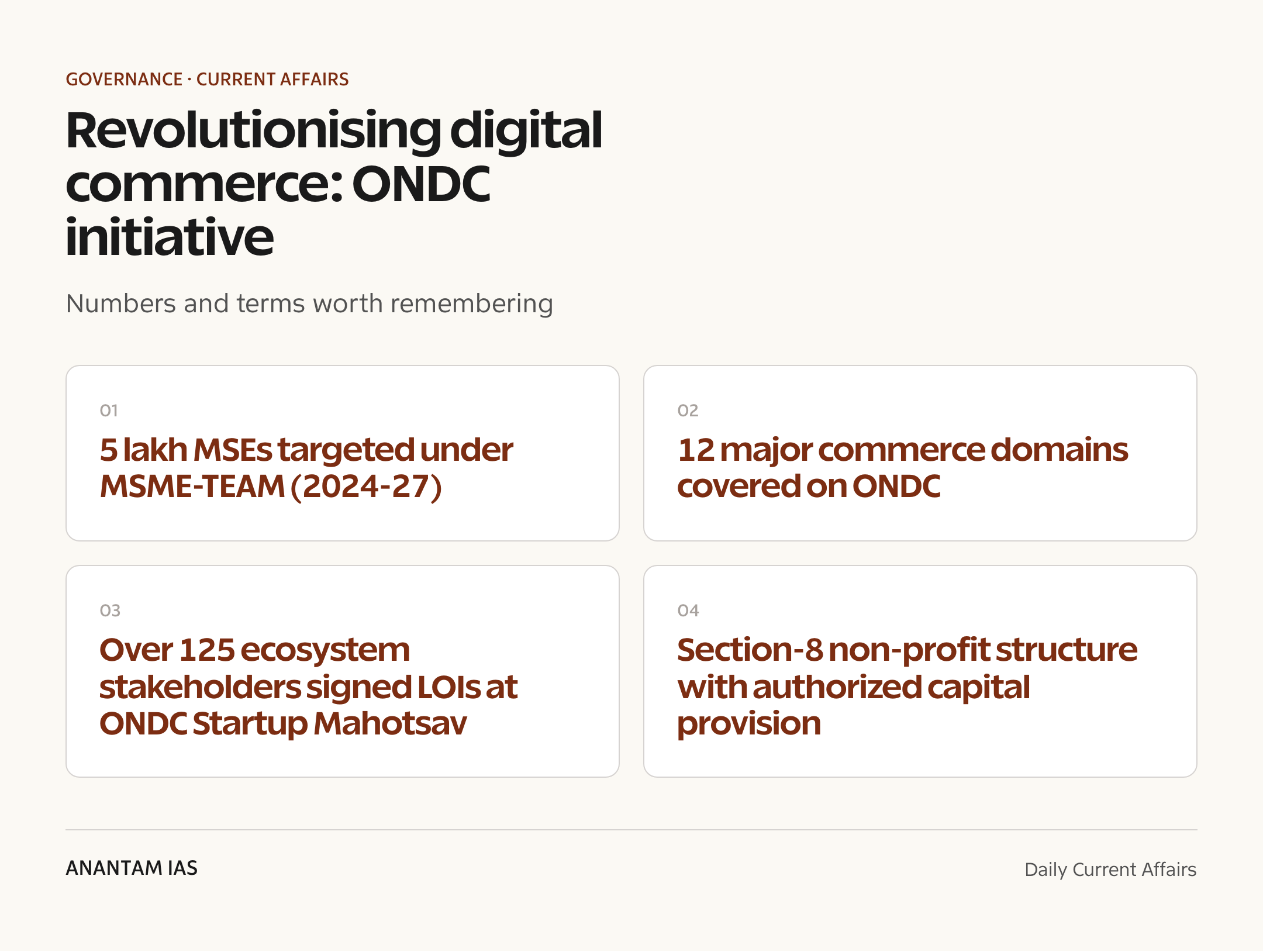
- MSME focus: Announcement of targeted onboarding and financial support under the MSME-TEAM scheme for 5 lakh MSEs.
- Scale-up signals: Reports of multiple Letter of Intents with startups and ecosystem players point to expanding network participation.
- Regulatory relevance: ONDC raises questions on competition policy, data governance and cross-platform interoperability.
The development matters in the context of:
- Origin and mandate: ONDC incorporated as a Section-8 non-profit to promote open networks for exchange of goods and services using open-source specifications and standardized APIs.
- Design principle: Decentralised architecture where buyers, sellers and service providers interact through protocol-level interoperability, not a single marketplace.
- Institutional backing: Incubated at Quality Council of India; Protean as co-founder; authorized capital provisioned to enable operations.
- Domains covered: Multi-sectoral — food, grocery, fashion, home, electronics, health, mobility, financial services, agriculture, education and more.
- Government linkages: DPIIT leads policy advocacy; collaborations with Ministries such as MSME for onboarding and with other departments for domain integration.
- Target outcomes: Increase discoverability for small sellers, reduce platform fees, stimulate competition, and foster localised digital commerce.

UPSC Relevance
Prelims Relevance
- Definition: Open Network for Digital Commerce — a protocol-based network to enable interoperable e-commerce.
- Basic facts: Incorporated as a Section-8 company, incubated at QCI; launched April 2022; active multi-domain network.
- Scheme specific: MSME-TEAM scheme for onboarding 5 lakh MSEs to ONDC, valid 2024-27 with priority to women-owned enterprises.
Mains Relevance
GS3 Economy
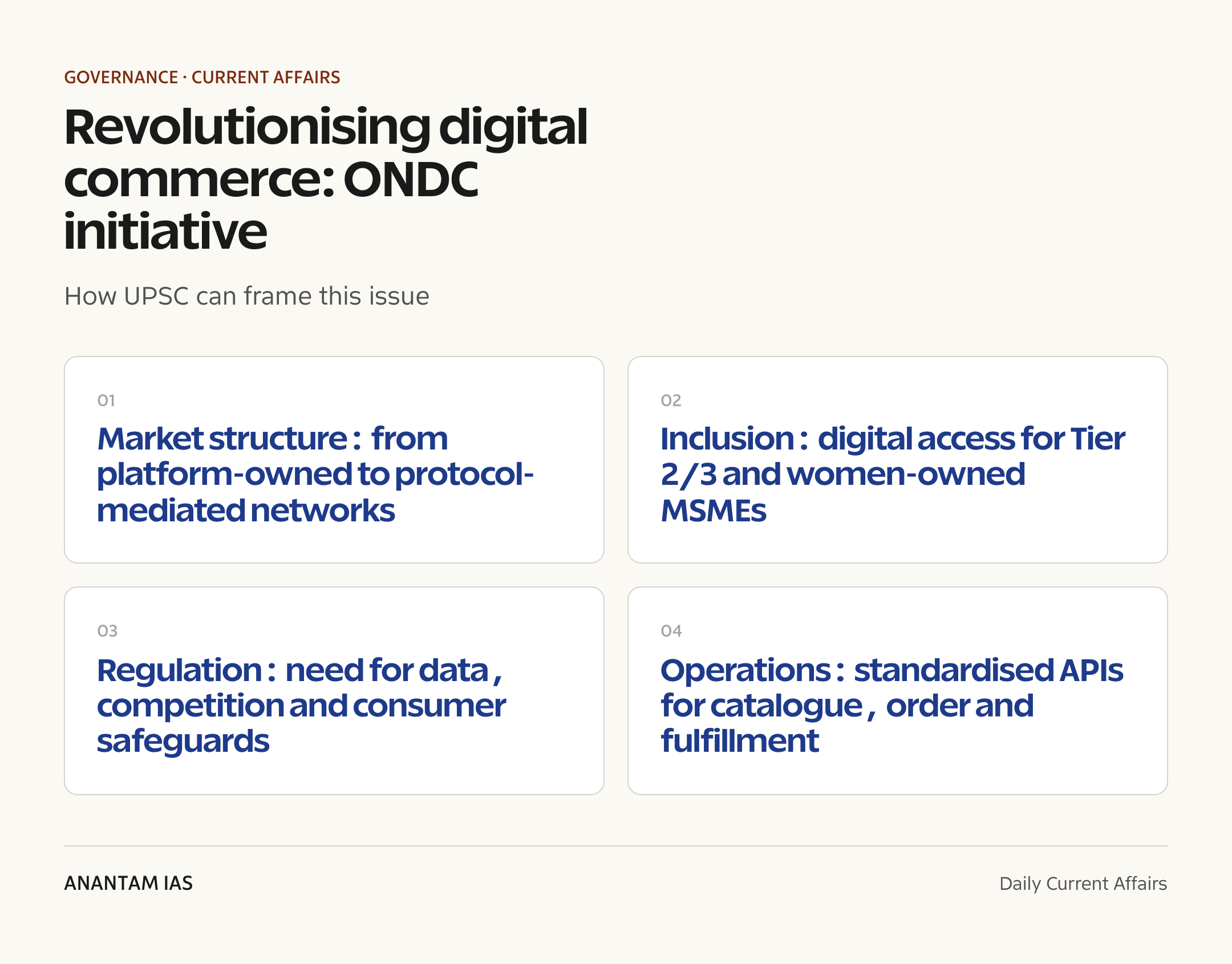
- Evaluate how open protocols can alter market power dynamics in digital platforms and implications for competition policy.
- Discuss policy measures required for digital inclusion of MSMEs and the role of public infrastructure in enabling access.
- Analyse governance trade-offs between decentralisation and the need for standards, security and consumer protection in digital commerce.
Essay
- Use ONDC as an example of public digital infrastructure shaping markets while balancing innovation and regulation.
- Discuss the broader theme of democratization of technology and implications for equitable economic growth and employment.
Background and Context
Genesis and institutional model
How ONDC was created and structured to operate as a public-good digital infrastructure.
- Launched in April 2022 with the aim to open e-commerce to protocol-based interoperability rather than platform lock-in.
- Incorporated as a Section-8 non-profit and incubated at the Quality Council of India to separate operational governance from commercial incentives.
- Protean joined as a co-founder and public and private financial institutions have contributed equity to provide an initial capital base.
- Model emphasises a startup mindset supported by government to accelerate adoption while retaining a neutral governance role.
Architecture and working
Technical and operational design that enables multiple buyers and sellers to transact over a common network.
- Based on open-source specifications and standardised APIs that enable discovery, catalogue, order, fulfillment and settlement across participants.
- Network roles include: Buyer apps, Seller apps, Gateway and logistics providers, and Registry/Certification entities.
- Interoperability allows a buyer on one app to place an order fulfilled by a seller discovered via another participant.
- Domains are organised so that verticals such as grocery, fashion, health and mobility can implement domain-specific rules on the shared protocol.
MSME focus and onboarding
Why small and micro enterprises are central to ONDC’s social and economic objectives.
- MSMEs face high platform fees, limited reach and dependence on a few large marketplaces for demand discovery.
- ONDC aims to reduce entry costs by standardising cataloguing and order management so sellers can switch between ONDC-compatible front ends.
- The MSME-TEAM scheme targets 5 lakh MSEs for onboarding from 2024 to 2027 with financial assistance for catalogue creation, logistics and packaging.
- Priority components include outreach in Tier 2/3 cities, cluster-level training and special focus on women-owned and SC/ST enterprises.
Scale-up and ecosystem engagement
Progress on partnerships, events and private sector participation that indicate practical adoption.
- DPIIT convened the ONDC Startup Mahotsav in May 2024, with around 5,000 participants and over 125 ecosystem stakeholders signing Letters of Intent.
- Startups and established firms from travel, healthcare, fintech and retail have signalled intent to interoperate using ONDC protocols.
- Evidence of cross-domain pilots indicates viability for vertical expansion into services, mobility and financial services.
- Recognition via awards on e-governance and disruptive tech reflects growing institutional acceptance and validation.
Economic and market implications
How ONDC could alter competition, prices and firm strategies in the digital economy.
- By lowering switching costs, ONDC can weaken network effects that sustain platform monopolies, increasing competition.
- Greater discoverability for small sellers can increase market fragmentation and reduce concentrated market shares held by incumbents.
- Potential reduction in platform commission fees can increase margins for sellers but may shift monetisation to services like logistics or advertising.
- Wider participation may increase consumer choice, localised offers and help formalisation of informal sellers via digital footprints.
Regulatory and governance questions
Policy issues that arise as the network expands and interacts with existing laws and market practices.
- Interoperability raises issues of data portability, consent and cross-platform data flows that need clear rules and oversight.
- Competition authorities will need to define abuse in protocol-level markets and assess whether dominant gateway services can emerge.
- Standards for consumer protection, dispute resolution and quality certification must be integrated into the network architecture.
- Cybersecurity, fraud prevention and identity verification demand robust technical and legal frameworks to maintain trust in the network.
Way Forward
Strengthen technical standards and certification
- Develop comprehensive security and data governance standards for all participants, including mandatory audits.
- Create a transparent certification regime for seller and buyer apps to ensure protocol compliance and consumer protection.
- Establish domain-specific quality marks that can be displayed by compliant seller apps to build trust.
- Publish developer-friendly documentation and sandboxes to accelerate third-party integrations.
Support MSME onboarding and capacity building
- Scale up the MSME-TEAM initiative with targeted grants for catalogue digitisation, packaging and logistics integration.
- Run cluster-based training in Tier 2 and Tier 3 towns with hand-holding for women-owned and SC/ST enterprises.
- Partner with state governments and industry associations to create local support centres for onboarding and dispute redressal.
- Provide microcredit linkages and simplified digital KYC pathways to enable rapid seller activation on the network.
Regulatory and competition safeguards
- Coordinate with the Competition Commission and IT regulators to set rules for gateway neutrality and prevent exclusionary practices.
- Draft clear data portability and consent norms specific to protocol-level transactions to protect consumer privacy.
- Introduce monitoring mechanisms to detect emergent gatekeepers and mandate interoperability obligations if needed.
- Set time-bound grievance resolution standards and a central Ombudsperson for cross-platform disputes.
Market development and incentives
- Provide performance-linked incentives for logistics and payments providers to plug last-mile gaps in smaller towns.
- Pilot public procurement use-cases where government buying occurs via ONDC to create initial transactional volume.
- Encourage anchor buyers such as large institutional cafeterias, hospitals and educational institutions to transact over ONDC.
- Run consumer-awareness drives highlighting benefits of choice, price discovery and local merchant support on the network.
Conclusion
ONDC represents a shift from platform-centric marketplaces to protocol-driven digital infrastructure that can democratise e-commerce.
Realising benefits requires parallel action on standards, MSME capacity building and regulatory safeguards to manage new market dynamics.
If successfully implemented, ONDC can expand digital market access for millions of micro and small sellers and reshape competition in India’s digital economy.
UPSC Practice Questions
Prelims MCQ 1
(a) A and C (b) B and D (c) Only B (d) Only D
Answer: (b) B and D
Explanation:
ONDC is built on open-source specifications and standardised APIs to enable interoperability. It was incorporated as a Section-8 non-profit. It is not a private for-profit marketplace nor restricted to large firms.
Prelims MCQ 2
(a) A, B and C (b) A and D (c) Only D (d) B and D
Answer: (a) A, B and C
Explanation:
MSME-TEAM targets 5 lakh MSEs, offers assistance for catalogue preparation and logistics, and is valid from 2024 to 2027. It does not exclusively benefit urban large retailers; it focuses on micro and small enterprises including women-owned and cluster-based units.
UPSC Mains Questions
- {‘q’: “Critically examine how ONDC’s protocol-based model can influence competition in India’s digital commerce market. Discuss the regulatory measures required to prevent emergence of new gatekeepers.”, ‘model_answer’: ‘Introduce ONDC and explain protocol-based interoperability. Analyse how reduced switching costs and standardised discovery can dilute network effects that favour incumbents. Discuss potential for new intermediaries (gateway services, logistics aggregators, specialized registries) to become gatekeepers. Recommend regulatory measures: gateway neutrality rules, monitoring by Competition Commission, data portability and consent rules, certification for market participants, mandated open APIs for essential services, and an Ombudsperson for disputes. Conclude on balancing innovation with oversight.’}
- {‘q’: ‘Assess the role of ONDC in promoting digital inclusion of MSMEs. What complementary policy measures should the government adopt to ensure equitable outcomes?’, ‘model_answer’: “Explain ONDC’s benefits for MSMEs: discoverability, lower entry costs, multi-app presence. Evaluate barriers: digital literacy, catalogue preparation costs, logistics and payment access. Recommend complementary policies: expand MSME-TEAM funding, local training centres, simplified digital KYC, targeted microcredit, partnerships with state clusters, and incentives for last-mile logistics and payments. Emphasise monitoring impact metrics like onboarded merchants, transactions in Tier 2/3 towns and women-owned enterprise participation.”}
Source: PIB, Ministry of Commerce & Industry.
Frequently Asked Questions
q
a
q
a
q
a
q
a
q
a
q
a