One Health Surveillance: Uttar Pradesh Targets Emerging Zoonotic Diseases
Why in News?
The Hindu reported that Uttar Pradesh is strengthening the early identification and reporting of emerging zoonotic diseases through a One Health initiative associated with the RISE Global Health Security project .
- The initiative places the Animal Husbandry Department inside a public-health preparedness framework instead of treating animal outbreaks only as a livestock-productivity issue.
- Its stated priorities include stronger disease surveillance, early reporting, laboratory capacity and rapid multisectoral response.
- Jhpiego describes its India global-health-security work as supporting One Health approaches, laboratory systems, disease surveillance and antimicrobial-resistance containment.
- The development complements India’s existing National One Health Mission and NCDC’s National One Health Programme for Prevention and Control of Zoonoses rather than replacing them.
- The immediate governance challenge is interoperability: a warning from a veterinarian, clinician, wildlife official or environmental monitor must trigger a defined process for verification, data sharing and joint action.
- A zoonosis is an infection naturally transmissible between vertebrate animals and humans. Transmission may be direct or occur through food, water, vectors or contaminated environments.
- The One Health approach recognizes that the health of humans, domestic and wild animals, plants and ecosystems is closely linked.
- Early animal or environmental signals can create a lead-time advantage before human cases become widespread, but only when field reporting is connected to diagnostics and decision-making.
UPSC Relevance
Prelims Relevance
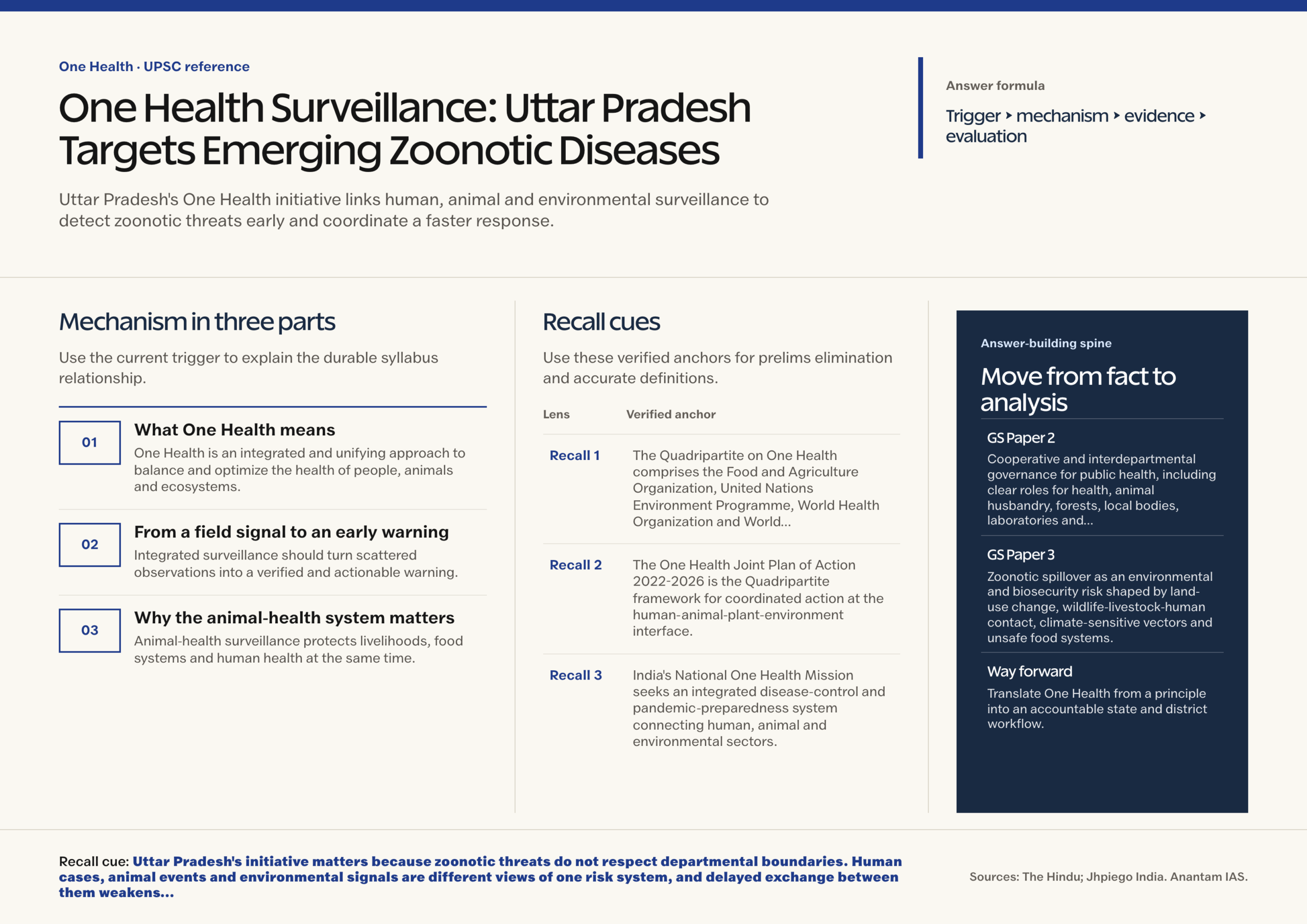
- The Quadripartite on One Health comprises the Food and Agriculture Organization, United Nations Environment Programme, World Health Organization and World Organisation for Animal Health.
- The One Health Joint Plan of Action 2022-2026 is the Quadripartite framework for coordinated action at the human-animal-plant-environment interface.
- India’s National One Health Mission seeks an integrated disease-control and pandemic-preparedness system connecting human, animal and environmental sectors.
- The National Centre for Disease Control under the Directorate General of Health Services runs the National One Health Programme for Prevention and Control of Zoonoses.
- The NCDC programme aims to institutionalize coordination from the national to village level and strengthen joint surveillance, diagnostics, training and outbreak investigation.
- The Department of Animal Husbandry and Dairying is under the Ministry of Fisheries, Animal Husbandry and Dairying, not the Union Health Ministry.
Mains Relevance
GS Paper 2
- Cooperative and interdepartmental governance for public health, including clear roles for health, animal husbandry, forests, local bodies, laboratories and disaster-management institutions.
- The need to connect frontline reporting, referral laboratories, risk communication and district-level decisions instead of building isolated digital dashboards.
GS Paper 3
- Zoonotic spillover as an environmental and biosecurity risk shaped by land-use change, wildlife-livestock-human contact, climate-sensitive vectors and unsafe food systems.
- The role of integrated surveillance, genomic and conventional diagnostics, joint risk assessment and rapid response in pandemic preparedness.
Essay
- Public health begins before the hospital: prevention depends on the condition of animals, food systems, water, land and ecosystems.
Background and Context
What One Health means
One Health is an integrated and unifying approach to balance and optimize the health of people, animals and ecosystems.
- The approach starts from interdependence. Human exposure can be shaped by animal infection, food production, vector ecology, land use, water quality and environmental contamination.
- It does not merge every department into one agency. It creates shared priorities, interoperable information, joint assessment and coordinated interventions while sectors retain their expertise.
- The environmental pillar is essential. Monitoring only patients and livestock may miss changes in wildlife mortality, vectors, water or habitat that provide an earlier warning.
- The Quadripartite gives the approach global institutional form through FAO, UNEP, WHO and WOAH. Their Joint Plan of Action links prevention, detection, preparedness and response.
- A One Health label has little value without operational rules: who reports, which event crosses a threshold, where a sample travels, who can see the result and who leads the response.
From a field signal to an early warning
Integrated surveillance should turn scattered observations into a verified and actionable warning.
- Signals may begin with unusual illness or death in animals, a cluster of fever among exposed people, an unexpected laboratory result, a change in vector abundance or contamination detected in food or water.
- Frontline workers need simple case and event definitions, safe sampling methods, reporting channels and feedback. Reporting falls when workers submit alerts but never learn what happened next.
- District teams should triage and verify the signal, connect epidemiological and laboratory evidence, assess exposure and decide whether joint investigation is required.
- A joint investigation may include public-health doctors, veterinarians, laboratory specialists, entomologists, wildlife or forest personnel, food-safety officials and local-government staff depending on the hazard.
- The response can include clinical care, animal-health measures, vaccination where applicable, vector control, safe carcass or waste management, food-safety action, community advice and protection of exposed workers.
Why the animal-health system matters
Animal-health surveillance protects livelihoods, food systems and human health at the same time.
- Veterinarians and livestock workers may observe a disease event before hospitals see a recognizable human cluster. That makes animal reporting an upstream component of health security.
- Farmers may hesitate to report illness if isolation, culling or market restrictions create uncompensated loss. A trusted system needs proportionate controls, transparent communication and timely support where law and policy provide it.
- Animal samples and human samples may move through different laboratory networks. Comparable identifiers, timestamps and location data can support joint analysis without collapsing separate legal and professional responsibilities.
- The Union Department of Animal Husbandry and Dairying’s Livestock Health and Disease Control Programme supports vaccination, veterinary services, surveillance and infrastructure for important, zoonotic, exotic and emerging animal diseases.
- Wildlife surveillance also matters because separation between animal and human monitoring can allow cross-species spillover signals to pass unnoticed. Surveillance should be risk-based and scientifically designed, not indiscriminate disturbance of wildlife.
India's One Health architecture
The Uttar Pradesh initiative sits within a wider national architecture that already assigns roles to research, surveillance and field programmes.
- NCDC’s National One Health Programme for Prevention and Control of Zoonoses seeks coordination at national, state, district, block and village levels.
- Its stated work includes regional coordination, sentinel surveillance, diagnostic support, workforce training, joint outbreak investigation, community outreach and stronger wildlife-pathogen surveillance.
- The National One Health Mission has a broader vision: integrated disease control and pandemic preparedness through human, animal and environmental collaboration.
- ICMR is strengthening infectious-disease research and diagnostic laboratories and has supported surveillance models for higher-risk interfaces such as bird sanctuaries, wetlands and slaughterhouses.
- State initiatives should map themselves to these systems. Parallel portals, competing reporting formats or donor-dependent units can deepen fragmentation if they are not institutionalized inside government workflows.
Way Forward
Create one operational protocol
- Define priority signals, notification timelines, nodal officers, verification steps and authority for joint investigation across relevant departments.
- Use common minimum fields and secure exchange standards so existing sectoral systems can share alerts without forcing duplicate data entry.
- Map field collection points, transport routes, district laboratories and reference laboratories; publish expected turnaround for each stage.
- Invest in biosafety, quality assurance, trained staff and referral logistics alongside newer diagnostic technology.
Conclusion
- Uttar Pradesh’s initiative matters because zoonotic threats do not respect departmental boundaries.
- The strongest One Health model is not the largest dashboard.
- If the RISE collaboration strengthens that chain inside permanent state institutions, it can improve routine disease control and pandemic preparedness together.
UPSC Practice Questions
Prelims MCQ 1
With reference to the One Health approach, consider the following statements:
- The Quadripartite collaboration includes FAO, UNEP, WHO and the World Organisation for Animal Health.
- One Health is limited to diseases transmitted directly from domestic animals to humans.
- Environmental surveillance can contribute to the early detection and prevention of zoonotic threats.
How many of the above statements are correct?
(a) Only one (b) Only two (c) All three (d) None
Answer: (b) Only two
Explanation:
Statements 1 and 3 are correct. One Health addresses interconnected human, animal, plant and ecosystem health and is wider than direct transmission from domestic animals. It also covers risks such as antimicrobial resistance, food safety and environmental drivers.
Prelims MCQ 2
Which one of the following institutions runs India’s National One Health Programme for Prevention and Control of Zoonoses?
(a) National Centre for Disease Control (b) National Biodiversity Authority (c) Central Pollution Control Board (d) Food Corporation of India
Answer: (a) National Centre for Disease Control
Explanation:
The National Centre for Disease Control, under the Directorate General of Health Services in the Union Health Ministry, runs the programme. It seeks intersectoral coordination, surveillance, diagnostic support, capacity building and joint action on zoonoses.
UPSC Mains Questions
- One Health surveillance is primarily a governance reform, not merely a technological upgrade. Discuss with reference to coordination among human-health, animal-health and environmental institutions. (15 marks, 250 words)
- Explain how integrated zoonotic-disease surveillance can create an early-warning advantage. What institutional, laboratory and community-level gaps must states address to convert signals into timely action? (15 marks, 250 words)
Sources: The Hindu and Jhpiego India.
Frequently Asked Questions
What is One Health surveillance?
One Health surveillance connects information about human, animal and environmental health to detect and assess shared threats. It combines routine case and laboratory data with unusual-event reporting, then supports joint verification, risk assessment and response. It does not require every.
What is a zoonotic disease?
A zoonotic disease is an infection naturally transmissible between vertebrate animals and humans. Transmission may occur through direct contact, food, water, vectors or contaminated environments. Rabies, brucellosis, leptospirosis and zoonotic influenza are examples, although each has a different reservoir, route.
What is the RISE Global Health Security project doing in Uttar Pradesh?
The reported collaboration involving Uttar Pradesh’s Animal Husbandry Department and Jhpiego aims to strengthen zoonotic-disease surveillance, early identification and reporting, laboratory systems and multisectoral outbreak response through a One Health approach. Publicly stated priorities establish the direction; operational coverage and.
Which organizations form the One Health Quadripartite?
The Quadripartite comprises the Food and Agriculture Organization of the United Nations, the United Nations Environment Programme, the World Health Organization and the World Organisation for Animal Health. It developed the One Health Joint Plan of Action 2022-2026 to support.
How does India’s National One Health Mission differ from the NCDC zoonoses programme?
The National One Health Mission provides a broad national vision for integrated disease control and pandemic preparedness across human, animal and environmental sectors. NCDC’s National One Health Programme for Prevention and Control of Zoonoses is a health-programme mechanism focused on.