One Nation One Subscription: Research Access for Public Institutions
Why in News?
The Union Cabinet approved the One Nation One Subscription (ONOS) scheme on 25 November 2024 and the scheme is slated to be implemented from 1 January 2025. ONOS centralises procurement and licensing of international scholarly journals and articles for government higher education institutions (HEIs) and central government R&D centres, enabling nationwide digital access to subscription content without individual institutional subscriptions.
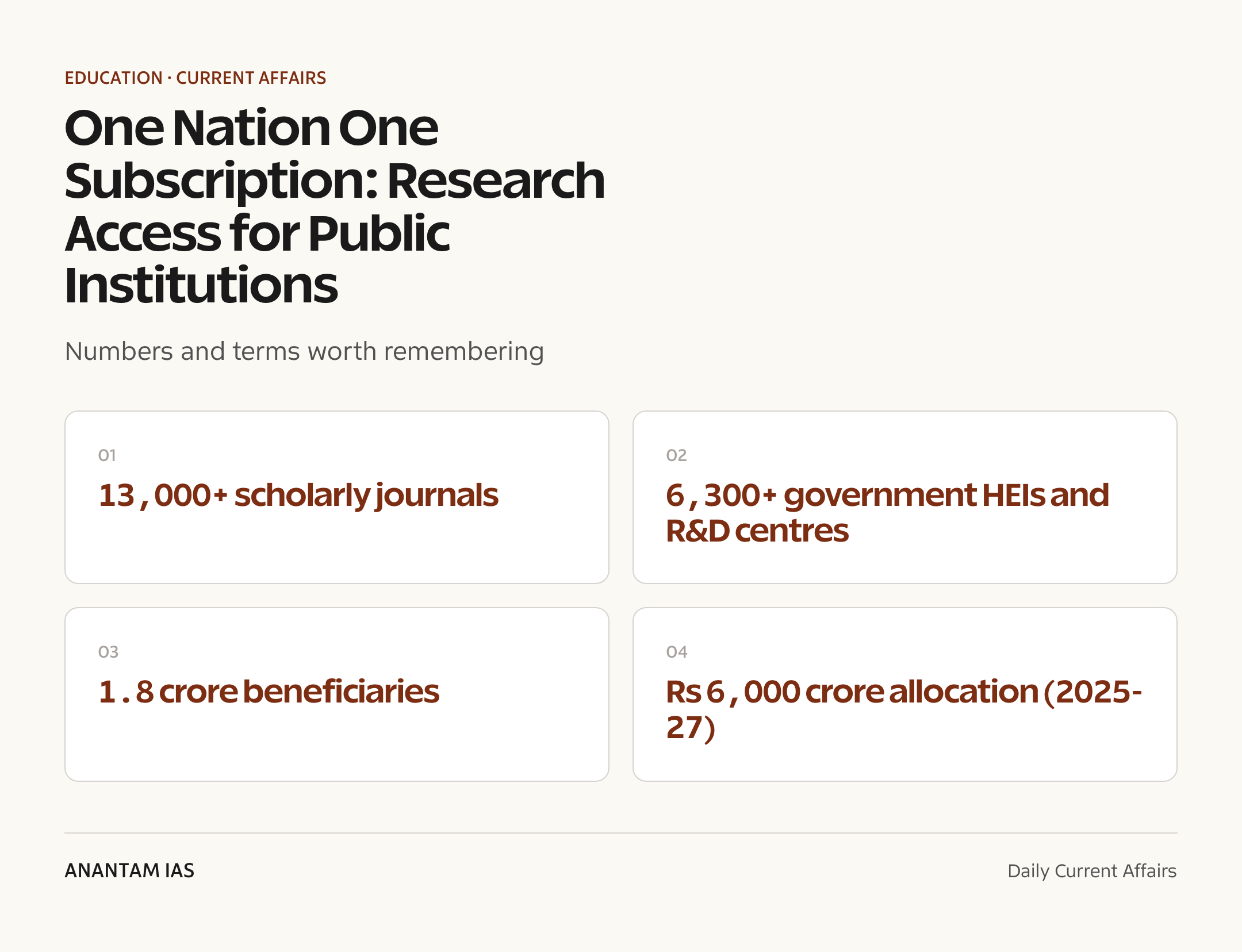
The announcement carries a targeted three-year funding envelope of Rs 6,000 crore (1 January 2025 to 31 December 2027) and promises access to more than 13,000 journals from around 30 major international publishers. The scale — covering over 6,300 government-managed HEIs and an estimated 1.8 crore beneficiaries — makes ONOS a significant national intervention in knowledge access and research-support infrastructure.
- Cabinet approval: ONOS has been approved as a centrally funded scheme to negotiate and provide subscription access on behalf of eligible government HEIs and central R&D institutions.
- Scale and scope: It targets coverage of over 13,000 scholarly journals from about 30 international publishers, extending benefits to roughly 1.8 crore students, faculty and researchers across more than 6,300 institutions.
- Funding and timeline: A budgetary allocation of Rs 6,000 crore has been provided for the initial three-year phase (2025–2027) to operationalise procurement, access management and capacity building.
The development matters in the context of:
- NEP 2020 alignment: The National Education Policy 2020 emphasises strengthening research culture and capacity in HEIs; ONOS operationalises the access component of that strategic aim.
- Jai Anusandhan and Viksitbharat@2047: Political and policy initiatives encouraging a national research push provide the impetus for measures that expand researchers’ access to global literature.
- Existing consortia experience: Several ministries and institutions have run subscription consortia; ONOS seeks to scale those lessons into a unified national model to improve negotiating leverage.
- Digital emphasis and repositories: The scheme focuses on electronic access via institutional authentication and is intended to complement investments in repositories, Indian journals and open access infrastructure.
- Time-bound pilot: The three-year window provides a period to stabilise licensing, monitor usage patterns and design a sustainable transition plan beyond subscription-heavy models.

UPSC Relevance
Prelims Relevance
- What ONOS provides: centralised digital access to international journals for public HEIs and central R&D institutions across disciplines.
- Key numbers: 13,000+ journals, 6,300+ institutions, ~1.8 crore beneficiaries, Rs 6,000 crore funding for 2025–2027.
- Implementation actors: Ministry of Education as nodal sponsor with designated agencies to handle procurement, authentication, access control and analytics.
Mains Relevance
GS2 Education
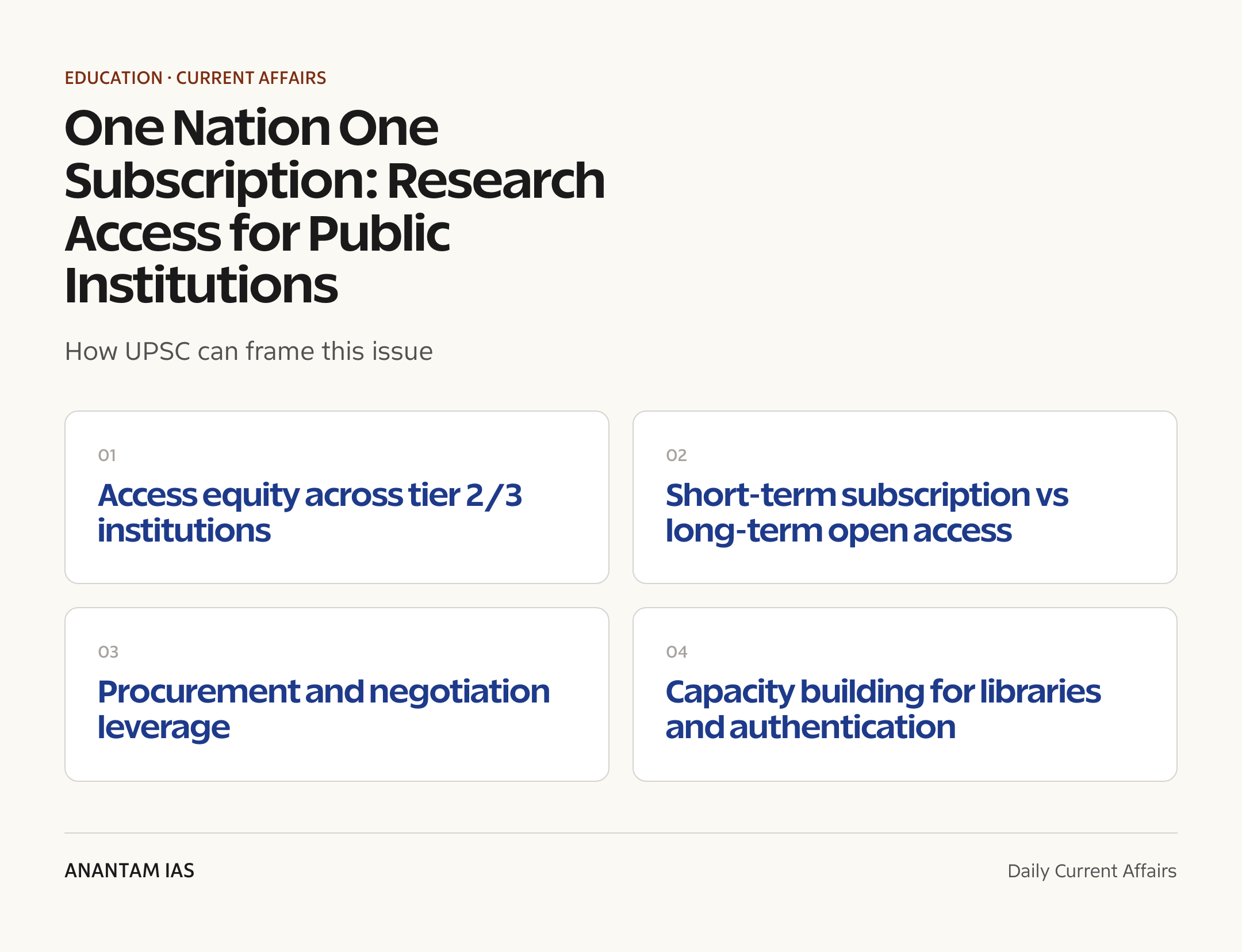
- Policy design and equity: Evaluate centralised procurement versus institutional autonomy, including trade-offs between negotiating power and local needs.
- Research quality and innovation: Discuss the anticipated impact on research outputs, collaborations, citation networks and translation of research into innovation.
- Fiscal and governance implications: Assess budgetary sustainability, procurement transparency, contractual safeguards (archival access, text-mining rights) and integration with open access goals.
Essay
- Themes: Education reform, science and technology policy, knowledge equity, capacity building and India’s development trajectory to 2047.
- Arguments: Case for facilitating access to global knowledge as a driver of development; examining how subscription access must be paired with open-science investments for long-term resilience.
Background and Context
Policy genesis
ONOS builds on policy pronouncements and the NEP 2020 focus on research-driven higher education.
- NEP 2020 places research and innovation at the centre of higher education reform and recommends strengthening institutional research capacity.
- Statements such as ‘Jai Anusandhan’ and the Viksitbharat@2047 vision elevated research as a national priority and underscored the need for broad access to global knowledge resources.
- Prior experiments with consortia by ministries and large universities exposed operational models for centralised subscriptions and shared services.
- Policymakers identified paywalls as a structural barrier for many public institutions, particularly in tier 2 and tier 3 cities, motivating a national scale intervention.
What ONOS offers
The scheme’s principal commitments as outlined by the Ministry of Education.
- Access to more than 13,000 scholarly journals from about 30 major international publishers spanning STEM, medicine, social sciences, humanities, management and professional subjects.
- Coverage envisaged for over 6,300 government-managed HEIs and central government R&D institutions, with estimated 1.8 crore beneficiaries including students, faculty and researchers.
- A dedicated budget allocation of Rs 6,000 crore to operationalise central procurement, licensing, authentication systems and capacity-building during 2025–2027.
- A time-bound approach to test procurement mechanisms, usage analytics, and to build the infrastructure for federated access and support services.
Implementation mechanics
How subscriptions, access and monitoring are expected to be organised under ONOS.
- Central procurement will involve negotiating national licenses with publishers, seeking bundled deals that include archival access and permissible uses such as text and data mining.
- Access management is likely to use a mix of IP-based access for institutional networks, federated logins (e.g., eduGAIN-like models) and individual credentials where necessary.
- Usage analytics and reporting are planned to inform renewal decisions by tracking downloads, active users, subject-wise demand and geographic distribution of usage.
- Operational responsibilities will include a nodal agency for licensing, technical teams for authentication, and local library networks to facilitate end-user support.
Equity and reach
The equity objective aims to reduce disparities in access between well-resourced and less-resourced institutions.
- Tier 2 and tier 3 colleges and remote institutions often lack budgets for multiple subscriptions; ONOS aims to remove that financial barrier by extending digital access.
- Digital-only delivery lowers logistical hurdles associated with print subscriptions, though it relies on adequate internet connectivity and local devices.
- Cross-disciplinary coverage ensures practitioners across social sciences, professional courses and humanities can benefit, not just STEM fields.
- Inclusion requires capacity building in institutional libraries so that faculty and students can discover and effectively use resources.
Synergies with open access
ONOS is positioned as an interim, pragmatic step that must work with the broader open science agenda.
- The scheme does not replace the long-term objective of expanding open access publishing and strengthening Indian journals and repositories.
- Practical measures could include negotiating offsetting agreements with publishers and safeguarding text- and data-mining rights for public research.
- Investment in national repositories, preprint servers and capacity to host Indian journals will be necessary to reduce dependence on subscription models over time.
- Research assessment reforms — rewarding open dissemination and reproducibility — would align incentives for authors to publish in accessible venues.
Fiscal and procurement challenges
While the initial allocation is sizeable, operational complexities will determine value for money.
- The Rs 6,000 crore allocation provides runway for three years, but long-term commitments need a sustainability plan that balances central support and institutional contributions.
- Transparent publisher negotiations are critical: rights such as perpetual archival access, multi-user licenses and text-mining must be secured.
- Measuring impact requires robust metrics beyond raw downloads — quality of use, citations, collaborative outputs and changes in research productivity matter.
- There is a risk of paying for low-usage titles; strategic curation and periodic reviews must avoid blanket renewals that waste public funds.
Way Forward
Usage-driven procurement and analytics
- Deploy advanced usage analytics to identify high-impact titles and subject gaps, guiding renewals and reallocation of spend.
- Implement periodic cost-benefit reviews to discontinue low-use subscriptions and reinvest in under-served disciplines.
- Use demand data to negotiate performance-based clauses with publishers, such as price adjustments tied to measured institutional usage.
Capacity building and authentication
- Strengthen institutional library infrastructure, including discovery platforms, link resolvers and training for librarians and researchers.
- Adopt federated authentication standards to provide secure and seamless off-campus access while protecting license terms.
- Provide user training modules and outreach to improve discoverability and proper citation practices among students and faculty.
Aligning subscriptions with open science
- Develop an explicit open access roadmap that runs in parallel — subsidise Indian journals, support repositories and negotiate offsetting deals.
- Mandate clauses in licensing that permit text and data mining for public-interest research and archival rights for long-term preservation.
- Reform research assessment frameworks to reward open dissemination and reproducibility, reducing incentives to publish solely in high-paywall journals.
Governance, transparency and sustainability
- Create an independent advisory committee comprising librarians, researchers, legal experts and government representatives to oversee renewals.
- Publish procurement outcomes, where contractual confidentiality allows, to build public trust and academic scrutiny into pricing and rights.
- Design a post-2027 funding strategy that blends central funding with calibrated institutional co-contributions and efficiency savings.
Conclusion
One Nation One Subscription is a major, time-bound initiative to democratise access to international scholarly literature for public HEIs and central R&D institutions. The scheme can raise research visibility and quality provided strong governance, demand-driven procurement and investments in library capacity accompany licensing. To realise long-term value, ONOS must be integrated with a broader open science strategy: strengthen Indian publishing and repositories, secure rights for archival and text-mining uses, and reform research assessment so that open dissemination is rewarded. Fiscal prudence, transparency in negotiations and an evidence-driven renewal process will determine whether ONOS becomes a bridge to an equitable, sustainable research ecosystem or a short-term bandage on systemic access challenges.
UPSC Practice Questions
Prelims MCQ 1
Which of the following are features of the One Nation One Subscription (ONOS) scheme announced for 2025?
(a) Centralised access to international journals for government HEIs and central R&D institutions (b) Access limited to only STEM journals (c) Allocation of Rs 6,000 crore for 2025-2027 (d) Coverage of over 13,000 scholarly journals
Answer: (a) and (c) and (d)
Explanation:
ONOS provides centralised access to international journals for government HEIs and central R&D centres, is funded with Rs 6,000 crore for 2025–2027, and covers over 13,000 journals. It is not restricted to STEM; social sciences, humanities and professional disciplines are included.
Prelims MCQ 2
ONOS primarily aims to address which issue in India’s higher education and research system?
(a) Digital infrastructure for online exams (b) Paywall-related barriers to accessing international scholarly literature (c) Faculty recruitment rules (d) Student loan interest rates
Answer: (b)
Explanation:
The core objective of ONOS is to remove paywall barriers by providing centralised access to international journals for eligible public institutions. The scheme does not directly target online exam infrastructure, faculty recruitment or student loan policies.
UPSC Mains Questions
- {‘question’: ‘Analyse how One Nation One Subscription can influence research quality and innovation capacity in India. What governance and fiscal safeguards are needed to ensure long-term impact?’, ‘answer’: ‘Comprehensive answers should argue that ONOS will increase access to global literature, enabling researchers in smaller institutions to engage with current scholarship, design better experiments and collaborate internationally. This can raise the baseline research quality, diversify citation networks and accelerate translation of research into innovation. Safeguards needed include: transparent national procurement with clauses on archival and text-mining rights; independent oversight for renewals based on usage and impact metrics; capacity building for institutional libraries and federated authentication; phased co-funding mechanisms and periodic cost-benefit analysis to ensure fiscal sustainability; and parallel investments to strengthen Indian journals and open repositories so dependence on paid subscriptions reduces over time.’}
- {‘question’: ‘Critically examine the tension between subscription-based national access schemes and the open access movement. How should India reconcile short-term access needs with long-term open science goals?’, ‘answer’: ‘Model answers should note the practical tension: subscription deals provide immediate, broad access but reinforce pay-to-read models that can crowd out open access growth. Reconciling the two requires a two-track strategy: use central subscriptions as a transitional measure while negotiating offsetting agreements and clauses that support open access (e.g., APC discounts, read-and-publish deals), invest in capacity for domestic journal publishing and repositories, reform evaluation metrics to reward open dissemination and reproducibility, and allocate funds to subsidise APCs for Indian authors. Policy coherence across funding agencies, publishers and institutions will be crucial for a smooth transition.’}
Source: PIB, Ministry of Education.
Frequently Asked Questions
q
a
q
a
q
a
q
a
q
a