One Nation One Subscription (ONOS): Rs 6,000-Crore Push for Research Journal Access
Why in News?
A recent policy commentary carried by The Hindu and analysed by Legacy IAS has revived scrutiny of One Nation One Subscription (ONOS), the centrally funded scheme that pools the country’s subscription budget to buy bulk access to international research journals. The piece argues that ONOS has solved the reading problem for cash-strapped colleges while leaving the deeper publishing problem untouched.
With the scheme now operational for over a year and its first three-year cycle running from 2025 to 2027, the debate has shifted from access to self-reliance — whether India should keep subsidising foreign publishers to read its own publicly funded research, or invest in domestic open-access platforms aligned with NEP 2020 and the Anusandhan National Research Foundation.
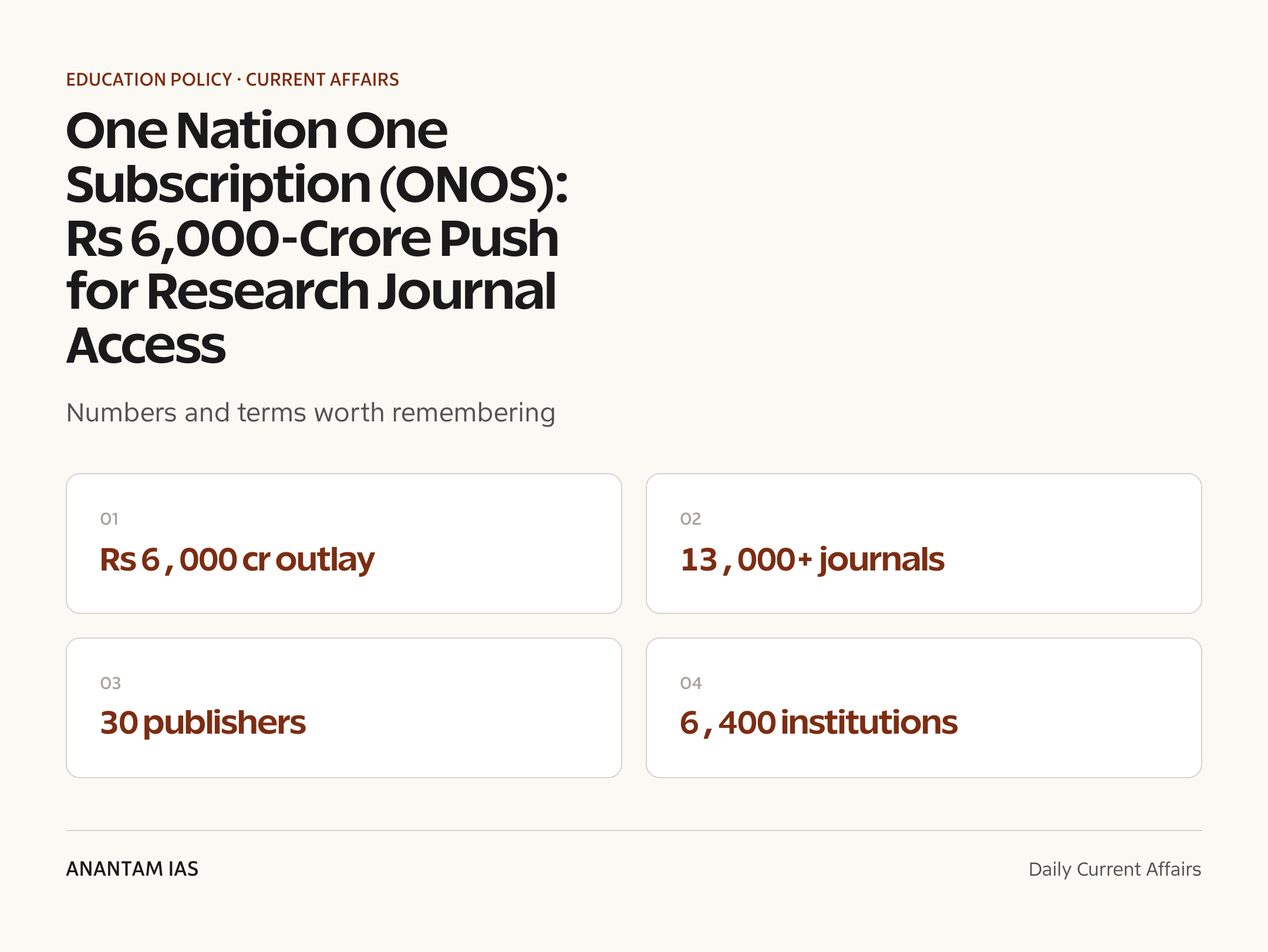
- ONOS commits Rs 6,000 crore over three years (2025-2027) to centrally negotiate and fund journal subscriptions for public institutions.
- The scheme covers 30 international publishers and more than 13,000 e-journals, reaching nearly 6,400 institutions.
- An estimated 1.8 crore students, faculty and researchers become eligible beneficiaries.
- Commentary flags continued dependence on commercial publishers and the absence of a transparent post-2027 strategy.
- Critics contrast India’s subscribe-and-read model with global moves toward diamond open access and immediate open-access mandates.
The development matters in the context of:
- Before ONOS, India ran several fragmented consortia (such as e-ShodhSindhu) where individual institutions negotiated separately, leaving smaller colleges with patchy access.
- The Union Cabinet approved ONOS on 25 November 2024; the access portal became functional in January 2025, with publisher agreements and payments finalised by March 2025.
- ONOS is positioned as a flagship deliverable under the research ecosystem reforms envisaged in NEP 2020.
UPSC Relevance
Prelims Relevance
- ONOS is a central-sector scheme of the Department of Higher Education, Ministry of Education.
- The implementing agency is the INFLIBNET Centre, an Inter-University Centre under the University Grants Commission (UGC).
- Total outlay: Rs 6,000 crore for the first cycle, 2025 to 2027.
- Coverage: 30 publishers, over 13,000 journals, and nearly 6,400 government higher-education and central R&D institutions.
- A dedicated fund of Rs 150 crore per year supports Article Processing Charges (APCs) for open-access publishing.
- INFLIBNET is headquartered in Gandhinagar, Gujarat, and also runs Shodhganga (theses repository) and Shodh Shuddhi (anti-plagiarism).
- The Anusandhan National Research Foundation (ANRF), set up under the ANRF Act 2023, is the apex body funding and steering research in India.
- Diamond open access means publication that is free to both read and publish, with no Article Processing Charge.
Mains Relevance
GS Paper 2
- Government policies and interventions for development in the education sector and issues arising from their design and implementation — ONOS as a case study in centralised welfare delivery.
- Role of the state in widening access to knowledge as a public good, and equity between tier-1 and tier-2/tier-3 institutions.
- Centre-state and institutional coordination through a single negotiating agency (INFLIBNET) to achieve scale and bargaining power.
GS Paper 3
- Science and technology developments and their applications — building a self-reliant research and innovation ecosystem.
- Issues of intellectual property, publishing sovereignty, and dependence on foreign commercial platforms for publicly funded research.
Essay
- Knowledge as a public good versus knowledge as a commodity.
- Self-reliance and Atmanirbharta in the digital knowledge economy.
Background and Context
What ONOS Is and How It Is Designed
ONOS replaces fragmented institution-by-institution deals with a single national licence negotiated centrally.
- It is a central-sector scheme fully funded by the Department of Higher Education, with no matching state contribution required.
- The INFLIBNET Centre under UGC negotiates one country-wide agreement with each publisher, giving India far stronger bargaining leverage than scattered libraries.
- Access is delivered through a unified portal with on-campus and remote login, so a researcher in a district college reads the same journals as one in a metro university.
- The first cycle runs 2025 to 2027 with a total commitment of Rs 6,000 crore.
Coverage and Scale
The numbers explain why ONOS is treated as a structural reform rather than a routine subscription.
- 30 major international publishers are on board, including the large commercial houses that dominate scholarly publishing.
- More than 13,000 e-journals are made accessible under one licence.
- Coverage extends to nearly 6,400 institutions — government higher-education bodies and central-government R&D laboratories.
- The eligible reach is roughly 1.8 crore students, faculty and researchers.
The Access Gap It Addresses
The core problem ONOS targets is the unequal reading access that held back research outside elite institutions.
- Premier institutes could afford rich journal bundles; most state universities and tier-2 and tier-3 colleges could not, creating a sharp reading divide.
- Subscription paywalls priced out exactly the students who most needed current literature for projects and dissertations.
- By centralising the spend, ONOS converts uneven institutional budgets into one equitable national entitlement.
- This directly serves the equity and quality goals of NEP 2020 for higher education.
The Open-Access and APC Debate
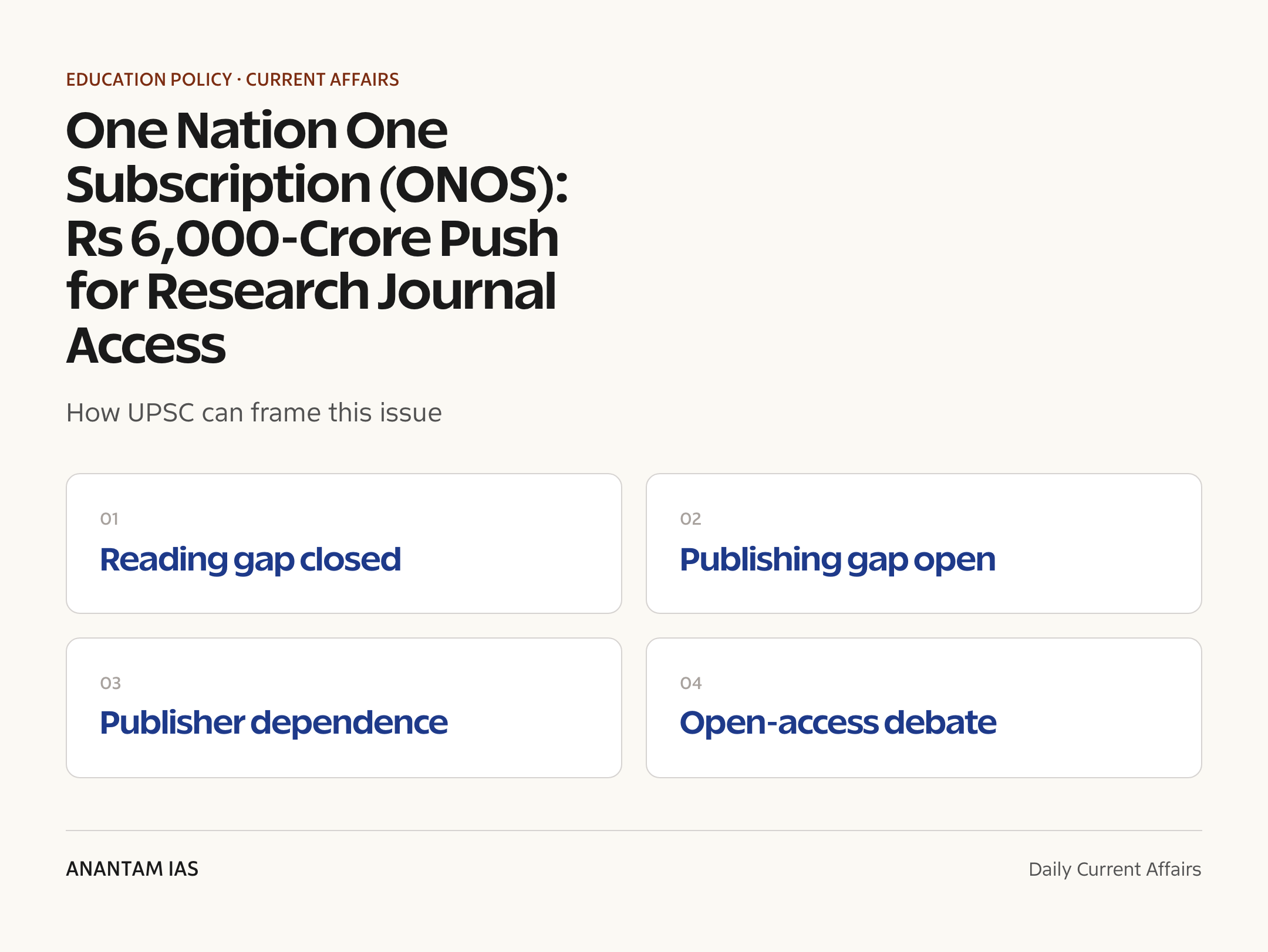
Critics argue ONOS fixes who can read, not who can afford to publish.
- Much of the content ONOS pays for is already freely available through preprints and open repositories, raising value-for-money questions.
- Indian authors still face steep Article Processing Charges to publish open access; ONOS sets aside Rs 150 crore a year for APCs, but this is modest against demand.
- The commentary contrasts India’s model with diamond open access (free to read and publish) used in parts of Europe, and Australia’s push for immediate open-access mandates.
- The concern is that the scheme subsidises reading without changing the economics that keep publishing expensive for Indian scholars.
Dependence on Commercial Publishers
A single large cheque to global publishers raises a sovereignty question.
- ONOS deepens reliance on a handful of commercial publishers who set prices and control the most-cited titles.
- India effectively keeps paying foreign firms to access research that its own public money funded — a knowledge-sovereignty gap.
- There is limited public clarity on per-publisher pricing and on the negotiating terms.
- No transparent post-2027 strategy has been disclosed, leaving long-run cost escalation an open risk.
Links to NEP 2020 and ANRF
ONOS is one piece of a larger architecture meant to make Indian research globally competitive.
- NEP 2020 calls for a vibrant, equitable research culture; ONOS supplies the reading infrastructure that ambition needs.
- The Anusandhan National Research Foundation (ANRF), created under the ANRF Act 2023, is meant to fund and steer research at scale.
- Analysts urge channelling ANRF resources toward domestic open-access platforms and Indian-run journals rather than only foreign subscriptions.
- Read together, ONOS, NEP 2020 and ANRF form the spine of India’s bid for genuine research self-reliance.
Way Forward
Pair the reading entitlement with a credible open-access publishing path — scale the APC fund and back diamond open-access journals so Indian authors are not priced out.
Publish transparent per-publisher pricing and a disclosed post-2027 roadmap to avoid lock-in and runaway costs.
Use ANRF funding to build and sustain domestic platforms, indexing services and Indian-run journals that reduce dependence on foreign publishers.
Track outcomes — citations, publications and downloads from tier-2 and tier-3 institutions — to confirm the access gain converts into real research output.
Conclusion
ONOS is a genuine equity win: for the first time a college in a small town reads the same journals as a national institute, and the Rs 6,000-crore commitment signals that the government treats research access as a public good worth funding at scale.
The harder test is sovereignty. Unless the reading subsidy is matched by investment in open access and home-grown publishing through ANRF and NEP 2020, India risks paying global publishers indefinitely to read its own knowledge — solving the reading problem while the publishing problem quietly compounds.
UPSC Practice Questions
Prelims MCQ 1
Consider the following statements regarding the One Nation One Subscription (ONOS) scheme: 1. It is implemented by the INFLIBNET Centre, an Inter-University Centre under the University Grants Commission. 2. It is a centrally sponsored scheme requiring an equal matching contribution from state governments. 3. It includes a dedicated annual fund to support Article Processing Charges for open-access publishing. Which of the statements given above is/are correct?
1 and 2 only 1 and 3 only 2 and 3 only 1, 2 and 3
Answer: 1 and 3 only
Explanation:
ONOS is implemented by INFLIBNET under UGC and carries a Rs 150-crore-per-year APC fund, so statements 1 and 3 are correct. It is a central-sector scheme fully funded by the Centre, not a centrally sponsored scheme with state matching, so statement 2 is wrong.
Prelims MCQ 2
With reference to the research and education ecosystem in India, consider the following: 1. Anusandhan National Research Foundation (ANRF) 2. INFLIBNET Centre 3. Shodhganga Which of the above are associated with strengthening access to or funding of research?
1 and 2 only 2 and 3 only 1 and 3 only 1, 2 and 3
Answer: 1, 2 and 3
Explanation:
ANRF funds and steers research under the ANRF Act 2023; INFLIBNET implements ONOS and digital library services; Shodhganga is INFLIBNET’s repository of Indian theses and dissertations. All three strengthen the research ecosystem.
UPSC Mains Questions
- One Nation One Subscription solves the reading problem but not the publishing problem. Critically examine this statement in the context of India’s pursuit of knowledge sovereignty. (250 words)
- Evaluate how the One Nation One Subscription scheme advances the equity goals of NEP 2020, and discuss the risks of long-term dependence on commercial academic publishers. (250 words)
- Open access is a public good but its costs are unevenly borne. Discuss with reference to Article Processing Charges and the role the Anusandhan National Research Foundation can play. (150 words)
Sources: The Hindu (via Legacy IAS analysis) and INFLIBNET Centre, Ministry of Education.
Frequently Asked Questions
What is the One Nation One Subscription (ONOS) scheme?
ONOS is a central-sector scheme of the Department of Higher Education that pools the country’s subscription spending to buy a single national licence for international research journals, giving nearly 6,400 public institutions centrally funded access.
How much funding does ONOS have and for how long?
The scheme commits Rs 6,000 crore over its first three-year cycle, running from 2025 to 2027. It also sets aside Rs 150 crore per year to support Article Processing Charges for open-access publishing.
Which agency implements ONOS?
The INFLIBNET Centre, an Inter-University Centre under the University Grants Commission (UGC) in the Ministry of Education, implements the scheme and negotiates the national agreements with publishers.
How many journals and institutions does ONOS cover?
ONOS covers more than 13,000 e-journals from 30 international publishers, accessible to nearly 6,400 government higher-education and central R&D institutions, benefiting roughly 1.8 crore students, faculty and researchers.
Why do critics say ONOS does not go far enough?
Critics argue it fixes reading access but not publishing economics — Indian authors still pay steep Article Processing Charges, and the scheme deepens dependence on commercial publishers without a clear post-2027 plan or a strong push toward diamond open access.
How does ONOS connect to NEP 2020 and ANRF?
NEP 2020 envisions an equitable research culture and ONOS supplies the reading infrastructure for it, while the Anusandhan National Research Foundation (ANRF) is meant to fund research and could be channelled toward domestic open-access platforms to reduce reliance on foreign publishers.