Operation Chakra-VI: CBI’s nationwide crackdown on digital-arrest scam networks
Why in News?
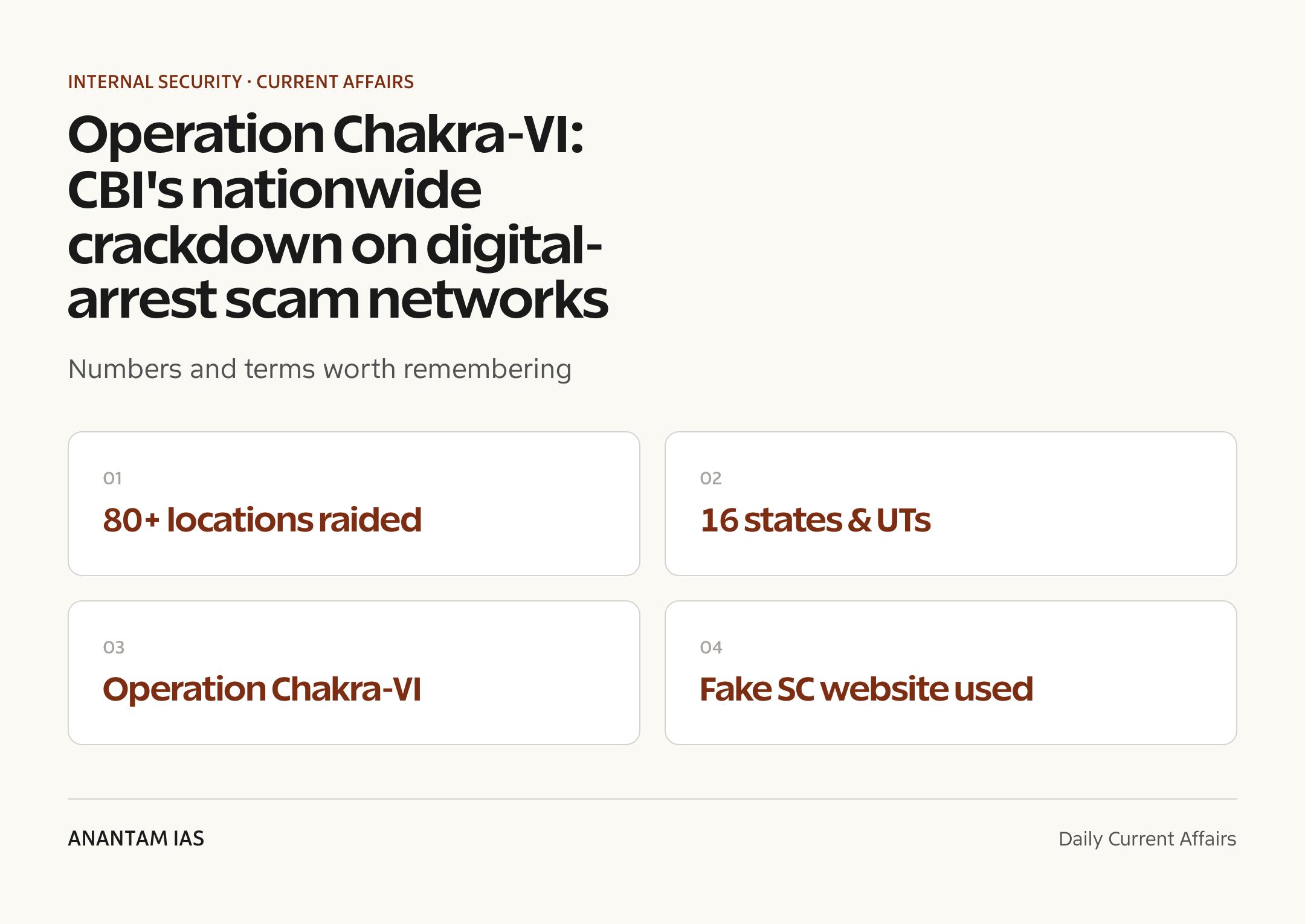
The Central Bureau of Investigation (CBI) launched Operation Chakra-VI, conducting simultaneous searches at more than 80 locations across 16 states and Union Territories to dismantle organised networks running the so-called ‘digital arrest’ fraud. The Hindu reported that the operation targeted syndicates that impersonated law-enforcement and judicial authorities to extort money from victims over fake video calls.
Deccan Herald reported that one network operated a fake Supreme Court website and used a web of mule bank accounts to layer and launder the proceeds. The case is a flagship illustration of cyber-enabled financial crime and how India’s investigative and coordination machinery is responding to a fast-evolving threat.
- Operation Chakra-VI is the sixth edition of the CBI’s series of anti-cybercrime operations targeting international and organised online fraud.
- Searches spanned 80+ premises across 16 states/UTs, with seizures of digital devices, documents and account records.
- Fraudsters built a fake Supreme Court website to lend false legitimacy to fabricated ‘arrest warrants’ and court orders.
- Money was routed through mule accounts – bank accounts rented or sold by third parties to move criminal proceeds.
- The probe links to complaints registered on the National Cyber Crime Reporting Portal (NCRP) and the 1930 cyber helpline.
The development matters in the context of:
- ‘Digital arrest’ is a scam in which fraudsters posing as CBI, police, ED or customs officials place victims under a fake, prolonged video-call ‘house arrest’ and coerce payments.
- Prime Minister Narendra Modi flagged the menace in his Mann Ki Baat address in November 2024, coining the mantra ‘Ruko, Socho, Action Lo’ (Stop, Think, Take Action).
- Coordination runs through the Indian Cyber Crime Coordination Centre (I4C) under the Ministry of Home Affairs.
UPSC Relevance
Prelims Relevance
- Operation Chakra is the CBI’s series of operations against organised cyber-enabled financial crime, often involving international cooperation with Interpol and the FBI.
- I4C (Indian Cyber Crime Coordination Centre) functions under the Ministry of Home Affairs, not the Ministry of Electronics and IT.
- The National Cyber Crime Reporting Portal is cybercrime.gov.in; the dedicated cyber-fraud helpline number is 1930.
- The Citizen Financial Cyber Fraud Reporting and Management System (CFCFRMS) enables quick reporting and freezing of defrauded funds.
- Mule accounts are third-party bank accounts used to receive and move the proceeds of crime to obscure the money trail.
- ‘Digital arrest’ has no basis in Indian law – no agency arrests or interrogates citizens over a video call.
- Cyber offences are prosecuted under the Information Technology Act, 2000 and the new Bharatiya Nyaya Sanhita (BNS), 2023 read with Bharatiya Nagarik Suraksha Sanhita (BNSS), 2023.
- The CBI is the nodal agency for Interpol coordination in India and derives its powers from the Delhi Special Police Establishment Act, 1946.
Mains Relevance
GS Paper 3
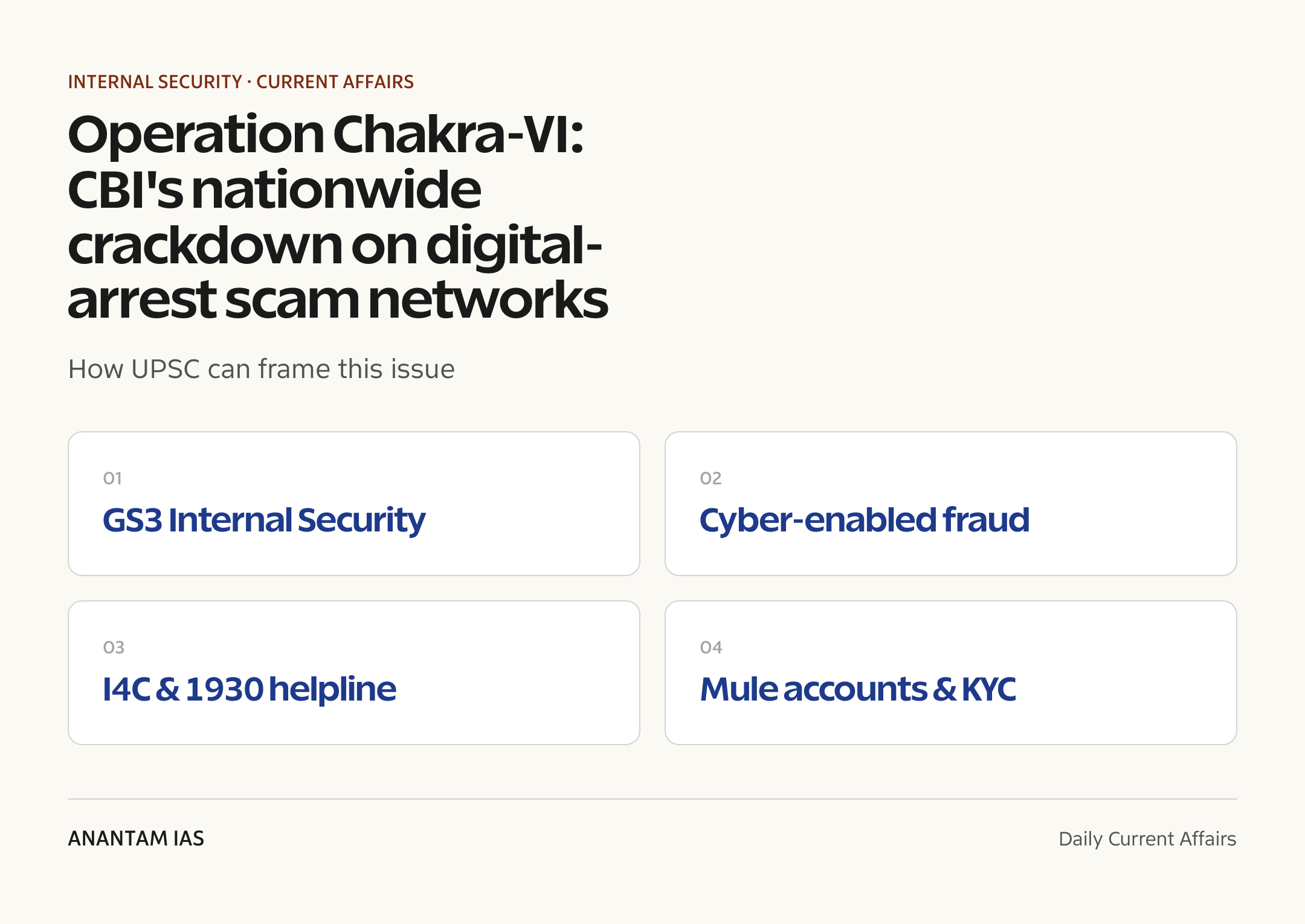
- Map the challenges in countering cyber-enabled financial crime – jurisdiction, mule-account chains, cross-border servers – and assess the role of coordinated operations like Operation Chakra.
- Evaluate the institutional architecture (I4C, NCRP, 1930 helpline, CFCFRMS) for cyber-fraud prevention, detection and rapid fund-freezing.
GS Paper 2
- Examine how impersonation of state authority in ‘digital arrest’ scams erodes citizen trust in institutions, and discuss the governance and grievance-redress response.
Essay
- Technology is a double-edged sword: the same connectivity that empowers citizens also arms the fraudster.
- Fear in the digital age – how scammers weaponise the authority of the state against the citizen.
Background and Context
What 'digital arrest' actually means
It is a confidence fraud built on fear, fake authority and isolation.
- Fraudsters call or video-call a victim claiming a parcel, SIM card or bank account is linked to crime – drugs, money laundering or human trafficking.
- They pose as officers of the CBI, police, Enforcement Directorate (ED) or customs, often in uniform against fake police-station backdrops.
- The victim is told they are under ‘digital arrest’ and must stay on continuous video, cut off from family, until they ‘clear’ their name.
- Under sustained psychological pressure, victims transfer large sums for ‘verification’ or ‘bail’, which is then siphoned through mule accounts.
- There is no such thing in law – no Indian agency conducts arrests or interrogations over video calls.
Operation Chakra: the CBI's anti-cybercrime series
Chakra-VI is the latest in a multi-year, internationally coordinated drive.
- The Operation Chakra series (I to VI) targets organised cyber-financial crime, tech-support scams and call-centre frauds operating across borders.
- Earlier editions saw the CBI work with Interpol, the FBI and platforms like Microsoft and Amazon to trace international fraud rings.
- Operation Chakra-VI struck 80+ locations across 16 states/UTs, as reported by The Hindu, seizing devices and financial records.
- Deccan Herald reported the use of a fake Supreme Court website to fabricate court orders and intimidate victims with apparent judicial authority.
- Targeting infrastructure – the fake site, mule accounts and handlers – aims to break the syndicate, not just individual scammers.
The institutional response architecture
India has layered a coordination, reporting and fund-freezing system over the last few years.
- The Indian Cyber Crime Coordination Centre (I4C), under the Ministry of Home Affairs, is the apex body coordinating cybercrime response across states.
- The National Cyber Crime Reporting Portal (NCRP) at cybercrime.gov.in lets citizens report frauds, especially against women and children and financial fraud.
- The 1930 helpline and the Citizen Financial Cyber Fraud Reporting and Management System (CFCFRMS) enable rapid reporting to freeze defrauded money before withdrawal.
- The CBI, as India’s Interpol nodal agency, leads cross-border operations; state cyber cells handle local FIRs and arrests.
- I4C has flagged and blocked thousands of fraudulent SIM cards, accounts and apps linked to digital-arrest rackets.
The legal toolkit
Cyber-fraud prosecution now draws on both special and general criminal law.
- The Information Technology Act, 2000 covers identity theft (Section 66C), cheating by personation using a computer (Section 66D) and related offences.
- The new Bharatiya Nyaya Sanhita (BNS), 2023 covers cheating, criminal impersonation, extortion and organised crime, replacing the IPC.
- Procedure now runs under the Bharatiya Nagarik Suraksha Sanhita (BNSS), 2023, with provisions for electronic records and zero-FIR.
- Mule accounts attract money-laundering scrutiny, linking the Prevention of Money Laundering Act (PMLA) and the ED to the chain.
- Banks face tightened KYC and account-monitoring obligations to choke the mule-account supply that powers these scams.
Why this matters for internal security
Cyber-fraud has moved from nuisance to a systemic threat to public order and the economy.
- ‘Digital arrest’ frauds have drained citizens of thousands of crores, hitting pensioners and professionals alike.
- Impersonating the CBI, courts and police erodes public trust in the very institutions meant to protect citizens.
- Servers, handlers and money mules often sit across borders, making attribution and recovery hard.
- The scam exploits low digital and financial literacy and the reflexive fear of state authority.
- It sits at the intersection of cybersecurity, financial crime and policing – a textbook GS-III internal-security challenge.
Way Forward
Citizen awareness and the 'Stop, Think, Act' reflex
- Mainstream the ‘Ruko, Socho, Action Lo’ message that no genuine agency conducts arrests over video calls.
- Run targeted campaigns for vulnerable groups – the elderly, students and first-time digital-payment users.
Choke the financial plumbing
- Tighten KYC and real-time monitoring to detect and freeze mule accounts faster.
- Strengthen the 1930 helpline and CFCFRMS for faster fund-freezing within the critical first hours.
Institutional and cross-border coordination
- Deepen CBI-Interpol and platform cooperation to dismantle international call-centre and server infrastructure.
- Build capacity in I4C and state cyber cells for forensics, attribution and faster takedowns of fake sites.
Conclusion
Operation Chakra-VI signals a shift from reactive complaint-handling toward proactive dismantling of cyber-fraud syndicates and the infrastructure – fake websites and mule-account chains – that sustains them. The use of a counterfeit Supreme Court website shows how scammers weaponise the symbols of state authority to manufacture fear and compliance.
Lasting protection will come from a triad: an alert citizen who pauses before paying, a financial system that can freeze fraudulent transfers within minutes, and an investigative ecosystem – CBI, I4C and state cyber cells – able to follow the money across borders. Technology created the threat, and a calibrated mix of awareness, law and coordination must contain it.
UPSC Practice Questions
Prelims MCQ 1
With reference to India’s cyber-fraud response architecture, consider the following statements:
- The Indian Cyber Crime Coordination Centre (I4C) functions under the Ministry of Home Affairs.
- The number 1930 is the dedicated helpline for reporting financial cyber fraud.
- ‘Digital arrest’ is a recognised arrest procedure under the Bharatiya Nagarik Suraksha Sanhita, 2023.
How many of the above statements are correct?
(a) Only one (b) Only two (c) All three (d) None
Answer: (b) Only two
Explanation:
I4C is under the MHA and 1930 is the cyber-fraud helpline, so statements 1 and 2 are correct. ‘Digital arrest’ has no legal basis – no Indian law permits arrest over a video call, making statement 3 wrong.
Prelims MCQ 2
The ‘Operation Chakra’ series of operations is associated with which of the following?
(a) Counter-insurgency operations in the Northeast (b) The CBI’s drive against organised cyber-enabled financial crime (c) Anti-narcotics seizures by the Narcotics Control Bureau (d) Border infrastructure projects along the LAC
Answer: (b) The CBI's drive against organised cyber-enabled financial crime
Explanation:
Operation Chakra (editions I-VI) is the CBI’s series of operations targeting organised cyber-enabled financial crime, often with Interpol and FBI cooperation. Operation Chakra-VI dismantled ‘digital arrest’ fraud networks.
UPSC Mains Questions
- ‘Digital arrest’ frauds represent a new frontier of cyber-enabled financial crime that exploits both technology and the fear of state authority. Examine the modus operandi and evaluate India’s institutional response, including Operation Chakra and the I4C ecosystem. (250 words)
- Discuss how mule accounts and fake official identities sustain organised online fraud in India. Suggest financial, legal and awareness-based measures to break this chain. (150 words)
Sources: The Hindu and Deccan Herald.
Frequently Asked Questions
What is a ‘digital arrest’ scam?
It is a fraud where criminals posing as CBI, police, ED or customs officers place a victim under a fake, prolonged video-call ‘house arrest’. They claim the victim is linked to a crime and coerce money for ‘verification’ or ‘bail’. No Indian agency arrests or interrogates anyone over a video call – it is entirely a confidence trick built on fear.
What is Operation Chakra-VI?
Operation Chakra-VI is the sixth edition of the CBI’s series of operations against organised cyber-enabled financial crime. In this round, the CBI searched more than 80 locations across 16 states and Union Territories to dismantle digital-arrest fraud networks, including one that ran a fake Supreme Court website and used mule bank accounts.
What is the I4C?
The Indian Cyber Crime Coordination Centre (I4C) is the apex body under the Ministry of Home Affairs that coordinates India’s response to cybercrime across states. It runs the National Cyber Crime Reporting Portal (cybercrime.gov.in), supports the 1930 helpline, and blocks fraudulent SIMs, accounts and apps used by scammers.
What are mule accounts?
Mule accounts are bank accounts rented, sold or lent by third parties so that criminals can receive and move the proceeds of fraud. By layering money through many such accounts, scammers obscure the trail and make recovery difficult. Tighter KYC and real-time monitoring of suspicious accounts are key to choking this network.
What should I do if I receive a ‘digital arrest’ call?
Stay calm, do not pay, and do not stay on the call. Remember the official advice – ‘Ruko, Socho, Action Lo’ (Stop, Think, Act). No genuine agency arrests anyone over video. Disconnect, verify with the actual agency through official numbers, and report immediately on the National Cyber Crime Reporting Portal or by calling the 1930 helpline.
Which laws apply to these cyber frauds?
Such frauds are prosecuted under the Information Technology Act, 2000 (identity theft and cheating by personation) read with the new Bharatiya Nyaya Sanhita, 2023 and Bharatiya Nagarik Suraksha Sanhita, 2023. Where laundering is involved, the Prevention of Money Laundering Act can also apply, bringing the Enforcement Directorate into the chain.