Optical Network Testbed: From Indigenous R&D to Market Readiness
Why in News?
The Department of Telecommunications and C-DOT signed a five-year agreement on 27 August 2026 to establish an end-to-end optical network testbed at C-DOT’s New Delhi campus.
- The facility is intended as a shared validation environment for Indian startups, researchers and telecom companies.
- Its planned technical scope joins optical core, optical access and quantum-security technologies in one end-to-end setting.
- The first two years are for setup; the following three years are planned for operations, maintenance and user support.
- The agreement and design are confirmed, but the testbed is not yet operational.
- Telecom products must work across interconnected layers, equipment and real traffic conditions; a component that succeeds in isolation may fail during integration or scaling.
- Shared test infrastructure can lower the validation barrier for smaller innovators while creating comparable evidence for operators deciding whether a technology is deployment-ready.
- For strategic communications, domestic testing capacity supports both industrial learning and scrutiny of security, interoperability and resilience before field deployment.
UPSC Relevance
Prelims Relevance
- C-DOT is the telecom research and development centre under the Department of Telecommunications, Ministry of Communications.
- An optical core network carries aggregated, high-capacity traffic between major network nodes.
- An optical access network connects end users or local access points to the wider telecom network.
- A testbed is controlled infrastructure for integration, testing, measurement and validation before wider deployment.
- Quantum-security technologies seek to protect communications using quantum principles; inclusion in a testbed does not by itself certify a product as secure.
Mains Relevance
GS Paper 3
- Role of shared testing infrastructure in converting indigenous research into commercially deployable telecom products.
- Need for interoperability, performance, security and reliability evidence in strategic digital infrastructure.
GS Paper 2
- Public research institutions as neutral conveners for startups, universities, equipment makers and network operators.
- Governance safeguards needed for fair access, transparent testing and credible validation.
Essay
- Technological self-reliance depends not only on invention, but also on institutions that can test, validate and improve inventions before society depends on them.
Background and Context
Why a Shared Testbed Matters
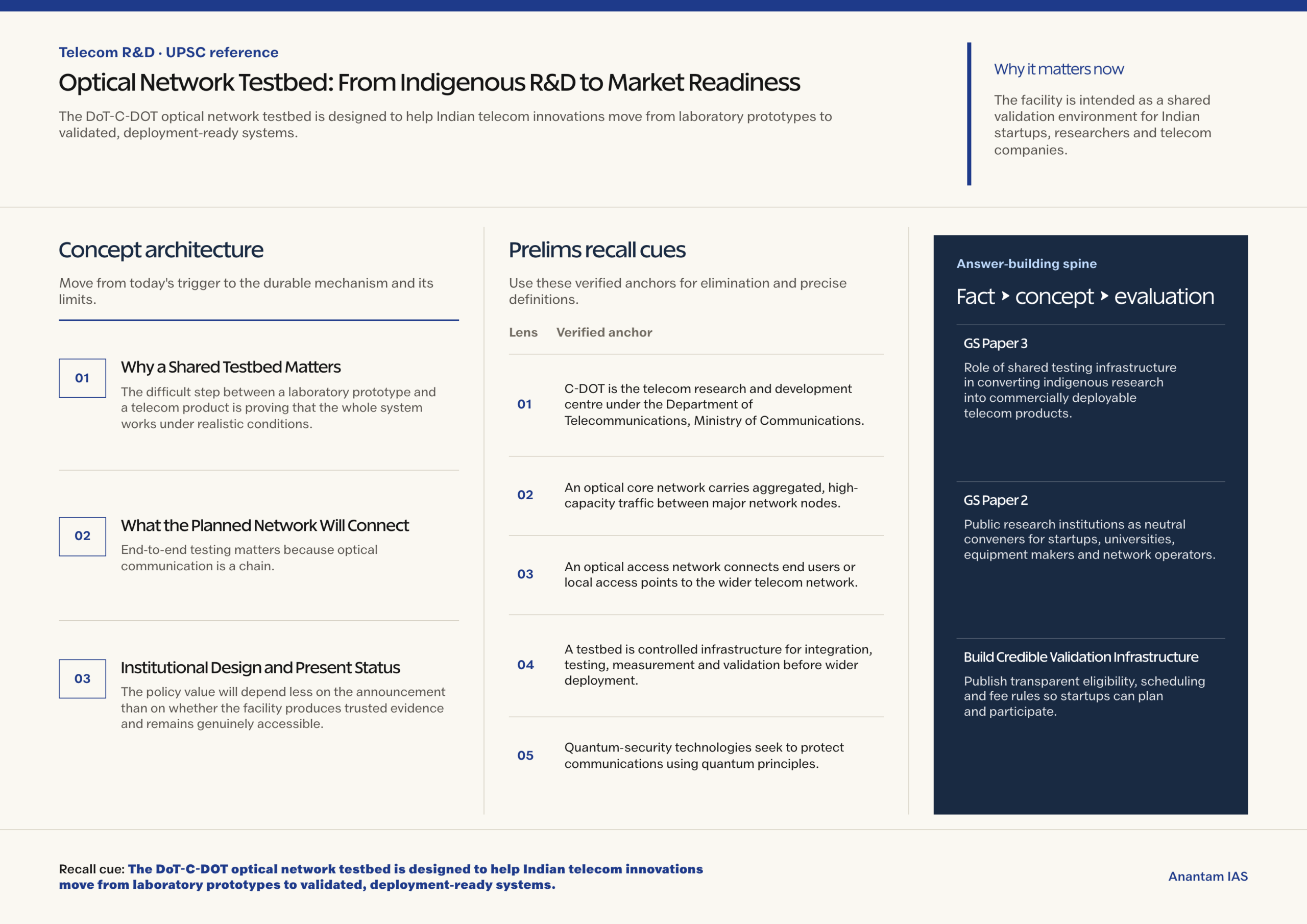
The difficult step between a laboratory prototype and a telecom product is proving that the whole system works under realistic conditions.
- A laboratory can demonstrate a device or protocol, while a testbed checks integration with other equipment, software, network layers and measurement tools.
- Repeated tests can expose failures in interoperability, traffic handling, latency, resilience or security that may remain invisible in a narrow demonstration, especially when multiple vendors’ components must operate together.
- Startups often cannot build an end-to-end network solely for validation; shared infrastructure can reduce duplication and give them access to advanced measurement capability.
- Operators need credible evidence before field trials or procurement because failures in communication networks can affect service continuity, data security and public confidence.
- A public testbed should bridge the R&D-to-market gap, but it cannot replace standards compliance, independent certification, field trials or commercial judgment.
What the Planned Network Will Connect
End-to-end testing matters because optical communication is a chain, and weakness at one layer can affect the service experienced at another.
- The optical core is the high-capacity backbone that aggregates and transports traffic between major nodes, demanding reliability, scale and efficient traffic management.
- The optical access segment links homes, enterprises or local network points with the broader system, where cost, reach and varied deployment conditions matter.
- Combining core and access allows testers to observe how a technology behaves across interfaces instead of treating each segment as an isolated product environment with idealised assumptions about upstream or downstream performance.
- The quantum-security component enables controlled examination of security technologies alongside the communications network they are meant to protect, including integration and operational constraints.
- Third-party test and measurement tools provide observable performance evidence, but the credibility of results depends on documented methods, calibrated instruments and reproducible conditions.
Institutional Design and Present Status
The policy value will depend less on the announcement than on whether the facility produces trusted evidence and remains genuinely accessible.
- C-DOT is the Department of Telecommunications’ research and development centre, giving it a convening role across public policy, engineering capability and the domestic telecom ecosystem.
- The official blueprint assigns years one and two to infrastructure setup and formal rollout; years three to five cover maintenance, technical support and educational outreach.
- As of the announcement, only the agreement, location and planned architecture are confirmed; no operational facility or completed technology validation should be inferred.
- Open access rules, published test protocols and conflict-of-interest safeguards would help prevent a shared national resource from favouring particular vendors or producing opaque endorsements.
- Useful performance indicators should track tested technologies, repeatability, standards alignment, field-trial progression and user access, not just events, training sessions or equipment installed, because activity counts do not prove readiness.
Way Forward
Build Credible Validation Infrastructure
- Publish transparent eligibility, scheduling and fee rules so startups, universities and established firms can obtain fair access.
- Align test protocols with relevant domestic and international standards while keeping security-sensitive details appropriately protected.
- Separate technical test results from procurement approval, certification and commercial endorsement to avoid false claims of readiness.
- Create pathways from testbed findings to redesign, repeat testing, field trials and operator feedback so failure becomes structured learning.
Conclusion
- The testbed’s durable significance lies in treating validation infrastructure as part of innovation policy, not as an afterthought between invention and procurement.
- In a Mains answer, connect shared facilities with lower entry barriers, stronger interoperability evidence and secure infrastructure, while stressing that the announced facility is still in its setup stage.
UPSC Practice Questions
Prelims MCQ 1
With reference to the proposed DoT-C-DOT optical network testbed, consider the following statements:
- It is planned to cover optical core, optical access and quantum-security technologies.
- It is already operational and has begun certifying commercial telecom products.
- C-DOT functions under the Department of Telecommunications.
How many of the above statements are correct?
(a) Only one (b) Only two (c) All three (d) None
Answer: (b) Only two
Explanation:
Statements 1 and 3 are correct. The agreement and planned architecture are confirmed, but the testbed is not yet operational and the announcement does not establish a certification function.
Prelims MCQ 2
Which one of the following best describes the main function of a technology testbed?
(a) It automatically grants market approval to every tested product (b) It replaces field trials and standards certification (c) It provides a controlled environment for integration, measurement and validation (d) It restricts research infrastructure to a single equipment vendor
Answer: (c) It provides a controlled environment for integration, measurement and validation
Explanation:
A testbed helps evaluate technologies under controlled, realistic conditions. Its results can inform later steps, but testing does not automatically equal certification, procurement approval or market success.
UPSC Mains Questions
- Shared technology testbeds can be as important as research grants in building indigenous strategic capability. Discuss with reference to optical communication networks. (150 words)
- What governance safeguards are necessary for a public telecom testbed to produce credible and widely usable evidence? (150 words)
Source: PIB, Department of Telecommunications.
Frequently Asked Questions
What is an optical network testbed?
It is controlled infrastructure where optical communication equipment, software and protocols can be integrated, measured and validated under realistic network conditions before wider field deployment.
What parts of the network will the proposed facility cover?
The planned scope combines optical core, optical access and quantum-security technologies, supported by advanced third-party testing and measurement tools.
Is the DoT-C-DOT testbed already operational?
No. The five-year agreement and technical design are confirmed, but the first two years are assigned to setup and formal rollout.
Why is shared validation infrastructure useful for startups?
It can provide access to costly end-to-end network and measurement facilities, helping smaller innovators identify integration failures and build evidence for later field trials.
Does successful testbed performance guarantee market approval?
No. Testbed evidence can support product improvement and readiness assessment, but it does not replace standards compliance, independent certification, field trials, procurement checks or commercial evaluation.