OptoSAR Satellites: Combining Radar and Optical Views
Why in News?
On 24 September 2026, the Technology Development Board announced an agreement supporting GalaxEye’s proposed OptoSAR satellite, which would combine synthetic aperture radar and electro-optical observations.
- The proposed multisensor satellite aims to combine radar and optical data rather than rely on either sensing method alone.
- The announced design targets sub-0.5-metre imaging; this is a development objective, not evidence of an operational capability already deployed.
- The release identifies surveillance and target classification among intended applications, with further development, testing and validation still required.
- Cloud cover and illumination can interrupt optical Earth observation precisely when users need fresh information.
- Complementary measurements can improve interpretation, but combining sensors does not eliminate the physical limits of each instrument.
UPSC Relevance
Prelims Relevance
- Synthetic Aperture Radar as active remote sensing
- Electro-optical imaging and illumination
- Microwave backscatter versus reflected light
- Synthetic aperture and platform movement
- Data fusion versus an optical view through clouds
Mains Relevance
GS Paper 3
- Indigenous Earth-observation capability and applications
- Evidence standards for emerging space technologies
Essay
- Better decisions require complementary evidence, not simply more images
Background and Context
Two instruments observe different properties
An optical image and a radar image are different measurements of the same landscape, not interchangeable photographs with different colour settings.
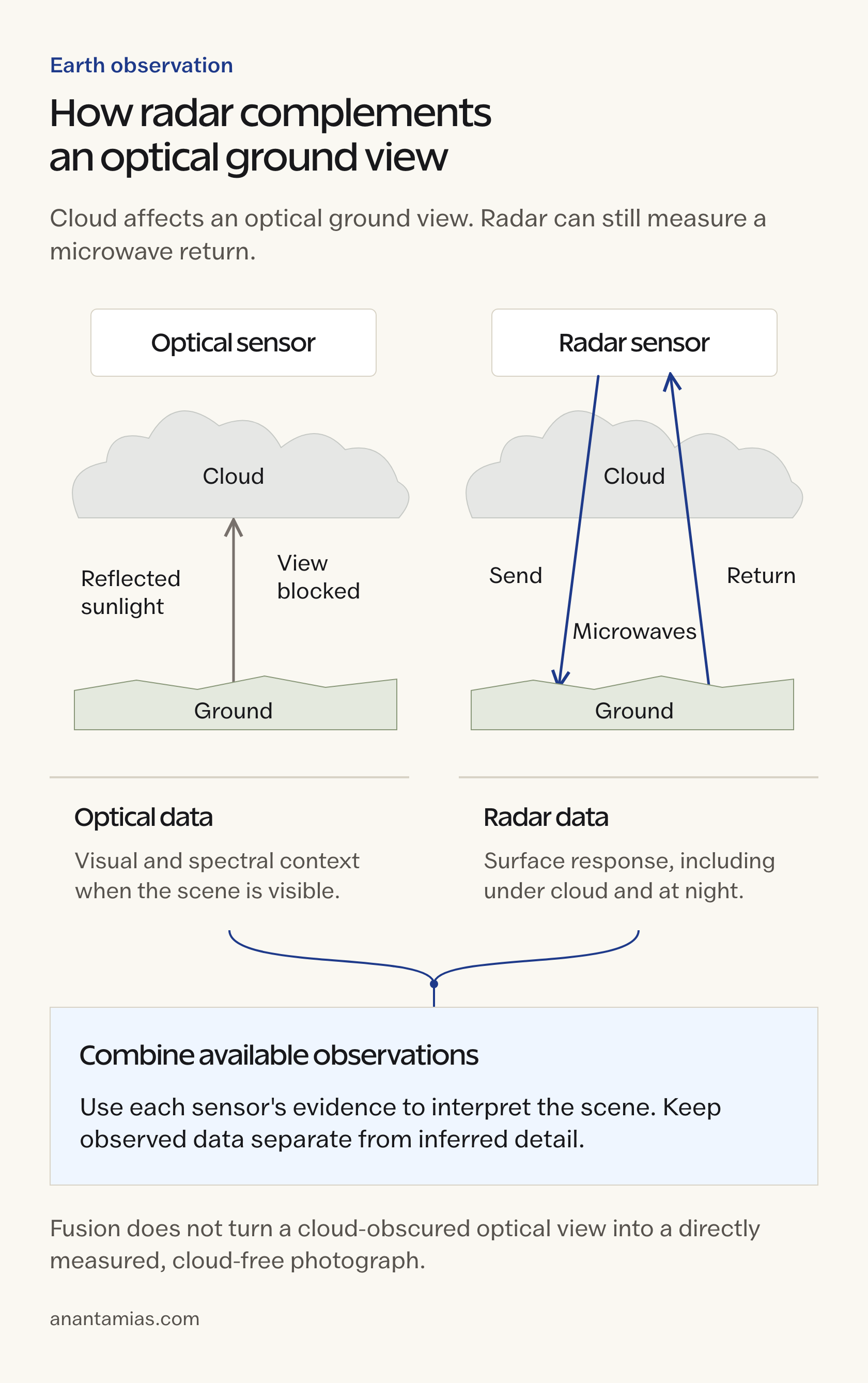
- Optical imaging in this comparison uses light received from the scene, including reflected sunlight. Surface colours and spatial patterns can help interpretation, but clouds can obscure the ground and illumination affects the available view.
- SAR sends microwave pulses and records returning energy. Because the instrument supplies its own illumination, it does not require daylight; suitable radar wavelengths can also pass through cloud cover that blocks optical ground views.
- Radar backscatter depends on how the transmitted signal interacts with the surface. Structure, moisture and viewing geometry matter, so a bright radar patch should not automatically be read as a bright-coloured object.
- The synthetic aperture is created by combining observations made as the instrument moves. NASA’s SAR explanation describes how this simulates a longer antenna, improving resolution without requiring an impractically large physical antenna.
- The central comparison is complementarity: optical sensing supplies visual or spectral information, while radar supplies a different response to physical conditions. Neither measurement is universally superior for every question about the ground.
What fusion adds, and what it cannot add
Fusion means combining information from the two observations; it does not change the wavelength or cloud sensitivity of the optical instrument.
- The proposed OptoSAR approach brings SAR and electro-optical data together to create a richer picture of Earth. Its value rests on the different information each sensor contributes, not on renaming two separate pictures.
- When clouds obscure the ground, radar observations can still contribute evidence about the surface. That does not mean the accompanying optical sensor suddenly records an unobstructed visual image through the same cloud layer.
- Shared interpretation can use one observation to help make sense of the other. For example, an available optical view may provide context for a radar feature; this is an explanatory example, not a demonstrated project result.
- A useful evaluation should ask whether combined data improve the intended task compared with either input alone. A visually striking fused product is insufficient proof if its object classifications cannot be independently checked.
- Missing observations must remain distinguishable from inferred information. If processing estimates what lies beneath a cloud, the result should not be presented as a direct optical measurement captured at that time and location.
Read proposed capability separately from proven performance
The announcement supports development of a system; it does not establish that its intended surveillance performance has been demonstrated under operational conditions.
- High-resolution imaging is a project objective in the release. The announced agreement is not a launch confirmation, a declaration of routine service or independent validation of the satellite’s planned ground-observation performance.
- Detection and classification ask different questions: whether something is present, and what it is. A system should be evaluated against the specific task claimed rather than treating all image-based decisions as equivalent.
- For surveillance applications, assess false detections and missed targets alongside useful detections. This is an evaluation requirement: the PIB announcement names intended applications but provides no published performance results establishing their accuracy.
- Day-and-night capability describes a radar advantage over sunlight-dependent optical viewing. It should not be expanded into a claim of uninterrupted global coverage, which the announcement neither specifies nor demonstrates for this proposed system.
- Domestic technology development can strengthen the capacity to build and interpret specialised observations. The immediate teaching point is sensor integration; financing details do not establish that the sensing challenge has already been solved.
Way Forward
Validate the information, not merely the image
- Test fused products against radar-only and optical-only results for clearly defined tasks and conditions.
- Report observation gaps and uncertainty so users can distinguish direct measurements from inferred features.
- Publish evidence of operational performance before treating design objectives as demonstrated capabilities.
Conclusion
- OptoSAR seeks to combine different kinds of evidence: optical detail and radar observations less constrained by daylight and clouds. Fusion is useful because the inputs differ, not because their limitations disappear.
- Distinguish instrument capability, processing claims and operational validation. The September agreement supports a proposed multisensor satellite; it does not prove that all intended imaging and classification outcomes are already available.
UPSC Practice Questions
Prelims MCQ 1
With reference to Synthetic Aperture Radar, consider the following statements:
- SAR transmits energy and measures the returning signal.
- SAR requires sunlight to illuminate the observed ground.
- A synthetic aperture combines observations to simulate a longer antenna.
How many of the above statements are correct?
(a) Only one (b) Only two (c) All three (d) None
Answer: (b) Only two
Explanation:
The first and third statements are correct. SAR is active sensing: its own transmitted energy allows operation without sunlight.
Prelims MCQ 2
Which statement best explains SAR-optical data fusion?
(a) Radar makes the optical sensor transmit microwaves (b) Optical cameras become able to see through every cloud (c) Complementary observations are combined while individual sensor limits remain (d) Fusion removes the need to validate classifications
Answer: (c) Complementary observations are combined while individual sensor limits remain
Explanation:
Fusion combines information from different sensors. It does not change the physical sensing properties of either instrument or establish accuracy without validation.
UPSC Mains Questions
- Explain why combining SAR and optical observations can improve Earth observation. What limitations remain after data fusion?
- Distinguish a proposed satellite’s design objectives from demonstrated operational capability. Suggest an evidence-based framework for evaluating multisensor surveillance systems.
Sources: PIB, Ministry of Science and Technology and NASA Earthdata, Synthetic Aperture Radar.
Frequently Asked Questions
What is OptoSAR?
In the announced project, OptoSAR is an approach combining synthetic aperture radar and electro-optical imaging. It seeks to fuse complementary observations into a richer picture of Earth, subject to development and validation.
Why can radar operate at night?
SAR is an active instrument that sends its own microwave signal and measures returning energy. Unlike sunlight-dependent optical observations, it does not need the Sun to illuminate the ground.
Does fusion let an optical camera see through clouds?
No. Radar may provide surface information through cloud cover, but the optical instrument retains its physical limitations. Combining those observations does not turn the radar measurement into an unobstructed optical photograph.
Is the announced satellite already operational?
The release describes a proposed satellite and a development agreement requiring engineering, testing and validation. Its imaging and classification objectives should not be reported as capabilities already demonstrated in routine service.