PACT: Aggregating Demand for Zero-Emission Freight Corridors
Why in News?
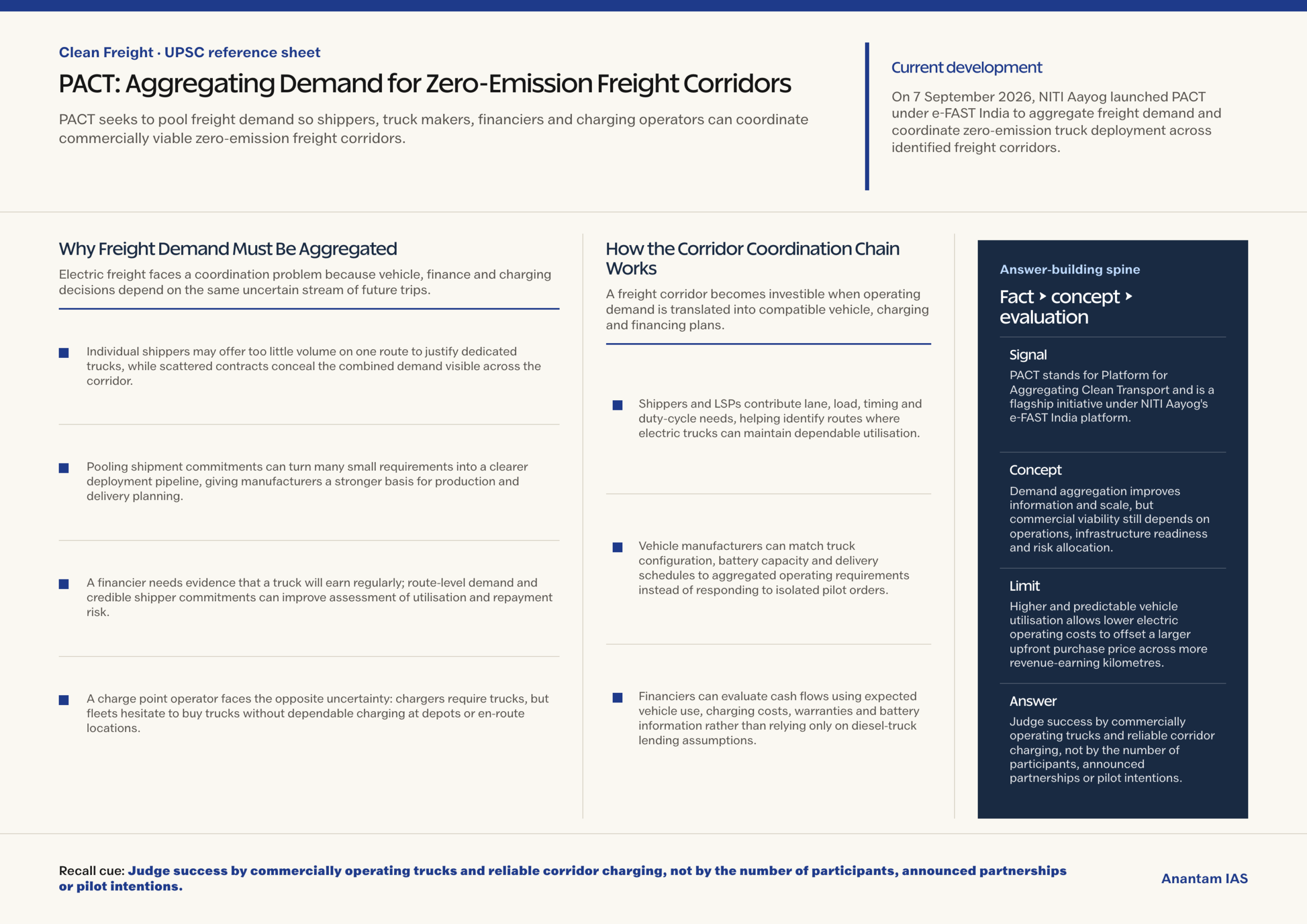
On 7 September 2026, NITI Aayog launched PACT under e-FAST India to aggregate freight demand and coordinate zero-emission truck deployment across identified freight corridors.
- PACT stands for Platform for Aggregating Clean Transport and is a flagship initiative under NITI Aayog’s e-FAST India platform.
- It connects shippers, logistics service providers, vehicle manufacturers, financiers and charge point operators around visible freight demand and corridor opportunities.
- PIB reported that e-freight deployments rose from 201 vehicles in FY25 to 826 in FY26, while more than 3,000 e-MHD trucks operate nationally.
- The summit also introduced the ZET Marketplace to support business, financing and charging partnerships that can move projects from intent to deployment.
- Electric trucks, loans and chargers are interdependent investments; each participant hesitates when the others’ commitments remain uncertain.
- Aggregated route demand can reveal where enough predictable truck traffic exists to support vehicle orders, tailored finance and well-used charging assets.
- The platform is an enabling coordination mechanism, not a fleet mandate, purchase subsidy or guarantee that every proposed corridor will become commercially viable.
UPSC Relevance
Prelims Relevance
- PACT: Platform for Aggregating Clean Transport
- e-FAST India: Electric Freight Accelerator for Sustainable Transport – India
- LSP: logistics service provider
- CPO: charge point operator
- e-MHDV: electric medium- and heavy-duty vehicle
- Corridor charging: depot or en-route charging planned around freight routes and duty cycles
Mains Relevance
GS Paper 3
- Freight decarbonisation and the economics of electric-truck deployment
- Infrastructure coordination, logistics competitiveness and energy security
GS Paper 2
- Government as a market coordinator across industry, finance and infrastructure providers
Essay
- Green transitions succeed when institutions coordinate complementary investments, not when technology is treated as a stand-alone purchase.
Background and Context
Why Freight Demand Must Be Aggregated
Electric freight faces a coordination problem because vehicle, finance and charging decisions depend on the same uncertain stream of future trips.
- Individual shippers may offer too little volume on one route to justify dedicated trucks, while scattered contracts conceal the combined demand visible across the corridor.
- Pooling shipment commitments can turn many small requirements into a clearer deployment pipeline, giving manufacturers a stronger basis for production and delivery planning.
- A financier needs evidence that a truck will earn regularly; route-level demand and credible shipper commitments can improve assessment of utilisation and repayment risk.
- A charge point operator faces the opposite uncertainty: chargers require trucks, but fleets hesitate to buy trucks without dependable charging at depots or en-route locations.
- PACT addresses this circular hesitation by making demand more visible and convening the parties whose investments must arrive in a coordinated sequence.
How the Corridor Coordination Chain Works
A freight corridor becomes investible when operating demand is translated into compatible vehicle, charging and financing plans.
- Shippers and LSPs contribute lane, load, timing and duty-cycle needs, helping identify routes where electric trucks can maintain dependable utilisation.
- Vehicle manufacturers can match truck configuration, battery capacity and delivery schedules to aggregated operating requirements instead of responding to isolated pilot orders.
- Financiers can evaluate cash flows using expected vehicle use, charging costs, warranties and battery information rather than relying only on diesel-truck lending assumptions.
- Charge point operators and DISCOMs need expected truck traffic, dwell time, land and grid-capacity information to choose depot and en-route charging locations.
- The resulting corridor plan should align vehicle arrival, charger commissioning and finance approval; a delay in any one element can strand the other investments.
Commercial Case, Infrastructure Choices and Limits
Demand aggregation improves information and scale, but commercial viability still depends on operations, infrastructure readiness and risk allocation.
- Higher and predictable vehicle utilisation allows lower electric operating costs to offset a larger upfront purchase price across more revenue-earning kilometres.
- Predictable traffic can improve charger utilisation, spreading infrastructure cost across more charging sessions and reducing the risk of underused corridor assets.
- Depot charging suits return-to-base operations, while en-route charging enables longer journeys; the mix must reflect dwell time, route length and scheduling constraints.
- Battery-health monitoring, warranties and buyback or leasing structures can reduce uncertainty about performance and resale value, which directly affects lender confidence and borrowing terms.
- PACT cannot replace project appraisal: planners must still test grid capacity, land availability, freight volumes, technology fit and the credibility of participating firms’ commitments.
Way Forward
Turn Aggregated Interest into Bankable Corridors
- Standardise non-sensitive demand data on lanes, loads, schedules and expected deployment so manufacturers, lenders and charging providers assess the same operating case.
- Sequence corridor investments through time-bound commitments for vehicle procurement, grid connection, charger commissioning and freight allocation, with responsibility assigned to each participant.
- Use early corridors to publish verified performance, charging-utilisation and battery-health evidence that helps financiers price risk and operators compare business models.
- Protect competition and smaller operators by using transparent participation rules, interoperable charging and financing structures that do not lock corridors to one vendor.
Conclusion
- PACT’s central value is coordination: pooled freight demand can give truck makers, lenders and charging providers enough visibility to invest around the same corridors.
- A strong Mains answer should connect demand certainty with vehicle utilisation, lender risk and charger utilisation, while noting that aggregation does not remove grid, land or execution constraints.
- Judge success by commercially operating trucks and reliable corridor charging, not by the number of participants, announced partnerships or pilot intentions.
UPSC Practice Questions
Prelims MCQ 1
With reference to the Platform for Aggregating Clean Transport (PACT), consider the following statements:
- It is a flagship initiative under NITI Aayog’s e-FAST India platform.
- It seeks to aggregate freight demand and translate it into deployment opportunities across identified freight corridors.
- It is a statutory regulator that mandates electric-truck procurement by logistics companies.
How many of the above statements are correct?
(a) Only one (b) Only two (c) All three (d) None
Answer: (b) Only two
Explanation:
Statements 1 and 2 are correct. PACT is a coordination platform connecting freight, vehicle, finance and charging stakeholders; it is not a statutory procurement regulator.
Prelims MCQ 2
In zero-emission freight planning, demand aggregation most directly helps resolve which problem?
(a) The constitutional division of road-transport taxation powers (b) Uncertainty over simultaneous investment in trucks, finance and charging infrastructure (c) The legal classification of national and state highways (d) The calculation of railway freight tariffs
Answer: (b) Uncertainty over simultaneous investment in trucks, finance and charging infrastructure
Explanation:
Aggregated demand improves visibility of expected vehicle use, helping manufacturers, financiers and charging providers coordinate complementary investments along freight corridors.
UPSC Mains Questions
- Demand aggregation can convert fragmented interest in electric trucks into commercially viable freight corridors. Explain the coordination mechanism and its limitations.
- Discuss how shippers, logistics providers, vehicle manufacturers, financiers, charge point operators and DISCOMs must coordinate to scale zero-emission freight in India.
Sources: PIB, NITI Aayog and NITI Aayog, Transforming Trucking in India.
Frequently Asked Questions
What is PACT?
PACT is the Platform for Aggregating Clean Transport, launched under NITI Aayog’s e-FAST India initiative to pool freight demand and support coordinated zero-emission truck deployment.
Why is freight demand aggregation important?
It reveals combined route demand, which can improve truck utilisation estimates and give manufacturers, lenders and charging providers a common basis for investment decisions.
Who participates in the PACT ecosystem?
The platform brings together shippers, logistics service providers, vehicle manufacturers, financiers, charge point operators and other partners needed for corridor-based electric freight deployment.
How does corridor charging differ from general public charging?
It is planned around truck routes, depot access, dwell times, grid capacity and high-power needs, so charging availability matches predictable freight operations.
Does PACT guarantee that a freight corridor will be commercially viable?
No. It improves coordination and demand visibility, but each corridor still requires appraisal of freight volumes, vehicle fit, financing, land, grid capacity and execution risk.