Padma Awards 2026: Civilian Honours, Social Recognition and Republic Day Symbolism
The Padma Awards 2026 list announced on Republic Day eve included 131 awards: 5 Padma Vibhushan, 13 Padma Bhushan and 113 Padma Shri. The list included women awardees, foreign or diaspora awardees, posthumous honours and several figures from grassroots public service.
For UPSC, Padma Awards are not just a Prelims list. They raise a governance question: how does a republic publicly recognise excellence, service, knowledge, art, sport and social work without turning honours into patronage?
This article uses the 2026 Padma list to revise civilian honours, Article 18, the Balaji Raghavan case and the idea of people’s recognition in a democratic republic.
Quick Facts
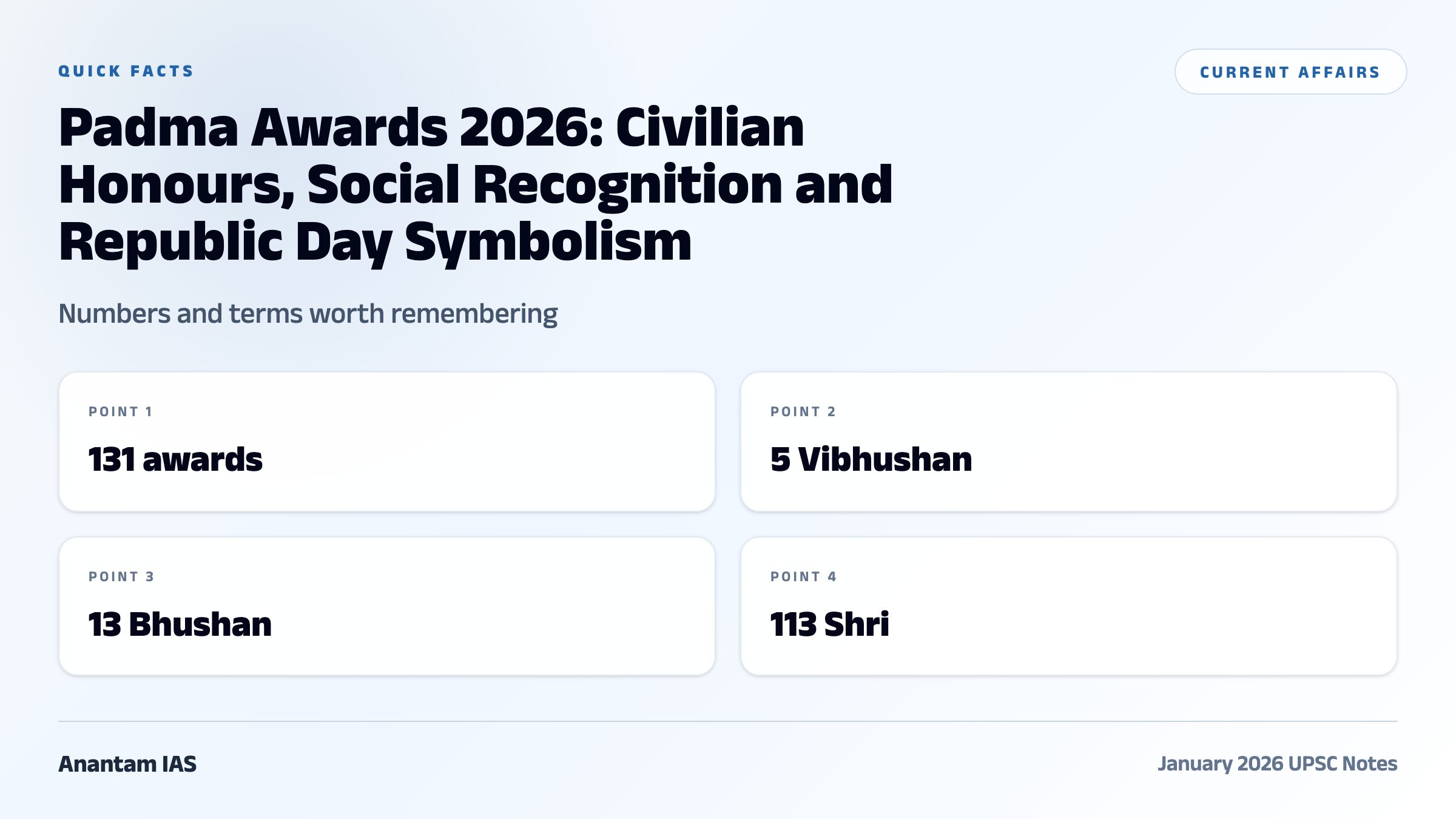
- Padma Awards 2026 included 131 awards, with two duo cases counted as one award each.
- The list had 5 Padma Vibhushan, 13 Padma Bhushan and 113 Padma Shri awards.
- It included 19 women awardees.
- It included 6 foreign, NRI, PIO or OCI awardees.
- It included 16 posthumous awardees.
- Padma Awards are announced on Republic Day eve and conferred by the President.
- Official source: PIB, Ministry of Home Affairs.
What Just Happened
The Ministry of Home Affairs released the 2026 Padma Awards list on the eve of Republic Day. The list covered public affairs, art, literature, education, science, engineering, medicine, sports, social work, trade and other fields.
The announcement followed the modern pattern of highlighting not only nationally famous names but also relatively lesser-known citizens whose work has produced social value.
For aspirants, the issue is worth studying beyond names. Padma Awards connect Article 18’s ban on titles, the Supreme Court’s interpretation of national honours and the state’s power to shape public recognition.
Background and Historical Context
Padma Awards were instituted in 1954. They sit below Bharat Ratna in India’s civilian honour system and are conferred in three categories: Padma Vibhushan, Padma Bhushan and Padma Shri.
Article 18 of the Constitution abolishes titles, except military and academic distinctions. This created a legal question: are civilian awards unconstitutional titles? The Supreme Court answered in Balaji Raghavan v Union of India that national awards are not titles if they are not used as prefixes or suffixes.
The awards have also been criticised for politicisation, lobbying and elite bias. Recent lists have tried to emphasise grassroots achievers, often described in public discourse as the people’s Padma approach.
Key Features of the Padma Awards System
The core policy architecture can be read through these features.
- Three categories: Padma Vibhushan, Padma Bhushan and Padma Shri.
- Selection: recommendations are considered by a Padma Awards Committee constituted by the Prime Minister.
- Conferment: the President presents the awards at Rashtrapati Bhavan.
- No title use: awardees cannot use Padma names as prefixes or suffixes.
- Fields: arts, public affairs, science, medicine, literature, education, sports, social work and more.
- Democratic shift: wider nominations and grassroots recognition have become more visible.
Why It Matters
This is a high-yield UPSC topic because it joins current news with durable syllabus themes.
- It gives Prelims facts on civilian awards and constitutional provisions.
- It gives GS-II material on state recognition, public ethics and institutional legitimacy.
- It gives GS-I culture content through awardee fields and traditions.
- It allows Essay reflection on excellence, service and recognition in a republic.
Detailed Analysis: Awards and Governance Lens
Honours are symbolic policy. A government cannot fund every form of public service equally, but it can signal what society should value. Awards shape public memory.
The constitutional limit matters. Article 18 prevents titles from recreating social hierarchy. Civilian honours are acceptable only when they remain recognition, not status markers.
The people’s Padma shift is useful but incomplete. Recognising unsung achievers improves legitimacy, but transparency, diversity and protection from lobbying must remain priorities.
Comparative Perspective
A comparison helps prevent the answer from becoming a one-dimensional news summary.
- Bharat Ratna: India’s highest civilian award for exceptional service or performance.
- Padma Vibhushan: exceptional and distinguished service.
- Padma Bhushan: distinguished service of high order.
- Padma Shri: distinguished service in any field.
Challenges
The policy or institutional promise runs into recurring constraints.
- Award selection can be perceived as political if criteria are not transparent.
- Grassroots awardees may receive symbolic recognition without institutional support for their work.
- Regional, gender and field representation need constant attention.
- Media coverage often focuses on celebrity names and misses social-work awardees.
- Use of awards for personal branding can weaken Article 18’s spirit.
Prelims Pointers
- Padma Awards were instituted in 1954.
- They are announced on the eve of Republic Day.
- The President confers the awards.
- Article 18 abolishes titles except military and academic distinctions.
- Balaji Raghavan v Union of India upheld national awards as constitutional if not used as titles.
- Padma awards cannot be used as prefixes or suffixes.
Mains Questions
- Civilian honours in a republic must recognise excellence without creating hierarchy. Discuss with reference to Article 18. (GS Paper II, 250 words)
- How can public awards be made more transparent, inclusive and socially meaningful? (GS Paper II, 150 words)
- The Padma Awards increasingly recognise grassroots achievers. What does this reveal about changing state-society relations? (GS Paper I, 250 words)
- Symbolic recognition is also a tool of governance. Critically examine. (GS Paper II, 250 words)
Way Forward
The Padma system should deepen public nominations, publish clearer selection principles and preserve the ban on title-like usage.
Award recognition can be linked with better documentation of social innovations, art forms, local knowledge and community service so that public memory does not end with the ceremony.
For UPSC, the smart answer is to move from list memorisation to constitutional reasoning: honours are legitimate only when they democratise recognition without creating hierarchy.
The examiner is unlikely to reward a bare fact dump here. The better answer connects the January 2026 event to institutional design, implementation capacity and India’s long-term development priorities.
Frequently Asked Questions
How many Padma Awards were announced in 2026?
The 2026 list included 131 awards, with two duo cases counted as one award each.
What are the three Padma categories?
Padma Vibhushan, Padma Bhushan and Padma Shri.
Are Padma Awards titles under Article 18?
No. The Supreme Court held in Balaji Raghavan that national awards are constitutional if they are not used as prefixes or suffixes.
Who confers Padma Awards?
The President of India confers them at Rashtrapati Bhavan.
Why are Padma Awards relevant for UPSC?
They connect polity, Article 18, public recognition, culture and governance.
Can an awardee write Padma Shri before their name?
No. Padma awards cannot be used as prefixes or suffixes.