Pallikaranai Marsh in Focus: Conserving a Ramsar Wetland in an Urbanising City
Why in News?
The Pallikaranai marsh in Chennai, a designated Ramsar site, is back in policy debate as authorities work to define its boundary and the surrounding Influence Zone — the buffer where land use must respect the wetland’s ecology. The marsh is one of the few surviving large freshwater wetlands of south India and a natural flood sink for a fast-urbanising city.
As The Hindu’s analysis notes, the dispute is not only ecological. Large stretches of the buffer overlap a planned development area and the OMR IT corridor, and thousands of families hold residential plots inside the zone. The episode frames a recurring exam theme: how to protect an urban wetland without making conservation an exclusionary or punitive process for lawful landholders.
- Boundary and Influence Zone for the Pallikaranai Ramsar wetland are under study by the National Green Tribunal (NGT) and the Chennai Metropolitan Development Authority (CMDA).
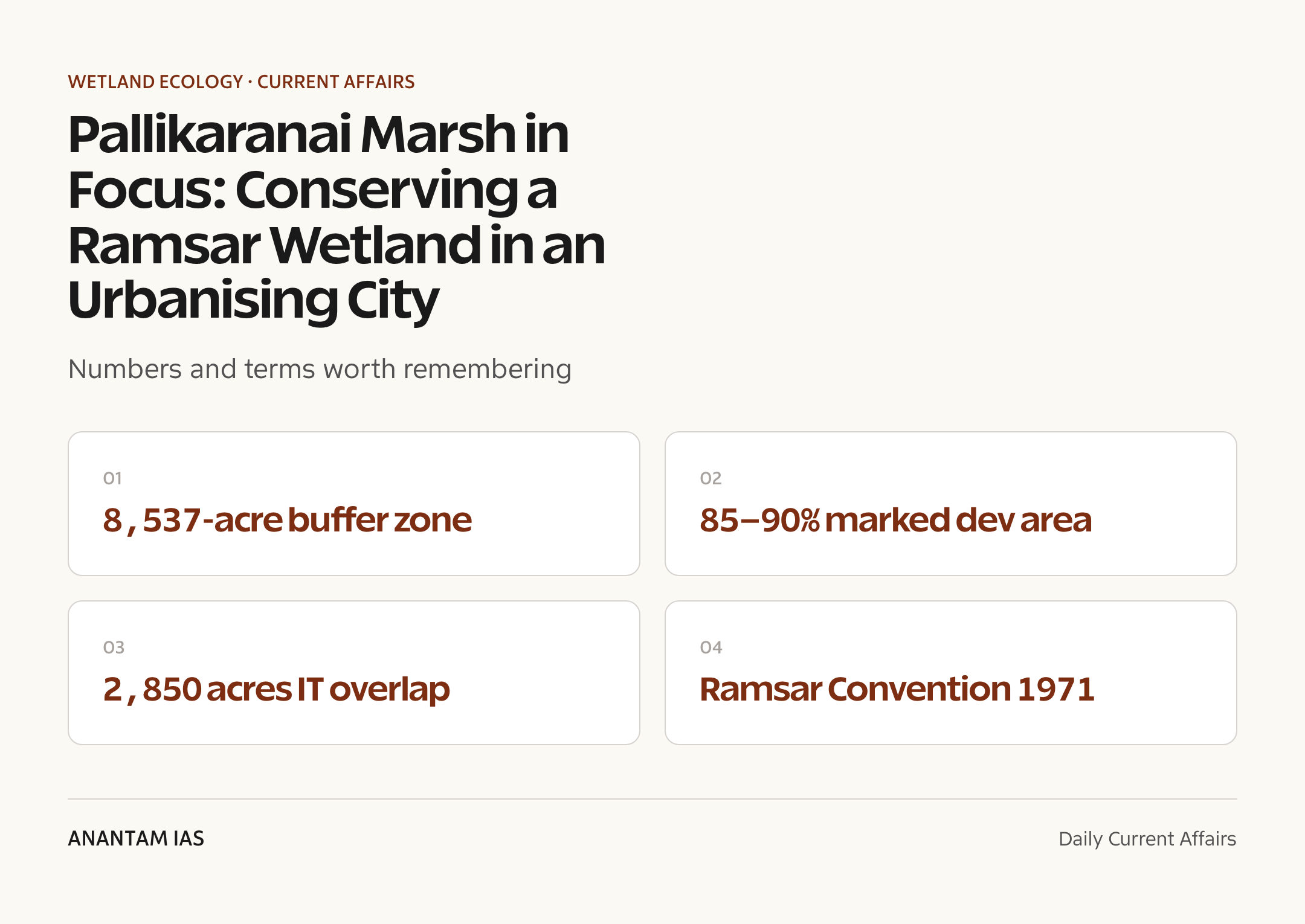
- The Hindu reports that about 85–90% of the 8,537-acre Influence Zone was already marked a development area under CMDA’s Second Master Plan (2008).
- Roughly 60% (2,850 acres) of the OMR IT corridor overlaps the Influence Zone, and there are claims of lawfully held private lands within the Ramsar boundary.
- Core tension: property rights and regulatory transparency versus the wetland’s role in flood mitigation, groundwater recharge and biodiversity.
The development matters in the context of:
- Pallikaranai is the case study India keeps returning to on urban wetlands, the lesson of the 2015 Chennai floods, and the limits of master-plan-led city growth over natural drainage.
- The marsh aids flood mitigation, groundwater recharge and biodiversity conservation — the ecosystem services that make wetland loss so costly for cities.
UPSC Relevance
Prelims Relevance
- Pallikaranai marsh lies in Chennai, Tamil Nadu — one of the few surviving large freshwater wetlands of south India and a Ramsar site.
- The Ramsar Convention on Wetlands was adopted in Ramsar, Iran, in 1971 and is the only global treaty dedicated to a single ecosystem type.
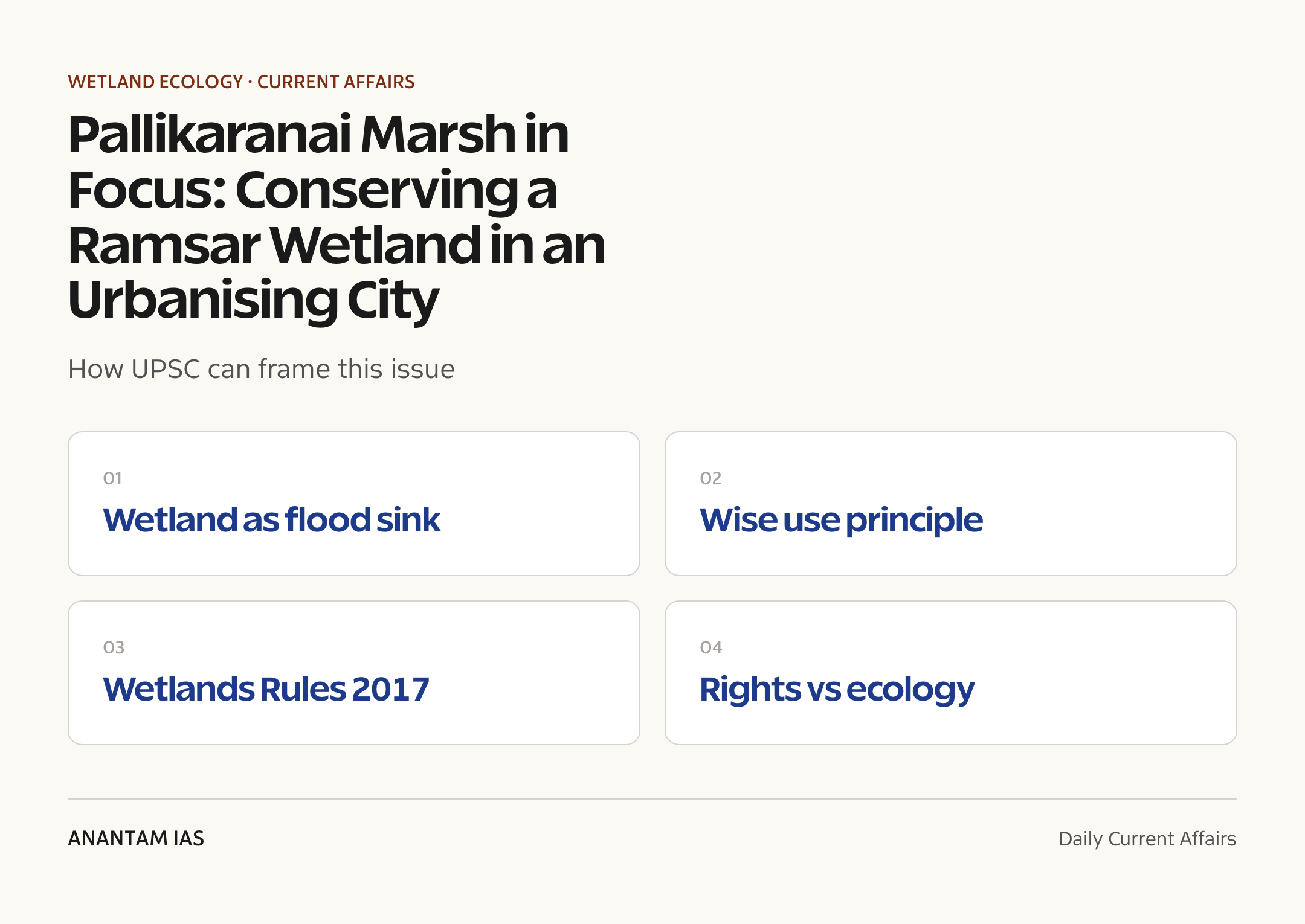
- The Convention’s guiding principle is the ‘wise use’ of wetlands — sustainable use that maintains ecological character.
- The Montreux Record lists Ramsar sites where ecological character has changed, is changing or is likely to change due to human pressure; India’s Keoladeo and Loktak have featured on it.
- India’s domestic framework is the Wetlands (Conservation and Management) Rules, 2017, notified under the Environment (Protection) Act, 1986.
- The 2017 Rules set up State/UT Wetlands Authorities and list prohibited activities such as encroachment and permanent construction.
- Tamil Nadu has among the highest number of Ramsar sites of any Indian state, several of them around the Chennai region.
- An Influence Zone is the buffer around a wetland where land use is regulated to protect the wetland’s hydrology and ecology.
- Key wetland ecosystem services include flood control, groundwater recharge, carbon storage and habitat for migratory birds.
- Wetlands are governed nationally by the Ministry of Environment, Forest and Climate Change (MoEFCC).
Mains Relevance
GS Paper 3
- Conservation of urban wetlands as natural infrastructure for flood control and groundwater recharge, using Pallikaranai as a model case.
- Effectiveness and gaps in the Wetlands (Conservation and Management) Rules, 2017 and the Ramsar framework for protecting ecologically sensitive land near cities.
- Balancing development pressure and the right to livelihood with ecological limits — the governance challenge of buffer zones and Influence Zones.
- Lessons of the 2015 Chennai floods for city master planning, drainage and climate resilience.
Essay
- Development versus environment: who pays the price when cities grow over their wetlands.
- Nature as infrastructure — why protecting ecosystems is also disaster risk reduction.
Background and Context
Pallikaranai marsh: a city's natural sponge
Pallikaranai is a freshwater marsh on the southern fringe of Chennai and a rare survivor among south India’s large urban wetlands.
- It functions as a natural flood sink, absorbing monsoon runoff that would otherwise inundate built-up Chennai.
- The marsh supports migratory and resident waterbirds and a distinct wetland biodiversity within a dense metropolitan setting.
- Decades of city expansion shrank the marsh through encroachment, road and rail embankments, and garbage dumping at its edges.
- Its Ramsar designation recognised both its ecological value and its vulnerability to urban pressure.
The Ramsar Convention and 'wise use'
The international anchor for wetland protection is the Ramsar Convention, the world’s oldest treaty focused on a single ecosystem.
- Adopted in Ramsar, Iran, in 1971, it commits parties to conserve and sustainably use wetlands of international importance.
- Its core idea is ‘wise use’ — maintaining the ecological character of wetlands while allowing sustainable human use.
- Sites under threat can be placed on the Montreux Record, flagging changes in ecological character for priority attention.
- Listing as a Ramsar site is a recognition and a commitment, not a fence — protection still depends on domestic law and local governance.
India's wetlands framework
India translates Ramsar commitments through national rules and state-level authorities.
- The Wetlands (Conservation and Management) Rules, 2017, issued under the Environment (Protection) Act, 1986, are the operative national law.
- They require states to constitute Wetlands Authorities and to identify and notify wetlands for protection.
- Prohibited activities include encroachment, permanent construction and solid-waste dumping within notified wetlands.
- The Rules have been criticised for slow notification of wetlands and for leaving buffer-zone rules to state discretion.
Urban pressure and the 2015 flood lesson
The Pallikaranai dispute is really a contest over how a city treats the land that drains it.
- The Hindu reports that 85–90% of the 8,537-acre Influence Zone was already a development area under the CMDA Second Master Plan (2008).
- About 60% (2,850 acres) of the OMR IT corridor overlaps the Influence Zone, layering economic stakes onto the ecology.
- The 2015 Chennai floods showed how building over natural drainage and wetlands magnifies urban flood damage.
- Loss of wetland storage shifts flood risk onto residents and public infrastructure across the city.
Property rights and regulatory transparency
Conservation collides with people who bought land in good faith, making fair process as important as the rule itself.
- There are claims of lawfully held private lands within the Ramsar boundary, and families who invested life savings in plots inside the Influence Zone.
- The NGT and CMDA are studying a clear boundary and Influence Zone framework to settle what is and is not buildable.
- The Hindu’s analysis stresses that environmental protection should not become an exclusionary or punitive process.
- Credible conservation needs transparent maps, public consultation and fair compensation where rights are extinguished.
Way Forward
Finalise a science-based boundary and Influence Zone for Pallikaranai with publicly accessible maps, so landholders and planners share the same reference.
Pair protection with fair compensation, land swaps or transferable development rights for lawful owners affected by the wetland boundary.
Strengthen the Wetlands Rules 2017 in practice — faster notification, stricter control on encroachment and dumping, and active eco-restoration of degraded stretches.
Embed urban wetlands into city master plans as flood infrastructure, treating them as assets to be funded, not vacant land awaiting development.
Conclusion
Pallikaranai shows that a Ramsar tag is the start of conservation, not the end. The hard work is governance — drawing honest boundaries, enforcing the Wetlands Rules, and restoring what cities have already degraded.
The durable lesson for exam and policy alike is that wetlands are infrastructure. Protecting them is cheaper than the floods that follow their loss, provided protection stays transparent and fair to the people who live at the water’s edge.
UPSC Practice Questions
Prelims MCQ 1
With reference to the Ramsar Convention on Wetlands, consider the following statements: 1. It was adopted in 1971 and is dedicated specifically to the conservation of wetlands. 2. The Montreux Record lists wetlands whose ecological character is under threat from human activity. 3. The ‘wise use’ principle bars all human use of designated wetlands. Which of the statements given above are correct?
1 and 2 only 2 and 3 only 1 and 3 only 1, 2 and 3
Answer: 1 and 2 only
Explanation:
The Ramsar Convention (1971) is the only global treaty focused on wetlands, and the Montreux Record flags sites with changing ecological character. ‘Wise use’ means sustainable use, not a total ban on human use, so statement 3 is wrong.
Prelims MCQ 2
Consider the following statements about wetland governance in India: 1. The Wetlands (Conservation and Management) Rules, 2017 were notified under the Environment (Protection) Act, 1986. 2. The Rules provide for the constitution of State/UT Wetlands Authorities. 3. Pallikaranai marsh is located in Karnataka. Which of the statements given above are correct?
1 and 2 only 1 and 3 only 2 and 3 only 1, 2 and 3
Answer: 1 and 2 only
Explanation:
The 2017 Rules sit under the Environment (Protection) Act, 1986 and create State/UT Wetlands Authorities. Pallikaranai marsh is in Chennai, Tamil Nadu, not Karnataka, so statement 3 is wrong.
UPSC Mains Questions
- Urban wetlands are natural infrastructure, yet they are among the first casualties of city growth. Examine this statement with reference to the Pallikaranai marsh and the lessons of the 2015 Chennai floods. (250 words)
- Critically evaluate the effectiveness of the Wetlands (Conservation and Management) Rules, 2017 and the Ramsar framework in protecting India’s urban wetlands. (250 words)
- Conservation of ecologically sensitive land near cities often collides with property rights. Discuss how regulatory transparency and fair process can reconcile the two, using a recent example. (150 words)
Source: The Hindu (via Legacy IAS analysis).
Frequently Asked Questions
Where is the Pallikaranai marsh located?
It is a freshwater marsh on the southern edge of Chennai, Tamil Nadu, and one of the few surviving large urban wetlands of south India. It acts as a natural flood sink and supports rich birdlife.
What is the Ramsar Convention?
It is an international treaty adopted in Ramsar, Iran, in 1971, dedicated to the conservation and ‘wise use’ of wetlands of international importance. India is a party and has designated dozens of Ramsar sites.
What is the Montreux Record?
It is a register under the Ramsar Convention listing wetlands where the ecological character has changed, is changing or is likely to change due to human pressure, so they receive priority conservation attention.
What law governs wetlands in India?
The Wetlands (Conservation and Management) Rules, 2017, notified under the Environment (Protection) Act, 1986, are the main national framework. They set up State/UT Wetlands Authorities and prohibit activities like encroachment and dumping.
What is the Pallikaranai ‘Influence Zone’ dispute about?
It concerns the buffer around the wetland where land use must protect its ecology. Much of this 8,537-acre zone was earlier marked for development and overlaps the OMR IT corridor, so the NGT and CMDA are working to fix a clear boundary that also respects lawful landholders.
Why does the 2015 Chennai floods episode matter here?
Those floods showed how building over wetlands and natural drainage worsens urban flooding. Protecting Pallikaranai is also a flood-resilience measure for the wider city.