Vice‑President highlights PanchPran as foundation for national transformation
Why in News?
The Vice-President publicly presented a values-based governance narrative — PanchPran — that could shape policy discourse, civic education priorities and centre-state messaging ahead of major national milestones.
- Values articulation: PanchPran frames a compact set of five value pillars that can be integrated into public communication, curricula and civic campaigns.
- Influence on youth: Announced at the NCC Republic Day Camp, the message targets cadets and youth who are key agents for diffusion of civic norms.
- Policy signalling: Emphasis on Swadeshi and self-reliance signals continued prioritisation of domestic capacity building in governance narratives.
- Electoral and federal optics: A high-profile moral framework from the Vice-President can shape public debate and become a reference for state governments and departments.
- National security dimension: Linking vigilance against anti-national forces to civic duties embeds a security subtext in everyday citizenship discourse.
The development matters in the context of:
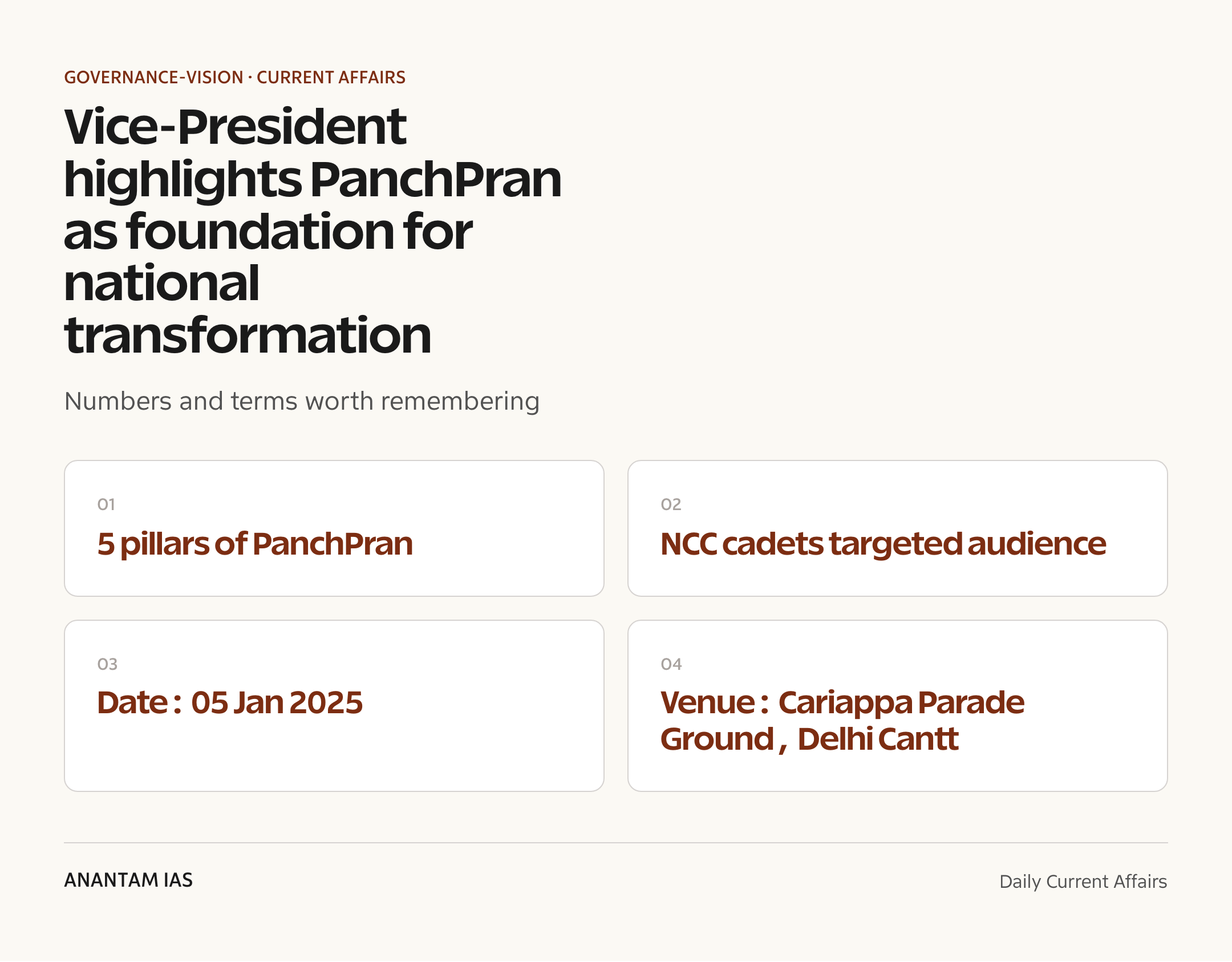
- Occasion: Speech delivered at the inauguration of the NCC Republic Day Camp 2025 at Cariappa Parade Ground, Delhi Cantt — a setting with disciplined youth who are potential civic leaders.
- Leadership role: The Vice-President, as the second-highest constitutional office, acts as a moral and institutional voice; such addresses have soft influence on public policy framing.
- National milestones: India is approaching important mid-century goals (for example, 2047 vision); value narratives often precede policy initiatives tied to such timelines.
- Existing programmes: The PanchPran elements overlap with current schemes: social harmony with social justice initiatives, family enlightenment with family and education programmes, environmental consciousness with climate and conservation missions, Swadeshi with Atmanirbhar Bharat, civic duties with voter and civic education.
- Historical precedents: Value-anchored frameworks by national leaders have previously been used to guide civil society campaigns, school curricula and institutional charters.
- Communication channels: The message was amplified via official PIB release and social media; targeting NCC increases propagation through institutional training and events.

UPSC Relevance
Prelims Relevance
- Recognise PanchPran’s five pillars and their definitions for objective-type questions.
- Connect institutional contexts such as NCC and Republic Day Camp when asked about civic education platforms.
- Distinguish between constitutional roles and ceremonial or moral leadership functions of the Vice-President.
Mains Relevance
GS2 Polity & Governance
- Discuss the role of value-based narratives in public policy and governance.
- Analyse how state and central institutions can incorporate civic duties and nationalism without compromising constitutional liberties.
- Evaluate the balance between cultural identity, Swadeshi policy and economic openness in India’s development strategy.
Essay
- Use PanchPran as a case study in essays on ‘Ethics, Integrity and Aptitude in Public Life’ or on ‘India’s vision for 21st century development’.
- Cite the theme when discussing ‘Role of youth in nation-building’ or ‘India’s soft power and national identity’.
Background and Context
What is PanchPran
A compact five-point value framework articulated by the Vice-President as foundational to national transformation.
- Definition: PanchPran comprises Social Harmony, Family Enlightenment, Environmental Consciousness, Swadeshi (self-reliance) and Civic Duties.
- Source: Announced during the NCC Republic Day Camp 2025 inauguration speech by the Vice-President.
- Audience focus: Targeted at youth cadets and wider citizenry to instil a nation-first perspective.
- Practical intent: Designed to link personal conduct, family education and public responsibility with national progress.
- Format: Value-based slogan-like construct suitable for awareness drives and educational modules.
Why this matters politically
Value narratives can shape debate, set agendas and guide administrative priorities across levels of government.
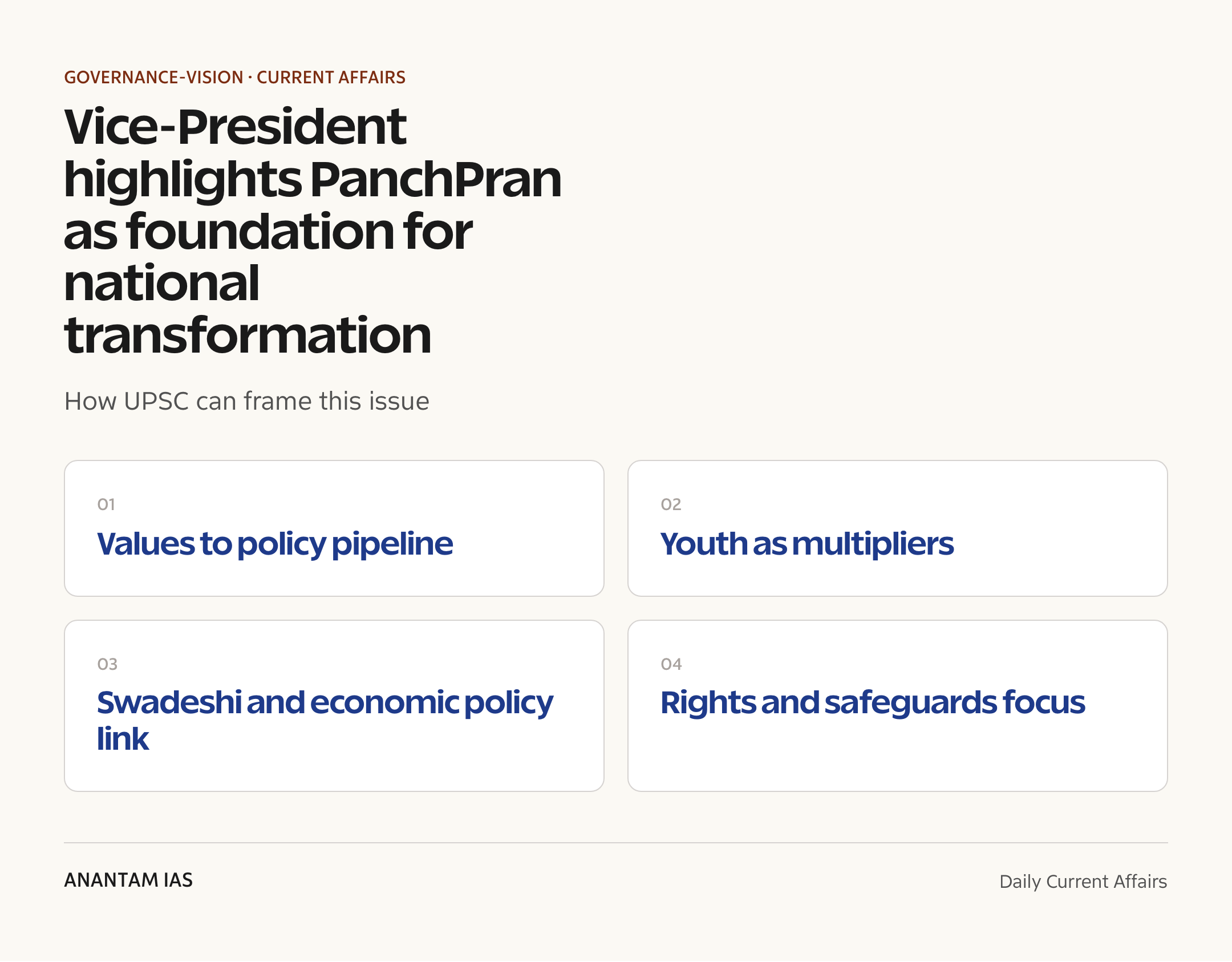
- Agenda setting: High-profile moral themes often precede policy emphasis in related domains, for example, Swadeshi and industrial policy.
- Federal diffusion: States may adopt similar language in local programmes, amplifying the message through governance actions.
- Election-era utility: Value frameworks can be adopted by political actors to resonate with voters on identity and civic duty.
- Administrative uptake: Ministries of education, environment and social justice can translate pillars into operational indicators.
Connections to existing programmes
Each PanchPran element overlaps with ongoing central and state initiatives, enabling faster operationalisation.
- Social Harmony: Linked to programmes on social justice, communal harmony cells and national integration efforts.
- Family Enlightenment: Aligns with health, nutrition and education schemes that promote family-level human capital.
- Environmental Consciousness: Resonates with National Action Plan on Climate Change, AMRUT, tree plantation and conservation drives.
- Swadeshi: Echoes Atmanirbhar Bharat policies, Make in India incentives and local procurement preferences.
- Civic Duties: Parallels voter awareness, civic education in schools and citizen charter initiatives.
Role of the Vice-President in public discourse
The constitutional office combines institutional gravitas with a platform for moral and civic messaging.
- Constitutional position: Vice-President is ex officio Chairperson of the Rajya Sabha and the second-highest constitutional authority.
- Soft power: Speeches can provide normative guidance without carrying direct executive power.
- Non-partisan voice: Traditionally expected to speak above daily politics, giving broader acceptability to value frameworks.
- Institutional reach: Addressing institutions like NCC extends influence into disciplined youth training systems.
NCC as a vehicle for civic values
The National Cadet Corps is an established platform to cultivate discipline, leadership and national outlook among youth.
- Mandate: NCC imparts military training, leadership and civic sense to enrolled cadets across schools and colleges.
- Scale: Thousands of cadets participate in regular camps, parades and community service activities.
- Multiplier effect: Cadets often act as local role models, spreading values to peers and communities.
- Institutional synergy: Messaging at NCC events can be institutionalised into training modules and badges.
Contestation risks and safeguards
Value-based frameworks can become contested if perceived to restrict pluralism or civic freedoms.
- Overreach risk: Nationalism messaging may be construed as stifling dissent unless coupled with constitutional guarantees.
- Implementation clarity: Operational guidelines are needed to prevent ambiguous enforcement of ‘civic duties’.
- Inclusivity test: Social Harmony must be translated into measurable protections for minorities and vulnerable groups.
- Legal bounds: Any civic campaigns must respect fundamental rights and not encourage punitive citizen action.
Way Forward
Policy translation and programme design
- Action plans: Ministries should prepare short-term roadmaps to translate each PanchPran pillar into measurable programmes.
- Cross-Ministry task force: Establish a nodal team with education, environment, social justice and youth affairs ministries to coordinate actions.
- Pilot schemes: Run pilot projects in diverse states to test messaging and delivery modes before national rollout.
- Monitoring metrics: Develop simple indicators for impact assessment, such as civic literacy scores or community-level harmony indices.
Integrating into education and training
- Curriculum modules: Introduce age-appropriate PanchPran content in school and NCC training materials with emphasis on critical thinking.
- Teacher training: Provide capacity building for teachers and NCC officers to deliver values education without bias.
- Experiential learning: Use community projects, environmental drives and local crafts to make Swadeshi and civic duties tangible.
- Assessment: Include project-based evaluation rather than rote tests for values education.
Community engagement and partnerships
- Local committees: Form community PanchPran committees with civil society, panchayats and youth clubs to localise initiatives.
- Public-private collaboration: Engage industry for Swadeshi promotion through procurement preferences and MSME linkages.
- Media campaigns: Run balanced national campaigns that explain pillars and provide examples of positive citizen action.
- Incentivise participation: Offer recognition and small grants for grassroots projects that promote PanchPran goals.
Safeguards and legal clarity
- Rights-respecting messaging: Frame civic duties in light of fundamental rights and constitutional values to avoid misuse.
- Grievance redress: Set up transparent mechanisms to report misuse of PanchPran rhetoric for coercion or discrimination.
- Independent review: Commission periodic independent evaluations to assess social impact and rights implications.
- Training on ethics: Include ethical guidelines for officials and volunteers implementing PanchPran-related programmes.
Conclusion
PanchPran is a concise, values-based framework that links personal conduct, family formation, environmental stewardship, self-reliance and civic duties under a nation-first narrative. Operationalising it requires careful policy design, inclusive communication, safeguards for rights and measurable indicators so that the aspirational language translates into constructive public action.
UPSC Practice Questions
Prelims MCQ 1
Which of the following are part of the PanchPran as outlined by the Vice-President in January 2025? 1. Social Harmony 2. Family Enlightenment 3. Digital Sovereignty 4. Civic Duties
(a) A. 1 and 2 only (b) B. 1, 2 and 4 only (c) C. 2, 3 and 4 only (d) D. All four
Answer: B
Explanation:
PanchPran consists of Social Harmony, Family Enlightenment, Environmental Consciousness, Swadeshi (self-reliance) and Civic Duties. Digital Sovereignty is not listed.
Prelims MCQ 2
The Vice-President delivered the PanchPran remarks while addressing which of the following institutions? 1. National Cadet Corps Republic Day Camp 2025 2. National Service Scheme Annual Meet
(a) A. 1 only (b) B. 2 only (c) C. Both 1 and 2 (d) D. Neither
Answer: A
Explanation:
The speech was given at the inauguration of the NCC Republic Day Camp 2025 at HQ DG NCC Camp, Cariappa Parade Ground, Delhi Cantt.
UPSC Mains Questions
- {‘question’: ‘Examine the role of value-based national narratives, like PanchPran, in strengthening civic culture in India. Discuss operational challenges in implementing such narratives across diverse states.’, ‘model_answer’: ‘Value-based narratives can provide a shared moral vocabulary, motivate civic participation and guide policy priorities. PanchPran emphasises Social Harmony, Family Enlightenment, Environmental Consciousness, Swadeshi and Civic Duties, which can be integrated into education, youth training and community programmes. Operational challenges include ensuring non-partisan delivery, avoiding coercive enforcement, tailoring messages to regional socio-cultural contexts, aligning with rights protections, and establishing measurable outcomes. Solutions include pilot projects, cross-ministry coordination, teacher and trainer capacity building, independent impact evaluation and transparent grievance mechanisms. Careful communication that respects pluralism and constitutional safeguards is essential to prevent alienation of minorities or curtailment of dissent.’}
- {‘question’: “Analyse how emphasis on ‘Swadeshi and self-reliance’ within a values framework interacts with India’s economic openness, foreign investment goals and Make in India objectives.”, ‘model_answer’: ‘Swadeshi framed as self-reliance can complement Make in India when it targets domestic manufacturing capacity and integration into global value chains. Policy must avoid protectionist instincts that deter foreign investment. A balanced approach includes targeted support to MSMEs, improved ease of doing business, technology transfer through FDI, procurement preferences that comply with WTO and domestic law, and skill development to absorb productive capacity. Communication should clarify that Swadeshi means strategic autonomy and local value addition, not blanket isolation. Metrics should track domestic value added in output and employment, while preserving investor confidence through predictable rules and liberalised sectors.’}
Source: PIB, Vice President's Secretariat.
Frequently Asked Questions
q
a
q
a
q
a
q
a
q
a
q
a