Paraquat Poisoning kills over 6000 Indian Farmers
Why in News?
Recently, cases of paraquat poisoning have been reported in India, including intentional ingestion (suicide cases) and accidental exposure among agricultural workers. These incidents have raised concerns about:
- Easy availability of highly toxic herbicides
- Lack of regulation and awareness
- High fatality rate with no specific antidote
UPSC Relevance:
GS-III: Science & Technology and Environment
What is Paraquat?
Paraquat is a non-selective contact herbicide used to kill weeds.
- Chemical name: Paraquat dichloride
- It is widely used in agriculture for weed control, especially in plantations
- It acts very fast by destroying plant tissues
It is considered one of the most toxic herbicides in the world
How Does Paraquat Poisoning Occur?
Poisoning can occur through:
- Ingestion (most common and deadly) – often in suicide attempts
- Inhalation – breathing in spray particles
- Skin contact – especially through cuts or prolonged exposure
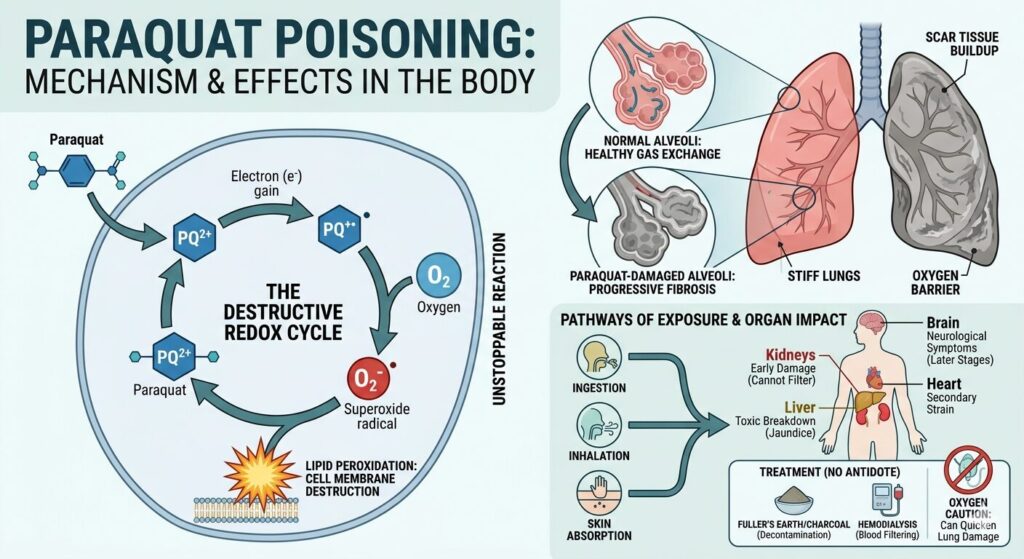
Mechanism of Toxicity
Paraquat causes damage through oxidative stress:
- Paraquat doesn’t just “poison” you in a general sense; it triggers a violent chemical reaction inside your cells called redox cycling.
- Once inside the body, paraquat reacts with oxygen to create free radicals (specifically superoxide anions). These molecules are highly unstable and “attack” the lipids (fats) that make up your cell membranes. This process is called lipid peroxidation.
Most affected organs:
- Lungs → fibrosis (scarring) → respiratory failure
- Kidneys → acute kidney injury
- Liver → damage
Even small amounts can be fatal
Symptoms of Paraquat Poisoning
Symptoms depend on dose but generally include:
- Burning sensation in mouth and throat
- Vomiting and abdominal pain
- Difficulty in breathing (due to lung damage)
- Organ failure in severe cases
Why is Paraquat So Dangerous?
Paraquat is especially dangerous because:
- There is no specific antidote
- It causes irreversible lung damage
- Very high mortality rate (often 50–90%)
- Even small ingestion can lead to death within days to weeks
Global Regulatory Status
Many countries have banned or restricted paraquat:
- European Union → Completely banned
- Several countries → Strict regulation due to toxicity
Status in India
- Paraquat is not completely banned
- It is regulated under the Insecticides Act, 1968
- Available for agricultural use, often with insufficient safeguards
This creates a policy dilemma between:
- Agricultural productivity
- Public health safety
What are the Challenges leading to the recent cases?
1. Easy Availability
Paraquat is easily accessible in rural areas, making it a common substance for suicide.
2. Lack of Awareness
Farmers and workers are often unaware of:
- Protective gear
- Safe handling practices
3. Weak Regulation
- Labeling and warnings are inadequate
- Enforcement is weak
4. Public Health Burden
- High fatality increases pressure on healthcare systems
- Limited treatment options
Government Response & Needed Measures
Existing Measures
- Regulation under insecticide laws
- Guidelines for safe handling
What is the way forward?
- Consider banning or phasing out paraquat
- Promote safer alternatives (bio-herbicides)
- Strengthen labeling and packaging norms
- Increase farmer awareness and training
- Restrict over-the-counter availability
- Improve poison control infrastructure
India needs a multi-pronged strategy:
- Balance agricultural needs with public health safety
- Shift towards sustainable agriculture practices
- Strengthen regulatory enforcement and monitoring
Other critical “poisonings” and chemicals:
1. Organophosphates
If paraquat is the most lethal herbicide, Organophosphates are the most common insecticides you’ll encounter in Indian agriculture.
Organophosphates are:
- A group of insecticides
- Chemically derived from phosphoric acid
- Widely used in agriculture
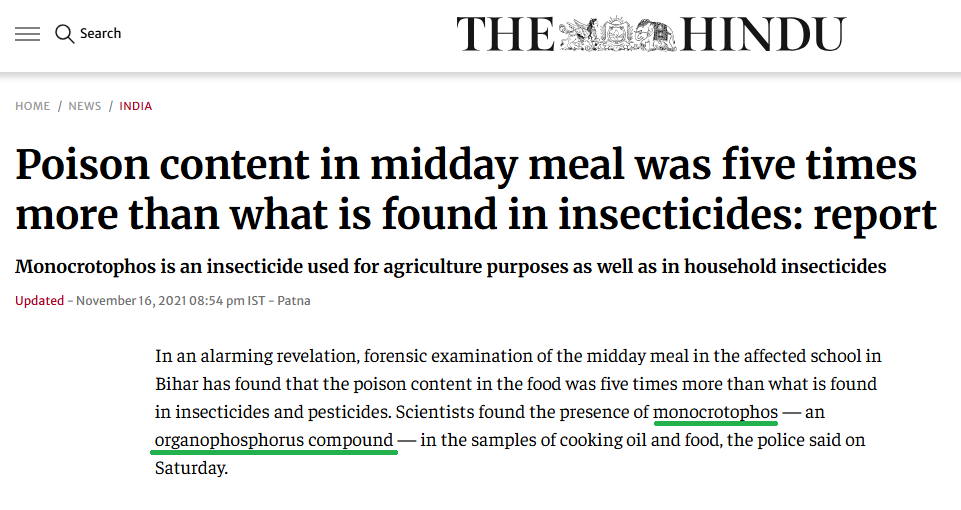
- Examples: Malathion, Parathion, Chlorpyrifos, Monocrotophos.
- Mechanism: They inhibit the enzyme Acetylcholinesterase (AChE), leading to accumulation of acetylcholine and causing a cholinergic crisis, where the nervous system becomes overactive
- Often in the news due to accidental poisonings of school children (Mid-day meal tragedies) or farm laborers.
Note: Carbamates (close cousin of organophosphates)
- Also inhibit AChE but reversibly
- Less toxic but commonly used
2. Aluminium Phosphide (Celphos)
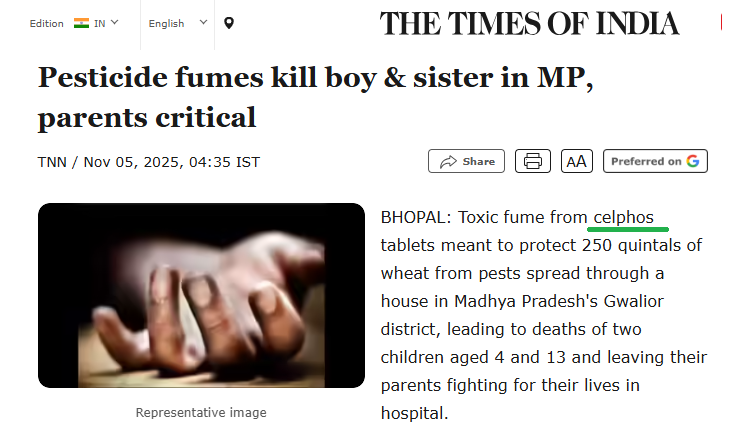
Widely used as a grain fumigant in India. Commonly used as a grain preservative in India to keep insects out of wheat and rice silos.
Mechanism: When it comes into contact with moisture (in the air or stomach), it releases Phosphine gas (PH₃). This gas is a potent mitochondrial poison that stops cells from producing energy (ATP)
- Very high fatality rate
- Common in rural poisoning cases
- Links to storage practices and food security
3. Endosulfan (The Legal/Environmental Landmark)
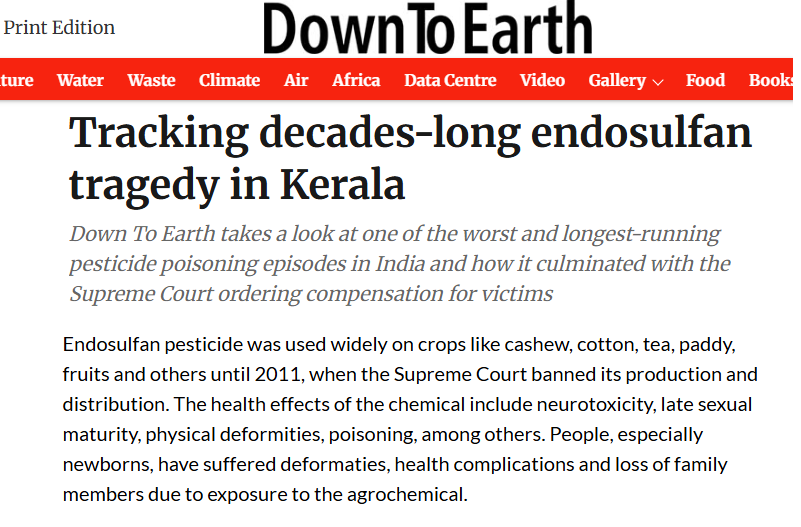
- The Issue: It was used extensively in cashew plantations in Kasaragod, Kerala, leading to horrific birth defects and neurological issues in the local population.
- Led to a landmark Supreme Court ban and is a key example of Bioaccumulation and Biomagnification.
- It is also listed under the Stockholm Convention on Persistent Organic Pollutants (POPs).
4. Heavy Metal Poisoning
| Metal | Disease/Effect | Key Source |
| Arsenic | Blackfoot disease | Groundwater contamination |
| Mercury | Minamata disease | Industrial discharge |
| Cadmium | Itai-itai disease | Mining waste |
| Lead | Plumbism | Paints, pipes |
Mercury pollution is regulated under the Minamata Convention on Mercury
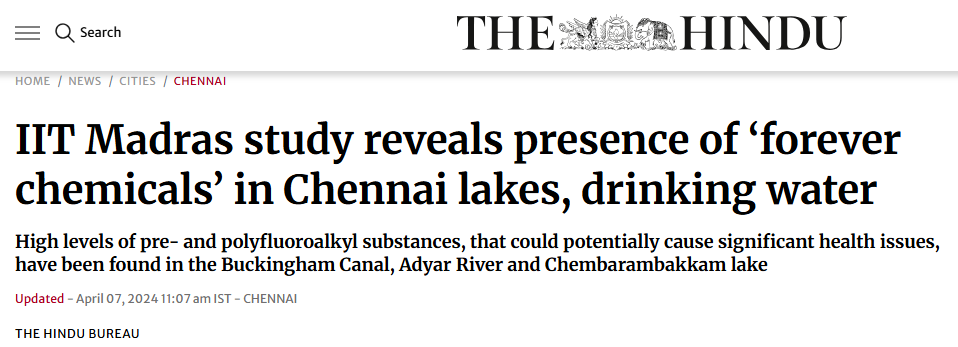
5. “Forever Chemicals” (PFAS)
- What they are: Per- and polyfluoroalkyl substances (PFAS) used in non-stick cookware and fire-fighting foams.
- Why they matter: They do not break down in the environment or the human body.
Practice Questions
Consider the following statements about Paraquat:
- It is a selective herbicide used for specific crops.
- It causes toxicity mainly through oxidative stress.
- There is a widely available antidote for paraquat poisoning.
Which of the above is/are correct?
(a) 1 only
(b) 2 only
(c) 1 and 3
(d) 2 and 3
Answer: (b)
Which of the following are correctly matched?
- Paraquat – Herbicide
- Malathion – Organophosphate insecticide
- Carbaryl – Carbamate pesticide
- Aluminium phosphide – Fumigant
Select the correct answer:
(a) 1 and 2 only
(b) 1, 2 and 3 only
(c) 2, 3 and 4 only
(d) 1, 2, 3 and 4
Answer: (d)
Mains Question
- “The problem of pesticide toxicity in India reflects a deeper governance failure.” Critically examine.
- “The continued use of highly toxic agrochemicals like paraquat reflects the tension between agricultural productivity and public health.” Discuss.
- Indiscriminate use of chemical pesticides poses a serious threat to both human health and the environment.” Discuss with examples