Pariksha Pe Charcha 2026: Exam Stress, Student Wellbeing and Public Communication
Pariksha Pe Charcha 2026 crossed a record registration figure in January, keeping exam stress, student wellbeing and parent-teacher communication in the public-policy conversation.
For UPSC, the topic is useful because it connects education policy with mental health, adolescent wellbeing, competitive pressure and the state’s use of public communication to shape social behaviour.
This article reads Pariksha Pe Charcha as a governance communication tool and asks what deeper reforms are needed to reduce exam stress.
Quick Facts
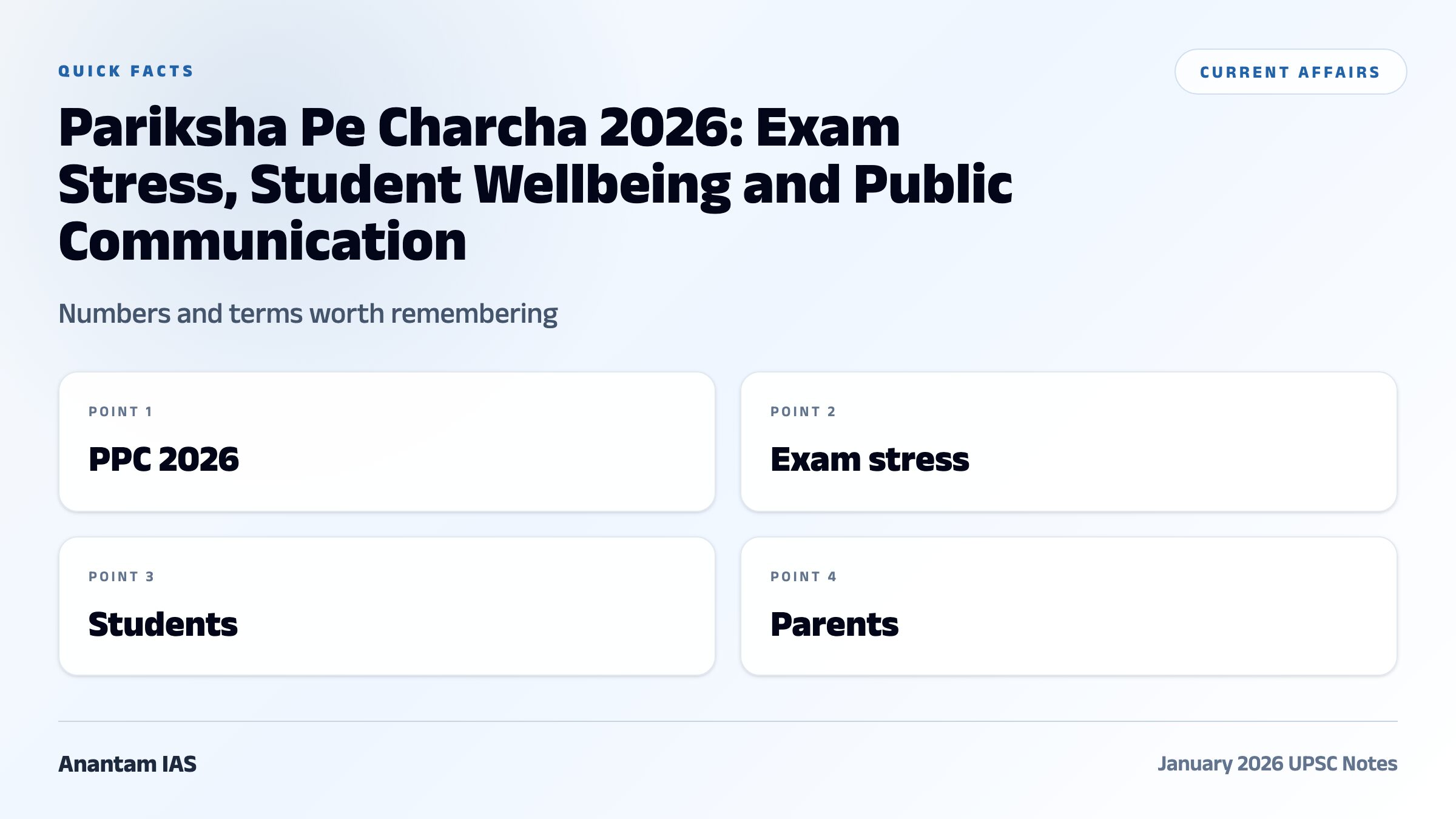
- Pariksha Pe Charcha is an annual interaction around exams, stress and student motivation.
- The 2026 edition saw very large registrations through official platforms.
- The event is linked to students, teachers and parents.
- The broader theme is exam stress and student wellbeing.
- It connects with NEP 2020’s emphasis on holistic education.
- Official source: PIB Ministry of Education release dated 13 January 2026.
- Official source: PIB, Ministry of Education.
What Just Happened
The Ministry of Education announced strong registration numbers for Pariksha Pe Charcha 2026.
The event seeks to normalise conversations around exam anxiety, preparation, motivation and parental pressure.
For aspirants, the news hook is a chance to discuss mental health in education without reducing it to motivational messaging.
Background and Historical Context
India’s education system has long been exam-heavy. Board exams, entrance tests and coaching ecosystems create pressure that affects students and families.
NEP 2020 calls for more holistic, flexible and competency-based education. Assessment reform is central to that vision.
Student wellbeing is now part of education governance because stress, dropout, self-harm and learning anxiety affect human capital.
Key Features of Student Wellbeing
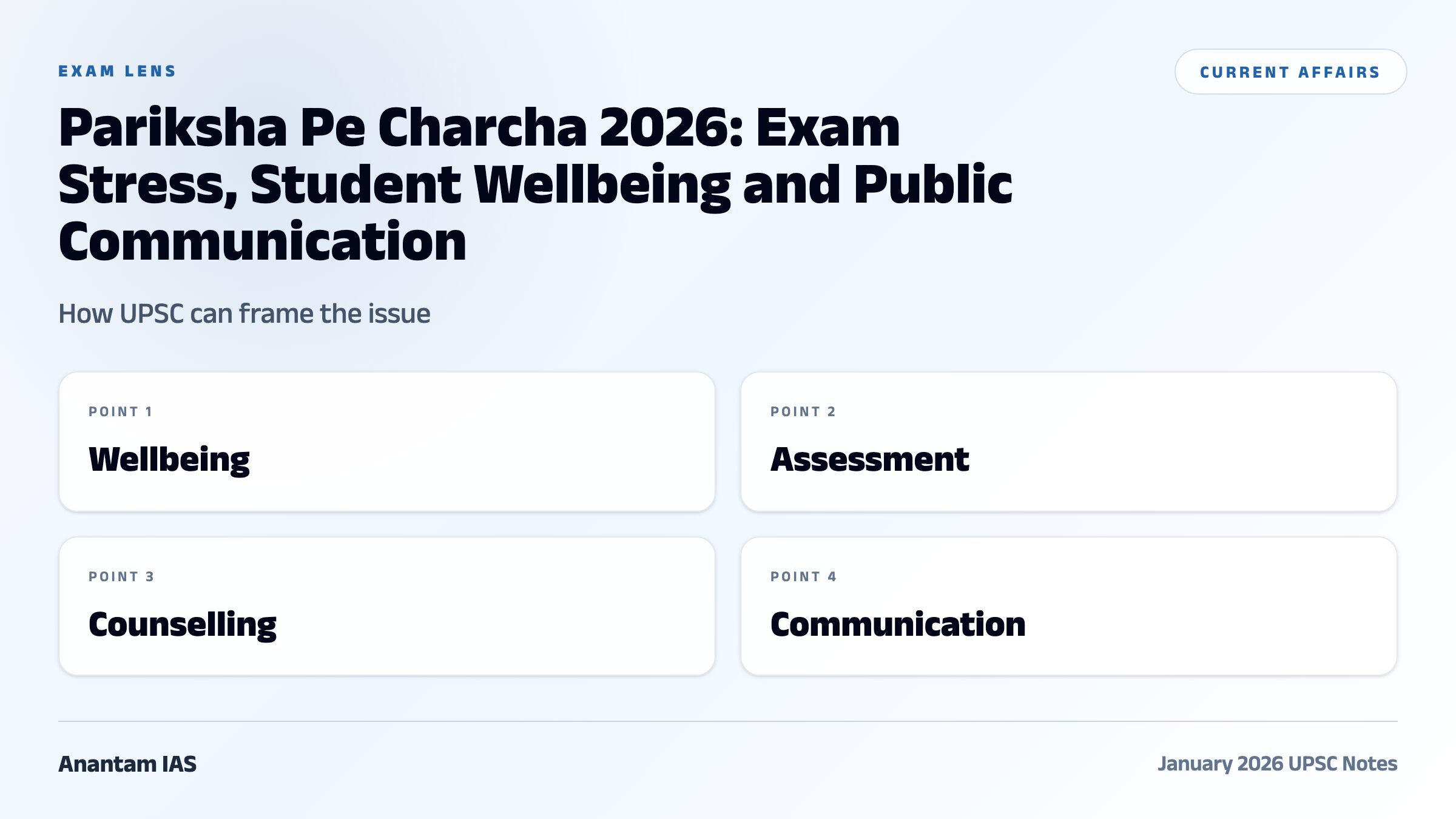
The core policy architecture can be read through these features.
- Public communication: the platform creates national conversation around exam stress.
- Stakeholder inclusion: students, teachers and parents participate.
- Behavioural signal: it tries to reduce fear and stigma around exams.
- NEP link: holistic education and assessment reform provide the policy background.
- Mental-health angle: stress management needs institutional support.
- Limitation: communication cannot replace counselling and assessment reform.
Why It Matters
This is a high-yield UPSC topic because it joins current news with durable syllabus themes.
- It connects a January 2026 event with durable UPSC syllabus themes.
- It gives usable facts for Prelims and analytical hooks for Mains.
- It helps students move from news recall to policy reasoning.
- It can be linked with static concepts in polity, economy, governance, science, environment or society.
Detailed Analysis: Student Wellbeing Lens
Motivation is useful, but structural pressure remains. Students still face high-stakes exams, coaching inequality and narrow definitions of success.
Parents are part of the policy ecosystem. Exam stress is shaped at home as much as in school.
Schools need counselling capacity. Public messaging should be backed by counsellors, teacher training and referral systems.
Comparative Perspective
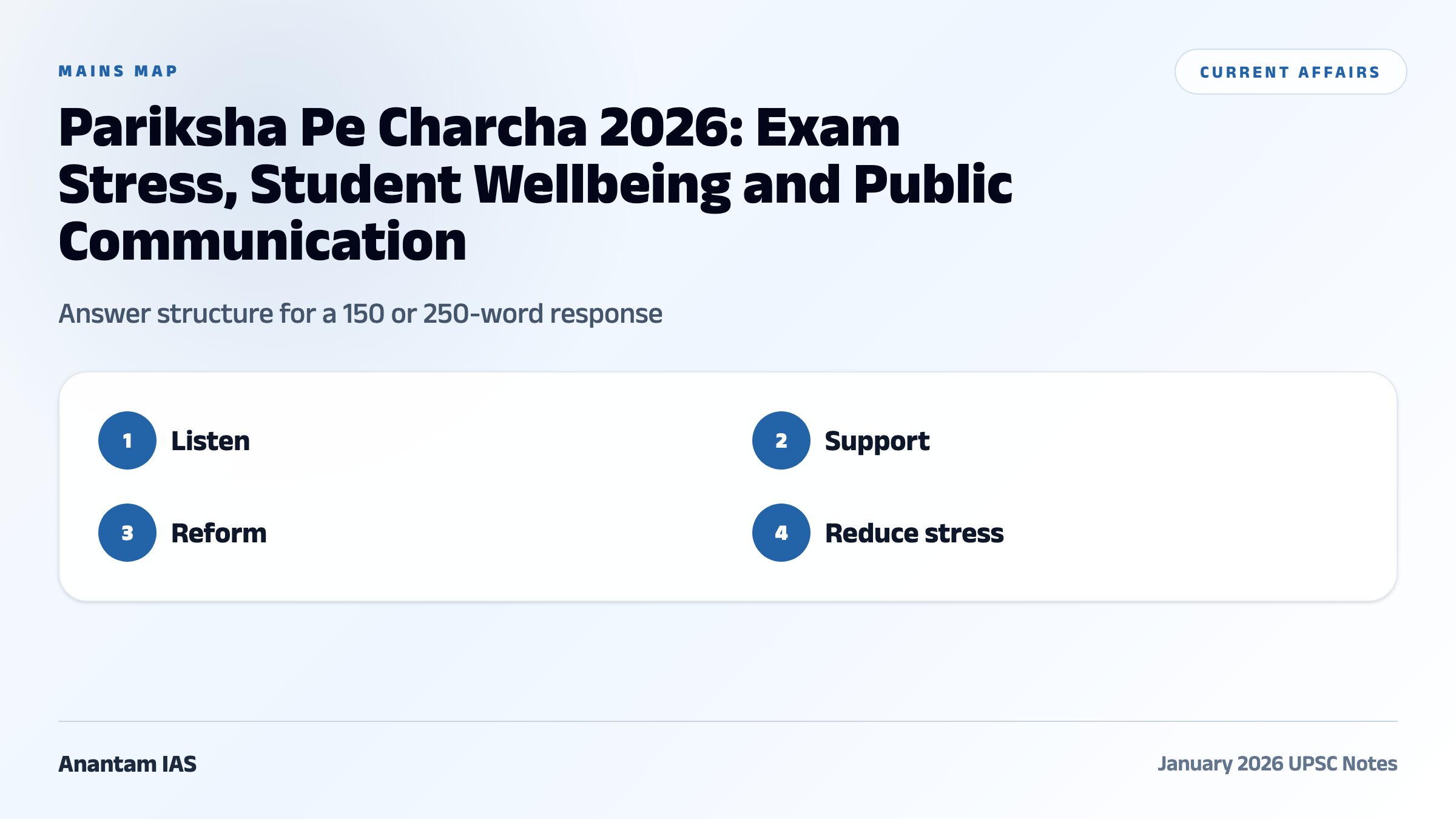
A comparison helps prevent the answer from becoming a one-dimensional news summary.
- Exam reform: changes assessment design and stakes.
- Counselling: provides direct mental-health support.
- Public campaigns: shift social norms and awareness.
- Pariksha Pe Charcha: works mainly as public communication and motivation.
Challenges
The policy or institutional promise runs into recurring constraints.
- One annual event cannot substitute for school-level counselling.
- Competitive exams continue to create high-stakes pressure.
- Rural and government schools need stronger wellbeing infrastructure.
- Parents and coaching centres may reinforce unhealthy pressure.
- Mental-health stigma prevents students from seeking help.
Prelims Pointers
- Pariksha Pe Charcha is linked to exam stress and student interaction.
- NEP 2020 emphasises holistic development and assessment reform.
- Adolescent mental health is a public-health and education concern.
- School counsellors and teacher training are important wellbeing measures.
- Competency-based assessment tests understanding rather than rote recall.
- Public communication can be a governance tool.
Mains Questions
- Student wellbeing must be treated as a core education-policy concern. Discuss. (GS Paper II, 250 words)
- Public communication can reduce stigma but cannot replace institutional reform. Analyse with reference to exam stress. (GS Paper II, 150 words)
- How can assessment reform reduce pressure in India’s school system? (GS Paper II, 250 words)
- Examine the role of parents and teachers in addressing adolescent mental health. (GS Paper II, 250 words)
Way Forward
Pariksha Pe Charcha should be backed by school counsellors, teacher mental-health training, helplines, peer-support systems and assessment reform.
Student wellbeing indicators should be tracked along with enrolment and learning outcomes.
In UPSC answers, use the event as a hook but move quickly to structural reforms.
The examiner is unlikely to reward a bare fact dump here. The better answer connects the January 2026 event to institutional design, implementation capacity and India’s long-term development priorities.
Frequently Asked Questions
What is Pariksha Pe Charcha?
It is an annual interaction focused on exams, stress, motivation and student wellbeing.
Why is it relevant for UPSC?
It links education policy with mental health, assessment reform and public communication.
Is it a scheme?
It is more of a public interaction and communication platform than a conventional welfare scheme.
What is the main limitation?
It cannot replace counselling, assessment reform and school-level wellbeing systems.
How does NEP 2020 connect?
NEP emphasises holistic education, flexibility and assessment reform.
Which GS paper is relevant?
GS-II social sector and governance.