Citizenship Proof: If a passport is not proof, then what is?
Why in News?
A senior Ministry of External Affairs (MEA) official clarified on June 24, 2026 that the Indian passport is a “travel document”, not a “citizenship document” — it attests to nationality abroad but cannot, by itself, establish citizenship. The Hindu reported that the clarification came amid the Special Intensive Revision (SIR) of electoral rolls underway in 16 states.
Days later, on June 30, 2026, the Gauhati High Court upheld a Foreigners’ Tribunal order declaring Aminul Hoque, a 38-year-old daily-wage labourer from Assam, a foreigner — even though he produced 15 documents, including a 1951 NRC copy, voter identity cards, a PAN and a 1973 land deed. The two developments revive a foundational polity question: what legally proves Indian citizenship?
- The MEA official said the passport, issued under the Passports Act, 1967, exists for travel; the Passport Manual places it “in the same category as any other evidence” of citizenship status.
- The bench upheld the opinion of Foreigners’ Tribunal No. 4, Kamrup (Metropolitan), which had declared Mr. Hoque a foreigner on February 28, 2019.
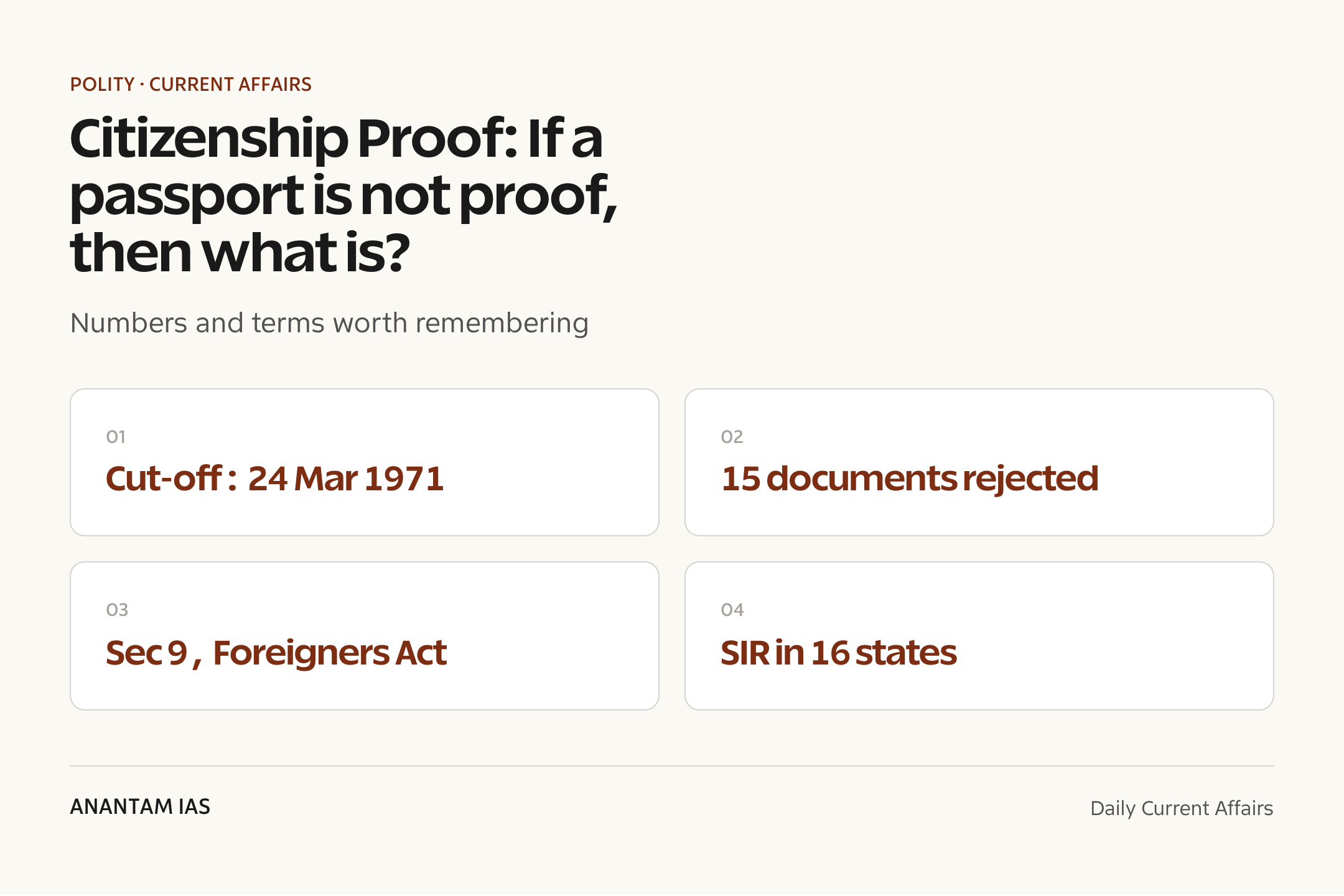
- The court held the 15 documents failed the burden cast by Section 9 of the Foreigners Act, 1946 — the suspected person must prove they are not a foreigner.
- The 1951 NRC extract was rejected as a printout lacking a Section 65B, Evidence Act certificate; the land deed fell over unexplained inheritance gaps.
- Oral testimony — his father identified him in court — was held insufficient without “admissible and relevant” documentary evidence.
The development matters in the context of:
- India issues no single conclusive citizenship document: Aadhaar, voter ID, PAN and even passports serve other statutory purposes.
- With the SIR in 16 states and NRC-linked litigation in Assam, the evidentiary standard for citizenship is a live governance and rights question, hitting the poorest hardest.
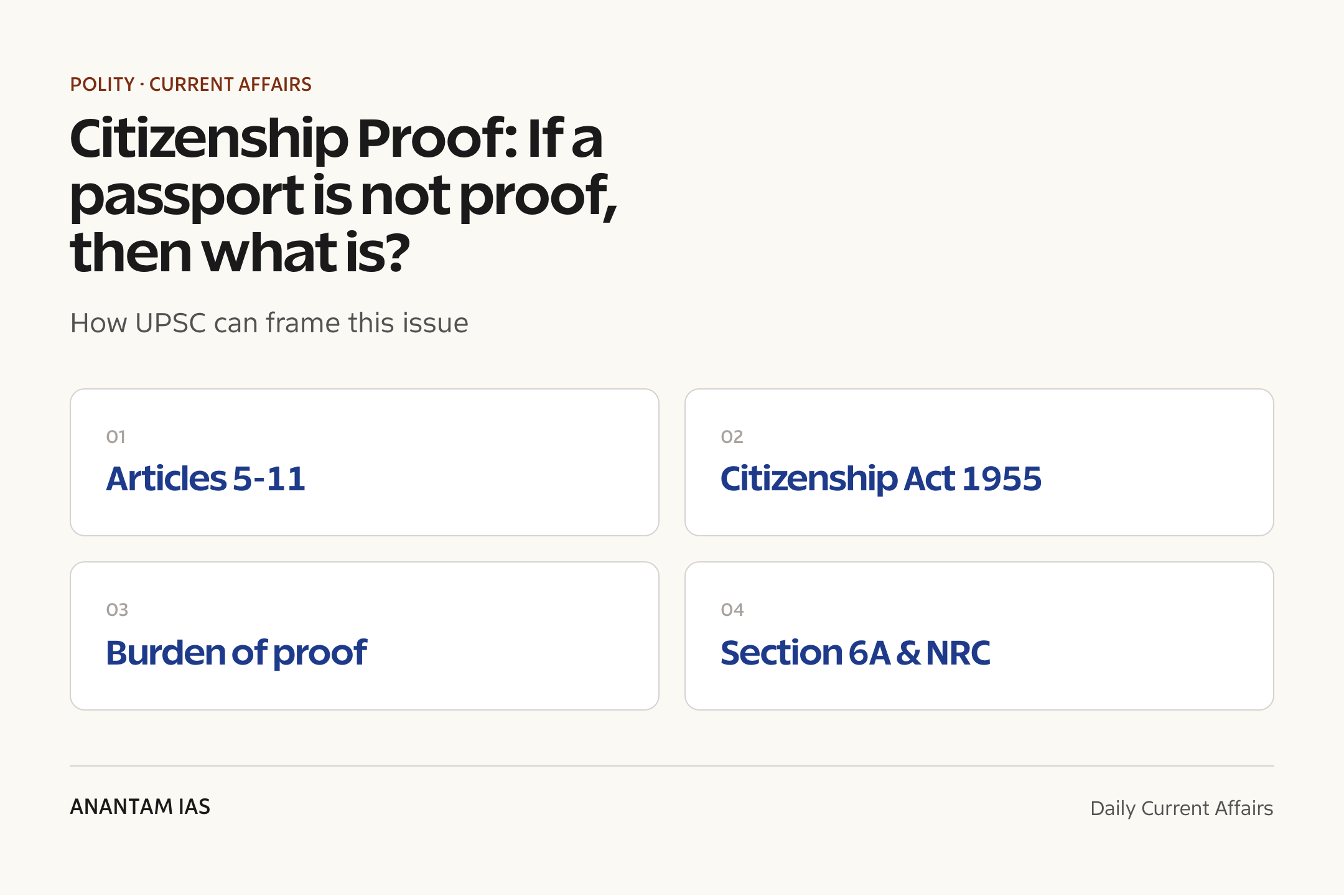
- The story bundles Articles 5–11, the Citizenship Act, 1955, Section 6A, Foreigners’ Tribunals and burden of proof into one case study.
UPSC Relevance
Prelims Relevance
- Articles 5–11 (Part II) — citizenship at commencement; Article 11 empowers Parliament to regulate citizenship by law.
- Citizenship Act, 1955 — five modes: birth (Sec 3), descent (Sec 4), registration (Sec 5), naturalisation (Sec 6), incorporation of territory (Sec 7).
- Birth cut-offs: before July 1, 1987 — citizen by birth; after December 3, 2004 — one parent a citizen, the other not an illegal migrant.
- Section 6A — special Assam regime from the Assam Accord, 1985; upheld 4:1 by a Constitution Bench in October 2024.
- Section 9, Foreigners Act, 1946 — reverse burden of proof on the individual; carried into the Immigration and Foreigners Act, 2025.
- Foreigners’ Tribunals — quasi-judicial bodies under the Foreigners (Tribunals) Order, 1964; function mainly in Assam.
- Section 9, Aadhaar Act, 2016 — Aadhaar is not proof of citizenship or domicile.
- Sarbananda Sonowal v. Union of India (2005) — struck down the IMDT Act, 1983; linked illegal migration to “external aggression” under Article 355.
- Assam cut-off — March 24, 1971 (midnight); the final Assam NRC (August 31, 2019) excluded about 19.06 lakh of 3.3 crore applicants.
Mains Relevance
GS Paper 2
- Citizenship as a constitutional-statutory scheme: Articles 5–11, the Citizenship Act, 1955 and executive documentation.
- The reverse burden of proof versus due process and Article 21 — how evidentiary rules shape substantive rights.
- Electoral integrity versus inclusion: the SIR, the ECI’s Article 324 mandate, and the documentation burden on poor and migrant citizens.
- Working of quasi-judicial bodies: Foreigners’ Tribunals and judicial review by High Courts.
GS Paper 1
- Post-independence consolidation: the Assam Movement (1979–85), the Assam Accord and its citizenship legacy.
- Migration from East Pakistan/Bangladesh and its demographic-political consequences in the Northeast.
Essay
- Paper trails and personhood: when belonging to a nation must be proved on paper.
- The weakest carry the heaviest burden: evidentiary justice and India’s documentation state.
Background and Context
The Trigger: An MEA Clarification and a Failed Citizenship Test
Two developments within a week crystallised the gap between the documents Indians hold and the citizenship they are presumed to have.
- On June 24, 2026, a senior MEA official said the passport “attests to your nationality” abroad but “is not a document of your citizenship” — the Passport Manual itself calls it evidence “in the same category as any other”.
- On June 30, 2026, the Gauhati High Court dismissed Aminul Hoque’s writ petition: his 15 documents — a 1951 NRC copy naming his father and grandparents, voter IDs, a PAN and a 1973 land deed — did not discharge his Section 9 burden.
- The NRC printout lacked a Section 65B certificate (Evidence Act, 1872); the land deed raised unanswered inheritance questions; the tribunal had committed no “patent error”.
- The ruling shows the exacting standard: each document must be admissible, relevant and consistent — volume alone proves nothing.
Constitutional Framework: Articles 5 to 11
The Constitution settled only who was a citizen on January 26, 1950, and handed everything after that to Parliament.
- Article 5 — citizenship at commencement via domicile plus birth, parentage or five years’ residence; Articles 6–8 — migrants from and to Pakistan (with a July 19, 1948 dividing line) and persons of Indian origin abroad.
- Article 9 — voluntarily acquiring foreign citizenship ends Indian citizenship; India permits no dual citizenship.
- Article 10 guarantees continuance subject to law; Article 11 gives Parliament full power over acquisition and termination — the basis of the Citizenship Act, 1955.
- Because the Constitution is silent on documents, proof of citizenship is a statutory-evidentiary question — the root of today’s confusion.
Citizenship Act, 1955: Five Modes and the Shrinking Birthright
The Act, administered by the Ministry of Home Affairs, recognises five modes of acquisition — and Parliament has steadily tightened the birth route.
- Section 3 (birth): born before July 1, 1987 — citizen regardless of parentage; 1987 to December 3, 2004 — one parent a citizen; after 2004 — one parent a citizen, the other not an illegal migrant.
- Section 4 (descent) — birth abroad to an Indian parent; Section 5 (registration) and Section 6 (naturalisation) — persons of Indian origin, spouses, long-term residents; Section 7 — incorporation of territory (Sikkim, Goa).
- Only citizens by registration or naturalisation get a citizenship certificate; citizens by birth or descent — the vast majority — hold no citizenship document at all.
- The Citizenship (Amendment) Act, 2019 fast-tracked six non-Muslim minorities from three neighbouring countries who entered by December 31, 2014. The Act’s text sits on the official India Code portal.
Why Everyday Documents Do Not Prove Citizenship
Each familiar identity document was created for a different statutory purpose, and each disclaims what people assume it proves.
- Passport — issued under the Passports Act, 1967 for travel; issuance presumes citizenship, but courts and the MEA treat it as evidence of nationality, not conclusive proof.
- Aadhaar — Section 9, Aadhaar Act, 2016 states an Aadhaar number is not proof of citizenship or domicile; it is residence-linked identity only.
- Voter ID (EPIC) — proves enrolment as an elector after a summary inquiry under the Representation of the People Act, 1950; it presumes citizenship without adjudicating it.
- PAN and ration cards — tax and welfare instruments; PAN is issued to foreigners too.
- Birth certificate — proves place and date of birth; after the 2004 cut-off it must be paired with proof of the parents’ status.
- Net effect: citizenship rests on a chain of evidence — birth records, parents’ legacy documents, admissibility formalities — hardest to assemble for the poor, landless and displaced.
Assam's Special Regime: Section 6A, the Accord and the NRC
Assam runs on a different citizenship clock, negotiated to end a six-year agitation against migration from the newly created Bangladesh.
- The Assam Accord (1985) fixed March 24, 1971 (midnight) as the cut-off: pre-1966 entrants are citizens; 1966–71 entrants got citizenship after a 10-year voting suspension; later entrants face detection and expulsion.
- Parliament codified this as Section 6A of the Citizenship Act; a five-judge Constitution Bench upheld it 4:1 in October 2024.
- The National Register of Citizens (1951) was updated for Assam under Supreme Court supervision; the final list of August 31, 2019 excluded about 19.06 lakh of 3.3 crore applicants and remains un-notified.
- Foreigners’ Tribunals — quasi-judicial bodies under the 1964 Order — give “opinions” on foreigner status, reviewable only by the High Court.
- The Hindu reported that in 2025 the Assam government began invoking the Immigrants (Expulsion from Assam) Act, 1950 to “push back” suspected foreigners without full tribunal proceedings.
Burden of Proof: Section 9, Sonowal and the Evidence Act
The decisive legal feature of citizenship litigation is that the State need not prove you are a foreigner — you must prove you are not.
- Section 9, Foreigners Act, 1946: once the question is raised, the onus of proving one is not a foreigner lies on that person — a reversal of the normal rule.
- In Sarbananda Sonowal v. Union of India (2005), the Supreme Court struck down the IMDT Act, 1983 (which put the burden on the State), holding unchecked migration amounted to “external aggression” under Article 355.
- The Immigration and Foreigners Act, 2025, which replaced the 1946 law, retains the individual’s burden; Mr. Hoque’s case proceeded under the 1946 Act.
- Admissibility formalities do heavy work: electronic printouts need a Section 65B certificate, copies must be duly certified, and names and dates must match across decades-old records.
- In the Bihar SIR litigation, the Supreme Court directed the Election Commission of India to accept Aadhaar as an identity document while reiterating it is not proof of citizenship (see eci.gov.in).
- The combined effect: 15 documents can fail where one properly certified legacy document might succeed.
Way Forward
Clarify the evidentiary standard
- Specify a graded, illustrative list of documents and the weight each carries in citizenship inquiries, so tribunals apply uniform standards.
- Relax hyper-technical objections (spelling variants, minor age mismatches) where the overall chain of evidence is coherent.
Fix the documentation deficit
- Push universal birth registration and digitised legacy records with easy access to Section 65B-compliant certified copies.
- Provide legal aid under Article 39A for persons before Foreigners’ Tribunals — most, like the Assam labourer, contest complex proceedings alone.
Institutional safeguards
- Standardise the composition, tenure and training of Foreigners’ Tribunal members, with reasoned, published opinions to enable High Court review.
- In roll-revision exercises like the SIR, keep inclusion the default: deletion should follow individualised notice and inquiry, since the ECI verifies electors, not citizenship.
Conclusion
India’s citizenship architecture rests on a paradox: the Constitution and the Citizenship Act, 1955 define who is a citizen, but the State issues no universal document that proves it. Proof collapses into a chain of old records that the poorest citizens are least able to produce and authenticate.
The MEA’s clarification and the Gauhati High Court ruling are the system working as designed, with a reverse burden of proof settled since Sarbananda Sonowal (2005). Whether that design serves justice amid NRC-style verification and the SIR is now the central question for lawmakers and courts. Track how it evolves in our daily current affairs digests.
UPSC Practice Questions
Prelims MCQ 1
With reference to proof of Indian citizenship, consider the following statements:
- The Indian passport is legally a travel document and is not conclusive proof of citizenship.
- The Aadhaar Act, 2016 expressly provides that an Aadhaar number is not proof of citizenship.
- Under the Foreigners Act, 1946, the burden of proving that a person is not a foreigner lies on the State.
How many of the above statements are correct?
(a) Only one (b) Only two (c) All three (d) None
Answer: (b) Only two
Explanation:
Statements 1 and 2 are correct: the passport is a travel document (Passports Act, 1967), and Section 9 of the Aadhaar Act, 2016 says Aadhaar is not proof of citizenship. Statement 3 is wrong — Section 9, Foreigners Act, 1946 places the burden on the individual.
Prelims MCQ 2
The cut-off date of March 24, 1971 (midnight), recently in the news in the context of citizenship in Assam, is prescribed by:
(a) The Citizenship (Amendment) Act, 2019 (b) Section 6A of the Citizenship Act, 1955, giving effect to the Assam Accord (c) Article 6 of the Constitution of India (d) The National Register of Citizens, 1951
Answer: (b) Section 6A of the Citizenship Act, 1955, giving effect to the Assam Accord
Explanation:
Section 6A, inserted in 1985 to implement the Assam Accord, fixes March 24, 1971 (midnight) as the citizenship cut-off for Assam; a Constitution Bench upheld it 4:1 in October 2024. The CAA 2019 cut-off is December 31, 2014.
UPSC Mains Questions
- “A passport attests to nationality but does not prove citizenship.” In the light of recent executive and judicial clarifications, examine the constitutional and statutory framework for determining Indian citizenship and the difficulties it creates for ordinary citizens. (250 words)
- The reverse burden of proof under Indian foreigners law places the heaviest evidentiary load on the poorest residents. Critically analyse with reference to Section 9 of the Foreigners Act, 1946, the Sarbananda Sonowal judgment and the working of Foreigners’ Tribunals in Assam. (250 words)
- India has no single, conclusive document of citizenship. Discuss the administrative and rights-related consequences of this gap, and suggest reforms to make verification exercises like the NRC and the Special Intensive Revision of electoral rolls both accurate and inclusive. (250 words)
Sources: The Hindu Explained and The Hindu.
Frequently Asked Questions
Is an Indian passport proof of citizenship?
No. The MEA clarified in June 2026 that the passport, issued under the Passports Act, 1967, is a travel document. It attests to the holder’s nationality while travelling abroad, but the government’s Passport Manual treats it as just one piece of evidence, not conclusive proof of citizenship.
Which documents legally prove Indian citizenship?
There is no single conclusive document. Citizens by registration or naturalisation get a citizenship certificate; citizens by birth or descent must build a chain of evidence — birth records, parents’ legacy documents, old electoral rolls or NRC extracts — each admissible under evidence law and consistent across records.
Is Aadhaar or a voter ID proof of citizenship?
No. Section 9 of the Aadhaar Act, 2016 expressly says Aadhaar is not proof of citizenship or domicile. A voter ID shows enrolment as an elector after a summary inquiry; it presumes citizenship but does not adjudicate or conclusively prove it.
What is Section 9 of the Foreigners Act?
It reverses the normal burden of proof: once a person’s citizenship is questioned, the onus of proving they are not a foreigner lies on that person, not the State. The Supreme Court reinforced this in Sarbananda Sonowal (2005), and the Immigration and Foreigners Act, 2025 retains the rule.
Why did the Gauhati High Court reject 15 documents?
On June 30, 2026 the court held Aminul Hoque’s documents were inadmissible or inconsistent — his 1951 NRC copy was a printout without the Section 65B Evidence Act certificate, and the 1973 land deed raised unexplained inheritance gaps — so he failed to discharge his burden under the Foreigners Act.
What is Section 6A of the Citizenship Act?
Section 6A, added in 1985 to implement the Assam Accord, creates a special citizenship regime for Assam with a March 24, 1971 cut-off. Entrants before 1966 are citizens; 1966–71 entrants got citizenship after a ten-year voting suspension. A Constitution Bench upheld it 4:1 in October 2024.