Peaceful Protest and Pellet Guns: Rights, Force and Accountability
Why in News?
On July 27, 2026, a three-judge Supreme Court Bench led by Chief Justice Surya Kant orally stressed that peaceful and lawful protest is constitutionally protected. The Bench was considering the listing of connected petitions alleging disproportionate police action during protests over examination paper leaks and said the competing claims of injured protesters and police personnel required a balanced, independent examination.
A separate Article 32 petition by retired Intelligence Bureau officer Yashovardhan Azad and two persons who say they suffered pellet injuries seeks the decommissioning or prohibition of metallic kinetic projectiles for dispersing civilian assemblies, compensation, treatment and rehabilitation. This is a live prayer, not a ruling: the Court had not declared a nationwide ban on pellet guns or finally decided that their use in the July 20 operation was unlawful.
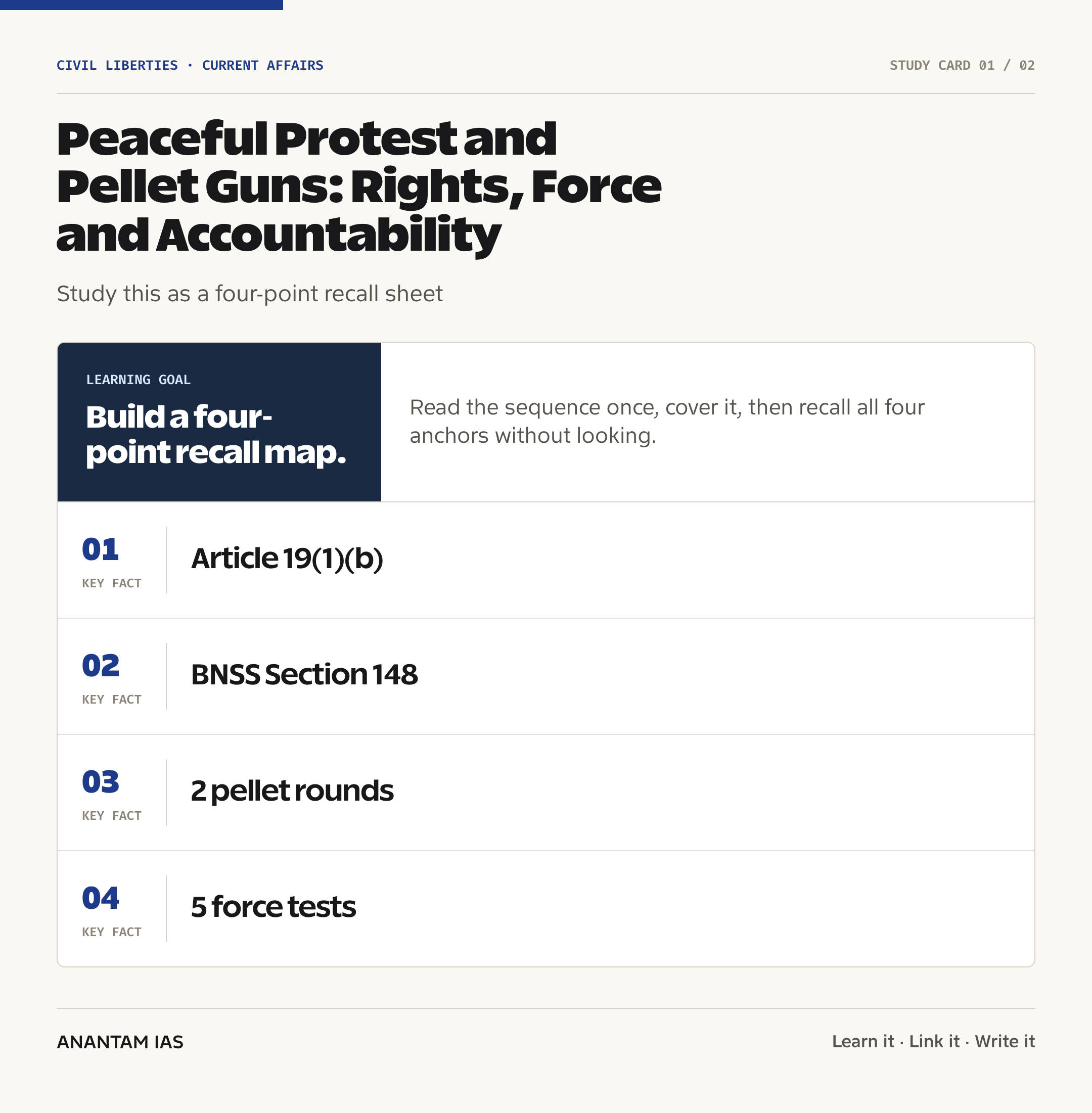
- The Hindu reported that a general diary entry recorded the Rapid Action Force firing two anti-riot rounds containing plastic pellets on the direction of a Delhi Police officer during the July 20 march.
- The reported diary entry also listed 55 non-electrical shells, 15 electrical shells and five tear-smoke grenades; these are details from a media-reviewed document, not findings recorded in a final judicial order.
- Delhi Police had earlier denied using pellet guns, while the CRPF said it was verifying media reports. The apparent conflict makes preservation and independent examination of operational records central to accountability.
- The July 27 Bench indicated that connected matters would be heard together on July 28 and discussed the possible need for a uniform protocol, but its remarks were oral observations during a pending proceeding.
- The legal issue is wider than whether an assembly had permission: it asks whether any force used was authorised, necessary, graduated, proportionate and followed by medical care, reporting and review.
The development matters in the context of:
- This matters in the context of the constitutional balance between Article 19 freedoms and the State’s duty to protect public order, commuters and police personnel.
- The label less-lethal describes a design objective, not a guarantee of safety; kinetic projectiles can penetrate tissue, damage eyes and cause permanent disability.
- A clear chain of command matters because lawful crowd management depends on who ordered dispersal, what warning was given, why a weapon was selected and how each discharge was recorded.
- The case can shape future standards for protest policing, but allegations, operational records, medical evidence and settled judicial holdings must not be collapsed into one narrative.
UPSC Relevance
Prelims Relevance
- Article 19(1)(a) protects freedom of speech and expression, while Article 19(1)(b) protects the right of citizens to assemble peaceably and without arms.
- Article 19(3) permits reasonable restrictions on peaceful assembly in the interests of the sovereignty and integrity of India or public order.
- Article 21 protects life and personal liberty and supplies the constitutional basis for dignity, bodily integrity and fair procedure in police action.
- Article 32 enables a person to approach the Supreme Court for enforcement of Fundamental Rights; filing a petition does not establish the truth of its allegations.
- BNSS Section 148 permits specified magistrates or police officers to command certain assemblies to disperse and, if the statutory conditions arise, to disperse them by civil force.
- BNSS Section 149 concerns use of the armed forces when an assembly cannot otherwise be dispersed and public security requires it; it expressly requires as little force and injury as consistent with dispersal.
- Ramlila Maidan Incident, Anita Thakur, Mazdoor Kisan Shakti Sangathan and Amit Sahni are important Supreme Court authorities on protest, regulation and police force.
- The Rapid Action Force is a specialised riot-control component of the Central Reserve Police Force, not a unit of Delhi Police.
- A kinetic impact projectile transfers energy by striking the body; calling it less-lethal does not make it non-injurious.
- The UN Basic Principles on the Use of Force and Firearms are international standards; they are persuasive benchmarks and should not be described as an Indian statute.
Mains Relevance
GS Paper 2
- Scope of Articles 19(1)(a), 19(1)(b), 19(3) and 21, and the difference between reasonable regulation of assemblies and arbitrary suppression of dissent.
- Judicial review of police action through the tests of legality, necessity, proportionality, precaution and accountability.
- Institutional design of a pan-India crowd-control protocol without converting judicial guidance into day-to-day operational command.
GS Paper 4
- Ethical duties of public officials: restraint, impartiality, empathy, truthfulness in official records and responsibility for foreseeable harm.
- Resolving the moral tension between protecting peaceful citizens and police personnel while isolating individuals who commit violence.
Essay
- Dissent tests a democracy most sharply when public order is under strain.
- Legitimate authority is strengthened, not weakened, by restraint and transparent accountability.
- Technology described as less-lethal still demands ethical limits because risk is borne by human bodies.
Background and Context
Constitutional Architecture of Peaceful Protest
The Constitution protects protest as a combined exercise of expression and assembly, while allowing carefully bounded regulation.
- Article 19 protects speech under clause (1)(a) and peaceful, unarmed assembly under clause (1)(b); the word peaceful is part of the guarantee itself.
- Restrictions on assembly must fit Article 19(3): they need legal authority, a connection with sovereignty and integrity or public order, and substantive reasonableness.
- Public order is not a free-standing licence to punish dissent. The State must connect the restriction or force to a real risk and cannot treat every inconvenience, slogan or criticism as violence.
- Article 21 adds protection for life, dignity and bodily integrity. Serious injury during a police operation raises questions under Articles 14, 19 and 21 together.
- Protesters also carry duties: an assembly must remain peaceful and unarmed, comply with lawful and reasonable regulation, avoid attacks and allow the rights of others to be protected.
- The correct constitutional frame is a balance of rights, not a choice between absolute protest freedom and unlimited police power.
What the Supreme Court Has Already Settled
Earlier judgments supply durable principles, but none should be misreported as a final decision on the new pellet-gun petition.
- In Ramlila Maidan Incident v. Home Secretary, Union of India (2012), the Court examined the forcible midnight dispersal of a gathering and treated speech, peaceful assembly, sleep, dignity and police restraint as constitutional concerns.
- In Anita Thakur v. Government of J&K (2016), the Court accepted that reasonable force may become necessary when an assembly turns violent, but held that excessive force violates human rights and human dignity; it awarded compensation to persons found to have suffered such excess.
- The judgment discussed minimum and progressive force: warnings and less harmful measures should precede more injurious options, subject to the actual threat and operational feasibility.
- In Mazdoor Kisan Shakti Sangathan v. Union of India (2018), the Court recognised protest under Articles 19(1)(a) and 19(1)(b), rejected an approach amounting to a blanket ban in central Delhi and required workable regulation that also protected residents.
- In Amit Sahni v. Commissioner of Police (2020), the Court reiterated the right to dissent but held that public ways cannot be occupied indefinitely; time, place and manner regulation may protect commuters and other rights.
- These holdings establish neither a categorical right to occupy any site nor a categorical power to use any weapon. They require contextual justification and review of the least harmful effective response.
Domestic Statutory Route for Dispersal
The Bharatiya Nagarik Suraksha Sanhita provides authority to disperse certain assemblies, but statutory power remains subject to Fundamental Rights.
- Under BNSS Section 148, an Executive Magistrate, station house officer or qualifying police officer may command an unlawful assembly, or an assembly of five or more likely to disturb public peace, to disperse.
- If the assembly does not disperse after the command, or manifests a determination not to disperse, the authorised official may use civil force for dispersal and may arrest and confine participants as legally necessary.
- Section 149 sets a higher institutional route for armed-forces assistance: the assembly cannot otherwise be dispersed, public security must require dispersal and an authorised Executive Magistrate must act.
- Section 149(3) states that the armed-forces officer should use as little force and cause as little injury as is consistent with dispersal and arrest. This text captures restraint but doesn’t answer every weapon-specific question.
- A power to disperse doesn’t automatically validate a particular projectile, target area, firing distance or number of rounds. Those choices must still satisfy the operational order, training, weapon protocol and constitutional standard.
- For examination answers, separate authority to disperse from manner of dispersal. A lawful objective can still be pursued through an excessive or poorly controlled means.
Pellet Guns and the Unsettled Regulatory Question
India has operational rules for riot-control weapons, but no simple nationwide statutory sentence declaring pellet guns either universally lawful or universally banned.
- A pellet shotgun or projectile-action system releases multiple small projectiles over an area. Its spread makes individualised targeting difficult, especially in a moving crowd.
- The Union Home Ministry told the Lok Sabha in March 2018 that an Expert Committee had been constituted on July 26, 2016 to explore alternatives and that a three-day special training programme covered less-lethal weapons in Jammu and Kashmir.
- That parliamentary answer said the Jammu and Kashmir SOP followed an established use-of-force hierarchy, including rubber and plastic bullets. It was an account of a particular operational framework, not a permanent nationwide judicial endorsement.
- Past Jammu and Kashmir litigation did not result in a nationwide Supreme Court ban. The earlier High Court’s refusal to impose a blanket prohibition in its factual setting doesn’t foreclose a fresh challenge based on a different assembly, record or injury pattern.
- The new petition reportedly asks for decommissioning or banning wholly or partly metallic kinetic projectiles for civilian crowd dispersal. The Court may accept, narrow or reject that prayer after hearing all sides.
- The legal gap worth analysing is weapon-specific transparency: publicly intelligible standards on authorisation, ammunition type, safe use, medical response, reporting and independent review.
Less-Lethal Does Not Mean Harmless
The relevant test is the foreseeable risk created by the weapon and manner of use, not the marketing label attached to it.
- Kinetic projectiles may cause blunt trauma, penetration, fractures and organ injury; strikes to the eye or head can cause permanent visual loss or death.
- The UN Human Rights Guidance on Less-Lethal Weapons says kinetic impact projectiles should generally be aimed directly at the lower abdomen or legs of a violent individual to address an imminent threat of injury.
- The same guidance warns that firing toward the face or head may cause brain injury, blindness or death and that elevated firing can increase the risk of head strikes.
- International guidance is not itself the holding in the pending Indian case. It offers a persuasive benchmark for necessity, proportionality, precaution and weapon design.
- Indiscriminate spread creates an attribution problem: peaceful participants, bystanders, journalists and violent individuals may be physically close, but their legal status and conduct differ.
- A rights-compliant protocol should match the response to individual conduct and imminent threat wherever feasible rather than treating the crowd as one undifferentiated target.
Evidence, Command Responsibility and Remedies
Accountability depends on reconstructing the decision chain rather than drawing conclusions from a single video, denial or newspaper report.
- Investigators should preserve the general diary, deployment plan, ammunition issue-and-return register, wireless logs, body-camera or CCTV footage, medical records and names of commanding officers.
- A diary entry may be important contemporaneous evidence, but a court must test its authorship, context, accuracy and relationship with other records before treating disputed facts as proved.
- Independent medical documentation should record the number, location and depth of projectiles without making unsupported conclusions about which unit fired them.
- A valid review asks who authorised dispersal, whether a warning was audible, whether exit routes remained open, what immediate threat existed, which alternatives failed and why each escalation was chosen.
- Possible remedies include medical care, rehabilitation, compensation, departmental action, criminal investigation, protocol revision and disclosure, depending on findings and legal responsibility.
- Protection of police personnel is part of the same design: suitable helmets, shields, spacing, training and extraction plans reduce injuries and lower the claimed need for high-risk force.
- Institutional learning requires after-action review even when force is found lawful. The aim is to reduce future harm, improve command decisions and preserve public confidence.
Way Forward
Publish a Rights-Based Use-of-Force Framework
- Create a clear national minimum standard built around legality, necessity, proportionality, precaution and accountability, while allowing local operational plans for venue and threat conditions.
- Define each weapon category, authorised officer, permissible threat threshold, prohibited target areas, warning requirements and mandatory post-use reporting.
Prefer De-escalation and Graduated Response
- Use liaison officers, intelligible directions, time to comply, open exit routes, barriers and targeted arrest before area-effect weapons wherever practicable.
- Separate peaceful participants from persons committing violence; isolated misconduct shouldn’t automatically extinguish protection for an otherwise peaceful assembly.
Make the Evidence Chain Auditable
- Digitally log each weapon issue, discharge, operator, commander, ammunition type and stated reason, with safeguards against later alteration.
- Require prompt independent review whenever a projectile causes serious injury, along with preservation of video and medical evidence.
Build Safety for Both Sides
- Equip police with protective gear and recurrent human-rights training so operational safety doesn’t depend on early escalation.
- Guarantee immediate medical access, family information and a time-bound complaint route for injured protesters, bystanders and police personnel.
Let the Court Decide on a Complete Record
- The pending petitions should be resolved after responses from the Union, police and force authorities, verified operational records, medical evidence and expert assessment of weapon risks.
- Any final guideline should distinguish peaceful assemblies, unlawful but non-violent assemblies and violent conduct instead of applying one force threshold to all three.
Conclusion
The immediate controversy is not proof that the Supreme Court has banned pellet guns. It is a live constitutional inquiry into alleged force, disputed official accounts, a reported command record and injuries that may reveal whether existing safeguards worked.
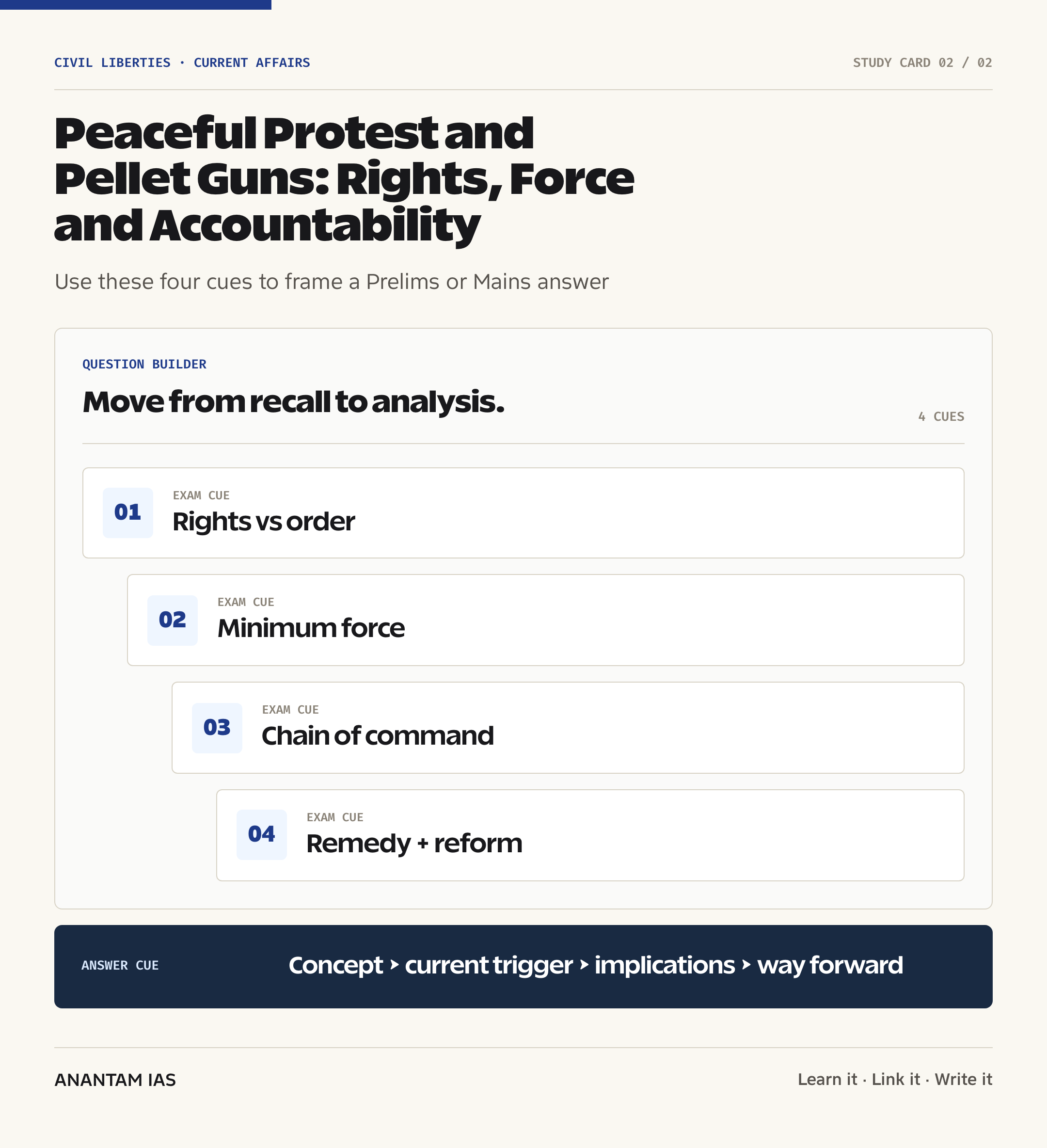
The durable UPSC lesson is that democratic policing is judged by both its objective and its method. Public order is legitimate, but force gains constitutional legitimacy only when it is lawful, necessary, proportionate, carefully directed and answerable to independent review.
A credible protocol must protect peaceful dissent, isolate actual violence, reduce risk to police personnel and produce records strong enough for courts and the public to test every serious use of force.
UPSC Practice Questions
Prelims MCQ 1
With reference to the constitutional right to protest in India, consider the following statements:
- Article 19(1)(b) protects the right of citizens to assemble peaceably and without arms.
- Reasonable restrictions on this right may be imposed in the interests of public order.
- The right permits indefinite occupation of any public road chosen by an assembly.
How many of the above statements are correct?
(a) Only one (b) Only two (c) All three (d) None
Answer: (b) Only two
Explanation:
Statements 1 and 2 are correct under Articles 19(1)(b) and 19(3). Statement 3 is incorrect: Amit Sahni affirmed peaceful dissent but rejected indefinite occupation of public ways and recognised reasonable time-place-manner regulation.
Prelims MCQ 2
Which one of the following correctly describes BNSS Section 148?
(a) It creates an absolute ban on all assemblies of five persons. (b) It authorises specified officials to command certain assemblies to disperse and permits civil force when statutory conditions are met. (c) It gives only the Supreme Court power to order crowd dispersal. (d) It specifically prohibits every kinetic impact projectile.
Answer: (b) It authorises specified officials to command certain assemblies to disperse and permits civil force when statutory conditions are met.
Explanation:
BNSS Section 148 concerns dispersal by civil force. It neither bans every five-person assembly nor creates a weapon-specific nationwide prohibition.
UPSC Mains Questions
- The right to peaceful protest and the duty to maintain public order are complementary constitutional responsibilities, not mutually exclusive claims. Examine this proposition with reference to Articles 19 and 21, Supreme Court jurisprudence and the principles governing police use of force.
- A label such as less-lethal cannot substitute for legality, necessity and accountability. Discuss the regulatory and institutional reforms needed for the use of kinetic impact projectiles in crowd control, including command responsibility, medical response and independent review.
Sources: The Hindu, Supreme Court of India, Ministry of Home Affairs and India Code and The Hindu.
Frequently Asked Questions
Has the Supreme Court banned pellet guns?
No. A fresh Article 32 petition reportedly seeks decommissioning or prohibition of certain kinetic projectiles for civilian crowd dispersal, but a prayer in a petition isn’t a judicial holding. The Court’s July 27 comments protected peaceful protest and discussed police excesses and protocols; they were oral observations in pending matters, not a final nationwide pellet-gun ban.
Is every protest protected by Article 19?
Article 19(1)(b) protects citizens assembling peaceably and without arms. The State may impose reasonable restrictions under Article 19(3) for sovereignty and integrity or public order. Violence, weapons or indefinite blockage can justify proportionate regulation, but isolated misconduct shouldn’t automatically erase the rights of every peaceful participant.
What does BNSS Section 148 permit?
BNSS Section 148 allows an Executive Magistrate or specified police officer to command an unlawful assembly, or an assembly of five or more likely to disturb public peace, to disperse. If statutory conditions continue, civil force may be used. The provision supplies authority; it doesn’t remove constitutional scrutiny of necessity, proportionality or method.
Why are pellet weapons called less-lethal?
They are intended to reduce the probability of death compared with conventional firearms, but less-lethal doesn’t mean harmless. Multiple projectiles can penetrate tissue and strikes to the head or eyes can cause blindness or death. Their legal assessment depends on design, ammunition, distance, targeting, threat level, warnings and medical response.
Which judgment governs excessive police force?
Anita Thakur v. Government of J&K (2016) is a key authority. It recognised that reasonable force may be justified when an assembly becomes violent, but held that excessive force violates human rights and dignity and may require compensation. Ramlila Maidan Incident also anchors police restraint and the protection of peaceful assembly.
What evidence should an independent inquiry examine?
It should examine the general diary, command and deployment orders, ammunition records, wireless logs, CCTV or body-camera footage, medical imaging, witness accounts and the sequence of warnings and exits. Each item needs authentication and comparison with the rest; neither an official denial nor a media report alone should be treated as conclusive.