PM CARES donations have dropped, and Utilisation is Abysmal
Why in News?
Audited statements of the Prime Minister’s Citizen Assistance and Relief in Emergency Situations (PM CARES) Fund for 2023-24 and 2024-25 were released in August 2026 after a prolonged disclosure gap. They reveal a growing corpus, falling donations and exceptionally low expenditure.
About PM CARES:
Established in March 2020 during the COVID-19 pandemic, PM CARES is a public charitable trust intended to respond to public-health emergencies, natural or human-made disasters and other situations of distress.
- The Prime Minister is its ex-officio chairperson; the Defence, Home and Finance Ministers are ex-officio trustees.
- It receives voluntary contributions without direct budgetary support.
- Donations enjoy 100% deduction under Section 80G, qualify as Corporate Social Responsibility expenditure and may be received from abroad under an FCRA exemption.
- Its accounts are audited by an auditor appointed by the trustees.
Key Findings:
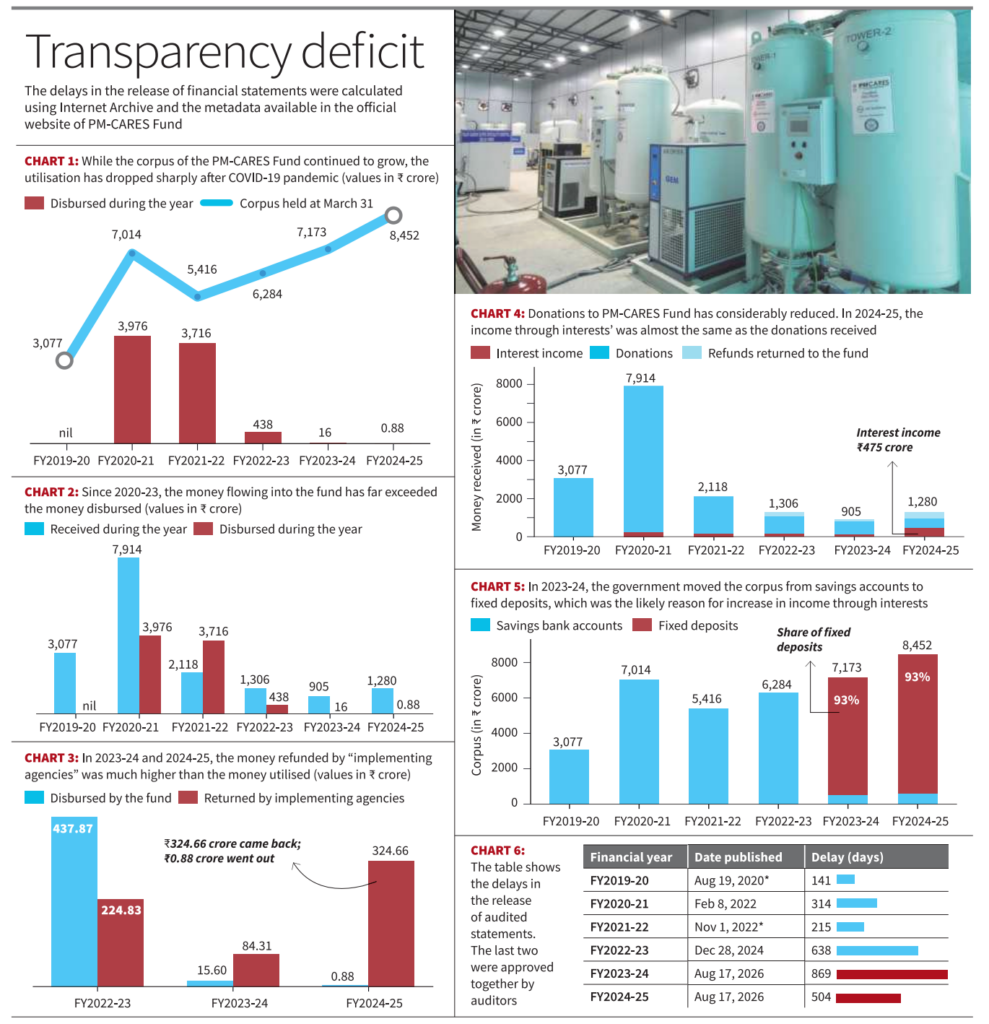
- The Fund’s closing balance increased from approximately ₹6,284 crore in 2022-23 to ₹8,452 crore in 2024-25.
- Donations fell by about 30% in 2024-25 to nearly ₹480 crore.
- Interest income reached approximately ₹475 crore, almost equalling donations, as about 93% of the corpus was held in fixed deposits.
- Only ₹87.85 lakh was spent during 2024-25; around 0.01% of the closing balance.
- Implementing agencies returned approximately ₹324.66 crore, but the published statement does not identify these agencies, projects or reasons for the refunds.
Major Concerns:
- Opportunity cost: Maintaining a contingency reserve is prudent, but prolonged accumulation means resources remain unavailable for disaster preparedness, public health and relief.
- Mission-utilisation mismatch: A fund created for emergency assistance must combine financial reserves with timely and outcome-oriented deployment.
- Transparency deficit: Delayed disclosures, aggregate accounts and absence of project-wise information prevent assessment of whether allocations achieved their intended outcomes.
- Unexplained refunds: Large refunds may indicate project completion savings, cancellation, procurement failures or weak implementation. Without explanatory notes, their significance cannot be evaluated.
- RTI ambiguity: PM CARES maintains that it is not a “public authority” under Section 2(h) of the RTI Act. However, its official character, tax concessions, CSR eligibility and administrative support from the PMO generate a strong expectation of public accountability.
- Limited external oversight: The Fund is independently audited but is not routinely subjected to CAG or parliamentary scrutiny.
- Institutional overlap: Its relationship with the National Disaster Response Fund, State Disaster Response Funds and Prime Minister’s National Relief Fund remains insufficiently defined, risking fragmentation of disaster financing.
Counter-Perspective:
- Low annual expenditure does not by itself establish misuse. The decline may reflect the end of the acute COVID-19 phase, while a large liquid corpus can enable rapid response to future pandemics or disasters.
- Similarly, the Fund receives voluntary rather than budgetary contributions.
Nevertheless, emergency reserves require a transparent strategy specifying how much should be retained and when funds should be deployed.
Way Forward:
- Prescribe a fixed deadline for publication of audited annual accounts.
- Release project-wise data on sanctions, disbursements, beneficiaries, outcomes and implementing agencies.
- Explain all refunds, cancellations and unspent balances.
- Frame a publicly available reserve and disbursement policy with objective emergency triggers.
- Undertake third-party performance and social audits while protecting individual donor privacy.
- Clarify coordination with statutory disaster-management funds to avoid duplication.
- Consider CAG-equivalent oversight or review by an independent multi-stakeholder body.
The credibility of an emergency fund depends not merely on the size of its corpus but on its capacity to deliver timely relief. PM CARES must reconcile operational flexibility with transparency, accountability and measurable public outcomes.