PM-DDKY Moves Toward Outcome Monitoring
Why in News?
On September 1, 2026, the Agriculture Ministry reviewed PM-DDKY and detailed a monitoring framework intended to connect scheme convergence, financial progress and beneficiary-level outcomes across 100 low-performing districts.
- The framework uses 121 indicators: 74 output indicators and 47 outcome indicators across converging schemes.
- The Financial Progress Module was implemented on August 31, 2026 to consolidate expenditure and investment information.
- A Beneficiary Progress Module was only targeted for mid-September 2026; it was not yet reported as implemented.
- The review considered the proposed nomination of two progressive farmers to each District Dhan-Dhaanya Committee.
- The dashboard’s average district score rose from 22.54 to 38.85 between April and July, but this is not an independent impact estimate.
- PM-DDKY applies convergence governance, coordinating existing interventions rather than operating as one isolated agricultural subsidy.
- Separating outputs from outcomes can reveal whether administrative activity produces measurable farmer-level change rather than merely higher spending or completed tasks.
- Credible outcome claims still require data quality, baseline comparability and attribution; a dashboard score alone cannot establish that the programme caused observed change.
UPSC Relevance
Prelims Relevance
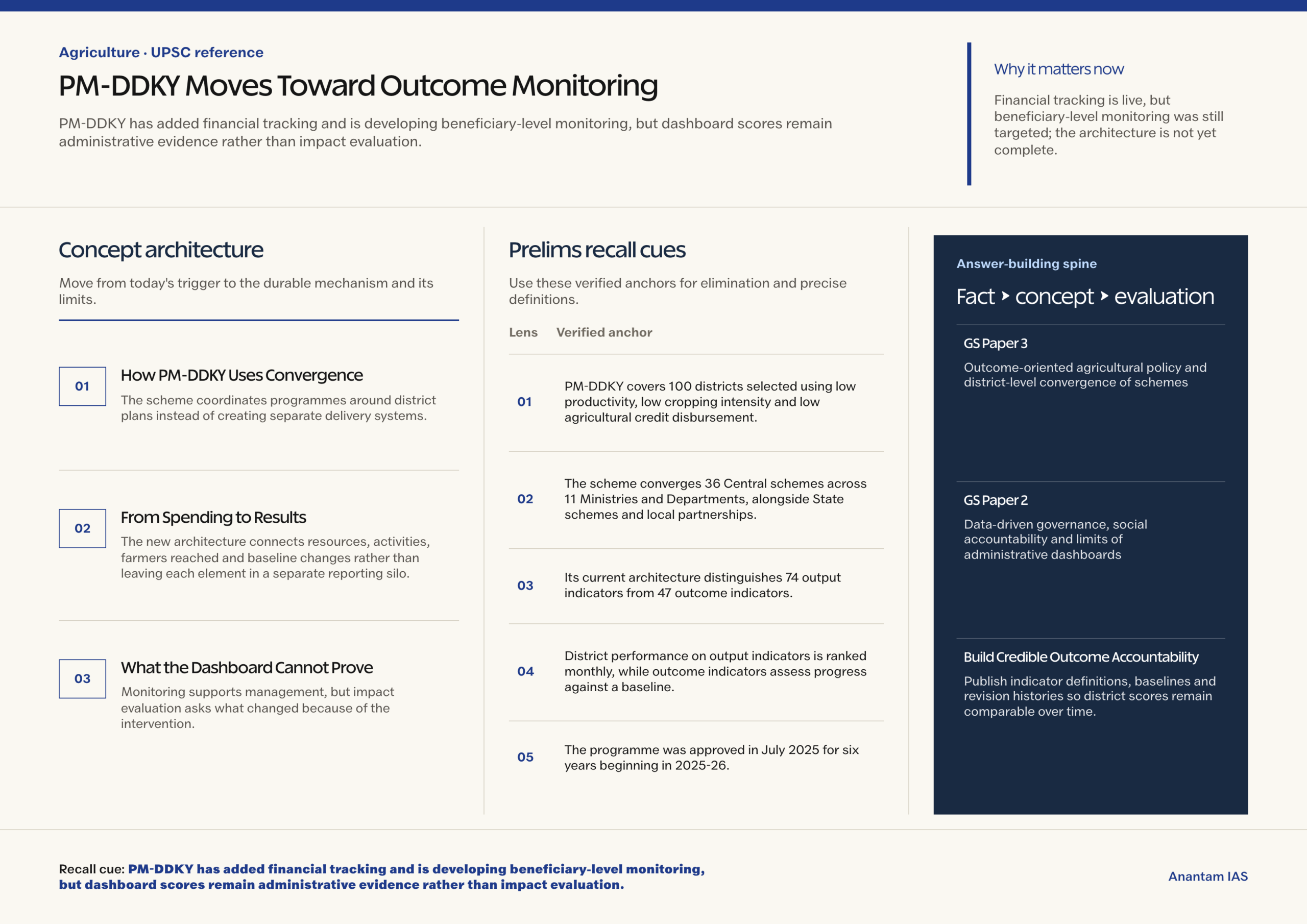
- PM-DDKY covers 100 districts selected using low productivity, low cropping intensity and low agricultural credit disbursement.
- The scheme converges 36 Central schemes across 11 Ministries and Departments, alongside State schemes and local partnerships.
- Its current architecture distinguishes 74 output indicators from 47 outcome indicators.
- District performance on output indicators is ranked monthly, while outcome indicators assess progress against a baseline.
- The programme was approved in July 2025 for six years beginning in 2025-26.
Mains Relevance
GS Paper 3
- Outcome-oriented agricultural policy and district-level convergence of schemes
- Using beneficiary evidence to connect public investment with productivity, resilience and access
GS Paper 2
- Data-driven governance, social accountability and limits of administrative dashboards
Essay
- What governments count shapes what administrations pursue, but measurement becomes meaningful only when it captures people’s outcomes.
Background and Context
How PM-DDKY Uses Convergence
The scheme coordinates programmes around district plans instead of creating separate delivery systems, linking multiple funding streams to shared agricultural goals.
- The Cabinet approved PM-DDKY for six years from 2025-26, drawing on the Aspirational Districts Programme’s district focus and scope for local problem-solving under coordinated plans.
- Districts were chosen using three structural gaps: low productivity, low cropping intensity and weak credit disbursement, which signal persistent underperformance rather than a one-season shock.
- The programme brings 36 Central schemes, State schemes and other interventions into District Action Plans, allowing connected constraints to be addressed through common agricultural objectives.
- Those six linked objectives cover productivity, diversification and sustainability, storage, irrigation, credit, and stronger governance and service delivery.
- District, State and national committees provide review layers, while Central Nodal Officers conduct field-level monitoring against plans and reported indicator data.
From Spending to Results
The new architecture connects resources, activities, farmers reached and baseline changes rather than leaving each element in a separate reporting silo.
- The Financial Progress Module, implemented on August 31, consolidates investments and spending from participating sources, allowing resources to be examined alongside actions rather than separately.
- The dashboard separates 74 output indicators, which record delivered activity, from 47 outcome indicators tracking baseline change; completed tasks should not be mislabeled as benefits.
- Monthly ranking currently uses output performance; it can compare reported administrative progress but cannot prove farmer welfare gains or show whether changes persist.
- The planned Beneficiary Progress Module is meant to capture who received benefits and link programme activity more systematically to beneficiary-level progress across schemes and districts.
- Because that module was only targeted for mid-September, the beneficiary-tracking layer should be treated as forthcoming, not operational; its actual functionality was not yet reported.
What the Dashboard Cannot Prove
Monitoring supports management, but impact evaluation asks what changed because of the intervention, especially when rankings create pressure to report progress.
- The score increase from 22.54 to 38.85 reflects the programme dashboard’s reported output framework, not an independently audited impact study; the release claimed no causal evaluation.
- Administrative rankings may improve because of execution, reporting, data completeness or indicator design; they can change without equivalent field outcomes, so causal attribution requires separate analysis.
- Outcome data need consistent definitions, comparable baselines, verification and disaggregation by landholding, gender, tenancy and geography so averages do not conceal unequal access.
- The 2025 Cabinet design envisaged progressive farmers on district committees; the latest review discussed proposing two nominees, leaving representation details and selection procedures unsettled.
- Farmer participation should influence planning and grievance correction, not become symbolic presence added after dashboard decisions; committee records should show how field feedback receives a response.
Way Forward
Build Credible Outcome Accountability
- Publish indicator definitions, baselines and revision histories so district scores remain comparable over time.
- Add beneficiary verification and grievance channels before treating enrolment or receipt records as evidence of improved outcomes.
- Use periodic independent evaluation, comparison strategies and field audits to test attribution beyond routine dashboard monitoring.
- Give farmer representatives transparent selection rules, meeting access and recorded responses to their district-level recommendations.
Conclusion
- PM-DDKY’s key governance shift is the attempt to join financial, output, outcome and beneficiary data across converging agricultural schemes at district level, making delivery gaps easier to locate and correct.
- In a Mains answer, distinguish monitoring from evaluation: dashboards guide implementation, while credible impact claims need verified baselines, beneficiary evidence, independent checks and causal assessment.
UPSC Practice Questions
Prelims MCQ 1
With reference to the PM Dhan-Dhaanya Krishi Yojana monitoring framework, consider the following statements:
- District performance is ranked monthly using output indicators.
- The Beneficiary Progress Module was fully operational by August 31, 2026.
- Outcome indicators are intended to assess progress against baseline conditions.
How many of the above statements are correct?
(a) Only one (b) Only two (c) All three (d) None
Answer: (b) Only two
Explanation:
Statements 1 and 3 are correct. The Financial Progress Module was implemented on August 31; the Beneficiary Progress Module was only targeted for mid-September 2026.
Prelims MCQ 2
Which set correctly states the three criteria used to identify PM-DDKY districts?
(a) Low productivity, low cropping intensity and low agricultural credit disbursement (b) Low rainfall, high tenancy and low fertilizer consumption (c) High irrigation coverage, low storage and high credit disbursement (d) Low forest cover, high rural population and low market access
Answer: (a) Low productivity, low cropping intensity and low agricultural credit disbursement
Explanation:
The scheme identifies districts using low agricultural productivity, low cropping intensity and low agricultural credit disbursement.
UPSC Mains Questions
- PM-DDKY seeks to move agricultural governance from tracking expenditure and activities toward measuring outcomes. Explain its monitoring architecture and the safeguards needed for credible evaluation.
- Administrative dashboards are useful management tools but weak substitutes for independent impact evaluation. Discuss with reference to district-level agricultural programmes.
Sources: PIB, Ministry of Agriculture and Farmers Welfare and PIB, Cabinet Committee on Economic Affairs.
Frequently Asked Questions
What is the main change in PM-DDKY monitoring?
The framework is joining financial, output and outcome data, with a planned beneficiary module intended to connect scheme activity more systematically to farmer-level progress.
Was the Beneficiary Progress Module operational on September 1, 2026?
No. PIB said it was targeted for implementation by mid-September; only the Financial Progress Module was reported as implemented on August 31.
What is the difference between an output and an outcome?
An output records what an administration delivered, while an outcome captures a change in conditions or benefits associated with those interventions and assessed against a baseline.
Does a higher dashboard score prove that PM-DDKY caused better farmer outcomes?
No. The reported score tracks dashboard performance; causal impact requires verified data, comparable baselines and an evaluation design that separates programme effects from other influences.
How is farmer representation being strengthened?
The latest review considered the proposed nomination of two progressive farmers to each District Dhan-Dhaanya Committee; the proposal should not be described as completed implementation.