PM-KISAN 23rd Instalment and PMFBY: Direct Income Support Meets Crop Insurance
Why in News?
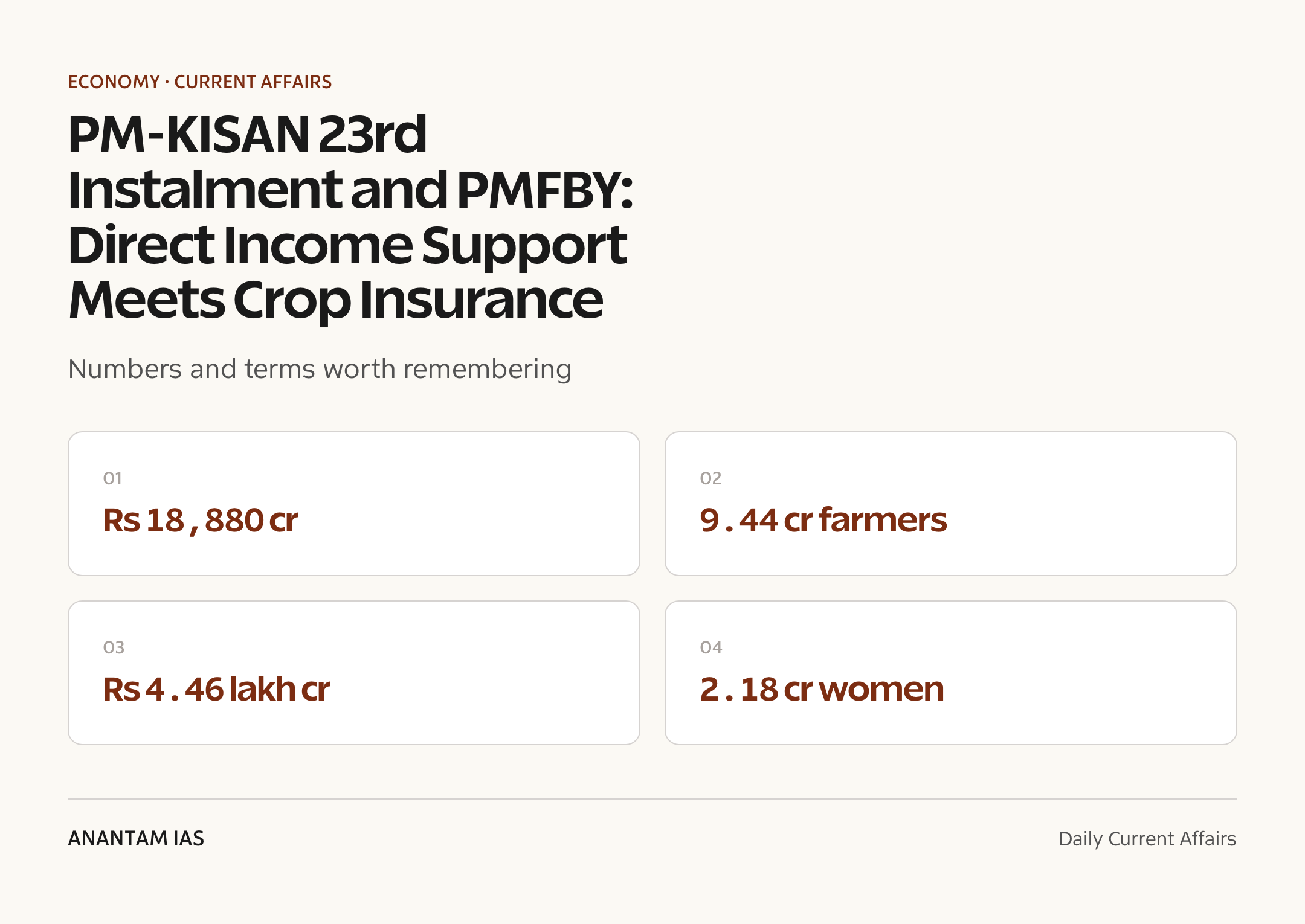
The Prime Minister released the 23rd instalment of PM-KISAN, transferring about Rs 18,880 crore directly into the bank accounts of roughly 9.44 crore farmers, including some 2.18 crore women farmers. The event was anchored at Tarakeswar, Hooghly district, West Bengal, and the money moved through the Direct Benefit Transfer (DBT) rails with no intermediary handling cash.
Alongside the income transfer, the government renewed its push on the Pradhan Mantri Fasal Bima Yojana (PMFBY) and the allied Restructured Weather Based Crop Insurance Scheme (RWBCIS), with crop-insurance enrolment targeting about 1.10 crore farmers over roughly 30 lakh hectares. PM-KISAN handles steady income; PMFBY handles the shock of a bad harvest, so the two are best read together.
- 23rd PM-KISAN instalment worth about Rs 18,880 crore released to ~9.44 crore farmers via DBT.
- Cumulative PM-KISAN disbursal since launch (Feb 2019) has crossed roughly Rs 4.46 lakh crore.
- Around 2.18 crore women farmers among the beneficiaries in this round.
- Parallel PMFBY / RWBCIS crop-insurance drive targeting ~1.10 crore farmers and ~30 lakh hectares.
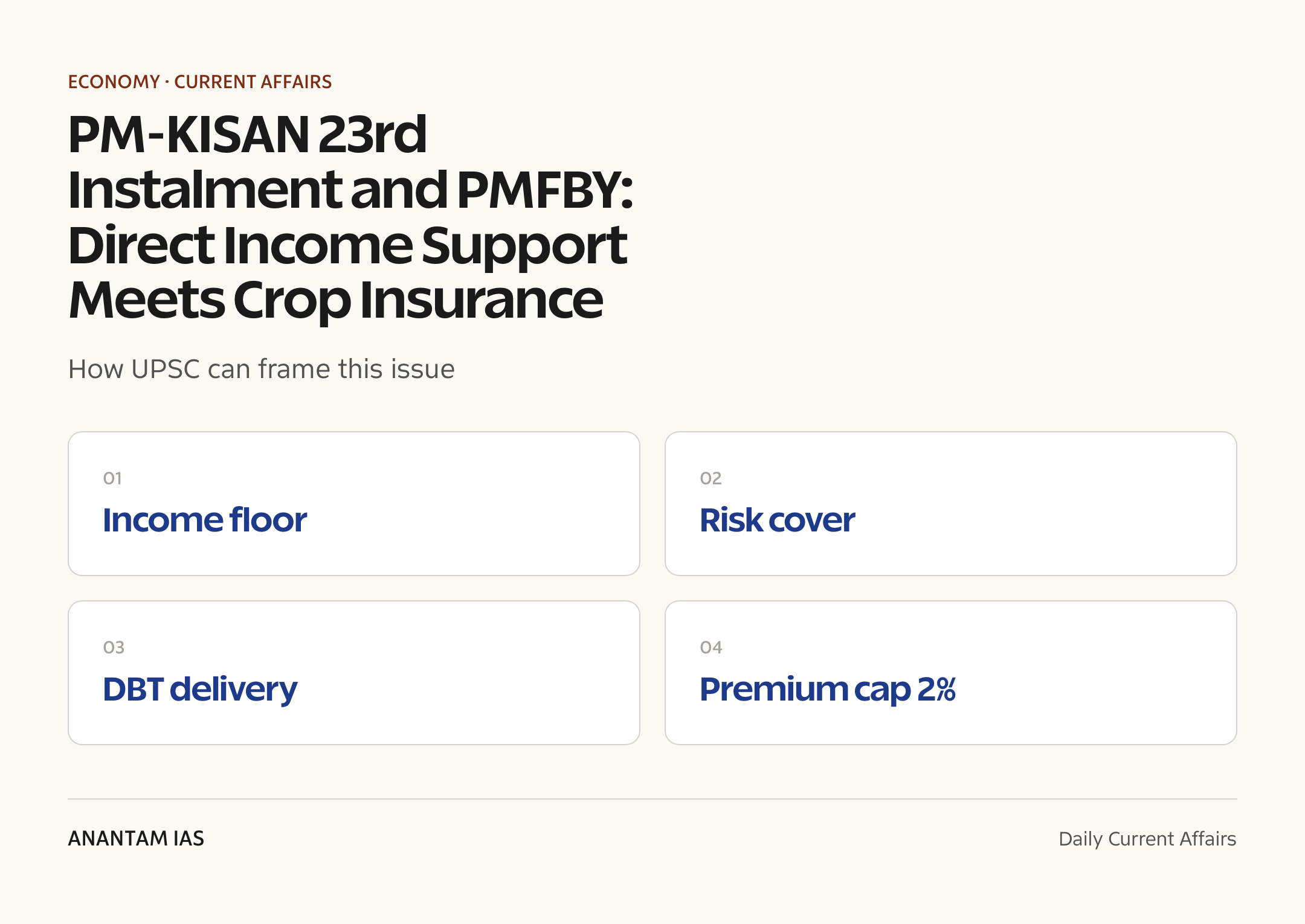
- Event positioned income support (PM-KISAN) and risk cover (PMFBY) as two halves of farm-safety-net architecture.
The development matters in the context of:
- PM-KISAN (launched February 2019) is a 100% centrally funded income-support scheme paying eligible landholding farmers Rs 6,000 a year in three equal instalments of Rs 2,000.
- PMFBY (launched 2016) is the flagship crop-insurance scheme that caps the farmer’s premium and lets governments subsidise the rest, cushioning crop losses from natural calamity, pests and disease.
- Both run on Aadhaar-seeding and digital databases, making them flagship examples of DBT-led and tech-enabled welfare delivery in agriculture.
UPSC Relevance
Prelims Relevance
- PM-KISAN: Rs 6,000/year in three Rs 2,000 instalments; launched February 2019; 100% central funding.
- PM-KISAN is implemented by the Ministry of Agriculture and Farmers Welfare; payments are Aadhaar-seeded and routed through DBT.
- eKYC is mandatory for PM-KISAN beneficiaries to receive instalments.
- PM-KISAN exclusion criteria: institutional landholders, income-tax payers, constitutional post-holders, serving/retired officials above certain ranks, and professionals like doctors and lawyers.
- PMFBY launched in 2016; farmer premium capped at 2% for Kharif, 1.5% for Rabi, and 5% for commercial and horticultural crops.
- Under PMFBY the balance of the actuarial premium over the farmer’s share is shared by Centre and States as subsidy.
- PMFBY became voluntary for all farmers (including loanee farmers) from the 2020 Kharif season.
- Yield is assessed through Crop Cutting Experiments (CCEs), increasingly supported by technology such as YES-TECH (yield estimation) and WINDS (weather data network).
- RWBCIS is a weather-index-based insurance product run alongside PMFBY.
- Cumulative PM-KISAN disbursal since 2019 stands at roughly Rs 4.46 lakh crore.
Mains Relevance
GS Paper 3
- Evaluate how direct income transfer (PM-KISAN) and crop insurance (PMFBY) together build a farm safety net, and where the gaps in coverage and adequacy remain.
- Examine the role of DBT, Aadhaar seeding and yield-estimation technology in reducing leakage and exclusion errors in agricultural welfare delivery.
Essay
- Security of the farmer is the foundation of the security of the nation: income stability and risk protection in Indian agriculture.
Background and Context
PM-KISAN: how the income transfer works
A flat, predictable income top-up delivered straight to farmer accounts.
- Pays Rs 6,000 per year to eligible landholding farmer families in three instalments of Rs 2,000 every four months.
- 100% funded by the Union government; states only help with verification and beneficiary lists.
- Money is sent through DBT into Aadhaar-seeded bank accounts, cutting out middlemen and cash handling.
- eKYC and land-record verification are mandatory, which both clean the database and explain why some eligible farmers miss instalments when their KYC lapses.
Who is left out: PM-KISAN exclusions
The scheme targets small and marginal cultivators, not the well-off.
- Excludes institutional landholders and families where any member is an income-tax payer.
- Excludes holders of constitutional posts, sitting and former ministers, MPs, MLAs, mayors and zila parishad chairpersons.
- Excludes serving and retired government employees above specified ranks and pensioners drawing above Rs 10,000 a month (barring Group D / multi-tasking staff).
- Excludes professionals like doctors, engineers, lawyers, chartered accountants in active practice.
PMFBY: capping the farmer's premium
The farmer pays a small fixed share; governments absorb the rest.
- Farmer premium is capped at 2% for Kharif food and oilseed crops, 1.5% for Rabi crops, and 5% for annual commercial and horticultural crops.
- The gap between this capped rate and the full actuarial premium is paid as subsidy, shared between the Centre and States.
- Covers losses from natural calamities, pests, diseases, and includes localised risks, prevented sowing and post-harvest losses.
- Made voluntary for all farmers, including those with crop loans, from the 2020 Kharif season.
Technology in crop insurance
Faster, less disputed loss assessment is the main reform thrust.
- Yield loss is traditionally measured through Crop Cutting Experiments (CCEs) at the unit-area level.
- YES-TECH uses remote sensing and satellite data to estimate yields and speed up claim settlement.
- WINDS builds a dense network of automatic weather stations and rain gauges to feed reliable, granular weather data.
- The RWBCIS variant settles claims against weather indices (rainfall, temperature) rather than measured yield.
Why income support and insurance go together
One smooths everyday cash flow, the other absorbs the bad year.
- PM-KISAN gives a predictable income floor that helps farmers buy inputs and meet small expenses without high-cost informal credit.
- PMFBY converts the uncertain risk of crop failure into a small, affordable, fixed premium.
- Read together, they target both the chronic low-income problem and the acute shock problem in farming.
- Both lean on the same digital and Aadhaar-linked rails, so improvements in data quality help both schemes at once.
Persistent challenges
Coverage, accuracy and trust remain the weak links.
- Exclusion and inclusion errors: genuine tenant farmers and sharecroppers without land records often miss PM-KISAN, while ineligible names sometimes slip in.
- PM-KISAN’s flat Rs 6,000 is not indexed to inflation, so its real value erodes over time.
- PMFBY has seen states opting in and out, and complaints about delayed claim settlement and disputed yield data.
- Weak digitisation of land and tenancy records limits how well both schemes can reach actual cultivators.
Way Forward
Fix the data backbone
- Accelerate digitisation and updating of land and tenancy records so actual cultivators, not just titleholders, are captured.
- Tighten eKYC and grievance redress so eligible farmers do not drop off lists for fixable reasons.
Strengthen crop insurance trust
- Scale YES-TECH and WINDS to make yield and weather assessment faster and less disputed.
- Enforce time-bound claim settlement with penalties for delay, so farmers see insurance as reliable, not adversarial.
Make support adequate and inclusive
- Periodically review the PM-KISAN amount against rising input costs and inflation.
- Design products and outreach for tenant farmers, sharecroppers and women cultivators who are most often left out.
Conclusion
The 23rd PM-KISAN instalment and the parallel PMFBY drive together sketch India’s emerging two-layer farm safety net: a steady income floor delivered through DBT, and a risk cover that converts the dread of a failed harvest into a small, fixed premium. Both run on the same digital and Aadhaar-linked plumbing, which is what makes their reach scalable.
The unfinished agenda is quality, not ambition. Cleaner land and tenancy records, inflation-aware support amounts, faster and trusted insurance payouts, and deliberate inclusion of tenant farmers, sharecroppers and women cultivators will decide whether these schemes protect the farmers who need them most.
UPSC Practice Questions
Prelims MCQ 1
With reference to PM-KISAN and PMFBY, consider the following statements:
- PM-KISAN is a 100% centrally funded scheme that pays eligible farmer families Rs 6,000 per year in three instalments.
- Under PMFBY, the farmer’s premium for Kharif food crops is capped at 2%.
- PMFBY has been made compulsory for all loanee farmers since the 2020 Kharif season.
How many of the above statements are correct?
(a) Only one (b) Only two (c) All three (d) None
Answer: (b) Only two
Explanation:
Statements 1 and 2 are correct. Statement 3 is wrong: PMFBY was made voluntary, not compulsory, for all farmers including loanee farmers from the 2020 Kharif season.
Prelims MCQ 2
Which of the following technology tools is associated with improving yield estimation and weather data under crop insurance in India?
(a) YES-TECH and WINDS (b) UDAN and SVAMITVA (c) BHARATMALA and SAGARMALA (d) GeM and PFMS
Answer: (a) YES-TECH and WINDS
Explanation:
YES-TECH supports satellite-based yield estimation and WINDS builds a weather-station network, both used to speed up and de-dispute PMFBY claim assessment.
UPSC Mains Questions
- “Direct income transfer and crop insurance address different problems in Indian agriculture.” In light of PM-KISAN and PMFBY, examine how the two together form a farm safety net and where the gaps remain. (250 words)
- Discuss how Direct Benefit Transfer, Aadhaar seeding and yield-estimation technology have reshaped agricultural welfare delivery in India, and identify the risks of exclusion that still persist. (250 words)
Sources: PIB / DD News and DD News.
Frequently Asked Questions
How much does PM-KISAN pay and how often?
PM-KISAN pays eligible landholding farmer families Rs 6,000 per year, released in three equal instalments of Rs 2,000 every four months. It is fully funded by the Union government and credited directly to Aadhaar-seeded bank accounts through Direct Benefit Transfer, with no state cost-sharing on the payout.
What was special about the 23rd PM-KISAN instalment?
The 23rd instalment released about Rs 18,880 crore to roughly 9.44 crore farmers, including around 2.18 crore women farmers, anchored from Tarakeswar in West Bengal. It was paired with a renewed PMFBY crop-insurance push, so income support and risk cover were highlighted together as one farm safety net.
How is the premium fixed under PMFBY?
PMFBY caps the farmer’s premium at 2% for Kharif crops, 1.5% for Rabi crops and 5% for commercial and horticultural crops. The remaining gap up to the full actuarial premium is paid as subsidy, shared between the Centre and the States, which keeps the farmer’s out-of-pocket cost low.
Is PMFBY compulsory for farmers?
No. From the 2020 Kharif season PMFBY was made voluntary for all farmers, including those with crop loans. Earlier, loanee farmers were automatically enrolled, but now every farmer can choose whether to take the cover, which changed enrolment patterns across states.
Who is excluded from PM-KISAN?
Higher-income and institutional categories are excluded: institutional landholders, income-tax payers, holders of constitutional posts, sitting and former legislators and ministers, higher-rank government employees and pensioners above a fixed monthly pension, and practising professionals such as doctors, engineers, lawyers and chartered accountants.
Why are PM-KISAN and PMFBY discussed together?
They tackle two different farm problems. PM-KISAN gives a predictable income floor to smooth everyday spending, while PMFBY absorbs the shock of a failed harvest by turning crop-loss risk into a small fixed premium. Both run on the same digital, Aadhaar-linked rails, so they form complementary layers of one safety net.