PM-SETU: Industry Partnerships Move Into ITI Implementation
Why in News?
PIB reported on 8 September that PM-SETU’s steering committee approved investment plans and witnessed the Bhiwadi cluster agreement at its 7 September meeting.
- The Shareholders’ Agreement between H.G. Infra Engineering Limited, Rajasthan and the Union skill ministry formally begins implementation activities for the Bhiwadi cluster.
- Approved Strategic Investment Plans cover Bhiwadi, Medchal and Meerut clusters, with a combined project outlay of ₹735.70 crore.
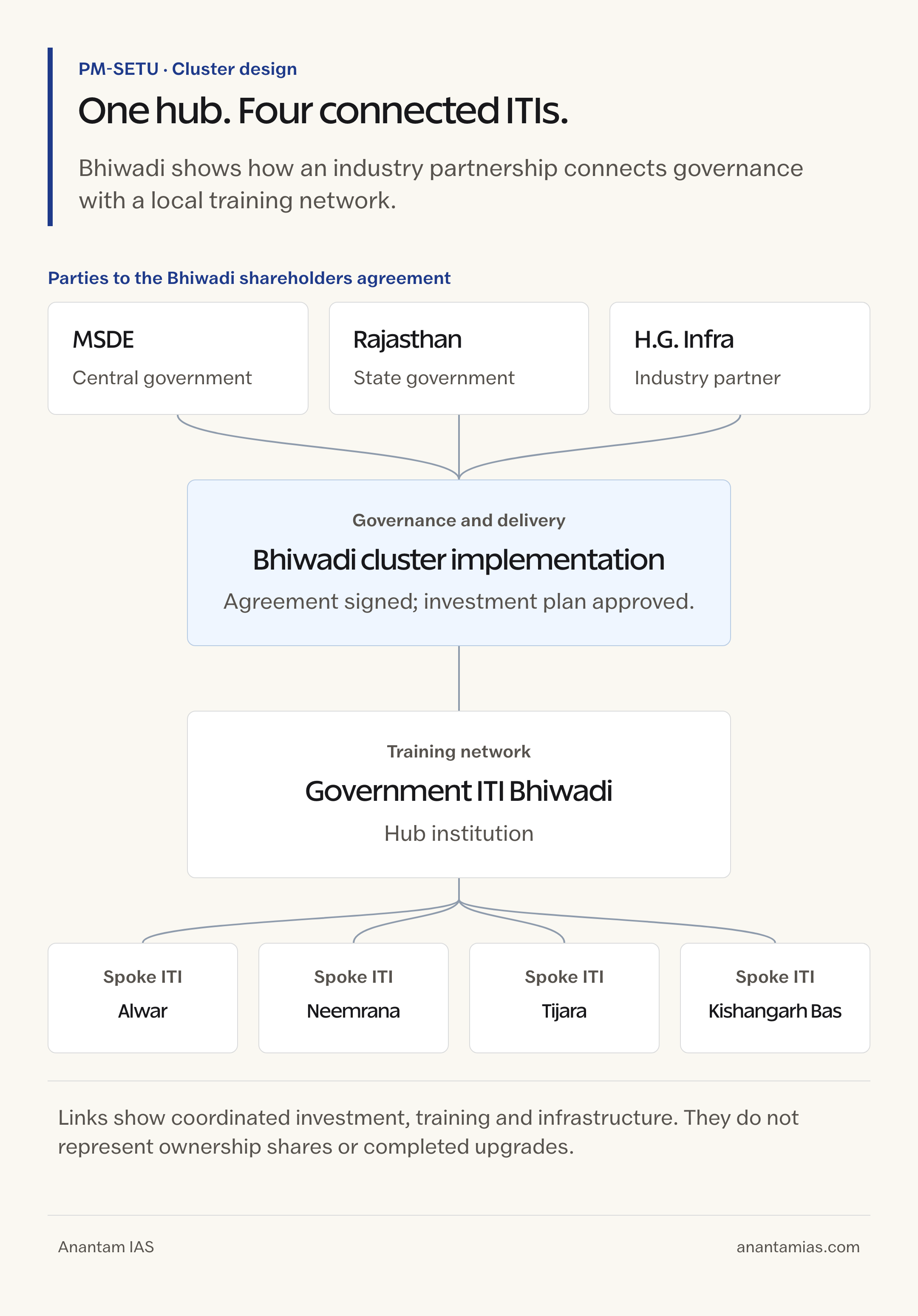
- Government ITI Bhiwadi is the hub; Government ITIs at Alwar, Neemrana, Tijara and Kishangarh Bas are its four spokes.
- The Medchal proposal received approval after clarifications on operational and financial matters that had led to its earlier deferral.
- Industry participation can connect workshop training with actual production requirements; public oversight must still protect educational quality and student access.
- Investment approval creates an implementation opportunity. It does not establish that equipment, courses or employment outcomes have already improved.
UPSC Relevance
Prelims Relevance
- PM-SETU: Pradhan Mantri Skilling and Employability Transformation through Upgraded ITIs.
- Nodal ministry: Ministry of Skill Development and Entrepreneurship.
- Cluster design: A hub ITI linked with spoke ITIs.
- Approval sequence: State Steering Committee evaluation and recommendation precede National Steering Committee consideration.
- Bhiwadi agreement: H.G. Infra, Rajasthan and the Union skill ministry are the named parties.
Mains Relevance
GS Paper 2
- Centre-State-industry coordination in public training institutions.
- Accountability when government institutions involve external delivery partners.
GS Paper 3
- Industry-relevant skills, employability and the difference between capital spending and productive workforce capability.
Essay
- Education serves development when institutional capacity becomes usable opportunity.
Background and Context
How the hub-and-spoke model works
The cluster is the unit of coordinated upgrading, connecting institutions instead of treating each workshop as an isolated investment.
- PM-SETU aims to transform government Industrial Training Institutes through industry partnerships, improved infrastructure and upgraded training programmes, with employability as the intended result of these changes.
- A hub ITI works with a network of spoke ITIs. The official design links their modernisation and industry-relevant training through a common cluster approach rather than unrelated institutional projects.
- For Bhiwadi, the named hub and surrounding government ITIs make this arrangement concrete: one cluster contains several teaching locations, rather than replacing them with a single new institute.
- The practical rationale for sharing capacity is to make specialised resources useful across institutions. Whether students can actually access shared facilities depends on timetabling, travel and operational arrangements.
- A hub-and-spoke label alone does not prove resource sharing works. An implementation assessment should check which services reach spoke students and whether access extends beyond the hub’s own intake.
Who shapes and scrutinises the investment
Industry involvement operates alongside a State-to-national review process; submitting a plan is different from securing its approval.
- Strategic Investment Plans specify the proposed upgrading package. The approved plans cover infrastructure, existing trades, new long-term and short-term courses, and stronger operational capabilities within the participating clusters.
- The respective State Steering Committees evaluate and recommend proposals before they reach the National Steering Committee. This establishes a review sequence connecting State involvement with national approval.
- The Medchal proposal illustrates substantive scrutiny: approval followed satisfactory responses about course structure, financial calculations, eligibility, documentation and civil works after an earlier committee had deferred consideration.
- An industry partner can help identify changing workplace requirements. The educational test is whether proposed courses build useful capabilities, rather than simply attaching an employer’s name to existing training.
- Public oversight should examine the connection between spending and teaching: proposed machinery needs suitable courses, instructors and operational support if an approved investment is to become a functioning learning resource.

What the Bhiwadi agreement establishes
The signed agreement is an implementation milestone, not evidence that the cluster’s transformation has already been completed.
- The Bhiwadi Shareholders’ Agreement brings together H.G. Infra Engineering Limited, the Government of Rajasthan and the Ministry of Skill Development and Entrepreneurship in the reported implementation arrangement.
- According to the official release, signing marks the formal commencement of implementation activities. This is the concrete development that distinguishes the news from a general statement supporting industry participation.
- The agreement’s name does not establish shareholding percentages, asset-transfer terms or private ownership of government ITIs. Those conclusions require the agreement or other authoritative documentation beyond this release.
- Approval, implementation and outcomes are separate stages. A sanctioned plan can begin execution without demonstrating that upgraded workshops are operational or that students have obtained better employment.
How employability accountability should work
Evaluation must follow the link from resources to learning and then to work, rather than stop at expenditure.
- Inputs include equipment and infrastructure; delivery concerns usable courses and instruction. An illustrative monitoring question is whether installed equipment is regularly used by learners in the intended trades.
- Learning outcomes require evidence of practical competence. Course enrolment or completion alone cannot establish whether graduates can safely and independently perform the tasks that training claims to teach.
- Employment outcomes should examine job relevance and sustained work, alongside placement. These are suggested evaluation criteria, not new reporting requirements or measured achievements announced in the PIB release.
- Equity belongs in cluster evaluation: stronger hub facilities should benefit students across participating institutions. Comparisons between hub and spoke access can reveal whether coordinated investment is spreading useful opportunities.
Way Forward
Make cluster delivery observable
- Publish implementation milestones that distinguish procurement, workshop readiness, instructor preparation and course delivery, allowing students and oversight bodies to see where progress has stalled.
- Specify shared-access arrangements for spoke learners, including practical-session schedules and travel needs; a common cluster plan should translate into usable teaching opportunities.
- Track competence and employment after training, with transparent definitions and follow-up periods. Report limitations so initial placement figures are not mistaken for lasting employability.
Conclusion
- PM-SETU’s implementation lesson is institutional: industry input, State scrutiny and national approval must connect with actual training delivery across the cluster.
- Use the case to distinguish governance milestones from development results. The signed Bhiwadi arrangement begins implementation; stronger skills and employment remain outcomes to demonstrate.
UPSC Practice Questions
Prelims MCQ 1
With reference to PM-SETU implementation reported in September 2026, consider the following statements:
- The scheme uses a hub-and-spoke ITI cluster model.
- State Steering Committees evaluate and recommend investment plans before national consideration.
- Signing the Bhiwadi Shareholders’ Agreement proves that its workshop upgrades are complete.
How many of the above statements are correct?
(a) Only one (b) Only two (c) All three (d) None
Answer: (b) Only two
Explanation:
The first two statements match the official design and review sequence. Signing formally begins Bhiwadi implementation; it does not demonstrate completed upgrades.
Prelims MCQ 2
Which development formally began implementation activities for the Bhiwadi ITI cluster?
(a) Transfer of all ITIs to private ownership (b) Publication of verified graduate earnings (c) Signing an agreement among H.G. Infra, Rajasthan and the Union skill ministry (d) Completion of every proposed workshop
Answer: (c) Signing an agreement among H.G. Infra, Rajasthan and the Union skill ministry
Explanation:
PIB identifies the Shareholders’ Agreement among these parties as the formal commencement of implementation activities. It does not report the other developments.
UPSC Mains Questions
- Explain how an industry-led hub-and-spoke model can improve public vocational training. What safeguards would make its benefits accessible to spoke institutions? (150 words)
- Distinguish investment approval, implementation progress and employability outcomes in evaluating PM-SETU. Suggest an accountability framework. (250 words)
Source: PIB, Ministry of Skill Development and Entrepreneurship.
Frequently Asked Questions
What is PM-SETU?
PM-SETU is Pradhan Mantri Skilling and Employability Transformation through Upgraded ITIs. It aims to improve government ITIs through industry partnerships, infrastructure upgrades and training programmes organised around connected hub-and-spoke clusters.
What happened at Bhiwadi?
H.G. Infra Engineering Limited, Rajasthan and the Union skill ministry signed a Shareholders’ Agreement at the 7 September meeting. PIB reported that this formally began Bhiwadi cluster implementation activities.
Does the agreement mean ITIs have been privatised?
The release does not establish private ownership of ITIs or publish shareholding percentages and asset-transfer provisions. The agreement’s title alone cannot support those conclusions; its documented implementation role is narrower.
Why is the Medchal decision useful for governance analysis?
Medchal’s plan had been deferred for operational and financial clarifications. Its later approval after satisfactory responses shows the distinction between submitting an investment proposal and completing the scrutiny needed for approval.