PM SVANidhi Street Food Hubs: first batch of towns approved
Why in News?
On 11 July 2026, PIB confirmed that the Ministry of Housing and Urban Affairs (MoHUA) has approved the first batch of Street Food Hubs under the PM SVANidhi initiative — a new infrastructure layer that will build up to 50 organised, hygienic street-food vending hubs in towns and cities across India.
The announcement came via Union Minister of State Dr Jitendra Singh, who disclosed that Lakhanpur in Kathua district (Jammu & Kashmir) figures among the first approved towns. The bigger story for aspirants is the scheme design: each hub gets ₹4 crore in central assistance, and the programme converges vendor micro-credit with tourism and food-safety infrastructure.
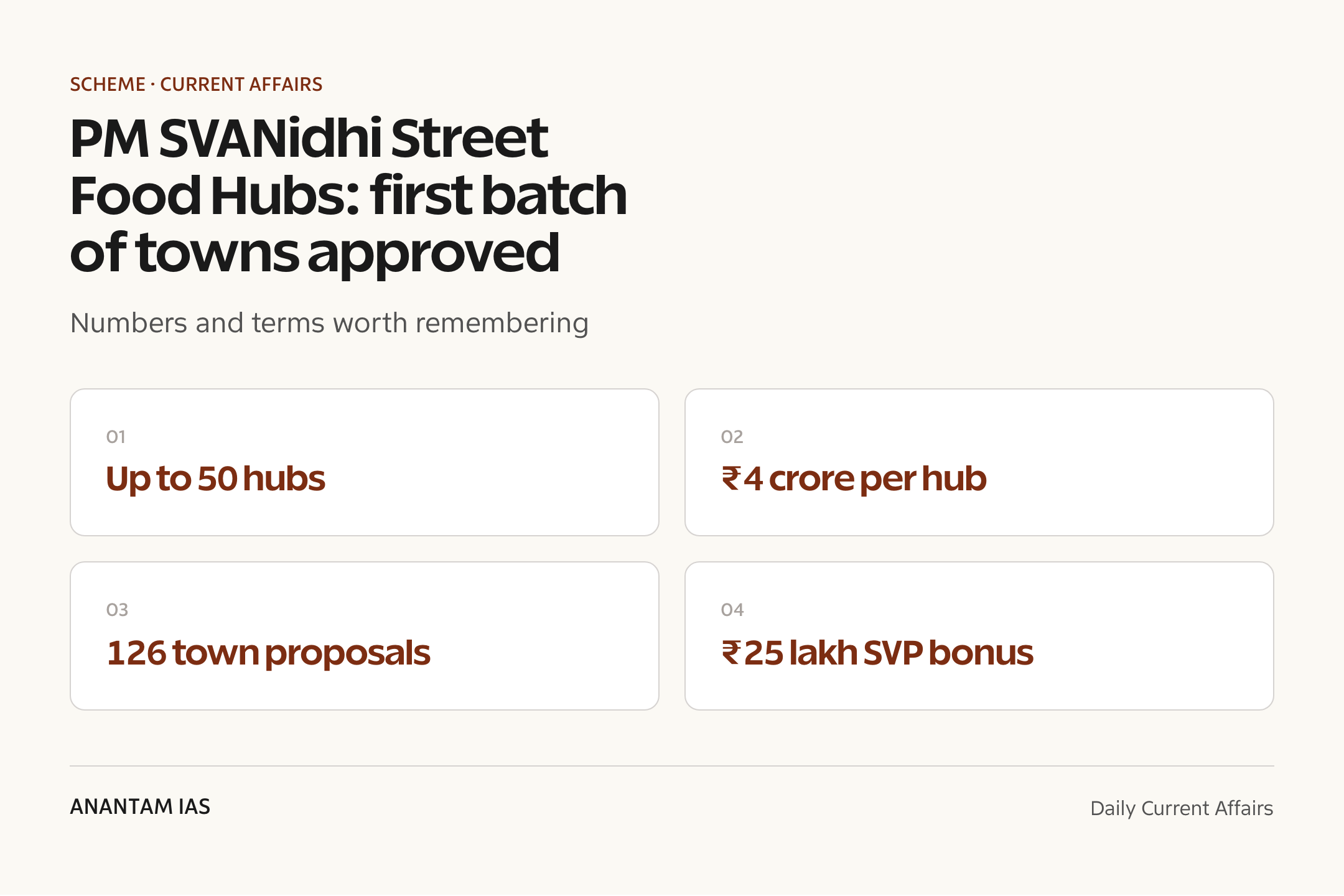
- MoHUA plans up to 50 Street Food Hubs nationwide under PM SVANidhi; the first batch of towns has now been approved.
- Each approved project receives ₹4 crore in financial assistance, released in three instalments — 30%, 50% and 20% (the last after completion).
- Cities that have notified their Street Vending Plan get an additional incentive of ₹25 lakh.
- The ministry received 126 proposals from 32 States and UTs, covering 106 Urban Local Bodies and seven Census Towns.
- The initiative follows a Whole-of-Government approach — MoHUA converges with the Ministry of Tourism and FSSAI.
- First-batch example: Lakhanpur (J&K) — two clusters over 1,754.25 sq m at the gateway to Jammu & Kashmir, promoting Dogra cuisine on the Amarnath and Vaishno Devi pilgrim routes.
The development matters in the context of:
- PM SVANidhi began in 2020 as a pure micro-credit scheme for street vendors; the Street Food Hubs add a brick-and-mortar infrastructure layer on top of credit and welfare linkage.
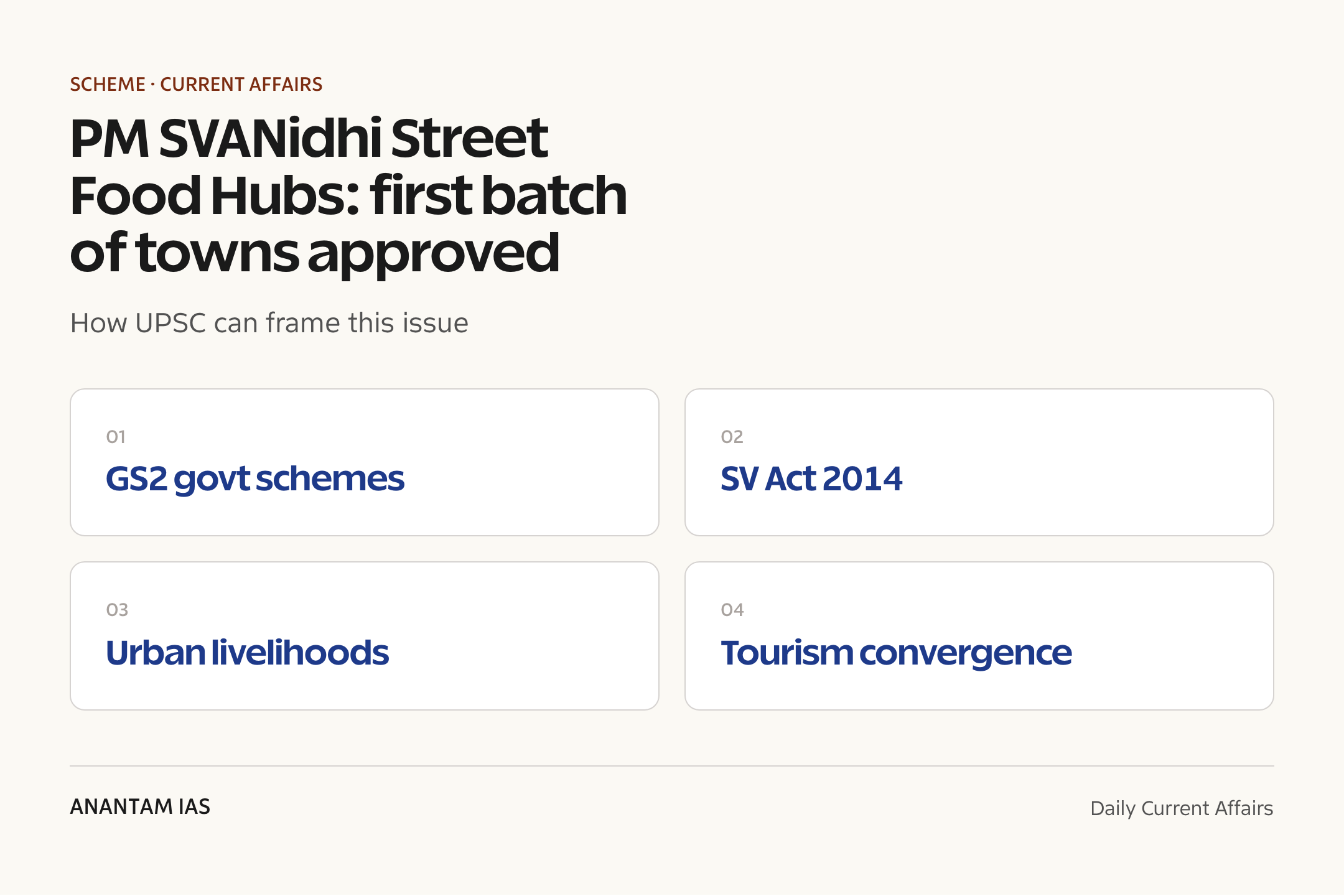
- The hubs tie urban livelihoods to tourism — selection favours towns with heritage value, distinctive cuisine and convergence with Swadesh Darshan and PRASHAD.
- This deepens the mainstreaming of street vendors that the Street Vendors Act, 2014 began — from legal protection, to credit, to dedicated public infrastructure.
UPSC Relevance
Prelims Relevance
- PM SVANidhi (PM Street Vendor’s AtmaNirbhar Nidhi) — launched 1 June 2020 by MoHUA as a special micro-credit facility for street vendors hit by the COVID-19 lockdown.
- Street Food Hubs — up to 50 hubs under PM SVANidhi; ₹4 crore per project in 30-50-20 instalments; ₹25 lakh incentive for cities with a notified Street Vending Plan.
- Selection preference — towns with high tourism potential, heritage significance, distinctive food traditions, and convergence with Swadesh Darshan, PRASHAD, UNESCO World Heritage Sites and UNESCO Creative Cities.
- Convergence partners — MoHUA + Ministry of Tourism + FSSAI (Whole-of-Government approach); technical support via Centres of Excellence for Urban Planning and AMRUT-funded Centres of Planning.
- Revamped PM SVANidhi (Cabinet, 2025) — loan tranches raised to ₹15,000 / ₹25,000 / ₹50,000; UPI-linked RuPay credit card with a ₹30,000 limit; lending extended to 31 March 2030.
- Revamped outlay — ₹7,332 crore, targeting 1.15 crore vendors including about 50 lakh new beneficiaries.
- SVANidhi se Samriddhi — socio-economic profiling of vendor families to link them with central welfare schemes (insurance, pension, food security).
- Street Vendors (Protection of Livelihood and Regulation of Street Vending) Act, 2014 — Town Vending Committees, vending certificates, protection from eviction; the legal backbone of vendor policy.
- PM SVANidhi is a Central Sector Scheme — fully funded by the Centre; SIDBI is the implementation partner for the credit component.
- Demand-side incentives — 7% interest subsidy on timely repayment plus cashback on digital transactions.
Mains Relevance
GS Paper 2
- Government interventions for vulnerable sections: PM SVANidhi’s evolution from emergency credit (2020) to welfare convergence (SVANidhi se Samriddhi) to physical infrastructure (Street Food Hubs) as a template for scheme layering.
- Implementation of the Street Vendors Act, 2014: how central incentives (the ₹25 lakh bonus for a notified Street Vending Plan) nudge states and ULBs to complete statutory duties.
- Cooperative and competitive federalism: 126 proposals from 32 States/UTs — challenge-mode selection of ULB projects under a central scheme.
GS Paper 3
- Inclusive growth and informal-sector formalisation: digital-transaction trails under PM SVANidhi as a pathway to credit history for the unbanked urban poor.
- Tourism economy linkage: food streets as local economic multipliers — the Lakhanpur model of converting a transit point into a culinary destination.
GS Paper 1
- Urbanisation and its problems: organised vending zones as a response to congestion, hygiene and contested street space in Indian cities.
Essay
- The street as an economic space: dignity of labour in India’s informal economy.
- From survival to enterprise — how micro-credit and infrastructure can transform urban poverty.
- Food as heritage: culinary traditions in nation-building and tourism.
Background and Context
PM SVANidhi: the parent scheme
The Street Food Hubs sit on top of a micro-credit scheme born during the pandemic.
- PM Street Vendor’s AtmaNirbhar Nidhi (PM SVANidhi) was launched on 1 June 2020 by the Ministry of Housing and Urban Affairs to help street vendors restart livelihoods disrupted by the COVID-19 lockdown.
- It is a Central Sector Scheme (100% centrally funded) offering collateral-free working-capital loans in rising tranches, with SIDBI as the implementation partner.
- Original loan ladder: ₹10,000 (first tranche) → ₹20,000 (second) → ₹50,000 (third), each unlocked by timely repayment of the previous loan.
- Incentives ride on behaviour: a 7% interest subsidy for timely repayment and cashback on digital transactions, nudging vendors into formal finance.
- The companion component SVANidhi se Samriddhi profiles vendor households and links them to central welfare schemes — insurance, pension and food-security cover.
The 2025 revamp: bigger loans, longer runway
The Union Cabinet restructured PM SVANidhi in 2025, as announced in the Union Budget 2025-26.
- Loan limits were raised to ₹15,000 / ₹25,000 / ₹50,000 across the three tranches.
- A UPI-linked RuPay credit card with a ₹30,000 limit was introduced for vendors who repay their second loan — instant micro-credit without fresh paperwork.
- The lending window was extended to 31 March 2030, with a total outlay of ₹7,332 crore targeting 1.15 crore vendors, including roughly 50 lakh new beneficiaries.
- The revamp added capacity building — training vendors in digital literacy, food hygiene and packaging — signalling the shift from credit alone to enterprise development.
- The Street Food Hubs announced now are the infrastructure arm of this revamped design: credit, skills and now physical vending space.
Street Food Hubs: design and funding
PIB confirmed the funding architecture of the new hubs in its 11 July 2026 release.
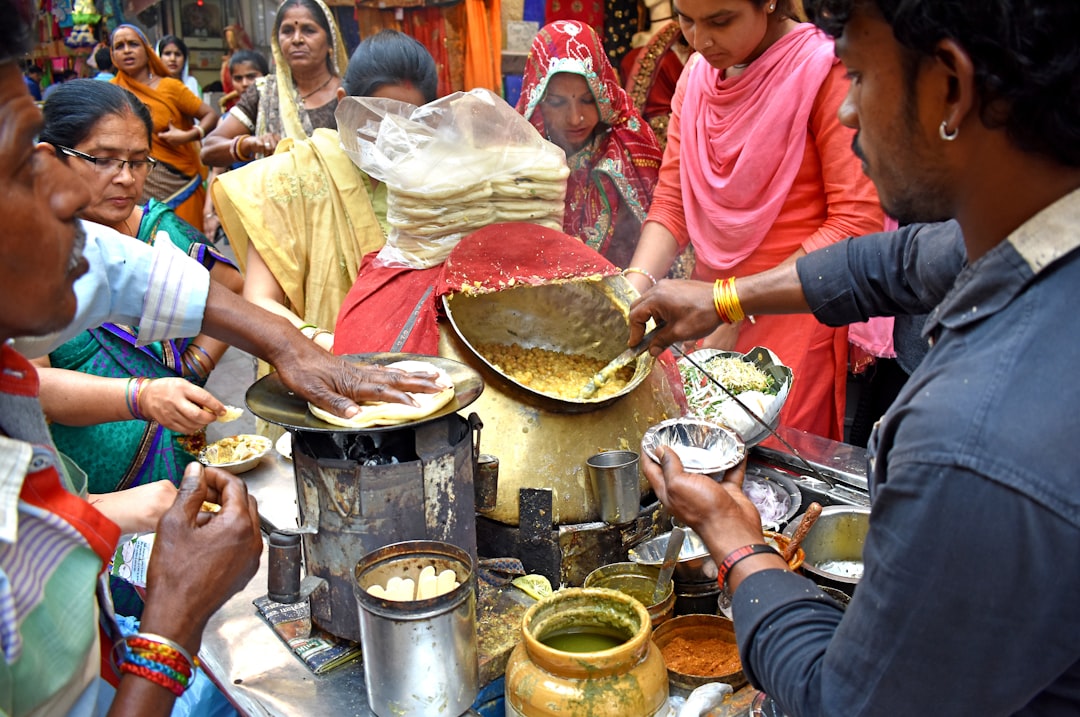
- MoHUA will establish up to 50 Street Food Hubs across the country — organised, hygienic, ‘world-class’ vending spaces showcasing regional cuisine.
- Central assistance of ₹4 crore per project, released in three instalments: 30% first, 50% second, and 20% after completion — a completion-linked payment design.
- Cities that have notified their Street Vending Plan under the 2014 Act receive an extra ₹25 lakh — a direct fiscal nudge for statutory compliance.
- Technical handholding comes from the Centres of Excellence for Urban Planning and AMRUT-funded Centres of Planning, helping states and ULBs prepare bankable projects.
- Response was strong: 126 proposals from 32 States and UTs, covering 106 Urban Local Bodies and 7 Census Towns — more than double the 50 slots available.
Selection criteria: tourism and heritage convergence
The hubs are deliberately placed where food, culture and visitor flows intersect.
- Preference goes to towns with high tourism potential, cultural and heritage significance, and distinctive local food traditions.
- Convergence is built in with Swadesh Darshan and PRASHAD (Ministry of Tourism schemes), plus UNESCO World Heritage Sites and UNESCO Creative Cities (India’s gastronomy entries include Hyderabad).
- FSSAI joins as the food-safety partner — echoing its existing ‘Eat Right Street Food Hub’ certification push for clean street-food clusters.
- The first-batch example of Lakhanpur (Kathua, J&K) shows the logic: two clusters over 1,754.25 sq m at the Pathankot gateway to J&K, on routes to Shri Mata Vaishno Devi and the Amarnath Yatra, promoting Dogra cuisine.
- The stated aim is to convert transit points and tourist towns into culinary destinations — livelihoods and tourism reinforcing each other.
The legal backbone: Street Vendors Act, 2014
Every layer of vendor policy rests on the 2014 statute.
- The Street Vendors (Protection of Livelihood and Regulation of Street Vending) Act, 2014 recognises vending as a legitimate livelihood and shields vendors from arbitrary eviction.
- It mandates Town Vending Committees (TVCs) — with at least 40% vendor representation — to conduct surveys, issue vending certificates and demarcate vending zones.
- States/ULBs must prepare a Street Vending Plan; patchy compliance has been the Act’s weakest link, which is exactly what the ₹25 lakh incentive targets.
- The Act followed the National Policy on Urban Street Vendors (2009) and Supreme Court rulings recognising vending under Article 19(1)(g) — the right to practise any profession or trade.
- Street Food Hubs operationalise the Act’s promise: designated, serviced vending space rather than contested pavements.
Significance and concerns
The scheme layering is promising, but exam answers need the critique too.
- Significance: hubs give vendors fixed, hygienic infrastructure — water, waste disposal, seating — raising both earnings and consumer trust.
- They formalise without displacing: vendors stay in their trade while gaining tenure security and visibility, unlike relocation-based ‘beautification’ drives.
- Concerns: 50 hubs is a pilot-scale footprint against an estimated 50-60 lakh street vendors nationwide; selection may favour showcase tourist towns over ordinary market towns.
- Allotment risk — who gets a stall inside a hub? Without transparent TVC-led selection, incumbent vendors could be edged out by better-connected entrants.
- Maintenance and user charges — ULBs with weak finances may struggle to run the hubs after the 20% completion instalment; recurring costs are the classic failure point of urban asset schemes.
Way Forward
Anchor allotment in the 2014 Act
- Route stall allotment through Town Vending Committees with published criteria, prioritising surveyed vendors holding vending certificates.
- Tie the hub’s operation plan to the city’s notified Street Vending Plan so infrastructure and legal entitlements move together.
Plan for the recurring costs
- Build O&M models upfront — modest vendor user fees, ULB budget lines, or CSR partnerships — so hubs don’t decay after commissioning.
- Use FSSAI’s Eat Right certification and periodic hygiene audits to keep quality (and footfall) from sliding.
Scale beyond the showcase 50
- Treat the first 50 as demonstrations; publish outcome data (vendor incomes, footfall, credit uptake) and let states replicate with their own or 15th Finance Commission urban grants.
- Link hub vendors to the revamped scheme’s UPI-linked credit card and capacity-building so infrastructure translates into enterprise growth.
Conclusion
The first batch of Street Food Hubs marks PM SVANidhi’s third act: a scheme that began as emergency pandemic credit, grew a welfare-linkage arm in SVANidhi se Samriddhi, and now builds physical market infrastructure for the vendors it banked. For GS2 answers — and for revision alongside our daily current affairs notes — this is a clean example of scheme layering: credit, welfare convergence and infrastructure stacked on one beneficiary base.
The test is execution. Fifty hubs are a pilot against India’s tens of lakhs of vendors, and their fate rests on the unglamorous machinery of the Street Vendors Act, 2014 — Town Vending Committees, vending plans and ULB finances. If that machinery works, the hubs become a replicable model of dignified urban livelihoods tied to India’s food heritage; if not, they join the long list of well-built, poorly-run urban assets.
UPSC Practice Questions
Prelims MCQ 1
With reference to the Street Food Hubs initiative under PM SVANidhi, consider the following statements:
- The Ministry of Housing and Urban Affairs proposes to establish up to 50 Street Food Hubs across the country.
- Each approved project receives central financial assistance of ₹4 crore, released in three instalments.
- Cities that have notified their Street Vending Plan receive an additional incentive of ₹25 lakh.
How many of the above statements are correct?
(a) Only one (b) Only two (c) All three (d) None
Answer: (c) All three
Explanation:
All three are correct per the PIB release: up to 50 hubs under MoHUA, ₹4 crore each in 30%-50%-20% instalments, and a ₹25 lakh incentive for cities with a notified Street Vending Plan under the Street Vendors Act, 2014.
Prelims MCQ 2
Under the revamped PM SVANidhi scheme approved by the Union Cabinet in 2025, what is the credit limit of the UPI-linked credit card offered to eligible street vendors?
(a) ₹10,000 (b) ₹20,000 (c) ₹30,000 (d) ₹50,000
Answer: (c) ₹30,000
Explanation:
The 2025 revamp introduced a UPI-linked RuPay credit card with a ₹30,000 limit for vendors who repay their second loan, alongside enhanced loan tranches of ₹15,000/₹25,000/₹50,000 and an extension of lending to 31 March 2030.
UPSC Mains Questions
- PM SVANidhi has evolved from an emergency micro-credit facility into a layered programme covering credit, welfare convergence and now physical infrastructure. Examine how such ‘scheme layering’ improves outcomes for street vendors, and identify the implementation risks it carries. (250 words)
- The Street Vendors Act, 2014 remains weakly implemented a decade after enactment. Discuss how centrally sponsored incentives such as those under the PM SVANidhi Street Food Hubs initiative can nudge states and urban local bodies toward statutory compliance. (250 words)
- Linking informal-sector livelihoods to tourism infrastructure can create local economic multipliers. Critically evaluate this approach with reference to the Street Food Hubs initiative under PM SVANidhi. (150 words)
Sources: PIB, Ministry of Science & Technology / Ministry of Housing and Urban Affairs and PM India (Cabinet approval of revamped PM SVANidhi).
Frequently Asked Questions
What is the Street Food Hubs initiative?
It is a new component under PM SVANidhi through which the Ministry of Housing and Urban Affairs will build up to 50 organised, hygienic street-food vending hubs in towns with tourism and heritage value. Each project gets ₹4 crore in central assistance, with the Ministry of Tourism and FSSAI as convergence partners.
How is each Street Food Hub funded?
Every approved project receives ₹4 crore from the Centre, released in three instalments of 30%, 50% and 20% — the final tranche only after completion. Cities that have notified their Street Vending Plan under the 2014 Act earn an additional ₹25 lakh incentive.
What is PM SVANidhi?
PM Street Vendor’s AtmaNirbhar Nidhi, launched on 1 June 2020 by MoHUA, gives street vendors collateral-free working-capital loans in rising tranches, a 7% interest subsidy for timely repayment, and cashback on digital transactions. It began as COVID-19 relief and is now a full livelihood programme.
What changed in the 2025 revamp of PM SVANidhi?
The Cabinet raised loan tranches to ₹15,000, ₹25,000 and ₹50,000, added a UPI-linked RuPay credit card with a ₹30,000 limit, extended lending to 31 March 2030, and provided a ₹7,332 crore outlay targeting 1.15 crore vendors, including about 50 lakh new beneficiaries.
How were the first hub towns selected?
MoHUA received 126 proposals from 32 States and UTs covering 106 urban local bodies. Preference went to towns with high tourism potential, heritage significance, distinctive cuisine, and convergence with Swadesh Darshan, PRASHAD, UNESCO World Heritage Sites and UNESCO Creative Cities.
Why does the Street Vendors Act, 2014 matter here?
The Act is the legal backbone of vendor policy — it mandates Town Vending Committees, vending certificates and city Street Vending Plans. The hubs reward compliance directly: only cities with a notified Street Vending Plan receive the ₹25 lakh bonus, nudging ULBs to complete their statutory duties.