Ujjwala LPG Refills Cut to Four: Subsidy Strain Meets West Asia Shock (UPSC GS2/GS3)
The Centre has reportedly reduced the annual cap on subsidised LPG refills under the Pradhan Mantri Ujjwala Yojana (PMUY) from nine cylinders to four per beneficiary household, a change reported in the second week of June 2026 against the backdrop of a sharp West Asia oil shock. PMUY is the 2016 scheme that gives below-poverty-line women a free LPG connection so they can move away from firewood, dung and kerosene. As per the reports, the ₹300-per-cylinder Direct Benefit Transfer subsidy now stops after the fourth refill, after which a beneficiary pays the full market price. The number of households affected is not marginal — coverage stood at about 10.55 crore connections, so a quota change of this kind reshapes the cooking-fuel budget of a tenth of India’s population in one stroke.
The trigger sits on the supply side. As the conflict tightened the Strait of Hormuz — through which roughly 54 percent of India’s LPG demand is routed — the Saudi contract price benchmark rose about 46 percent since late February, the Delhi domestic cylinder climbed to ₹942, and oil marketing companies (OMCs) booked an under-recovery of close to ₹700 on each domestic cylinder. That is the cross-paper relevance line: one welfare cut that simultaneously touches GS-II social justice, GS-III energy security and GS-III public finance. Read together, the supply shock and the subsidy cap are two halves of a single problem — a state trying to hold a clean-cooking promise to the poor while a geopolitical event abroad rewrites the cost of keeping it.
An examiner will read this not as an LPG price story but as a stress test of how a flagship welfare scheme behaves when an external price shock collides with a stretched subsidy bill.
Quick Facts
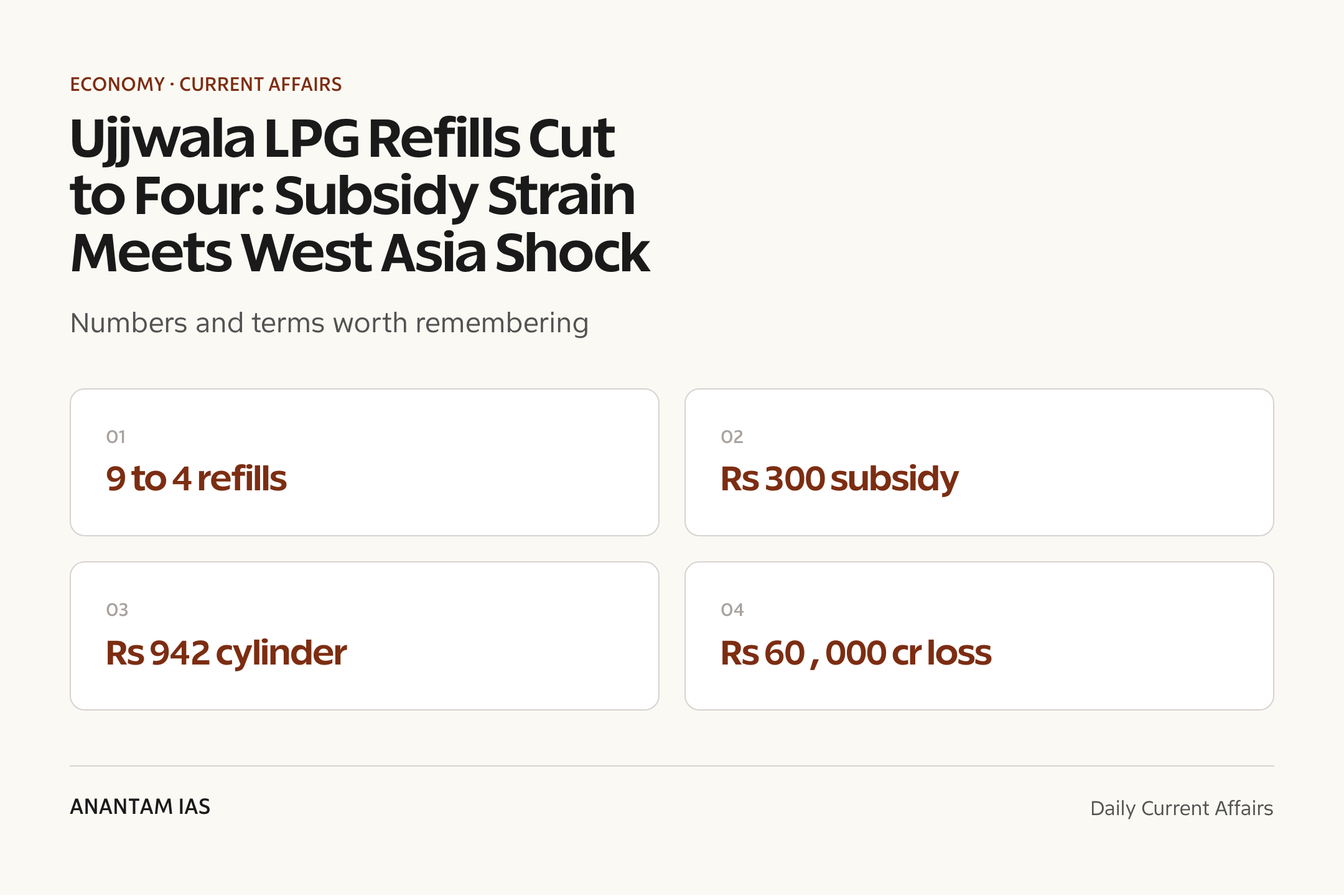
- As per reports, the subsidised PMUY refill cap was cut from 9 to 4 cylinders per year in June 2026.
- PMUY beneficiaries get a Direct Benefit Transfer (DBT) subsidy of about ₹300 per 14.2-kg cylinder.
- PMUY launched on 1 May 2016; the original ceiling was up to 12 refills, rationalised to 9 for FY 2025-26.
- PMUY covered about 10.55 crore connections as of late May 2026.
- The Delhi domestic LPG cylinder rose to ₹942; the effective PMUY price was about ₹642 per cylinder.
- OMC under-recovery reached roughly ₹700 a cylinder against a supply cost above ₹1,600.
- Cumulative domestic-LPG under-recovery touched about ₹60,000 crore by end-FY25, up from ₹1,338 crore a year earlier.
- About 54 percent of India’s LPG demand transits the Strait of Hormuz, exposing supply to West Asia disruption.
- Sources: The Hindu (UPSC analysis, 9 June 2026) and The Hindu Editorial Analysis, 9 June 2026.
What Just Happened
As per the reports, the government lowered the annual quota of subsidised 14.2-kg cylinders for PMUY households from nine to four. The ₹300 DBT continues on those first four refills; beyond the cap, a beneficiary buys LPG at the full retail price with no subsidy. Officials, as quoted in the coverage, justified the move on two grounds — that average PMUY consumption already runs at about four to five cylinders a year, so the new cap roughly tracks typical rural usage, and that a tighter cap curbs the diversion of cheap domestic cylinders into commercial use. It is worth flagging the uncertainty honestly: the figure is reported across outlets as a notified change, but the primary government notification text was not independently available, so it should be cited as “reportedly” until the gazette or OMC circular is confirmed.
The change cannot be read apart from the price spike that preceded it. The domestic LPG cylinder in Delhi was raised by ₹29 in early June 2026, the second hike in three months, taking the general-consumer price to ₹942 and the effective PMUY price to about ₹642. Because the OMCs’ cost of supplying a cylinder had crossed ₹1,600 — driven by a Saudi contract-price benchmark up about 46 percent since 28 February — each domestic cylinder sold carried an under-recovery near ₹700. The cumulative under-recovery on domestic LPG had already ballooned to roughly ₹60,000 crore by the close of the last financial year, against a mere ₹1,338 crore the year before.
On the wider fuel basket, OMCs were also running under-recoveries of about ₹6 a litre on petrol and ₹30 a litre on diesel as the West Asia conflict pushed crude and product benchmarks to multi-month highs. That matters for the LPG decision because the three OMCs absorb domestic-LPG losses on the same balance sheets that carry petrol and diesel margins, so a simultaneous squeeze on all three fuels narrows the room to keep cross-subsidising cooking gas. When auto-fuel margins are healthy, OMCs can quietly carry an LPG under-recovery for a few quarters; when petrol and diesel are themselves loss-making, that cushion disappears and the pressure to either raise the cylinder price or compress the subsidy bill becomes acute.
The political reaction was immediate, with the Congress attacking the refill cut as a squeeze on the poorest households at the worst possible moment, calling the move proof of a government detached from rural distress. That framing turns a technical pricing decision into a visible equity question, which makes this an unusually clean GS-II debate: the same fact set supports both the fiscal-prudence reading (a runaway subsidy bill was capped, and the cap roughly tracks actual usage) and the welfare-failure reading (the state withdrew support from women-led poor households exactly when the alternative — firewood — became most tempting). A good answer holds both readings at once rather than choosing a side.
Background and Context
PMUY was launched on 1 May 2016 by the Ministry of Petroleum and Natural Gas to provide deposit-free LPG connections to adult women from poor households, with the connection issued in the woman’s name. The aim was a clean-cooking transition: replacing biomass and kerosene combustion that causes household air pollution, indoor smoke deaths and the daily time-burden of fuel collection borne mostly by women and girls. So PMUY is as much a public-health and gender-empowerment scheme as an energy scheme, and it maps directly onto Sustainable Development Goal 7 (affordable and clean energy).
The harder design problem PMUY has always faced is the refill or usage gap. Giving a free connection is one thing; ensuring a poor household actually buys refills at market-linked prices is another. When the international LPG price rises, the cash outlay on a refill can push beneficiaries back toward firewood — the so-called fuel-stacking or relapse problem, where a household keeps the LPG connection but burns biomass for routine cooking and reserves the cylinder for guests or emergencies. The targeted ₹300 subsidy, delivered by DBT into the beneficiary’s bank account, was the government’s answer to keep refills affordable without reverting to a blanket consumer subsidy. The original ceiling allowed up to 12 subsidised refills; it was trimmed to nine for FY 2025-26 and now, as per reports, to four — a downward drift that tracks the rising cost of honouring the subsidy as global prices climbed, and that quietly narrows the gap between PMUY’s promise of clean cooking and the volume the budget is willing to underwrite.
The DBT mechanism itself descends from DBTL/PAHAL (Pratyaksh Hanstantarit Labh), launched in 2015, which moved the LPG subsidy from a price subsidy at the cylinder to a direct cash transfer into Aadhaar-linked bank accounts. Under the old price-subsidy model, every consumer — rich or poor — bought the cylinder at a discounted counter price, which leaked benefits up the income ladder and invited diversion to the black market. PAHAL flipped the logic: the consumer pays the market price at the point of sale and the subsidy lands later in the bank account, only for verified beneficiaries. That plugged leakages, weeded out duplicate and ghost connections, and built the plumbing that now lets the state switch a per-cylinder subsidy on or off and cap it at four refills. The same architecture that made the ‘Give It Up’ campaign possible — voluntarily surrendered subsidies — is what makes a hard refill cap administratively feasible today.
The fiscal backdrop is India’s structural import dependence. The country imports well over half its LPG, so the domestic subsidy bill is hostage to the global benchmark and the exchange rate, and a West Asia shock passes through almost directly to the under-recovery. India consumes far more LPG than it produces domestically, and the gap is met by imports priced off the Saudi Contract Price; when that benchmark jumps, the OMCs either pass the cost to consumers or absorb it as under-recovery, and the government either lets the cylinder price rise or compensates the OMCs out of the budget. PMUY sits at the sharp end of this chain because its beneficiaries are the least able to absorb a price rise, which is precisely why the ₹300 DBT exists — and why capping it is so consequential.
Key Features of the PMUY LPG Subsidy Design
- Free connection: A deposit-free LPG connection issued in the name of an adult woman from an eligible poor household.
- Targeted DBT subsidy: About ₹300 per 14.2-kg refill credited directly to the beneficiary’s bank account, not paid at the cylinder.
- Refill cap (reported): The subsidy now reportedly applies to only four refills a year, down from nine; further refills are at full market price.
- Clean-cooking goal: The scheme targets a shift away from biomass and kerosene, aligning with SDG 7 and reduced household air pollution.
- PAHAL backbone: The 2015 DBTL/PAHAL architecture enables Aadhaar-linked, leakage-resistant subsidy delivery and quick policy switching.
- Import-linked pricing: Retail LPG is benchmarked to international (Saudi CP) prices, so global shocks pass through to the subsidy bill.
Why It Matters for UPSC
This is a high-yield topic because it ties a current development to durable syllabus themes.
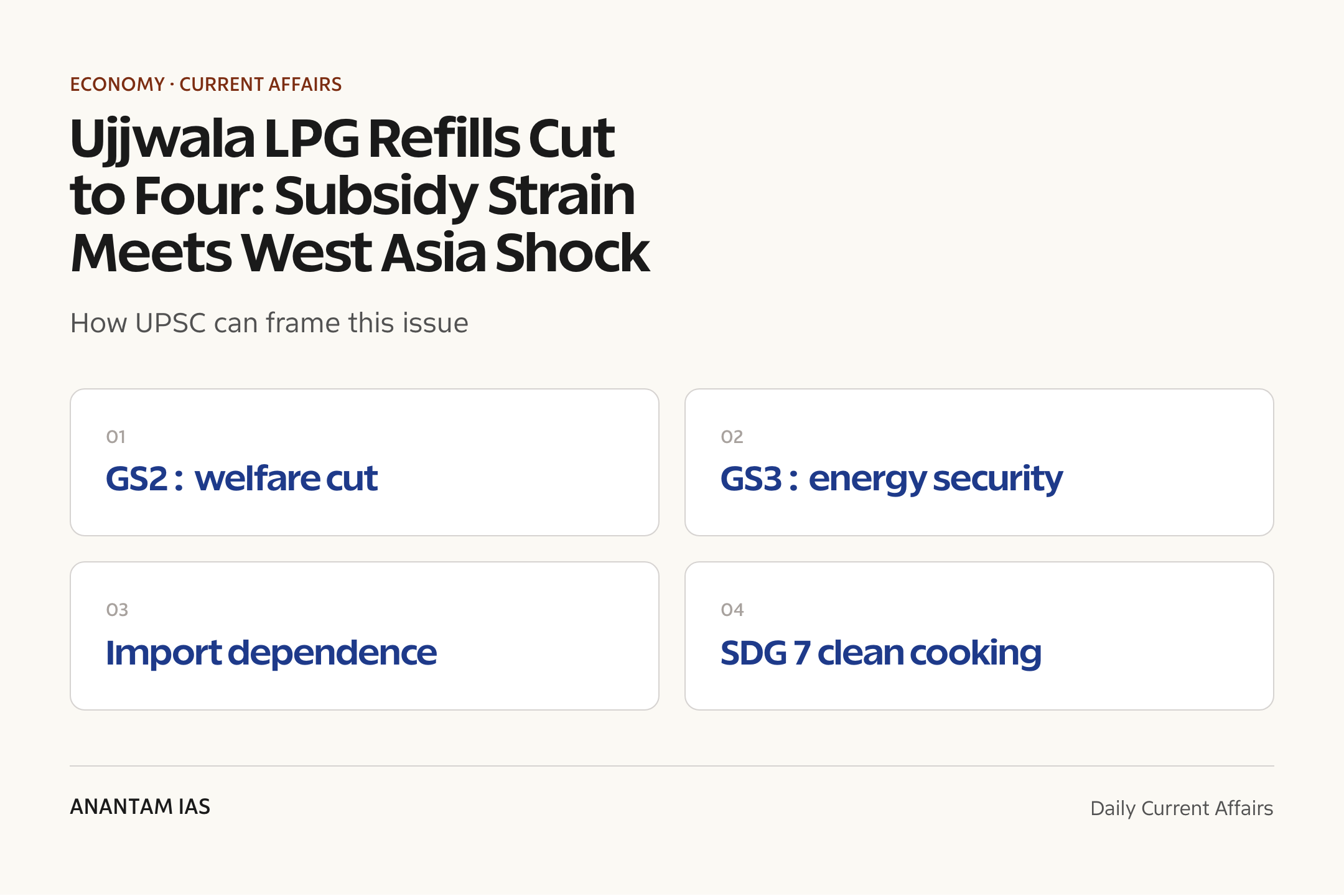
- GS-II: it tests welfare-scheme design, last-mile delivery and the equity cost of fiscal consolidation for the poorest women-led households.
- GS-III: it links the current LPG shock to static topics — energy security, import dependence, under-recoveries, oil-price pass-through and the subsidy bill.
- Prelims: refresh PMUY launch year, DBT/PAHAL, the ₹300 subsidy, the Strait of Hormuz exposure and SDG 7.
- Essay/Ethics: clean cooking versus affordability, and the moral hazard of capping a health-and-gender subsidy during a price spike.
What It Means: Economy Lens
This is a subsidy-design trade-off, not just a price hike. Capping subsidised refills at four converts an open-ended welfare commitment into a bounded one, which protects the budget when the international benchmark spikes. But it shifts the entire price risk onto the household precisely when LPG is dearest. A beneficiary whose genuine need exceeds four cylinders now faces the full ₹942 cylinder for the fifth onward — the exact moment fuel-stacking and a relapse to firewood become rational, undercutting the clean-cooking purpose the scheme exists to serve. The design choice is between two kinds of risk: a fixed cap caps the government’s fiscal risk but loads price risk onto the poorest, while an uncapped subsidy protects the household but leaves the exchequer exposed to a benchmark it cannot control. The June move resolves that tension firmly in favour of the budget, which is defensible in a fiscal sense but reverses the scheme’s original premise that the state, not the beneficiary, should absorb LPG-price volatility for the poorest.
The shock exposes how little buffer sits between a global benchmark and an Indian kitchen. With about 54 percent of LPG demand routed through the Strait of Hormuz and a Saudi CP benchmark up roughly 46 percent, the pass-through to the under-recovery was almost mechanical — ₹1,338 crore of annual under-recovery becoming ₹60,000 crore. PAHAL gave the state precise control over who gets the subsidy, but it did nothing to reduce the import dependence that makes the subsidy so volatile. Energy security, not just welfare design, is the deeper variable.
The defensible core of the move is targeting, not retrenchment. If average PMUY usage is genuinely four to five cylinders and diversion to commercial use is real, a cap can be fiscally honest without hurting the median beneficiary. The risk is distributional: averages hide the larger households and colder regions that legitimately consume more. A static four-cylinder cap is administratively simple but blunt; a needs-responsive cap, or a price-linked top-up that widens when the benchmark spikes, would defend both the budget and the scheme’s health rationale. There is also a behavioural subtlety — the very fact that many PMUY households already buy only four to five cylinders may itself be a symptom of the affordability problem, not proof that four is enough. A family rationing its cooking gas because refills are dear is not the same as a family whose genuine need is four cylinders, and a cap that freezes the rationed level in place risks mistaking distress for preference.
For the examiner, the durable lesson is that subsidy reform and energy security are inseparable. The cleanest fix for the welfare side — keep the ₹300 flowing on more cylinders — worsens the fiscal side, and the cleanest fix for the fiscal side — cap the subsidy — worsens the welfare side. The only way to relax that trade-off is to attack the underlying volatility: reduce import dependence, build buffer stocks, diversify supply routes away from a single chokepoint and broaden the clean-cooking mix beyond LPG to piped natural gas and electric or solar cooking. Capping refills manages the symptom for one budget cycle; energy resilience is what actually shrinks the problem over time.
Challenges and Concerns
- A fixed four-refill cap may underserve larger households and colder regions whose genuine need exceeds the rural average.
- Withdrawing the subsidy at the fifth cylinder during a price spike risks fuel-stacking and a relapse to biomass, defeating the clean-cooking goal.
- Heavy LPG import dependence keeps the subsidy bill hostage to West Asia geopolitics and the rupee, limiting domestic policy room.
- Distinguishing genuine high consumption from commercial diversion is hard, so a blunt cap can penalise honest beneficiaries.
- The reported figure’s policy status needs confirmation; communicating a contested welfare cut poorly can erode trust in DBT-based schemes.
Prelims Pointers
- PMUY was launched on 1 May 2016 by the Ministry of Petroleum and Natural Gas.
- PMUY connections are issued in the name of an adult woman of an eligible poor household.
- The targeted PMUY refill subsidy is about ₹300 per 14.2-kg cylinder, delivered by Direct Benefit Transfer.
- DBTL/PAHAL (2015) shifted the LPG subsidy from a price subsidy to a direct cash transfer in Aadhaar-linked accounts.
- As per reports, the subsidised PMUY refill cap fell from nine to four cylinders a year in June 2026.
- About 54 percent of India’s LPG demand transits the Strait of Hormuz.
- The Saudi Contract Price (CP) is the international benchmark for LPG retail pricing in India.
- Under-recovery is the gap between an OMC’s cost and the regulated retail price it can charge.
- SDG 7 targets affordable, reliable, sustainable and modern energy for all, including clean cooking.
- PMUY coverage was about 10.55 crore connections as of late May 2026.
- Cumulative domestic-LPG under-recovery reached roughly ₹60,000 crore by end-FY25.
- India imports more than half its LPG, making its subsidy bill sensitive to global price shocks.
Mains Practice Questions
- The Pradhan Mantri Ujjwala Yojana shows that providing access is easier than ensuring sustained usage. Critically examine the refill-gap problem and recent measures to address it. (GS Paper II, 250 words)
- Examine how India’s dependence on LPG imports transmits West Asian geopolitical shocks into its domestic fuel-subsidy bill. Suggest measures to build resilience. (GS Paper III, 250 words)
- Capping subsidised LPG refills illustrates the tension between fiscal consolidation and welfare entitlements. Discuss with reference to clean-cooking and SDG 7. (GS Paper III, 150 words)
- Direct Benefit Transfer has improved subsidy targeting but not insulated beneficiaries from price volatility. Analyse with reference to LPG. (GS Paper II, 150 words)
Way Forward
Make the refill cap responsive rather than static — for example, a needs-based or price-linked subsidy that widens when the international benchmark spikes, so the clean-cooking goal is not abandoned at the worst moment.
Attack the import-dependence root cause: expand domestic gas output, build strategic LPG storage, diversify import sources beyond Gulf routes and accelerate alternatives such as PNG piped gas and electric and solar cooking.
Pair any cap with transparent communication and a grievance route, so a contested welfare change does not erode trust in the DBT system that makes targeted subsidies possible in the first place.
Frequently Asked Questions
What is the PMUY refill change in June 2026?
As per reports, the Centre cut the cap on subsidised LPG refills under the Pradhan Mantri Ujjwala Yojana from nine to four cylinders a year. The ₹300 subsidy continues on the first four refills; beyond that, a beneficiary pays the full market price. The figure should be cited as reported until the official notification is confirmed.
Why was the cap reduced now?
A West Asia oil shock pushed the international LPG benchmark up about 46 percent, the Delhi cylinder to ₹942 and OMC under-recoveries near ₹700 a cylinder. With the subsidy bill ballooning, the cap is presented as a way to contain fiscal strain while matching average rural usage.
What is the ₹300 LPG subsidy?
It is the targeted per-cylinder amount credited by Direct Benefit Transfer into a PMUY beneficiary’s bank account to keep refills affordable. It descends from the DBTL/PAHAL reform of 2015, which moved the subsidy from the cylinder price to a direct cash transfer.
How does West Asia affect India’s LPG?
About 54 percent of India’s LPG demand transits the Strait of Hormuz, so conflict near the strait disrupts supply and lifts the Saudi benchmark price. Because India imports over half its LPG, that shock passes almost directly into the domestic subsidy bill.
What is the refill or usage gap in PMUY?
It is the problem that beneficiaries get a free connection but may not buy enough refills at market prices, sliding back to firewood when LPG turns costly. This fuel-stacking undercuts the scheme’s clean-cooking and health goals, which is why an affordable refill matters as much as the connection.
How is PMUY linked to SDG 7?
PMUY supports SDG 7’s clean-cooking target by replacing biomass and kerosene with LPG, cutting household air pollution and easing the fuel-collection burden on women. A subsidy cut that pushes households back to dirty fuels works against that goal.