PNG vs LPG: Why is India pushing transition to Piped Natural Gas?
Why in News?
The Government has mandated a transition from LPG (liquefied petroleum gas) to PNG (piped natural gas) in areas where PNG is available. The households will get a 3-month window to switch once notified, failing which their LPG supply may be discontinued.
The objective is to ease some pressure off LPG supplies, which are at risk of looming supply chain disruption, amid escalating tensions in West Asia.

| UPSC Relevance: GS1- Geography: Distribution of key natural resources; GS-3 Economy: Energy; GS-3 Science and Technology: Energy Technology Prelims: LPG vs PNG; Distribution of Natural Gas Mains: Gas-based Economy: Opportunities & Challenges |
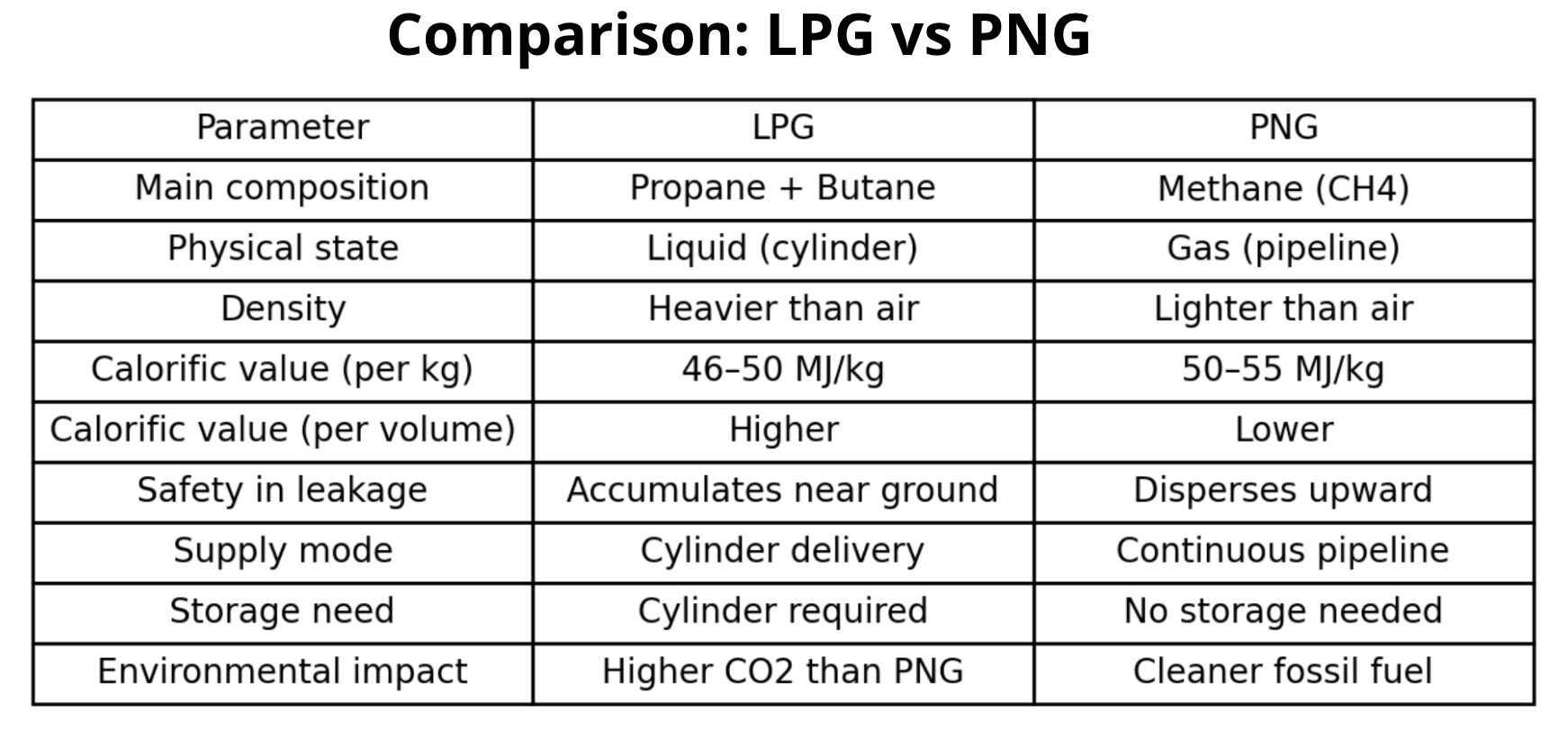
Liquefied Petroleum Gas (LPG) vs Piped Natural Gas (PNG):
Liquefied Petroleum Gas (LPG):
- LPG is a colourless and highly flammable gas. It is a co-product of oil refining and natural gas processing.
- Composition: Primarily propane (C3H8) and butane (C4H10).
- Uses: Cooking, heating, and automotive fuel, as it is a cleaner-burning fossil fuel than diesel or petrol.
- Safety: A pungent odorant (like ethyl mercaptan) is added to LPG to detect leaks. LPG vapour is heavier than air and settles in low areas.
- Transportation: Propane and butane gases are mixed, pressurised, and cooled (liquified) to below 40 degrees Celsius, and then transported to consuming countries via ships. LPG is bottled in cylinders and physically delivered to customers.
- Availability: India imports about 60% of its LPG consumption, and out of these, about 90% imports come through the Strait of Hormuz. Mostly imported from Saudi Arabia and Qatar.
- Domestic LPG Consumption: India has ~33 crore LPG connections. Over 10 crore of these connections were added under the Pradhan Mantri Ujjwala Yojana (PMUY) since 2017 to promote clean cooking fuel.
Liquefied Natural Gas (LNG)/ Piped Natural Gas (PNG):
- Liquefied Natural Gas (LNG) is natural gas that has been cooled to below –160 degrees Celsius to turn it into a liquid for shipping. Liquefaction reduces its volume by 1000 times.
- Transportation: LNG carriers use special cargo tanks and insulation systems designed for ultra-low temperatures. At the destination, LNG is regasified and transported to the final consumer through pipes, thus called Piped natural gas (PNG).
- Composition: Methane (CH4). Natural gas is much lighter than LPG. But one kilogram of natural gas can deliver more energy than one kilogram of LPG.
- Uses: Residential, commercial, and industrial applications.
- Availability: India imports around 50% of its natural gas needs. Mostly imported from Saudi Arabia, Qatar, the United Arab Emirates (UAE), Kuwait, United States (US).
- Consumption: India has approximately 1.1-1.2 crore active domestic PNG connections. The government estimates that domestic natural gas production alone could cater to 30 crore PNG connections.
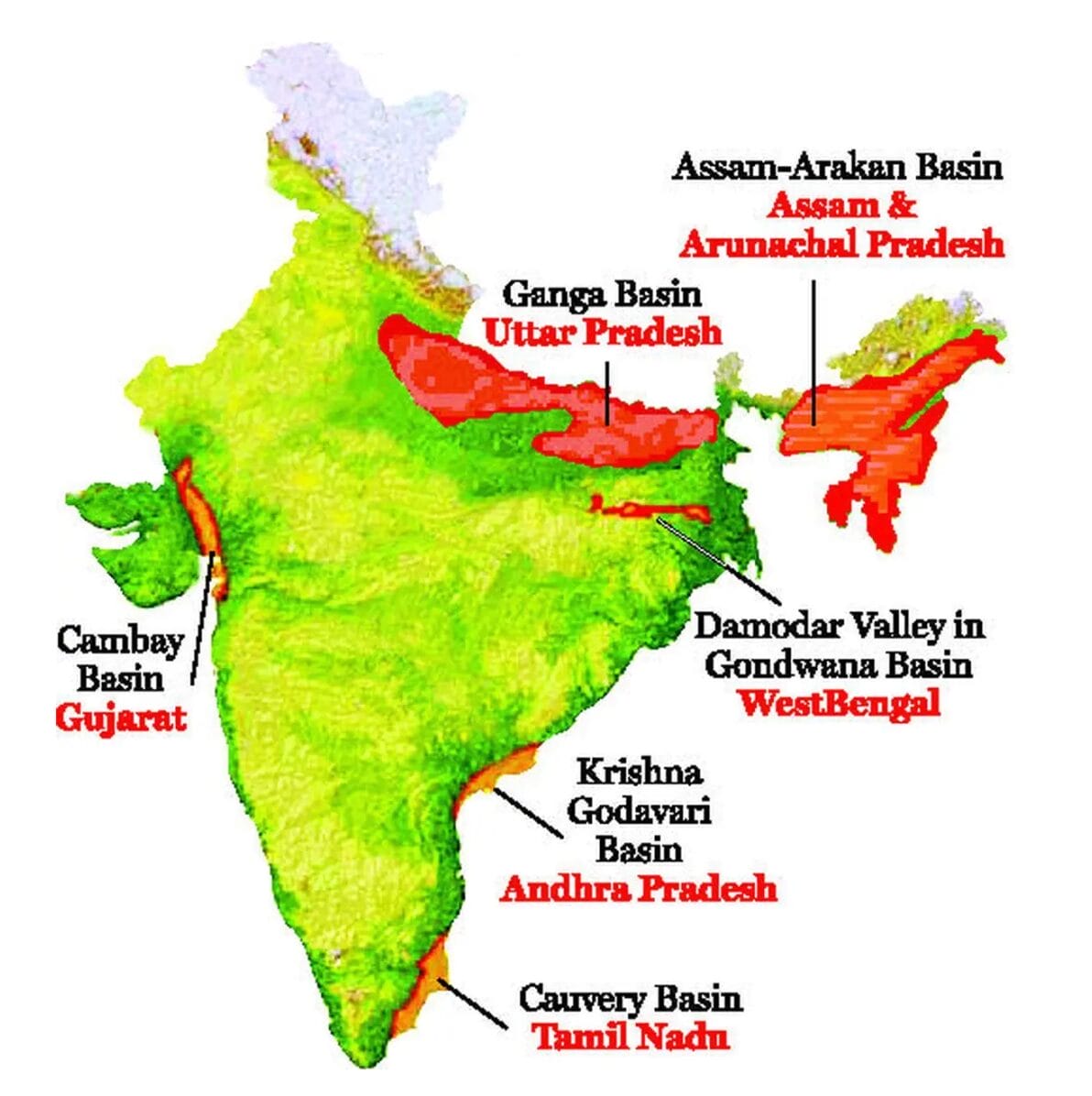
Natural Gas distribution within India:
India has significant natural gas fields located in western and southeastern areas, e.g., Hazira basin, Mumbai offshore, Krishna-Godavari basin, Cauvery basin, North-Eastern India (Assam & Tripura).
India’s gas pipeline network spans about 25,000 kilometres, with an additional 10,500 kilometres under construction. The Ministry of Petroleum and Natural Gas has a target to cover ~12 crore PNG connections by 2034.
Challenges in Transition to PNG (gas-based economy):
- Declining domestic natural gas production: Domestic output has shown a declining trend in recent years, with production falling about 5% YoY in early 2026. This reflects structural challenges such as ageing fields, limited exploration, delays in new field development, etc. This ultimately leads to increasing imports of LNG.
- Regional imbalance in pipeline infrastructure: India has Inadequate gas-pipeline infrastructure and a regional imbalance. E.g., the gas pipeline network is currently concentrated in western and northern India. The under-construction 10,000-kilometre-plus pipelines cover tier-2 and tier-3 cities in parts of central and eastern India. However, the pipelines remain significantly low in large regions of central, southern and northeastern India. Further, the alignment of the gas pipeline network is more intended to serve industrial needs than households.
- High capital cost and Long gestation period: Gas infrastructure is highly capital-intensive, requiring heavy investment in pipelines, LNG terminals, compressors, etc. Long monetisation cycles discourage private investment in PNG networks.
- Bureaucratic hurdles: Despite having capex ready, City Gas Distribution (CGD) entities face difficulties in pursuing pipeline expansion. E.g., obtaining permissions, land, bidding criteria, and NOC requirements from local authorities.
- Lower domestic demand: Affordability issues as prices for India’s gas supplies (majorly) are government-controlled, and set arbitrarily rather than market-determined.
The government is ensuring that PNG pricing remains competitive with LPG. Even if projections of 12 crore PNG connections are met in another 10 years, LPG connections will still be more than 20 crore, leaving India requiring to import significant amounts of LPG.
The Ministry of Petroleum and Natural Gas has introduced norms to help accelerate the uptake of and transition to PNG. The Petroleum and Natural Gas Regulatory Board (PNGRB) has been designated as the nodal agency to monitor the implementation, including tracking approvals, rejections, and overall compliance.
Way Forward:
- Ensure a time-bound framework for laying and expanding pipelines across the country, addressing delays in approvals and access to land, and enabling faster development of natural gas infrastructure.
- Enhance Domestic Gas Production: Accelerate exploration under the Open Acreage Licensing Policy (OALP) and the Hydrocarbon Exploration & Licensing Policy (HELP). Provide fiscal incentives for deep-water and ultra-deep-water exploration.
- Expand National Gas Grid Infrastructure: Fast-track completion of One Nation One Gas Grid initiative. Expand pipeline connectivity to central, southern and north-eastern regions. Strengthen last-mile connectivity and accessibility of PNG in Tier-2 and Tier-3 cities.
- Policy certainty: Rationalise gas pipeline tariffs /adopt a single-zone tariff to attract investment in gas infrastructure. Simplify regulatory approvals for pipeline construction and CGD expansion. Encourage PPP models for infrastructure financing. Bring natural gas under GST for better pricing.
- Import diversification and Strategic Energy Agreements with energy-rich countries to ensure energy security. E.g., Investments in Russian-Far East.
India’s aim to improve the share of natural gas to 15% of the energy mix by 2030 needs a major acceleration in the infrastructure development and robust policy support.
UPSC Mains PYQ 2022
Q. Do you think India will meet 50 per cent of its energy needs from renewable energy by 2030? Justify your answer. How will the shift of subsidies from fossil fuels to renewables help achieve the above objective? Explain.
UPSC PYQ 2023
Q. Consider the following heavy industries:
1. Fertiliser plants
2. Oil refineries
3. Steel plants
Green Hydrogen is expected to play a significant role in decarbonising how many of the above industries.
(a) Only one
(b) Only two
(c) All three
(d) None
Answer: (c)