Polar Satellite Launch Vehicle(PSLV)


Why in news:
India is set to witness its first privately built PSLV rocket launch in early 2026. The launch is being developed through a private consortium (HAL + L&T) working with ISRO, marking a key transition from government-only launches to commercial and private manufacturing in India’s space sector.
UPSC Relevance:
Science and Tech.
UPSC PYQ:
Q. With reference to India’s satellite launch vehicles, consider the following statements:
- PSLVs launch the satellites useful for Earth resources monitoring whereas GSLVs are designed mainly to launch communication satellites.
- Satellites launched by PSLV appear to remain permanently fixed in the same position in the sky, as viewed from a particular location on Earth.
- GSLV Mk III is a four-staged launch vehicle with the first and third stages using solid rocket motors; and the second and fourth stages using liquid rocket engines.
Which of the statements given above is/are correct?
a) 3 only
b) 1 only
c) 2 and 3
d) 1 and 2
Significance of this Private Launch:
| Dimension | Impact |
|---|---|
| Strategic | Reduces dependence on ISRO; creates autonomous private launch ecosystem. |
| Economic | Helps India tap the $600+ billion global space economy; lower-cost launches attract global satellite companies. |
| Technological | Boosts India’s capacity in rocket manufacturing, satellite deployment, and reusable launch technology over time. |
| Employment & Innovation | Encourages startups (Skyroot, Agnikul, Bellatrix, Pixxel) and high-skill engineering jobs. |
About PSLV:
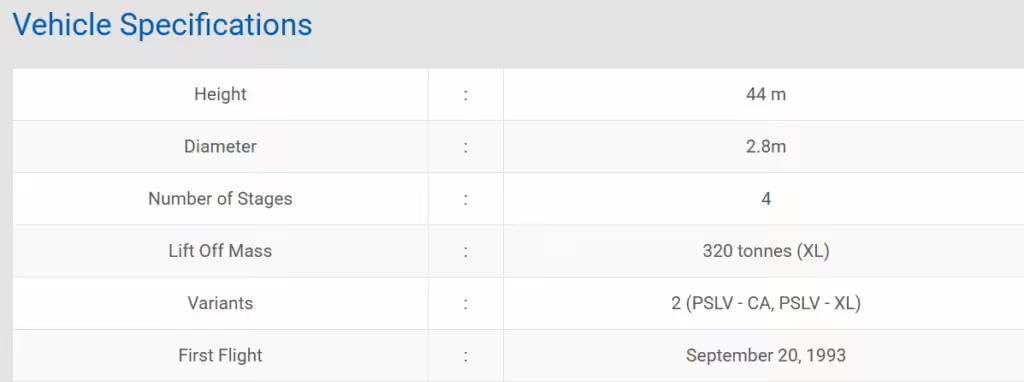
- Polar Satellite Launch Vehicle (PSLV) is the third generation launch vehicle of India.
- It is the first Indian launch vehicle to be equipped with liquid stages. After its first successful launch in October 1994, PSLV emerged as a reliable and versatile workhorse launch vehicle of India.
- The vehicle successfully launched two spacecraft “Chandrayaan-1 in 2008 and Mars Orbiter Spacecraft in 2013″that later travelled to Moon and Mars respectively.
PSLV earned its title ‘the workhorse of ISRO’ through consistently delivering various satellites into low earth orbits, particularly the IRS Series of satellites.
PSLV Payload Capacity:
Payload to SSPO (Sun-Synchronous Polar Orbit):
- Can launch payloads to Sun-Synchronous Polar Orbits at ~600 km altitude.
- Capacity: 1,750 kg
- PSLV earned the title “Workhorse of ISRO” for consistently launching satellites to LEO (Low Earth Orbit), especially IRS series satellites.
Payload to Sub-GTO (Sub-Geostationary Transfer Orbit):
- Used to deploy satellites like those from the IRNSS/NavIC constellation.
- Capacity: 1,425 kg
- PSLV has been used to launch satellites to Geosynchronous and Geostationary Orbits.