Police Modernisation Scheme: Funding and Custodial Accountability
Why in News?
On 5 August 2026 , the Union government told the Supreme Court that a proposal for in-principle approval of an umbrella scheme for police modernisation had been sent to the Department of Expenditure in the Ministry of Finance on 8.
- The reported umbrella proposal is meant to cover police-force modernisation as a whole and includes CCTV installation.
- The Court asked the Centre to place the proposal’s details on record through an affidavit within two weeks and listed the matter for further hearing.
- The Assistance to States and Union Territories for Modernisation of Police scheme has reportedly been extended until 31 March 2027 for, among other things, CCTV infrastructure.
- The proceeding followed concern that cameras at police stations were non-functional, not merely absent. A camera that does not record, retain footage or remain operational cannot provide accountability.
- The amicus stressed that modernisation must not be reduced to acquiring vehicles; scientific investigation, secure evidence systems and trained personnel are central to the idea.
- The issue joins public order and policing, which are primarily State responsibilities, with Union financial assistance and common rights-based standards.
- It is a useful case for writing about the difference between buying equipment and building an accountable criminal-justice capability.
- For an answer on custodial violence, the policy chain is prevention, recording, independent scrutiny, investigation and remedy, not surveillance alone.
UPSC Relevance
Prelims Relevance
- Police and public order are entries in the State List under the Seventh Schedule, while criminal law and criminal procedure have Concurrent List dimensions.
- Article 21 protects life and personal liberty; custody does not erase the State’s duty to protect dignity and follow fair procedure.
- Article 22 contains safeguards concerning arrest and detention, including communication of grounds of arrest and access to legal counsel subject to its terms.
- In Paramvir Singh Saini v. Baljit Singh, the Supreme Court directed the installation of CCTV cameras and recording equipment at police stations and in specified central investigating agencies.
- The directions contemplated coverage of locations such as entry and exit points, lock-ups, corridors, reception areas and rooms of Inspectors and Sub-Inspectors.
- A suo motu proceeding is initiated by a court on its own cognisance rather than on an ordinary petition by an aggrieved party.
Mains Relevance
GS Paper 2
- Assess police accountability as a constitutional-governance question involving dignity, due process, judicial oversight and cooperative federalism.
- Discuss why financial approval and scheme design should translate into measurable compliance rather than one-time asset creation.
GS Paper 3
- Examine police modernisation through the lens of scientific investigation, forensic capacity, secure digital evidence and internal security.
- Evaluate the risks of treating surveillance hardware as a substitute for training, maintenance, data governance and independent accountability.
Essay
- Technology strengthens public institutions only when it is paired with lawful purpose, human capability and transparent accountability.
Background and Context
Why Police Modernisation Is a Governance Issue
Police modernisation is often described as procurement, but its real test is whether the police can prevent crime, investigate fairly and remain answerable to the public.
- Police stations are the first institutional point of contact for victims, witnesses and accused persons. Their physical conditions, record systems and supervisory practices shape everyday access to justice.
- The Constitution’s federal design places public order and police largely with States. Yet minimum rights standards, criminal-procedure reform, national crime systems and Union assistance create a shared governance space.
- A modern force needs more than mobility and weapons. It needs trained investigators, forensic links, reliable communications, case-management systems, victim support and supervision that can detect misconduct.
- A scheme should distinguish capital expenditure from recurring needs. Cameras, servers and forensic devices deteriorate without maintenance contracts, electricity, connectivity, trained operators and audits.
CCTV Directions and Custodial Safeguards
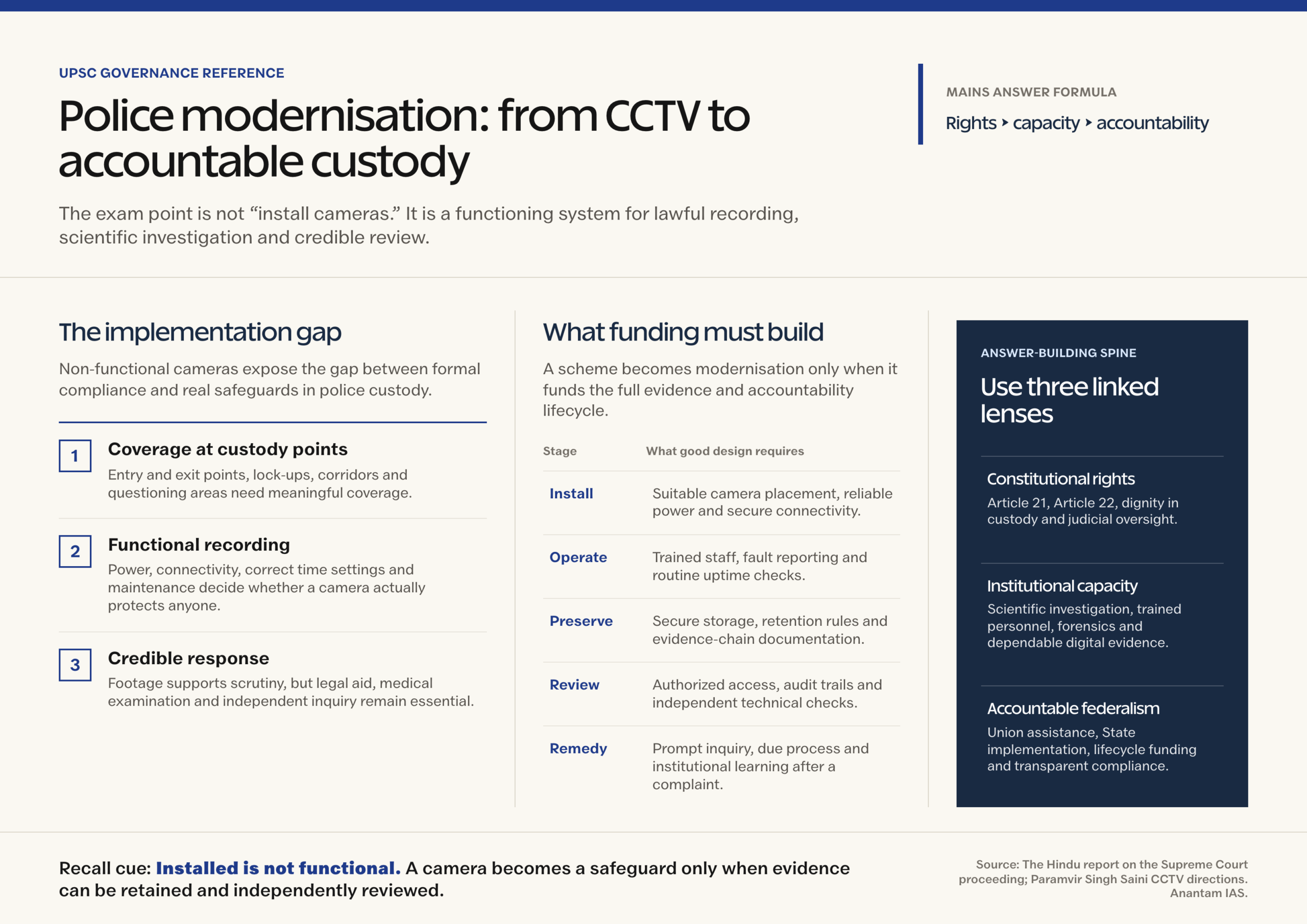
The Court’s CCTV directions turn a broad accountability principle into a practical institutional requirement.
- The Supreme Court’s directions in Paramvir Singh Saini sought coverage at police-station locations where an arrested person may be received, questioned, moved or held. The purpose is deterrence, evidentiary reliability and scrutiny when allegations arise.
- Cameras cannot replace the safeguards developed in arrest and custody jurisprudence. Intimation to relatives, medical examination, arrest records, access to counsel and judicial oversight remain independently important.
- The present proceeding highlights a critical distinction: installation is an output; functional recording with retrievable footage is an outcome. An offline camera may create the appearance of compliance while failing the safeguard it was meant to.
- Footage must be protected from routine deletion, manipulation and unauthorized access. Clear retention protocols, access logs and escalation procedures are needed to balance accountability with privacy and the security of investigations.
Scientific Investigation, Not a Vehicle-Centric Upgrade
A police-modernisation mission should improve the quality and credibility of investigation from crime scene to court.
- Scientific investigation begins with lawful scene preservation, photography, evidence collection, documentation and an unbroken chain of custody. Weak early practices can undermine later prosecution.
- Forensic laboratories, trained personnel, interoperable records and timely expert reports are as important as equipment at a police station. A device without trained use and maintenance becomes an idle asset.
- Digital tools must be governed by necessity, proportionality and authorization. Data collection that is poorly secured or used beyond its stated purpose can damage both civil liberties and public trust.
- Performance assessment should look beyond the number of devices supplied. It should examine uptime, response to complaints, evidence quality, investigation timelines, conviction quality and the treatment of vulnerable persons.
Fiscal Federalism and Implementation
The Finance Ministry’s consideration of an umbrella proposal shows why police reform cannot be separated from scheme architecture and fiscal capacity.
- Central support can help reduce unequal capacity across States and Union Territories, especially for common infrastructure such as CCTV networks, communications and forensic capability.
- Funding conditions should be linked to a publicly reviewable implementation plan: location coverage, uptime standards, maintenance responsibility, secure storage, training and a grievance route for allegations of malfunction.
- States need flexibility to respond to local crime patterns, terrain and staffing constraints. At the same time, rights safeguards cannot vary with a State’s ability to procure equipment.
- Independent technical audits and judicially reviewable compliance reports can convert a budget announcement into an accountability loop rather than a list of purchases.
Way Forward
Fund the Full System
- Tie funding to power backup, secure storage, network uptime, maintenance contracts and replacement cycles instead of treating installation as the last stage.
- Create a State-wise dashboard of coverage and functional uptime, with sensitive operational details protected but compliance outcomes visible to oversight bodies.
- Standardize time synchronization, access logs, retention schedules and chain-of-custody procedures for footage relevant to complaints or investigations.
- Train station staff, supervisory officers and investigators in evidence handling, privacy duties and rapid escalation when cameras fail.
Conclusion
- The proposed police-modernisation mission should be judged by whether it makes investigation more scientific and custody more accountable.
- For UPSC answers, connect this development to Articles 21 and 22, federal distribution of police functions, judicial directions on CCTV coverage, fiscal design and the need to turn formal compliance into reliable protection of rights.
UPSC Practice Questions
Prelims MCQ 1
With reference to police and public order in India, consider the following statements:
- Police and public order are primarily State List subjects.
- Article 21 ceases to apply to a person after lawful arrest.
- The Supreme Court’s CCTV directions are relevant to custodial accountability.
How many of the above statements are correct?
(a) Only one (b) Only two (c) All three (d) None
Answer: (b) Only two
Explanation:
Police and public order are primarily State List subjects, and CCTV directions are linked to custodial accountability. Article 21 protects life and personal liberty and remains relevant in custody.
Prelims MCQ 2
The principal purpose of maintaining a reliable chain of custody for digital or physical evidence is to:
(a) increase the number of arrests (b) establish the history of handling and reduce doubts about alteration (c) replace judicial scrutiny (d) avoid all privacy safeguards
Answer: (b) establish the history of handling and reduce doubts about alteration
Explanation:
A chain of custody records how evidence was collected, transferred, stored and examined. It supports authenticity and fair adjudication; it does not replace judicial scrutiny or privacy duties.
UPSC Mains Questions
- Police modernisation is not a procurement exercise but a constitutional-governance reform. Discuss with reference to custodial safeguards and scientific investigation.
- How can Union financial assistance and State-level implementation be designed to make CCTV-based police accountability effective without weakening privacy and due process?
Sources: The Hindu and Supreme Court of India, Paramvir Singh Saini directions.
Frequently Asked Questions
What is the police-modernisation issue before the Supreme Court?
The Union government has informed the Supreme Court that an umbrella police-modernisation proposal is under consideration for in-principle financial approval. The matter arose while the Court was examining non-functional CCTV cameras at police stations and compliance with its earlier directions.
Why are CCTV cameras relevant to custodial violence?
Functional cameras can deter abuse, preserve a record of events and assist inquiry into allegations. They are only one safeguard: lawful arrest procedures, medical examination, access to counsel, independent investigation and judicial oversight remain necessary.
What did Paramvir Singh Saini v. Baljit Singh emphasize?
The Supreme Court directed the installation of CCTV cameras and recording equipment in police stations and specified central investigating agencies. The directions focused on locations where people may enter, be questioned, move through or be held in custody, making functional.
Why is police modernisation connected with federalism?
Police and public order are primarily State subjects, so day-to-day functioning depends on States. The Union can support common capacity through finance, national systems and standards. Effective reform needs State flexibility alongside non-negotiable constitutional safeguards.
What makes CCTV compliance meaningful rather than formal?
Meaningful compliance needs suitable camera placement, power and network reliability, secure storage, time synchronization, retention rules, access logs, maintenance and an independent route to investigate a failure. Merely installing a device does not ensure that usable evidence will exist when.