Police-Station CCTV: Modernisation Must Deliver Accountability
Why in News?
The Supreme Court asked the Union government to use available police-modernisation funds for CCTV gaps instead of waiting for a proposed replacement mission.
- The existing ASUMP scheme is due to continue until March 2027.
- The Centre is seeking approval for a broader Police Modernisation Mission.
- The case concerns non-functional police-station CCTV and compliance with the Paramvir Singh Saini directions.
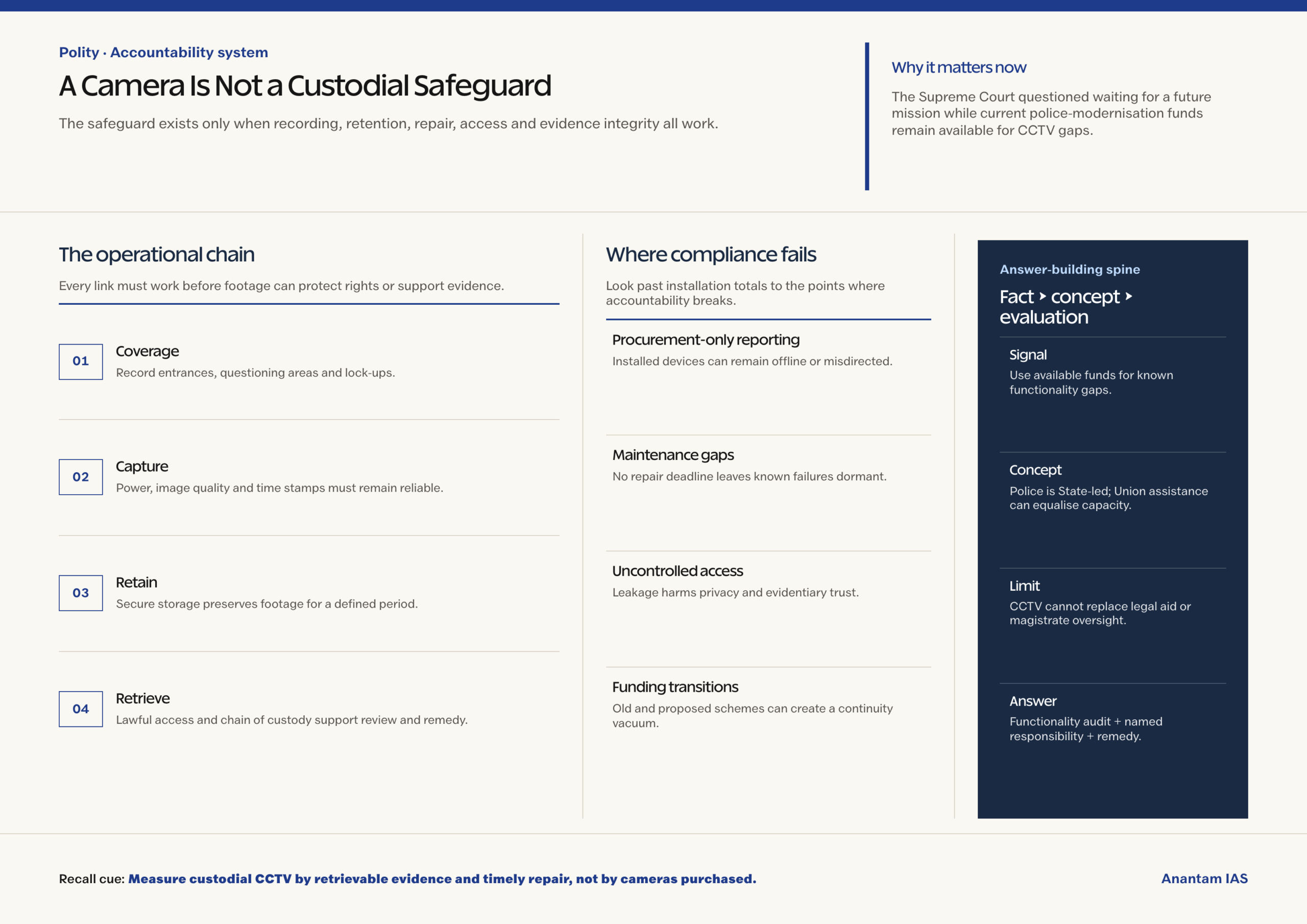
- A camera installed but not recording, storing or retrieving footage offers only symbolic compliance.
- Police modernisation must combine operational capability with constitutional accountability for people held in State custody.
UPSC Relevance
Prelims Relevance
- Police and public order fall primarily in the State List of the Seventh Schedule.
- The Union supports police modernisation through financial assistance and coordination despite State responsibility for policing.
- Paramvir Singh Saini v. Baljit Singh required CCTV coverage at key police-station locations.
- CCTV safeguards depend on recording, storage, maintenance, access and independent oversight, not installation alone.
- Continuing mandamus allows a constitutional court to monitor compliance over time.
Mains Relevance
GS Paper 2
- Judicial monitoring of custodial safeguards
- Centre-State roles in police reform
GS Paper 3
- Technology and internal-security modernisation
- Operational resilience of evidence systems
Essay
- Technology strengthens rights only when institutions maintain and answer for it.
Background and Context
Why Police-Station CCTV Is a Rights Safeguard
Custody creates a steep power imbalance, so reliable records can deter abuse and preserve evidence when accounts conflict.
- CCTV can document entry, movement, questioning and lock-up conditions, making unexplained gaps or injuries easier to investigate.
- The safeguard protects detainees and honest officers by replacing unsupported allegation or denial with time-linked visual evidence.
- Coverage must include locations where questioning or confinement occurs; a camera confined to the station entrance misses the highest-risk spaces.
- Footage access requires a lawful process that protects privacy while enabling courts, investigators and oversight bodies to examine alleged abuse.
- CCTV cannot replace arrest records, medical examination, legal aid, magistrate oversight or accountability for unlawful detention.
Installation Is Not Functionality
The weakest link may be electricity, storage, maintenance or retrieval rather than the absence of a camera on paper.
- A functional system needs clear image quality, accurate time stamps, adequate retention and protection against routine deletion or tampering.
- Power backup and network resilience matter because outages often coincide with precisely the periods that later attract scrutiny.
- Maintenance contracts need repair deadlines and escalation routes; otherwise failed cameras can remain dormant while inventories still show compliance.
- District and State dashboards can flag offline devices, storage failures and missing feeds, but alerts must trigger verified field action.
- Independent audits should compare equipment lists with random footage retrieval rather than accepting self-certified installation reports.
Modernisation Finance and Federal Responsibility
A proposed future mission cannot justify leaving available funds unused while known custodial safeguards remain incomplete.
- States run police stations, identify gaps, procure equipment and maintain systems because policing remains their constitutional responsibility.
- Union assistance can reduce unequal State capacity and support common technical standards, procurement quality and interoperable monitoring.
- Funding transitions need continuity so one scheme’s closure and another’s approval do not create a maintenance or procurement vacuum.
- Modernisation spending should separate rights-critical infrastructure from weapons, vehicles and general technology to prevent CCTV needs from disappearing inside an umbrella budget.
- Outcome reporting must show functional coverage, retention and repair time, not only expenditure released or devices purchased.
Privacy and Evidence Integrity
Surveillance safeguards can protect rights only when access is controlled and footage remains trustworthy from capture through courtroom use.
- Role-based access, tamper logs and secure export procedures reduce unauthorised viewing, selective deletion and leakage of sensitive custodial footage.
- Retention periods should preserve evidence long enough for complaints while avoiding indefinite storage of every visitor and detainee without purpose.
- A documented chain of custody is necessary when footage supports disciplinary, criminal or judicial proceedings, because authenticity may be contested.
- Complaint procedures should let detainees or families seek preservation quickly before routine retention periods erase potentially relevant evidence.
Way Forward
Make Every Link Auditable
- Map uncovered and non-functional locations, then use existing funds before waiting for a successor programme.
- Adopt common standards for coverage, retention, power backup, security, repair time and lawful footage access.
- Require independent random retrieval audits and publish aggregate functionality data without exposing sensitive footage.
- Preserve funding continuity while assigning named responsibility for every unresolved camera or storage failure.
Conclusion
- Police-station CCTV is effective only as a maintained accountability system, not as a procurement count.
- A strong answer should connect State policing, Union assistance and continuing judicial oversight through the operational chain from recording to retrieval and remedy.
UPSC Practice Questions
Prelims MCQ 1
With reference to police administration in India, consider the following statements:
- Police is primarily a State List subject.
- The Union may provide financial assistance for police modernisation.
- CCTV installation alone guarantees compliance with custodial safeguards.
How many of the above statements are correct?
(a) Only one (b) Only two (c) All three (d) None
Answer: (b) Only two
Explanation:
Statements 1 and 2 are correct. Compliance also requires functioning recording, retention, access and oversight.
Prelims MCQ 2
The Supreme Court’s police-station CCTV directions are associated with which case?
(a) Paramvir Singh Saini v. Baljit Singh (b) Kesavananda Bharati v. State of Kerala (c) S.R. Bommai v. Union of India (d) Indra Sawhney v. Union of India
Answer: (a) Paramvir Singh Saini v. Baljit Singh
Explanation:
The Paramvir Singh Saini case established detailed CCTV expectations for police stations and investigating agencies.
UPSC Mains Questions
- Why should police-station CCTV be evaluated as an accountability system rather than a technology procurement project?
- Discuss the Centre-State and judicial roles in ensuring continuity of custodial safeguards during police-modernisation funding transitions.
Sources: LiveLaw and Supreme Court of India.
Frequently Asked Questions
Why are police-station cameras important?
They can deter abuse, preserve evidence and clarify disputed accounts of questioning, detention and lock-up conditions.
Is installing a camera enough?
No. The system needs coverage, power, recording, retention, maintenance, secure retrieval and independent oversight.
Who is responsible for policing?
Police is primarily a State subject, though the Union supports modernisation through funding, standards and coordination.
Can CCTV replace other safeguards?
No. Arrest records, medical examination, legal aid, magistrate oversight and investigation of abuse remain essential.