Power Subsidies are Slowing Household Solar Adoption
Why in News?
Incentivising households and farmers to generate electricity locally is a crucial step for India’s clean energy transition. But high upfront costs and cheap grid power have slowed the adoption of decentralised solar.
| UPSC Relevance: GS-3 Economy: Energy; GS-3 Environment and Biodiversity: Renewable energy, climate change Prelims: PM Surya Ghar, PM-KUSUM scheme Mains: India’s Clean Energy Transition & the significance of solar energy |
India’s Clean Energy Transition:
- India is rapidly expanding renewable energy, especially solar power. As of early 2026, India’s cumulative solar capacity stood at about 157 GW, including 118.7 GW ground-mounted solar, 27.8 GW grid-connected rooftop solar, and 6.3 GW off-grid solar.
- Finding land for large solar parks is a problem. This is why decentralised solar power, through rooftop solar and solar pumps, has become important.
- Two major schemes are central to this transition:
- PM Surya Ghar: Muft Bijli Yojana for household rooftop solar
- PM-KUSUM for solarisation of agriculture and irrigation
Ironically, the same welfare tool that has made electricity affordable, free or highly subsidised power, is also reducing the incentive for households and farmers to invest in decentralised solar.
What is Decentralised Solar Power?
- Decentralised solar refers to electricity generation close to the point of consumption, rather than at large centralised power plants.
Examples:
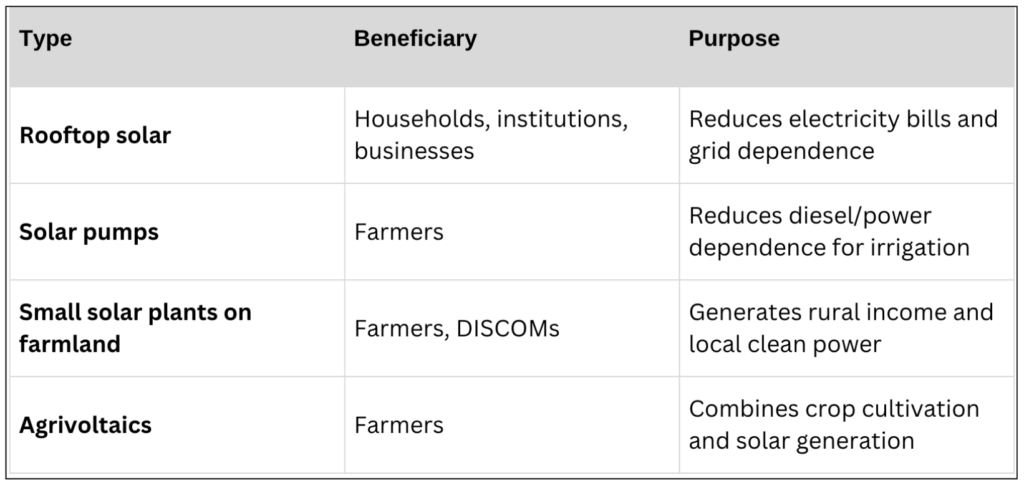
Key Government Schemes:
1. PM Surya Ghar: Muft Bijli Yojana
- The scheme was launched in 2024 with an outlay of ₹75,021 crore to install rooftop solar systems for one crore households and provide up to 300 units of free electricity per month.
- The scheme provides central financial assistance for residential rooftop solar systems and seeks to reduce household power bills, promote clean energy, and lower the subsidy burden of governments.
- The scheme offers subsidy support of up to 40% of the cost of solar panels and is expected to benefit one crore households.
2. PM-KUSUM:
- PM-KUSUM was launched to promote solar energy in agriculture, reduce diesel dependence, provide energy security to farmers and improve farmer incomes. The scheme aims to add 34.8 GW solar capacity with central financial support of ₹34,422 crore.
- Its major components include:
- Component A: Setting up decentralised ground-mounted or stilt-mounted solar power plants
- Component B: Installation of standalone solar agriculture pumps
- Component C: Solarisation of grid-connected agriculture pumps
MNRE states that PM-KUSUM targets 10,000 MW under Component A and 14 lakh standalone solar agriculture pumps under Component B.
What is the Progress So Far?
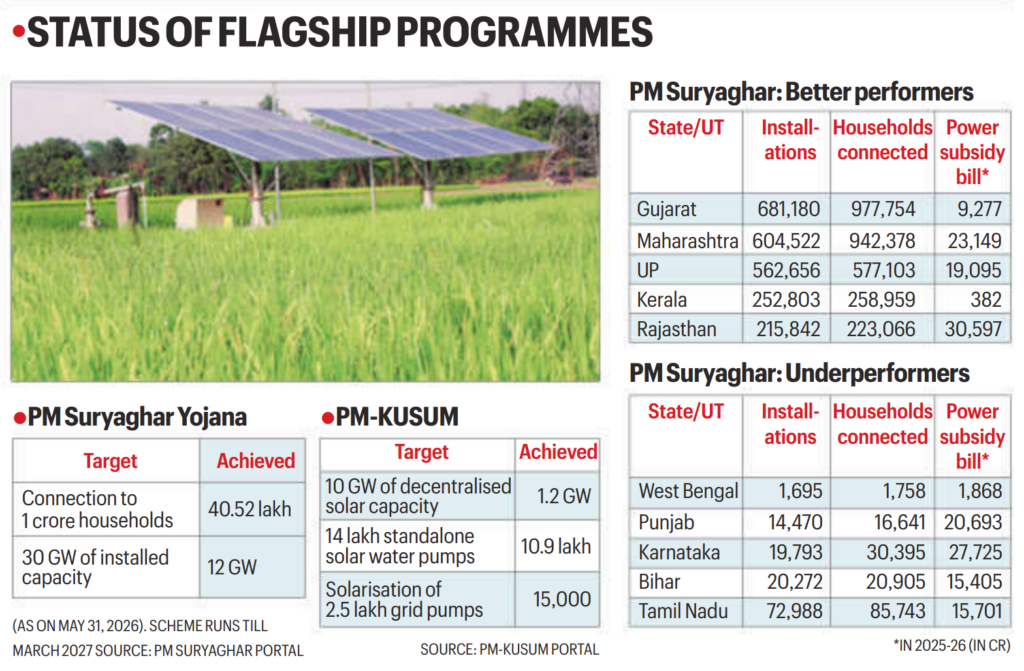
- India’s distributed solar segment has grown significantly. In FY26, distributed renewable energy from solar contributed 16.3 GW, including 7.6 GW under PM-KUSUM and 8.7 GW from rooftop solar.
- The government also reported that cumulative rooftop installations had benefited more than 42 lakh households with PM Surya Ghar at 34.3 lakh installations.
- Under PM-KUSUM, installation accelerated in FY26 with 25 lakh pumps installed or solarised till date.
However, performance remains uneven across states.
- Together, PM Suryaghar Yojana and PM-KUSUM have resulted in the installation of about 13 GW of decentralised solar power against a target of 40 GW by the end of the current financial year.
- The top five states under PM Surya Ghar (Gujarat, Maharashtra, Uttar Pradesh, Kerala and Rajasthan) account for nearly 70% of rooftop installations.
Why are Power Subsidies Slowing Solar Adoption?
Weak Financial Incentive for Consumers:
- Rooftop solar requires upfront investment. Even with a central subsidy, households often need to pay a significant amount initially. If grid electricity is already free or almost free, consumers do not see rooftop solar as financially attractive.
- For example, states such as Punjab provide free electricity to domestic consumers up to a certain limit and free power for agricultural tubewells. In such cases, households and farmers ask a simple question: Why invest in solar when grid electricity is already free?
- The Estimates Committee of Parliament observed that one reason for the low adoption of PM Surya Ghar in some states was that free or near-zero electricity tariffs reduce the attractiveness of rooftop systems.
Recurring Subsidies Distort Energy Choices:
Electricity subsidies lower the visible price of grid power. This creates a mismatch between:
- the economic cost of supplying electricity,
- the tariff paid by consumers, and
- The long-term value of switching to solar.
As a result, even environmentally beneficial technologies may fail to attract users because the pricing system hides the real cost of power.
Agricultural Power Subsidies Reduce PM-KUSUM Uptake:
- Agricultural electricity is either free or highly subsidised in many states. This reduces farmers’ incentive to shift to solar pumps or grid-connected solar pumps.
- Under PM-KUSUM, the Estimates Committee noted that for grid-connected pump solarisation, only 60,828 pumps had been sanctioned against a target of 1.5 lakh pumps, and progress was concentrated in a few states. It also observed that in some states, lack of additional state support meant farmers had to bear about 70% of the cost, making adoption difficult.
High Upfront Cost:
- A rooftop solar system may cost a few lakh rupees, depending on capacity. Poor and lower-middle-class households may not have the liquidity to invest, even if they are eligible for a subsidy.
- This is especially important because many target beneficiaries of PM Surya Ghar are not high-income households but ordinary domestic consumers.
DISCOM Incentive Problem:
- DISCOMs often lose high-paying consumers when they shift to rooftop solar. In states where cross-subsidy is important for DISCOM finances, large-scale rooftop solar can reduce revenue from better-paying consumers while subsidised consumers remain dependent on the grid.
- This creates a governance challenge: DISCOMs are expected to promote rooftop solar, but their revenue model may make them reluctant.
State-Level Variation:
- States with higher effective tariffs, better urban implementation capacity, smoother net metering, and additional incentives have performed better. States with very low consumer tariffs or free electricity have weaker consumer demand for solar.
- This explains why Gujarat, Maharashtra, Kerala, Rajasthan and Uttar Pradesh have performed better, while some states with large subsidy commitments have shown lower uptake.
Why more Subsidies may still be a Rational Solution?
- At first, it may seem contradictory that power subsidies are slowing solar adoption, and the suggested solution is more subsidies. But there is an important difference between:
- Electricity consumption subsidy: Recurring/Continues every year
- Solar capital subsidy: One-time: Paid once to create a long-term asset
- A one-time subsidy for rooftop solar or solar pumps can reduce future recurring power subsidy obligations. Therefore, targeted solar subsidies may be a more fiscally prudent approach than indefinite electricity subsidies.
The Estimates Committee also suggested that the government should explore ways to make it easier for consumers to pay the upfront cost and access scheme benefits.
Way Forward:
- Replace Recurring Power Subsidies with Smart Solar Subsidies: States should gradually shift from open-ended consumption subsidies to targeted capital subsidies for solar assets. This should be done carefully so that poor households and small farmers are protected.
- Target the Poor and Low-Consumption Households: Solar subsidies should be higher for low-income households, small and marginal farmers, and rural consumers who face unreliable power supply.
- Improve Access to Finance: The government should expand:
- collateral-free loans
- interest subvention
- pay-as-you-save models
- EMI-linked rooftop solar
- SHG-based and cooperative financing.
The government has already reported progress on collateral-free soft loans, with 13.7 lakh loan applications sanctioned and 11.3 lakh disbursed under rooftop solar-related efforts.
- Strengthen DISCOM Incentives: DISCOMs should be compensated for facilitating rooftop solar, feeder solarisation and net metering. Their role should shift from electricity sellers to local energy service providers.
- Promote Agrivoltaics: The Estimates Committee recommended studying the impact of agrivoltaics on crops and farmer income and considering subsidies for large-scale adoption. This can reduce land conflicts and support farmer income.
- Link Solar Pumps with Water Governance: Solar irrigation should be combined with:
- micro-irrigation,
- groundwater monitoring,
- feeder-level metering,
- incentives for selling surplus power instead of over-pumping water.
- Improve Implementation and Awareness: Local bodies, panchayats, SHGs and cooperatives should be used to create awareness, identify beneficiaries, and help households navigate applications, loans and vendor selection.
Power subsidies have played an important welfare role in India, especially for poor households and farmers. But when electricity becomes free or nearly free, consumers have little incentive to invest in rooftop solar or solar pumps. This slows India’s decentralised clean energy transition.
A shift from recurring electricity subsidies to one-time, targeted solar capital subsidies can reduce fiscal stress, improve energy access, support farmers, strengthen climate resilience and accelerate the clean energy transition.