PRAGATI-50: Tracking Sanitation Services Across the Whole City
Why in News?
On 29 September 2026, the Ministry of Housing and Urban Affairs launched PRAGATI-50 to improve sanitation through targeted action and outcome-based monitoring in selected cities.
- The initiative covers 50 cities across 24 states within the framework of Swachh Bharat Mission–Urban 2.0.
- Its whole-city approach covers cleanliness, solid waste, used water, sanitation and citizen participation.
- Ministry officers will receive specific city assignments for supervision and support, backed by a digital review mechanism.
- The ministry also released source-segregation guidelines and an SOP for secondary collection centres for construction and demolition waste.
- A clean street can coexist with failures in collection, processing or used-water management. City performance requires examining connected services.
- The central governance question is whether monitoring identifies and resolves service failures, rather than simply increasing the number of reports submitted.
UPSC Relevance
Prelims Relevance
- PRAGATI-50 and the Ministry of Housing and Urban Affairs
- Swachh Bharat Mission–Urban 2.0
- Source segregation of municipal solid waste
- Construction and demolition waste collection centres
- Outputs versus outcomes in public-service monitoring
Mains Relevance
GS Paper 2
- Accountability and coordination in urban service delivery
- Citizen feedback and outcome-based programme review
GS Paper 3
- Urban waste management and sustainable municipal services
Essay
- A city is clean only when its everyday systems work.
Background and Context
What the whole-city approach changes
PRAGATI-50 frames cleanliness as a connected service-delivery task across the city, rather than isolated cleaning.
- The announced scope joins urban cleanliness, solid waste and used-water management with sanitation and citizen participation. A city assessment must consider how these services interact daily.
- Urban local bodies, stakeholders and partners are included in planning and implementation. This matters because a visible failure may involve several service providers rather than a single municipal team.
- The selected cities are intended to become demonstration cities. Their selection is a programme decision, not evidence that they have already achieved sustained cleanliness or resolved their waste-management problems.
- Micro-level action plans were urged at the launch. Such plans can connect city ambitions to local service gaps, but their preparation and effective execution still need to be established.
- A useful analytical test is coverage across neighbourhoods: improvements in prominent public spaces should not conceal unreliable services elsewhere. This is a review recommendation, not a published programme threshold.
Follow the solid-waste service chain
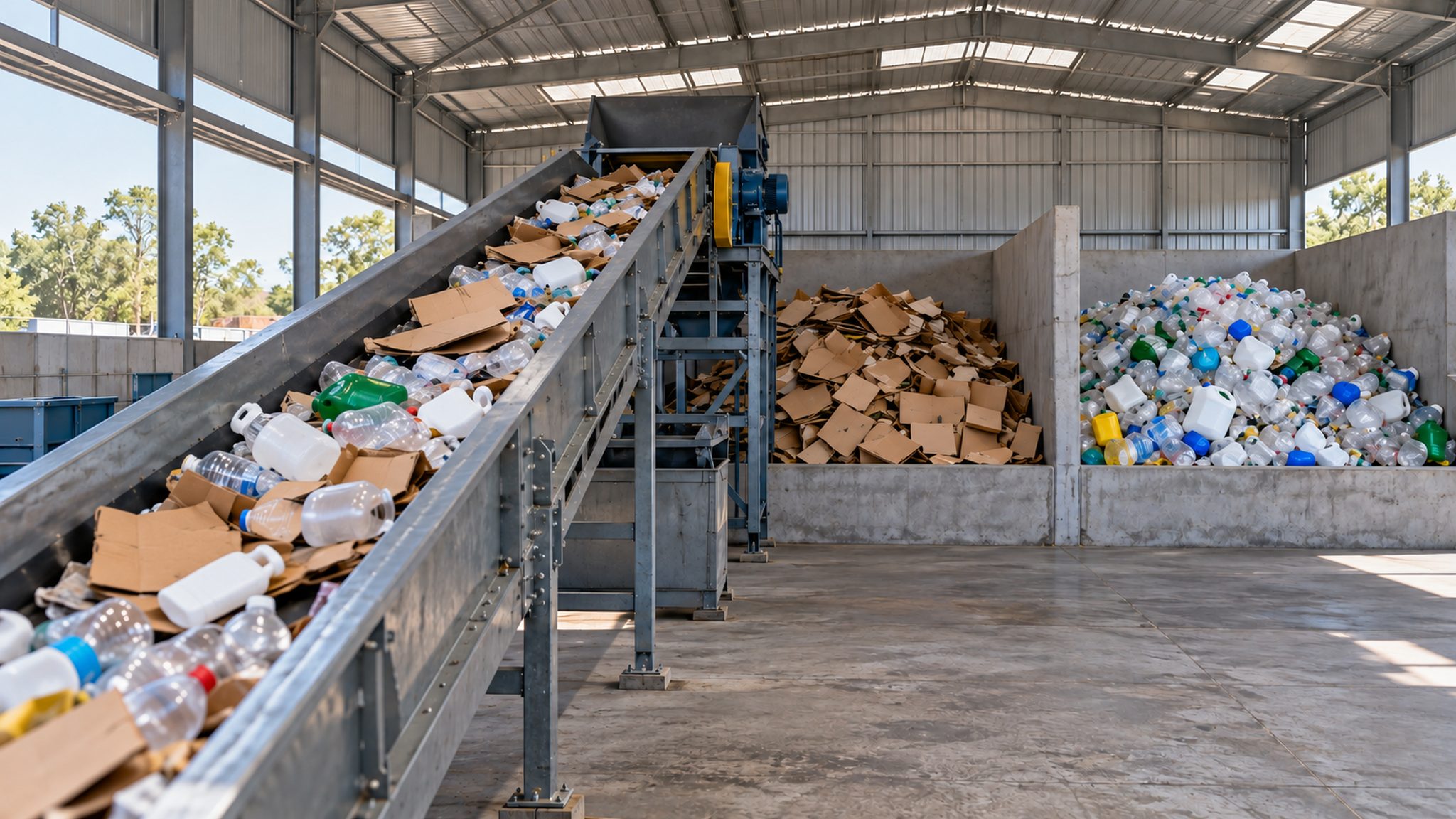
For waste services, the practical relationship runs from separation where waste arises through collection to appropriate downstream handling.
- Source segregation separates waste before collection. Its teaching value lies in the connection with later handling: material separation loses much of its purpose if the collection system mixes it again.
- Collection reliability determines whether separated material reaches the next stage. A city can distribute containers and run campaigns while residents still face missed pickups or recurring waste accumulation.
- Sorting and processing must match what the collection system delivers. A sorting facility is one part of this chain; its existence alone cannot establish that the city receives reliable service.
- Construction and demolition waste needs an organised collection pathway. The newly released SOP concerns secondary collection centres, but the announcement does not supply detailed design specifications for those centres.
- The ministry released implementation guidance alongside the initiative. The launch announcement alone should not be used to infer exact segregation categories, new penalties or commencement dates for legal obligations.
Connect supervision to service outcomes
The initiative introduces assigned oversight and technology-enabled reviews, while the real test remains better services on the ground.
- Assigned ministry officers will supervise and support specific cities. Naming responsibility can make follow-up more organised, but responsibilities across local implementation teams must be clear to resolve problems.
- Outcome-based assessments are part of the announced design. Analysts should distinguish completed activities, such as inspections or equipment procurement, from improvements actually experienced by residents using municipal services.
- Digital review can bring information together for discussion. Its usefulness depends on accurate reporting and action on identified gaps; a dashboard by itself cannot establish cleanliness or effective processing.
- Citizen complaints can identify recurring failures that aggregate city figures miss. The launch included an additional complaint channel, but receiving a complaint and resolving its underlying cause are different administrative steps.
- The release describes KPI-based action without supplying the detailed indicator framework. Specific numerical thresholds, penalties, funding entitlements or performance rankings should not be invented from this broad description.
Distinguish demonstrated improvement from reported progress
Verification is a separate mechanism: it tests whether reported progress corresponds to sustained service changes.
- A proposed baseline should identify the service gap before corrective action. Without a starting point, a report of improvement is difficult to assess, where local conditions differ.
- Field checks should examine the same service beyond a ceremonial visit. Repeated observation can reveal whether collection, sorting or complaint resolution remains dependable after initial attention.
- Resident experience offers a check on administrative completion claims. A complaint marked closed should be assessed against whether the problem has stopped recurring, beyond closure status.
- Local operating conditions shape replication. A practice that works in one city may require changes elsewhere; copying equipment without examining staffing, collection arrangements and maintenance can leave service gaps unresolved.
- These are evaluation recommendations, not claims about results already achieved or provisions confirmed in the programme. The current news establishes a launch and oversight design, not a completed impact assessment.
Way Forward
Close the loop from reporting to correction
- Publish clear indicator definitions and baselines so reported progress can be interpreted consistently without confusing activities with outcomes.
- Link identified service failures to responsible teams and follow-up checks, including whether problems recur after being recorded as resolved.
- Assess whole-city coverage through field observations and resident feedback alongside administrative reporting, with attention to areas receiving unreliable services.
Conclusion
- PRAGATI-50 creates a framework for selected cities to improve sanitation through targeted action and review. Success must be demonstrated through dependable services across the city, rather than inferred from the launch.
- In a governance answer, connect planning, service-chain coordination and verification. Technology supports this sequence when it helps officials identify a failure, assign corrective work and check whether the correction lasts.
UPSC Practice Questions
Prelims MCQ 1
With reference to PRAGATI-50, consider the following statements:
- It is situated within the framework of Swachh Bharat Mission–Urban 2.0.
- Its scope includes used-water management as well as solid waste.
- Selection confirms that each city has already achieved the intended sanitation outcomes.
How many of the above statements are correct?
(a) Only one (b) Only two (c) All three (d) None
Answer: (b) Only two
Explanation:
Statements 1 and 2 match the announcement. Selection and launch do not establish that intended results have already been achieved.
Prelims MCQ 2
Which finding most directly indicates a continuing gap between complaint closure and service outcomes?
(a) A complaint dashboard has been created (b) More inspection reports have been uploaded (c) Waste repeatedly accumulates at a location after its complaint is marked resolved (d) An officer has been assigned a city
Answer: (c) Waste repeatedly accumulates at a location after its complaint is marked resolved
Explanation:
Repeated accumulation tests the underlying service outcome. Administrative closure, reporting and officer assignment are not sufficient evidence of a lasting correction.
UPSC Mains Questions
- Explain why urban cleanliness requires a whole-city service-delivery approach. Illustrate how failures at one stage of waste management can undermine improvements elsewhere.
- Discuss the opportunities and limits of technology-enabled, outcome-based monitoring in urban sanitation. Suggest ways to verify whether reported progress improves resident experience.
Source: PIB, Ministry of Housing and Urban Affairs.
Frequently Asked Questions
What is PRAGATI-50?
It is a Ministry of Housing and Urban Affairs initiative for selected cities to demonstrate improved sanitation through targeted action, technology-enabled monitoring and outcome-based review within Swachh Bharat Mission–Urban 2.0.
What does the whole-city approach include?
The announced scope covers urban cleanliness, solid waste, used-water management, sanitation and citizen participation. It includes urban local bodies, partners and stakeholders in planning and implementation across the city.
Does the launch prove that the cities are clean?
No. The launch establishes an initiative and its intended oversight arrangements. Sustained improvements in service coverage and quality need subsequent evidence; selection itself is not proof of achieving those outcomes.
Why must source segregation connect with collection?
Separating waste where it arises is useful only if later handling preserves and uses that separation. Mixing it again during collection can undermine downstream sorting and appropriate processing.