Pre-Budget consultation meetings for Union Budget 2025-26 conclude
Why in News?
The annual Pre-Budget consultations concluded ahead of the Union Budget 2025-26, gathering structured stakeholder inputs that will shape fiscal choices, sectoral allocations and policy signals for the coming financial year.
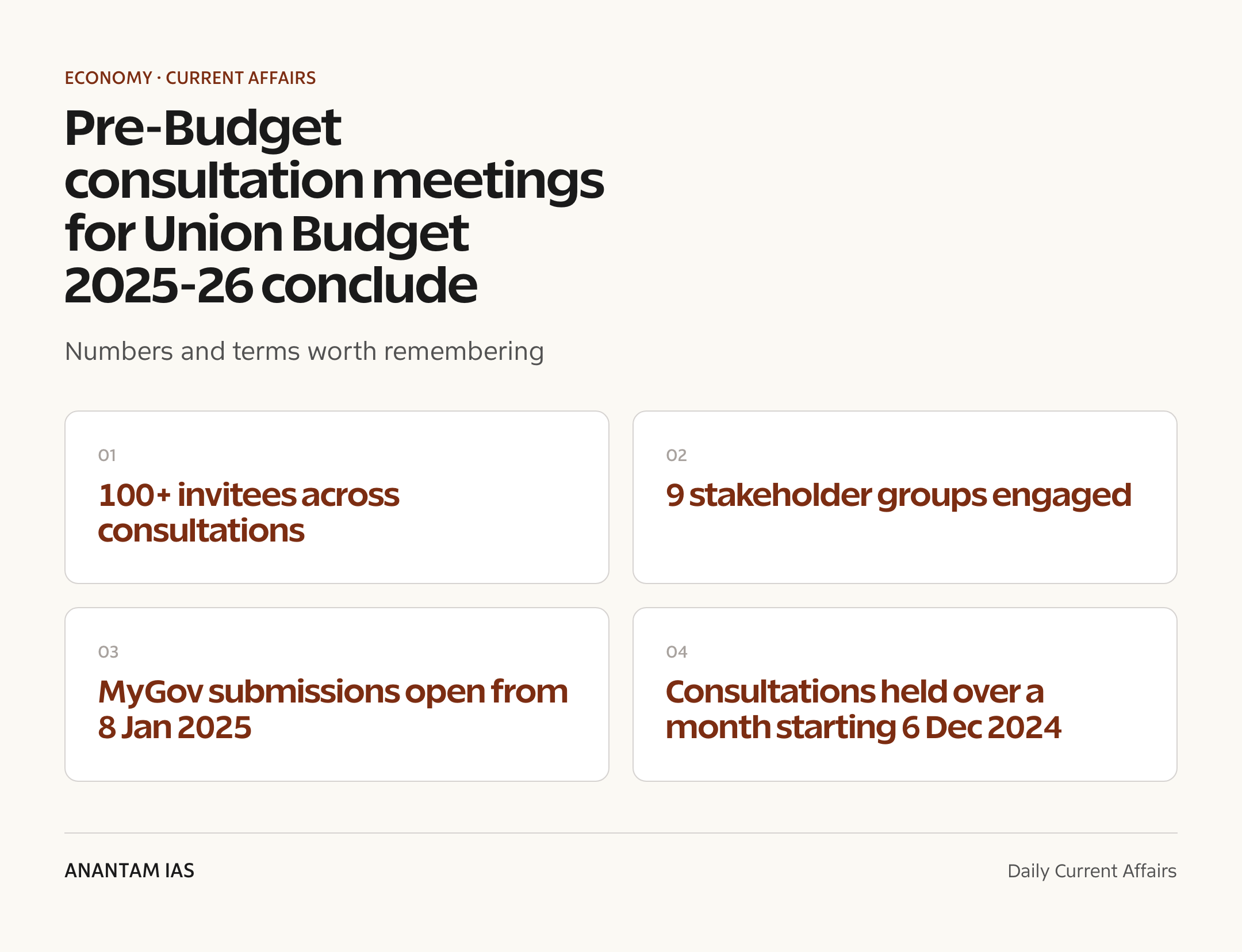
- Timing: Consultations ended in early January 2025, just weeks before the Budget, giving inputs immediate operational relevance.
- Broad participation: Over 100 invitees across nine stakeholder groups provided sector-specific recommendations on revenue, expenditure and reforms.
- Government commitment: The Finance Minister and senior secretaries led the process, indicating that recommendations will be recorded for consideration in Budget drafting.
- Citizen engagement: MyGov portal opened for public submissions from 8 January 2025, expanding the consultative base beyond invited experts.
- Policy impact: Inputs cover macro-fiscal issues, agriculture, MSMEs, infrastructure, financial sector and social sectors, which can affect deficit management and sectoral allocations.
The development matters in the context of:
- Pre-Budget consultations are a recurring institutional practice used by the Ministry of Finance to get stakeholder inputs before finalising Budget proposals.
- These consultations are one element of the Budget cycle that also includes Ministry budgets, Cabinet approvals, and Parliamentary scrutiny at the time of Budget presentation.
- The meetings bring together sector experts, industry bodies, trade unions, farmer associations and financial sector representatives to offer evidence-based and demand-side perspectives.
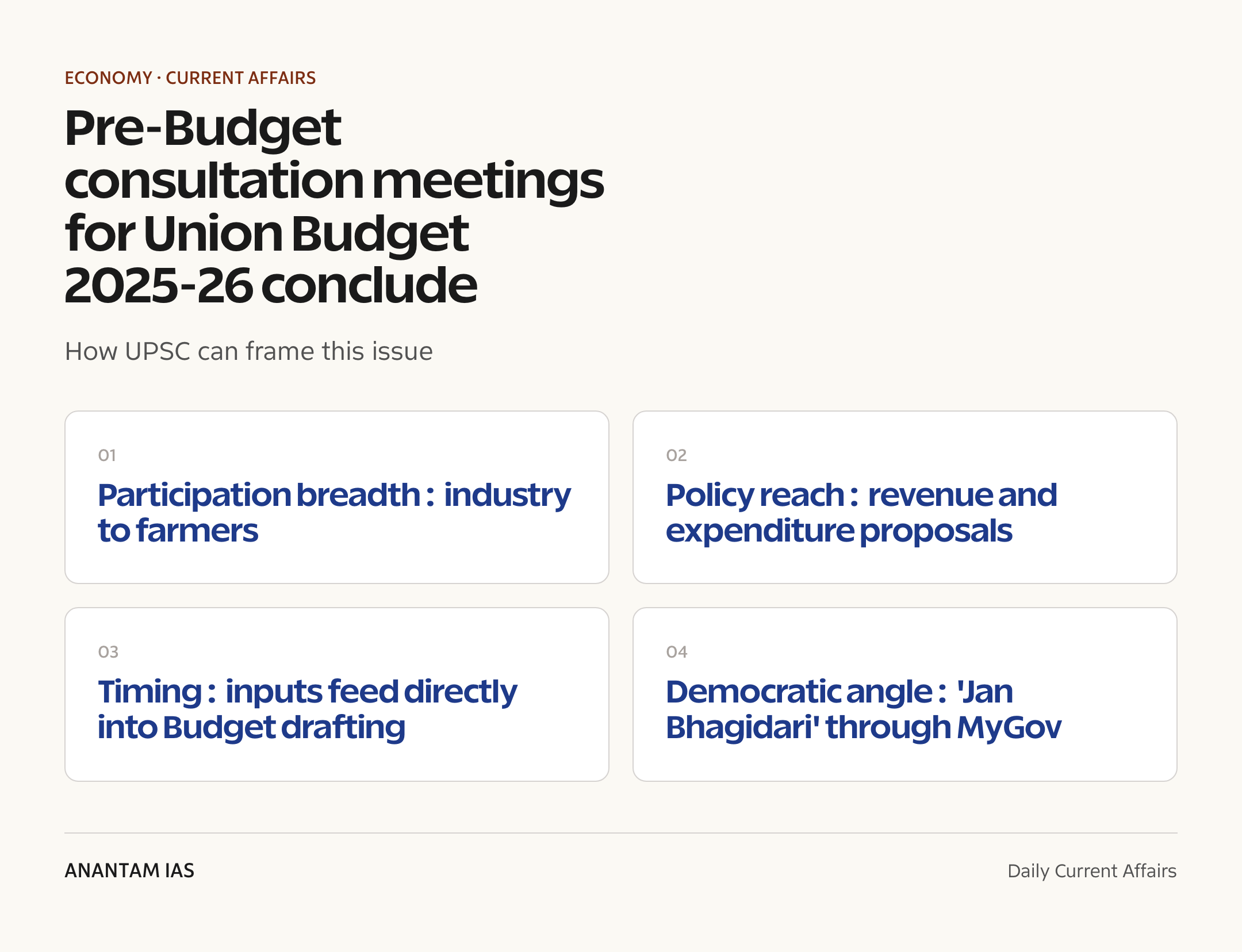
- Citizen inputs via MyGov aim to enhance ‘Jan Bhagidari’ and make the Budget process more inclusive by crowd-sourcing ideas on spending priorities and reform measures.
- The composition of participants signals which sectors the Ministry may prioritise for reforms or higher allocations; presence of financial sector and capital markets experts points to attention on fiscal-financial linkages.
- Policy suggestions from consultations feed into internal papers prepared by Departments and the Budget Division, which reconcile competing claims within overall fiscal constraints.

UPSC Relevance
Prelims Relevance
- High. Questions may ask about procedural aspects of budget formulation, the role of pre-budget consultations, and the MyGov platform for citizen inputs.
Mains Relevance
GS3 Economy
- Direct. Material supports answers on budgetary process, participatory governance, fiscal policy making, and evaluations of stakeholder consultation as a democratic tool.
Essay
- Relevant for essays on economic governance, participatory policymaking, fiscal responsibility and the role of institutions in enhancing accountability.
Background and Context
What are Pre-Budget Consultations
Structured meetings organised by the Ministry of Finance to obtain inputs from stakeholders before finalising the Union Budget.
- Held annually in the lead-up to the Budget presentation; timing varies but typically in December-January.
- Aim to gather evidence-based suggestions on revenue measures, expenditure priorities and structural reforms.
- Invitees include economists, industry associations, farmers’ groups, trade unions, sector experts and financial market representatives.
- Inputs are considered alongside departmental budget proposals, macro-fiscal targets and government priorities when drafting the Budget.
- The consultations are not legally binding but carry political and technical weight because they inform officials and Ministers.
Institutional actors involved
Senior officials and specialised departments participate to translate suggestions into actionable Budget items.
- Finance Minister chairs the consultations to signal political ownership of the process.
- Finance Secretary, Secretaries of Department of Economic Affairs, Department of Financial Services and DIPAM are present to assess feasibility.
- Chief Economic Adviser and officials from the Budget Division evaluate macro-fiscal implications of proposals.
- Other ministries participate in sector-specific meetings so that inter-ministerial coordination can occur early.
- MyGov and the Ministry of Finance act as channels for public submissions and contribute to transparency.
Scope of stakeholder inputs
Inputs typically cover revenue, expenditure, reform measures and special requests by sectors.
- Revenue-related suggestions include tax policy changes, simplifications, and measures to widen the tax base.
- Expenditure suggestions propose new schemes, expansion of existing benefits, or targeted subsidies for vulnerable groups.
- Sectoral reforms often focus on agriculture, MSME credit, education, health, infrastructure and energy policy.
- Financial sector inputs address capital market reforms, banking sector support, insolvency and credit delivery mechanisms.
- Trade unions and labour groups raise concerns on employment, minimum wages, social security and labour law reform.
Role of MyGov in Budget consultations
An online portal enabling citizens to submit suggestions and engage with policymaking.
- MyGov call for inputs opens after formal consultations to broaden participation to the general public.
- Submissions can be thematic and are collated for consideration by relevant departments.
- The platform increases transparency and creates a public record of citizen priorities ahead of the Budget.
- Quality and technical depth of suggestions vary; Ministries synthesise inputs and prioritise technically feasible proposals.
Budget calendar and decision points
How consultation inputs fit into the Budget-making timeline.
- Pre-Budget consultations feed into internal drafting that culminates in the Budget document presented in Parliament in February.
- Macro-fiscal targets such as the fiscal deficit ceiling are decided early in the cycle and constrain overall allocations.
- Sectoral allocations are negotiated among ministries, with the Finance Ministry mediating trade-offs.
- Cabinet approval and Parliamentary debate are later stages where policy choices are publicly tested.
Way Forward
Strengthen technical synthesis
- Create a public synthesis report that summarises major recommendations and the Ministry response to each theme.
- Require departments to publish impact assessments for high-cost suggestions to allow evidence-based prioritisation.
- Use standard templates for submissions to improve comparability and make administrative assimilation faster.
- Institutionalise follow-up mechanisms to track which consultation recommendations are implemented.
Enhance citizen participation quality
- Run capacity-building webinars on MyGov to help citizens prepare technically sound proposals.
- Encourage collaborative submissions from civil society and academic consortia to raise analytical quality.
- Introduce thematic deadlines and curated questionnaires on MyGov to focus inputs on policy trade-offs.
- Publish anonymised exemplars of high-quality submissions to guide future contributors.
Improve sectoral representation and balance
- Ensure representation from small and marginalised producer groups, and not just large industry bodies.
- Hold regional consultations or virtual sessions to capture geographically diverse needs.
- Increase participation of health and education practitioners when social sectors are under discussion.
- Invite independent fiscal experts and think tanks to provide countervailing views on major proposals.
Link consultations to medium-term fiscal strategy
- Publish an annual statement explaining how consultation inputs align with medium-term fiscal targets.
- Prioritise proposals that have high benefit-cost ratios and low recurring fiscal burden.
- Develop a multi-year investment plan for infrastructure recommendations to smooth fiscal impact.
- Use consultation outcomes to refine tax expenditure reviews and subsidy rationalisation strategies.
Conclusion
Pre-Budget consultations for 2025-26 reaffirm the role of stakeholder inputs in the budget process. The meetings and the MyGov call expand the evidence base for fiscal decisions, but to maximise value the process should improve synthesis, raise submission quality and link proposals to fiscal constraints. Expected outputs include targeted sectoral measures and reform signals in the forthcoming Budget.
UPSC Practice Questions
Prelims MCQ 1
Which of the following is a feature of the MyGov platform used in budget consultations?
(a) It legally mandates implementation of citizen suggestions. (b) It allows citizens to submit ideas for the Union Budget. (c) It replaces departmental budget proposals. (d) It only accepts submissions from registered political entities.
Answer: (b) It allows citizens to submit ideas for the Union Budget.
Explanation:
MyGov is an online platform for citizen engagement and accepts public suggestions for the Budget. It does not legally mandate implementation, nor does it replace departmental proposals, and it is open to individuals rather than only political entities.
Prelims MCQ 2
Pre-Budget consultation meetings typically include which of the following participants?
(a) Only members of Parliament and State Ministers. (b) Experts, industry representatives, farmer associations and trade unions. (c) Foreign governments’ finance ministers as mandatory invitees. (d) Judicial officers for legal vetting of Budget proposals.
Answer: (b) Experts, industry representatives, farmer associations and trade unions.
Explanation:
Consultations invite sector experts, industry bodies, farmer groups and trade unions among others. They do not routinely include foreign finance ministers or judicial officers as part of the standard consultation composition.
UPSC Mains Questions
- {‘question’: ‘Analyse the role of pre-budget consultations in enhancing the quality of fiscal policymaking in India. Discuss limitations and suggest measures to improve effectiveness.’, ‘points’: [‘Define the consultation mechanism and its place in the Budget cycle.’, ‘Explain how stakeholder inputs increase information flow, sectoral perspectives and democratic legitimacy.’, ‘Discuss limitations such as representational bias, variable technical quality of submissions and weak follow-up.’, ‘Recommend measures: publish synthesis reports, capacity building for citizens, stronger representation of marginal groups and linkages to medium-term fiscal frameworks.’]}
- {‘question’: ‘Examine the trade-offs the Finance Ministry must consider when incorporating stakeholder recommendations into the Union Budget within the constraints of fiscal deficit targets.’, ‘points’: [‘Outline the fiscal constraint: revenue mobilization, fiscal deficit ceiling and interest burden.’, ‘Assess trade-offs between capital expenditure and revenue expenditure, short-term subsidies and long-term reforms.’, ‘Consider equity issues: targeted welfare vs universal programmes and regional allocation disparities.’, ‘Suggest mechanisms like multi-year budgeting, benefit-cost assessments and prioritisation frameworks to reconcile demands.’]}
Source: PIB, Ministry of Finance.
Frequently Asked Questions
q
a
q
a
q
a
q
a
q
a
q
a